


The popular advice to take a daily spirulina tablet for energy, immunity, and better health skips the most important questions: How much spirulina does the tablet contain, and has that amount produced a meaningful benefit in people? A nutrient-rich ingredient isn't automatically an effective supplement, and an attractive label doesn't establish product purity.
The useful way to evaluate spirulina tablets benefits is to separate measurable clinical effects from marketing claims, then compare the label with the amounts tested. Manufacturing transparency belongs in that decision too, because a plausible benefit isn't worth much if the manufacturer can't document what's in the bottle.
Table of Contents
- Spirulina Tablets Benefits and What the Evidence Shows
- What Spirulina Is and What Is Inside a Tablet
- Blood Lipids, Blood Pressure and Blood Sugar Effects
- Antioxidant, Immune and Energy Claims Checked
- Why Spirulina Is Not a Reliable Vitamin B12 Source
- Side Effects, Drug Interactions and Who Should Avoid It
- Dose, Label Checks and Your Next Step
Spirulina Tablets Benefits and What the Evidence Shows
Spirulina's strongest case is narrower than its reputation: it may modestly shift a few cardiometabolic lab markers. It does not behave like a general health upgrade.
The distinction between a trial and a tablet matters. Clinical studies test specific amounts over set periods. A bottle supplies a daily dose that may sit well below those amounts, and the label usually says nothing about phycocyanin content or other fractions that vary between products. Manufacturing transparency, including documented testing and batch consistency, determines whether a plausible trial result has any chance of appearing in the tablet you take. The result can be a product that is chemically plausible and clinically underdosed.
The lipid evidence is mixed. Triglycerides and total cholesterol have fallen in some trials and shown no significant change in others. Diastolic blood pressure shows a small average reduction, too small for an individual to notice or use as a treatment target. Fasting glucose has weak, inconsistent support. HbA1c, HDL cholesterol, body weight and BMI have not shown meaningful effects in the human data. Even where an average difference appears, it may depend on a dose or duration that a typical bottle does not match.
Antioxidant and inflammatory markers have limited, inconsistent evidence. Immunity has the weakest support of the popular claims, with no reliable human evidence that spirulina prevents infection. Energy claims fail for the same reason: people who are not deficient have no demonstrated boost.
That pattern leads to a practical conclusion. Spirulina is most defensible when the goal is a specific measurement, such as a modest change in a lipid marker, and least defensible when the goal is a felt upgrade in energy or immune protection. The label gap decides whether even the modest claim is worth testing. A product that does not disclose its active content or testing has no clear relationship to the doses used in trials.
Practical rule: Choose a measurable goal before choosing a supplement. If you cannot say what improvement would justify continuing, marketing language will make the decision.
Expectations should stay small, condition-specific, and testable. Spirulina fits as a possible adjunct to diet, exercise, and medical care, not as a replacement for any of them.
What Spirulina Is and What Is Inside a Tablet
Say you're comparing a bottle of spirulina tablets with a multivitamin. Both come in a familiar supplement format, but they aren't nutritionally interchangeable. A spirulina tablet is closer to a small portion of concentrated, dried food than a deliberately formulated collection of vitamins and minerals.
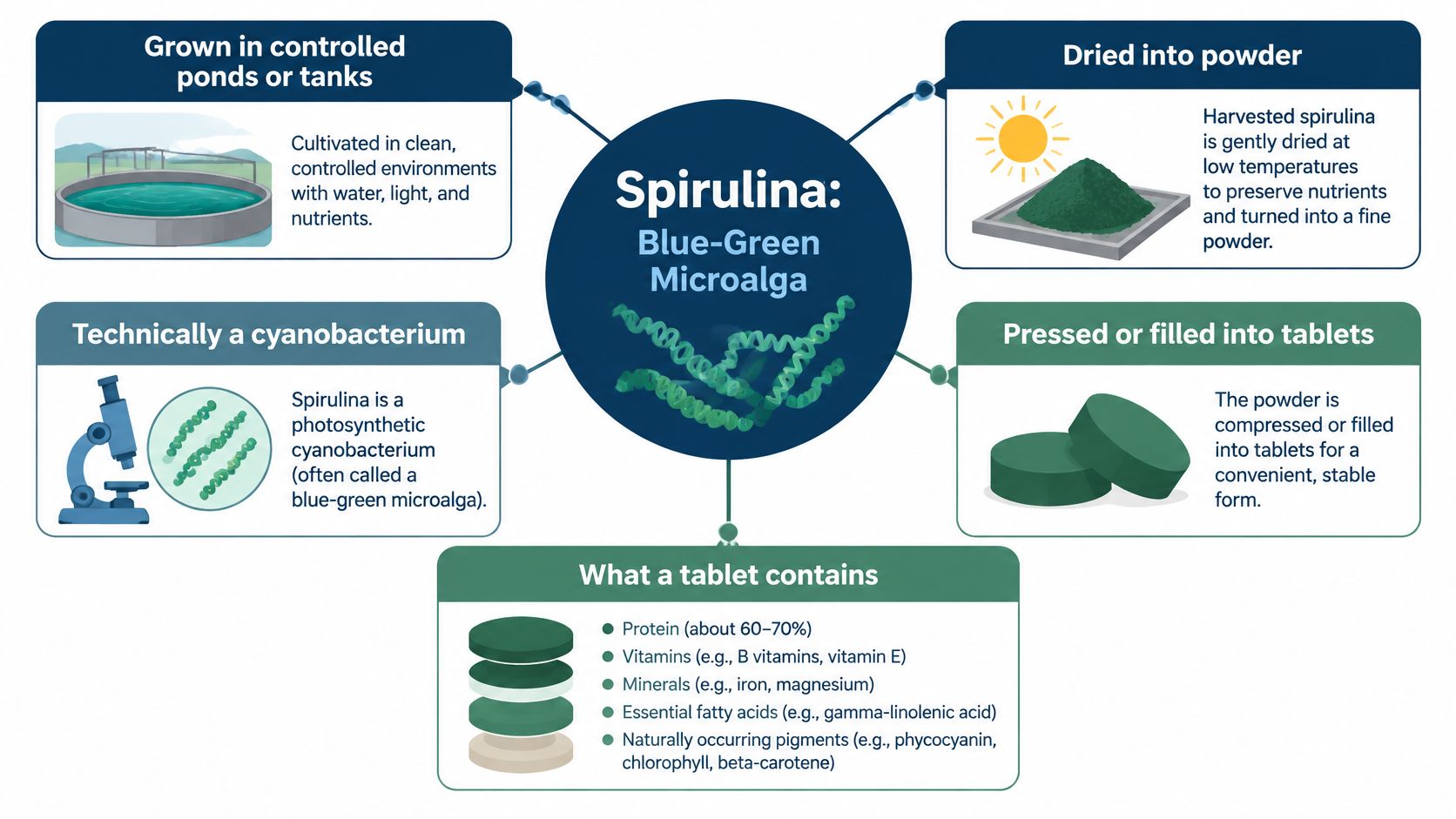
Spirulina is commonly described as a blue-green microalga, although it's technically a cyanobacterium. Commercial production involves growing it in controlled ponds or tanks, harvesting it, and drying it into powder that can be made into tablets.
The production process helps explain why tablet format alone tells you little about nutritional value.
Ingredients aren't the same as outcomes
Spirulina contains protein, iron, chlorophyll, carotenoids, and other naturally occurring compounds. Researchers also examine phycocyanin, the blue pigment-protein complex associated with many of its proposed antioxidant effects.
Those components explain scientific interest, but they don't establish a clinically useful dose. A tablet can contain a nutrient without supplying enough to make a meaningful contribution to someone's diet.
Read the ingredient list alongside the Supplement Facts panel:
- Whole spirulina or extract: Identify whether the product contains dried spirulina, an extract, or a mixture.
- Spirulina amount: Find the declared mass of spirulina rather than relying on the total tablet weight.
- Other ingredients: Check binders, coatings, and additional active ingredients separately.
- Nutrient declarations: Don't assume naturally occurring vitamins are present in useful amounts or biologically usable forms.
A blend creates another interpretation problem. If spirulina shares the serving with other ingredients, the total serving weight doesn't tell you how much spirulina you're getting unless the label separates it.
Read the label for the amount of spirulina per serving, not the tablet count or the word superfood.
That approach keeps the comparison grounded. You're buying an identifiable ingredient at a declared exposure, not a nutritional category defined by its color, packaging, or reputation.
Blood Lipids, Blood Pressure and Blood Sugar Effects
The cardiometabolic case for spirulina is narrower than the marketing suggests. Pooled trials show small, inconsistent reductions in some blood lipids, weaker effects on blood pressure, and no reliable change in glucose control. The more useful question is whether a daily tablet supplies an exposure close to the trials that produced those results.
The 2018 systematic review and meta-analysis examined 12 clinical trials involving 14 treatment arms, with daily doses from 1 to 19 grams and interventions lasting 2 to 24 weeks. Its pooled findings included statistically significant reductions in total cholesterol, LDL cholesterol, triglycerides, very-low-density lipoprotein cholesterol, fasting glucose, and diastolic blood pressure.
The same review found no substantial effect on HDL cholesterol, systolic blood pressure, HbA1c, body weight, or BMI. Multiple positive results across a wide range of outcomes can look impressive in a summary, but they do not establish an overall metabolic transformation.
What the later adult trials found
The 2021 systematic review of seven randomized trials involving 338 adults found average reductions of 15.34 mg/dL in triglycerides and 11.83 mg/dL in total cholesterol, but changes in LDL cholesterol, fasting glucose, and HbA1c were not statistically significant. Participants had obesity, diabetes, dyslipidemia, or related metabolic conditions, so these findings should not be treated as evidence of a comparable benefit in healthy shoppers.
Those null results mean the pooled trials did not demonstrate a reliable effect on LDL cholesterol, fasting glucose, or HbA1c. They leave room for a small effect in some subgroups, but they cannot support a clinical claim. Differences in participant health, product composition, dose, duration, and trial design can explain why reviews disagree, and a pooled average is not a prediction for an individual bottle or user.
Turning a label dose into a trial comparison
The reviewed daily doses span 1 to 19 grams, a 19-fold range. A product that supplies 1 gram of spirulina per day sits at the bottom of that range, while a 3-gram serving still falls well short of the high-dose end. If the label does not state grams of spirulina per serving, there is no way to compare the bottle with the exposures used in these trials.
That comparison changes how to read a benefit claim. A tablet count tells you how many pills to swallow. It does not tell you whether the product matches the dose, duration, or participant group behind a pooled result.
How to use the findings without overreading them
For someone with high triglycerides or borderline diastolic pressure, the sensible question is whether a clinician-supervised addition produces a useful change while established care continues. For someone with diabetes, the inconsistent glucose findings are too uncertain to build a treatment plan around.
- Choose the relevant measurement: Triglycerides, blood pressure, and glucose are not interchangeable outcomes.
- Keep prescribed treatment stable unless your clinician changes it: A supplement trial is not a reason to stop medication.
- Document other changes: Diet, activity, and medication adjustments can make it difficult to attribute an improvement to spirulina.
- Do not stack products casually: A red yeast rice nutritional-support tablets listing is not evidence that adding another supplement improves lipids, and combining products without clinician review makes safety and attribution harder.
The data support a modest, inconsistent effect on triglycerides and total cholesterol in people with metabolic conditions. They do not support spirulina as a treatment for diabetes, hypertension, or abnormal blood lipids, and they do not justify replacing or delaying established care.
Antioxidant, Immune and Energy Claims Checked
Antioxidant activity isn't the same as a demonstrated health benefit. Phycocyanin offers a biologically plausible reason to study spirulina, but the key question is whether changing a biological pathway leads to an outcome people need.
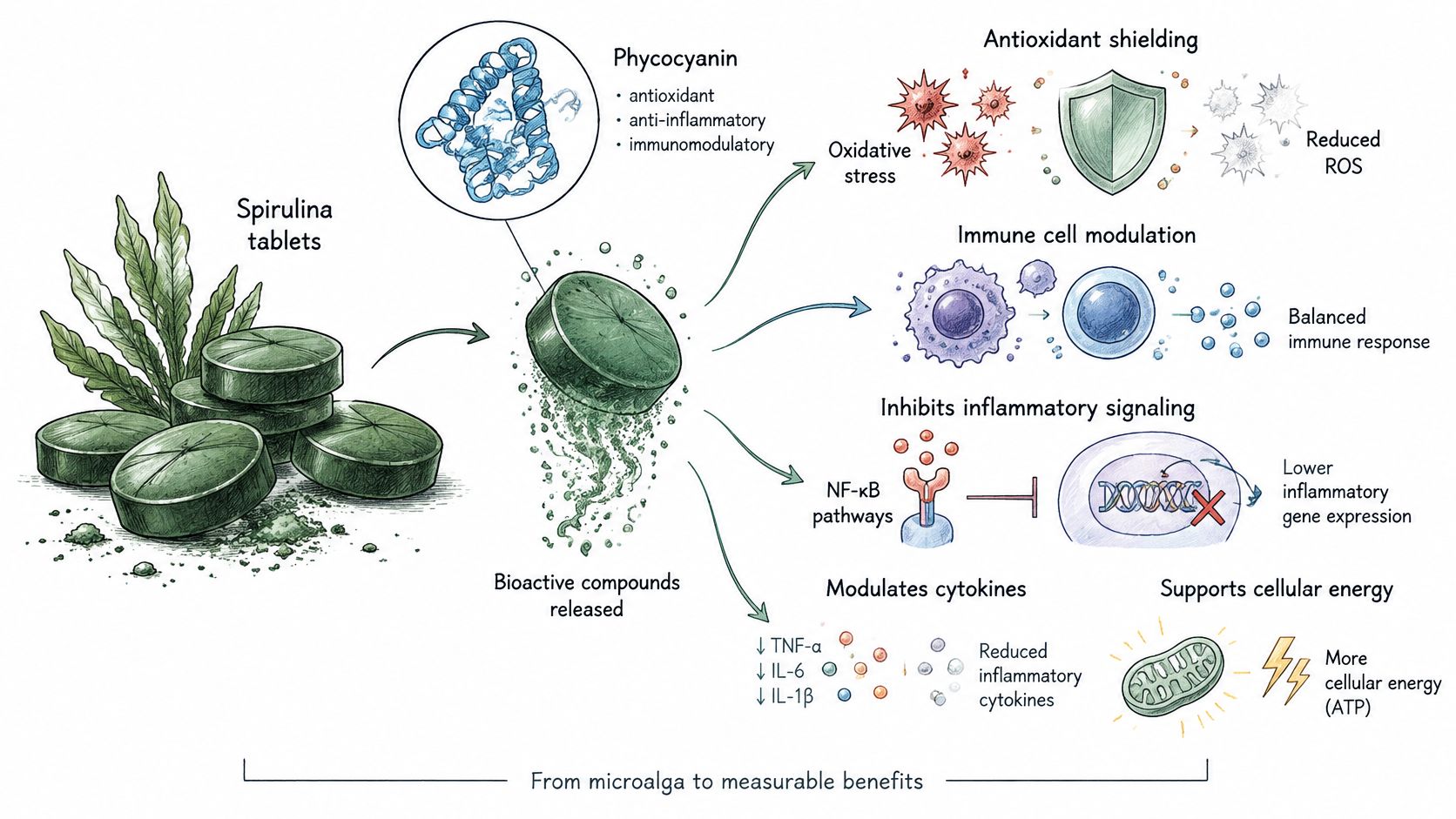
Treat the following illustration as a map of proposed effects, not proof that each benefit has been established.
Antioxidant and inflammatory claims
Experimental work connects phycocyanin with oxidative-stress and inflammatory signaling, including pathways involved in cytokine production. That's a mechanism worth investigating, not proof of disease prevention.
The review of spirulina's antioxidant and immune evidence describes a randomized, double-blind, placebo-controlled trial in 78 healthy older adults taking 8 g daily for 16 weeks, with increases in interleukin-2 in men and women, decreased interleukin-6 in men, and increased superoxide dismutase activity in women. It also describes a meta-analysis of 11 studies involving 465 participants in which an apparent interleukin-2 increase disappeared after sensitivity analysis.
That loss of significance matters. It suggests the conclusion wasn't consistent across analytical changes and may have depended on particular trials.
For a broader comparison of antioxidant language in everyday products, Pep Tea's guide to antioxidant teas offers useful context. Apply the same test to teas, spirulina, and an astaxanthin antioxidant product listing: identify whether the supporting evidence concerns a mechanism, a laboratory marker, or a meaningful clinical outcome.
Immunity and energy claims
Human evidence is insufficient to claim that spirulina protects against infection. A change in immune signaling doesn't establish fewer illnesses, shorter infections, or better recovery.
Energy claims require similar restraint. Spirulina's protein and iron content doesn't demonstrate that tablets improve fatigue in someone who isn't deficient, and the available evidence doesn't establish a dependable energy boost.
For additional visual context, this video can accompany those distinctions without replacing clinical evidence.
The useful standard is outcomes over mechanisms. If a claim concerns how you feel or how often you get sick, evidence about an antioxidant enzyme alone doesn't answer it.
Why Spirulina Is Not a Reliable Vitamin B12 Source
Spirulina isn't a dependable vitamin B12 source and shouldn't replace a validated B12 supplement. The University of Rochester Medical Center's spirulina reference explains the central problem: spirulina predominantly contains pseudovitamin B12, a form that's biologically inactive in humans.
Think of it as a key that resembles the right one but doesn't turn the lock. Detecting a B12-like compound doesn't establish that the body can use it to meet its needs.
What a plant-based label doesn't establish
A vegan-friendly tablet can fit someone's dietary preferences without covering the nutrients that require deliberate planning. Spirulina's broader nutritional content doesn't convert it into a general multivitamin or make it suitable for preventing or treating B12 deficiency.
People with anemia, neurological symptoms, pregnancy, malabsorption conditions, or a vegan diet shouldn't rely on spirulina for B12. The priority is a medically validated source, such as appropriately fortified foods or a B12 supplement selected with a clinician.
- For routine intake: Check that the product supplies usable vitamin B12, rather than relying on spirulina's reputation.
- For possible deficiency: Seek assessment instead of increasing spirulina intake.
- For treatment decisions: Match the route and formulation to the clinical situation, not to marketing.
A methylcobalamin B12 lozenge listing illustrates a product category intended specifically for B12, rather than an algae-based substitute. If injections enter the discussion, Luxe Aesthetic Surgery & Medical Spa's page on vitamin B12 shots describes that service, but whether injections are appropriate requires clinical assessment.
The important question isn't whether spirulina contains something labeled B12. It's whether your chosen source reliably supplies a biologically active form for your needs.
If symptoms suggest deficiency, ask a clinician about blood testing and appropriate follow-up rather than trying to correct the problem with spirulina.
Side Effects, Drug Interactions and Who Should Avoid It
Spirulina is generally tolerated in clinical use, but tolerance and product purity are separate safety questions. The Drugs.com spirulina clinical monograph describes commonly studied doses of approximately 1 to 10 g daily as generally tolerated, with mild gastrointestinal symptoms among the most frequent complaints, while also identifying contamination and potential medicine interactions as concerns.
Stomach upset may be inconvenient rather than dangerous, but that doesn't justify dismissing new symptoms. Long-term evidence is less developed, and a person's medicines or medical conditions can change the risk assessment.
Medicines and conditions that need review
Potential interactions deserve attention even when their clinical size isn't well quantified. Spirulina may affect immune activity, blood glucose, or clotting-related processes, so the right response is disclosure and review rather than assuming a natural product can't interfere with treatment.
Conditions and medicines that call for a clinician first
| Condition or medicine | Concern | Action |
|---|---|---|
| Immunosuppressants | Spirulina can interact with immune-suppressing drugs | Ask a clinician before starting |
| Diabetes medicines | May add to blood-sugar-lowering effects | Monitor glucose with a clinician |
| Anticoagulant or antiplatelet drugs | Possible interaction affecting clotting | Check with the prescriber first |
| Phenylketonuria | Spirulina may be unsuitable | Avoid unless a doctor approves |
| Autoimmune conditions | Immune effects aren't well characterized | Consult a clinician before use |
| Pregnancy or breastfeeding | Insufficient research data | Ask a clinician before use |
For pregnancy and breastfeeding, absence of established harm isn't evidence of safety. Don't assume a product is suitable because it's plant-based or sold without a prescription.
The risk that a clean ingredient list can't resolve
Commercial-product reviews have reported variable heavy-metal concentrations and detections of microbial contaminants and cyanotoxins. Microcystins are among the contaminants that deserve explicit attention.
That changes the buying question. Instead of asking only whether spirulina is safe, ask whether the manufacturer can substantiate the identity and purity of the actual batch you're considering.
A general safety description applies to an ingredient under particular conditions, not automatically to every tablet on the shelf. Likewise, a claim about controlled cultivation doesn't replace finished-product testing.
If symptoms appear, stop the tablets and record the product, lot number, daily amount, and when symptoms began. Contact a clinician if symptoms persist or are severe, and seek urgent care for a severe reaction.
The practical benefit-risk variable may therefore be manufacturing transparency, not a blanket judgment that spirulina itself is either safe or unsafe.
Dose, Label Checks and Your Next Step
Start with the Supplement Facts panel, not the suggested tablet count. The number you need is the amount of spirulina in each tablet or serving, excluding unrelated ingredients.
A 2025 systematic review and meta-analysis describes protocols typically lasting 8 to 16 weeks, using amounts from 200 mg daily of liquid extract to 8 g daily, and found a small statistically significant diastolic-pressure reduction but no significant systolic-pressure or cholesterol reduction versus placebo. Its dose context also illustrates that 500 mg tablets require 4 to 16 tablets to supply 2 to 8 g daily.
That range is a comparison with trial exposure, not a recommendation to take that many tablets. A liquid extract and whole dried spirulina aren't necessarily interchangeable because their weights can be expressed in the same unit.
Translate the label before buying
Use this calculation process to understand what the bottle delivers.
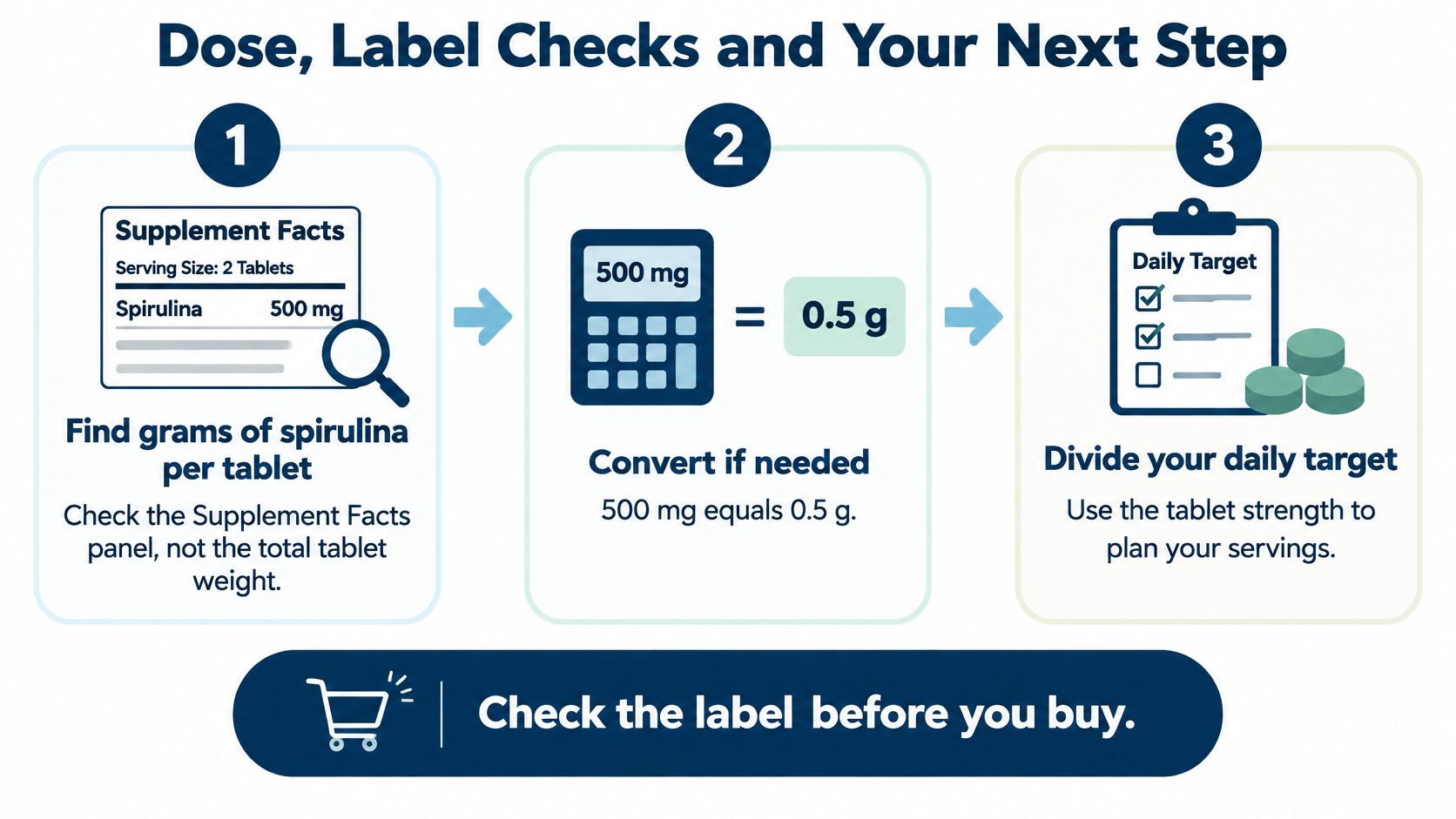
- Find the spirulina amount. Check whether the label reports it per tablet or for the entire serving.
- Use matching units. Convert the target and tablet strength into the same unit before dividing.
- Calculate the tablet count. Divide the clinician-agreed daily amount by the amount in each tablet.
- Check practicality and instructions. Don't exceed the product directions or independently escalate intake to copy a trial.
The following arithmetic applies the stated tablet strengths to the daily amounts used for comparison; it isn't a dosing prescription.
Tablets needed to reach studied daily amounts
| Target daily spirulina | Tablets at 500 mg | Tablets at 1,000 mg | Where this falls against trial doses |
|---|---|---|---|
| 1 g | 2 | 1 | Low end of commonly studied doses |
| 2 g | 4 | 2 | Lower bound of the 2 to 8 g range used in many studies |
| 4 g | 8 | 4 | Within the 2 to 8 g range |
| 8 g | 16 | 8 | Upper end of the 2 to 8 g range |
The important inference isn't that more tablets are better. It's that a convenient daily serving may not resemble the exposure behind a clinical claim, while matching that exposure still doesn't guarantee the same outcome.
Make quality documentation part of the decision
Before committing, work through a short quality check:
- Request batch evidence: Look for a certificate of analysis tied to the lot you're buying.
- Inspect the testing scope: Confirm that lead, arsenic, mercury, microcystins, and microbial contamination are addressed.
- Check identity and quantity: Look for clear species identification and an unambiguous spirulina amount per serving.
- Read warnings: Review allergens, phenylketonuria cautions, and medicine-related precautions.
- Resolve clinical questions: Bring the full label to your clinician or pharmacist if you take medicines or have an autoimmune condition.
A test badge without accessible details leaves important questions unanswered. Check that the document identifies the product and batch, names the tests, and reports actual results rather than offering only a general purity statement.
Our 60-day return policy provides purchase context, but it isn't a substitute for evaluating suitability and documentation before ordering.
If your clinician agrees that a trial is reasonable, choose a conservative, label-consistent starting amount and agree on when to reassess. Record the relevant baseline measurement, keep a symptom and intake record, and review follow-up blood pressure or lipid results before deciding whether continued use is worthwhile.
Supplemynts Inc offers vitamins, minerals, herbs, proteins, and vegan and powder supplement selections for comparing ingredients and formats. Visit Supplemynts Inc to review product labels, then use the dose calculation and quality checklist to prepare a focused discussion with your clinician before adding spirulina.



Please complete your information below to login.
Sign In
Create New Account