


Fat-soluble vitamins include A, D, E, and K. The comparison table below separates their jobs, adult intake guidance, and label units so you can tell what belongs in your diet and what needs a closer safety check.
If these vitamins all dissolve in fat, why can't you judge their supplements the same way? Shared absorption doesn't mean shared dosing or risk. A vitamin's chemical form, your life stage, and your medications can matter as much as the amount printed on the bottle.
Table of Contents
- Fat Soluble Vitamins Include These Four
- How Dietary Fat Carries Them Into Storage
- Food Sources and a Day That Covers All Four
- Risk by Form Dose and Medication
- When Self Supplementing Is the Wrong Move
- Decide on Food or a Modest Supplement
Fat Soluble Vitamins Include These Four
Fat soluble vitamins include A, D, E, and K, each with a different primary job. Unlike vitamin C and the B vitamins, which are water-soluble, these nutrients follow fat-associated absorption and storage pathways.
Fat-soluble vitamins at a glance
| Vitamin | Main role | Adult daily target | Adult upper limit | Label unit |
|---|---|---|---|---|
| Vitamin A | Vision, skin and mucous membranes, immunity | Use the age- and sex-specific dietary reference intake | Applies specifically to preformed vitamin A | mcg RAE |
| Vitamin D | Calcium balance and bone health | 15–20 mcg daily, equivalent to 600–800 IU, according to NIH vitamin D guidance | Compare total intake with the adult upper limit, not the recommended intake | mcg and IU |
| Vitamin E | Lipid-phase antioxidant | Use the adult vitamin E reference intake | Check the limit applicable to supplemental vitamin E | mg |
| Vitamin K | Activation of blood-clotting proteins | Use the sex-specific adequate intake | No established upper limit does not mean unrestricted supplementation is appropriate | mcg |
The most useful distinction is between a daily target and an upper limit. The target helps you plan adequate nutrition. An upper limit is a safety boundary, not an amount to aim for.
Match the nutrient to its job
Vitamin A helps maintain vision and the tissues lining body surfaces, including mucous membranes. Vitamin D helps regulate calcium and supports skeletal health. Vitamin E works primarily as an antioxidant in fatty environments, while vitamin K helps activate proteins needed for normal clotting.
These functions aren't interchangeable. A product rich in vitamin E won't compensate for inadequate vitamin D just because both are fat-soluble.
The units also deserve attention:
- Vitamin A uses activity-based labeling. RAE means retinol activity equivalents, which helps account for differences between vitamin A forms.
- Vitamin D may use two units. Micrograms and international units describe the same nutrient using different measurement systems.
- Vitamins E and K use different scales. Vitamin E commonly appears in milligrams, while vitamin K commonly appears in micrograms.
Read the serving, not just the front label
A bottle's front panel might emphasize a vitamin letter without explaining the daily serving clearly. Turn to the Supplement Facts panel and check whether the listed amount applies to a capsule, several capsules, or a measured portion of liquid.
Also check who the product is intended for. Adult guidance shouldn't be applied automatically to an infant, child, or adolescent. Pregnancy and breastfeeding require their own intake assessment rather than a casual adjustment to an adult multivitamin.
Label-reading rule: Match the vitamin, chemical form, intended age group, and serving size before comparing amounts.
A higher number isn't evidence of a better product. It may mean you're buying a more concentrated dose than your diet requires.
How Dietary Fat Carries Them Into Storage
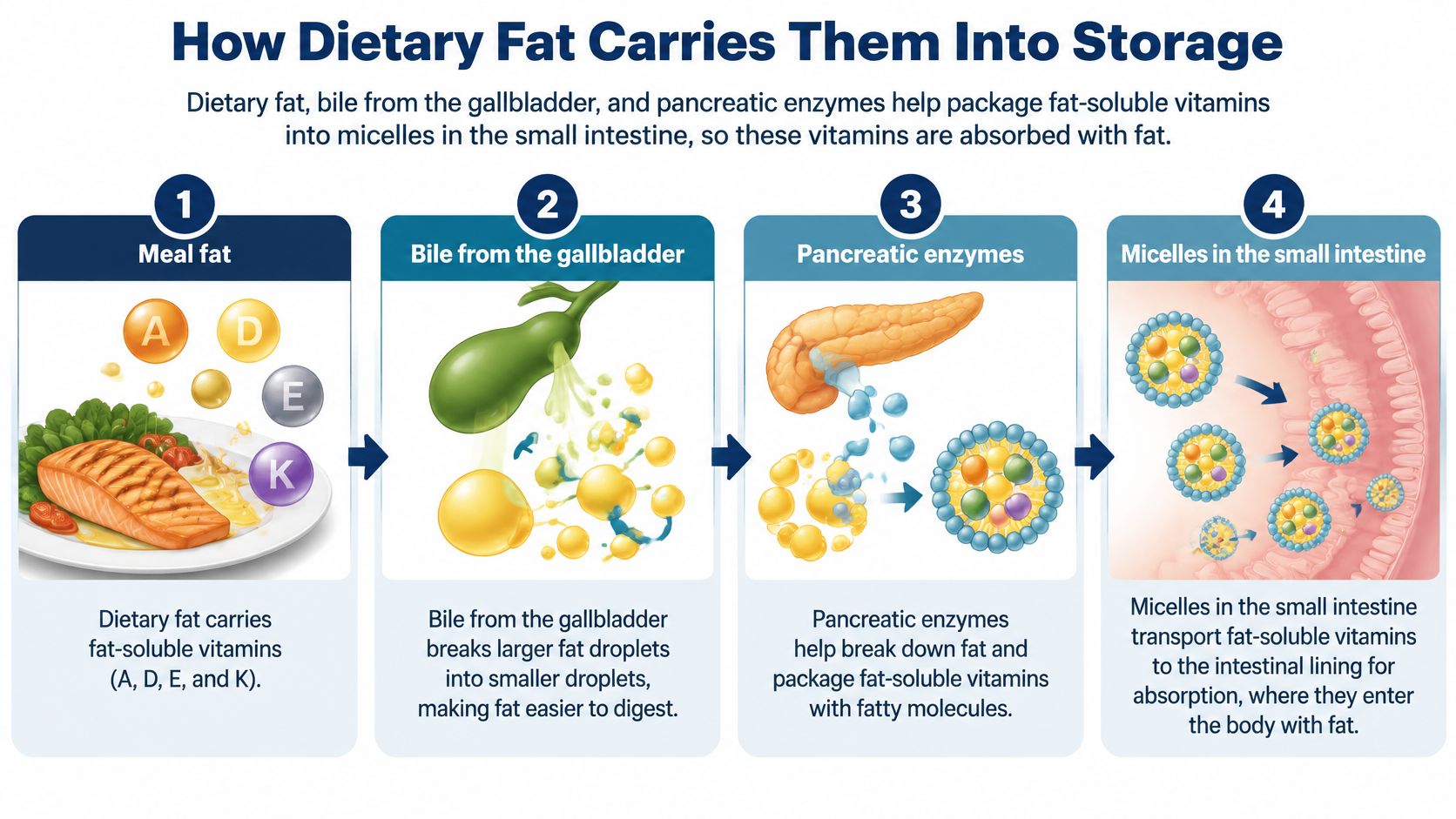
Say you eat vegetables with a meal containing eggs and a little olive oil. The fat isn't just adding flavor. During digestion, it helps create the conditions your body needs to absorb the fat-soluble vitamins present in the meal.
Bile helps disperse fat, and pancreatic enzymes help digest it. Small structures called micelles carry fat-digestion products and fat-soluble vitamins toward the intestinal surface, where absorption can occur.
The diagram shows how those digestive steps work together.
From the intestine to body reserves
After absorption, fat-associated transport systems help move these nutrients through the body. The liver and adipose tissue can retain them, which explains both their nutritional usefulness and the need for care with concentrated supplements.
The National Academies' account of fat-soluble vitamins describes their shared fat-associated absorption, transport, and storage, while distinguishing vitamin A compounds, vitamin D compounds, vitamin E tocopherols and tocotrienols, and vitamin K compounds.
Think of storage as a pantry. You don't have to replace everything in the pantry at every meal, but repeatedly adding large quantities can create an excess. The analogy has limits, because the vitamins differ in how the body handles them, but it explains why taking more isn't automatically harmless.
Storage also doesn't make regular food intake unnecessary. Your body still needs an ongoing supply, and having reserves doesn't tell you whether a particular supplement dose is appropriate.
Put the absorption lesson into practice
You don't need to turn every vitamin-containing meal into a high-fat meal. Pairing foods or a supplement with an ordinary meal containing some fat is a practical approach.
- For vegetables: Use an oil-based dressing, or cook them with a little oil.
- For breakfast: Eggs, dairy, nuts, or nut butter can supply dietary fat alongside other foods.
- For a capsule: Follow its directions and consider a meal rather than a fat-free snack when appropriate.
Don't assume adding oil solves every absorption problem. People with impaired bile flow, pancreatic function, or intestinal absorption may need medical assessment rather than a different meal pairing.
Food Sources and a Day That Covers All Four
A useful eating pattern combines different food groups instead of asking a single “superfood” to supply everything. Eggs, fish, vegetables, nuts, seeds, and fortified foods contribute different nutrients, and their vitamin content isn't interchangeable.
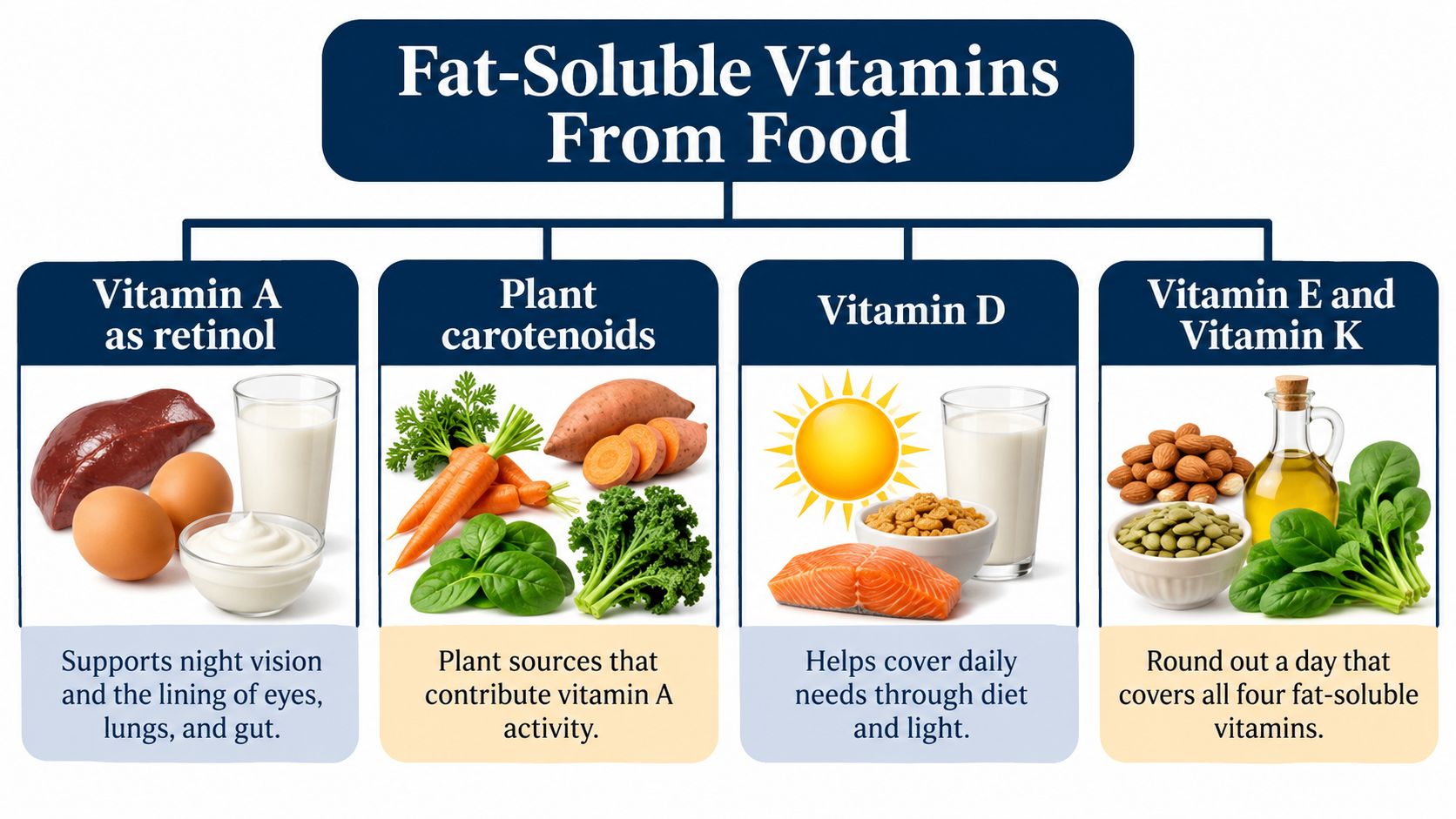
This chart illustrates the main food categories to consider.
Choose foods by vitamin and form
Vitamin A comes in meaningfully different forms. Liver, eggs, dairy products, and some fortified foods provide preformed vitamin A. Carrots, sweet potatoes, spinach, and kale provide carotenoids that can contribute vitamin A activity after conversion.
That distinction matters when you compare foods with supplements. A carrot and a retinol capsule shouldn't be treated as equivalent exposures just because both relate to vitamin A.
Vitamin D has a narrower food-source list. Fatty fish, egg yolks, and fortified milk or plant drinks can contribute. Fortification isn't universal, so check the Nutrition Facts panel rather than assuming every plant drink or dairy product supplies it.
Skin can also produce vitamin D in response to sunlight, but sunlight isn't a food source or a reliable dose measurement. Don't use an assumed amount of outdoor exposure to justify a high-dose supplement.
Vitamin E fits naturally into meals containing nuts, seeds, and oils. Almonds, sunflower seeds, wheat germ, and vegetable oils are useful foods to consider. Their role in the diet is broader than vitamin delivery, so choose them as ingredients rather than treating them like measured pills.
Vitamin K commonly comes from greens. Kale, spinach, broccoli, and other green vegetables contribute vitamin K, particularly its K1 form. K2 occurs in certain fermented foods and animal products, but chasing a subtype shouldn't displace a varied eating pattern.
If you want to get more familiar with a versatile leafy vegetable, you can browse details about spinach from Shopifarm. Use that kind of plant resource for food familiarity, not to determine a supplement dose.
Build an ordinary day around complementary foods
Breakfast could combine eggs with fortified milk or fortified soy drink. Check the drink's label for vitamin D and vitamin A rather than assuming the words “milk” or “plant-based” establish its nutrient content. Add whole-grain toast or another food you enjoy to make it a satisfying meal.
For lunch, try a salmon or sardine salad with an oil-based dressing. Fish can contribute vitamin D, leafy vegetables contribute vitamin K and carotenoids, and the dressing supplies fat that supports absorption.
Dinner might include roasted sweet potato with sautéed kale or broccoli. Nuts or sunflower seeds can add texture and contribute vitamin E, either as a topping or as a snack elsewhere in the day.
This is an illustrative meal pattern, not a calculated guarantee of adequacy. Portions, food varieties, preparation, and fortification determine how much you consume.
A supplementary visual explanation can help connect the food choices with the vitamin categories.
Notice what an otherwise healthy day can miss
A day built around juice, cereal, and lean protein can look vitamin-conscious while containing few greens. A very low-fat day may include carotenoid-rich vegetables without providing the same supportive meal context for absorption.
Vitamin D deserves a deliberate food-label check when fish and fortified drinks rarely appear in your meals. Don't assume a varied vegetable intake supplies it.
Build a repeatable weekly eating pattern, not an occasional attempt to catch up with liver or a heavily fortified product.
If you're considering a cod-liver-oil product, inspect its actual vitamin declarations before combining it with other supplements. The product category alone doesn't establish its vitamin content or make it a substitute for the meal pattern above.
Risk by Form Dose and Medication
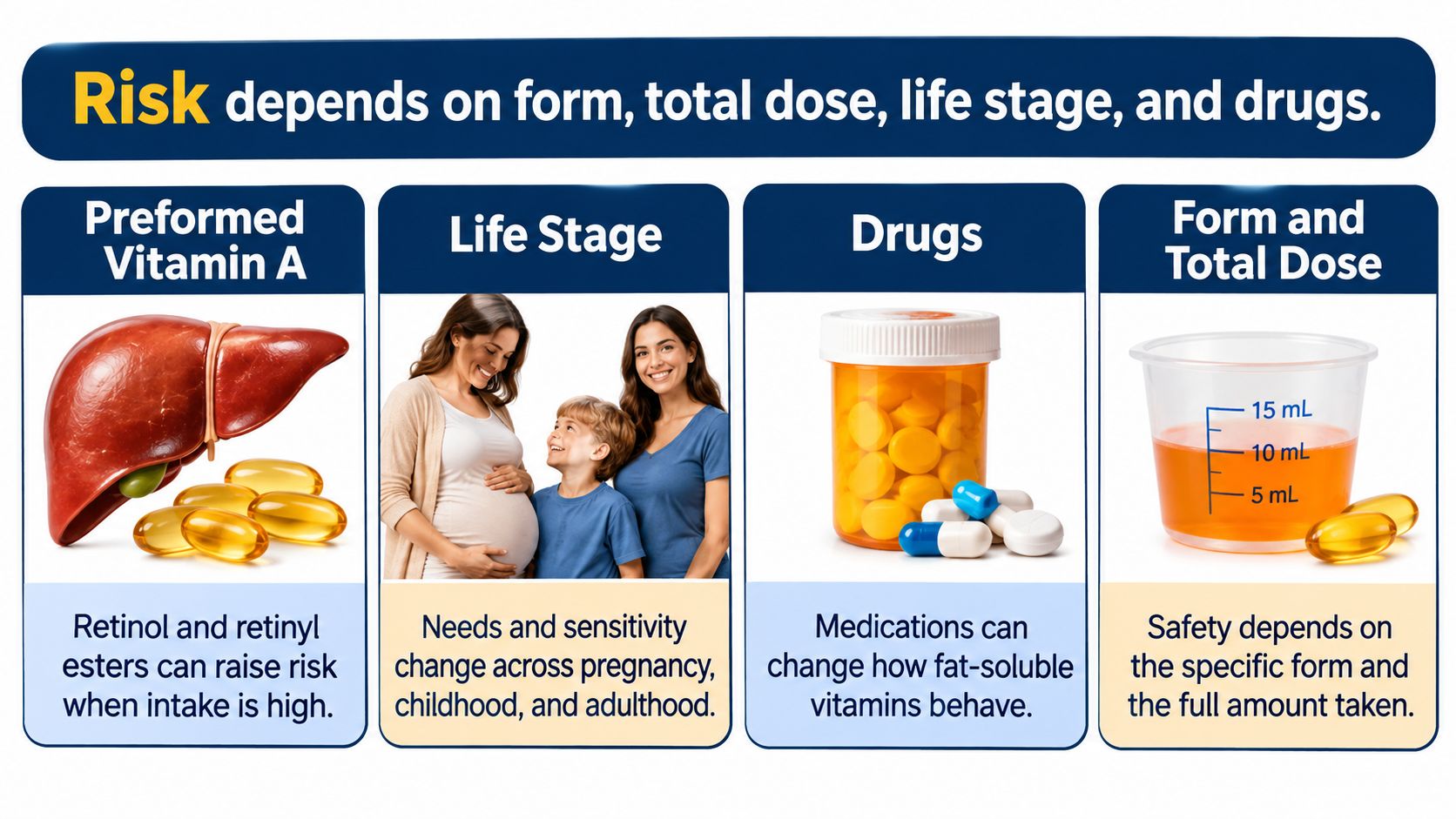
A ranking from “safest” to “most dangerous” gives the wrong impression. Risk depends on chemical form, total dose, life stage, and medication use, not on which vitamin letter appears on the label.
Preformed vitamin A deserves particular attention because retinol and retinyl esters can accumulate and cause toxicity. The NIH vitamin A fact sheet distinguishes these forms from plant carotenoids and describes the risks of excessive preformed vitamin A, including during pregnancy.
The main decision factors are shown below.
Where fat-soluble vitamin risk actually rises
| Form or vitamin | Higher-risk situation | What can go wrong | Practical boundary |
|---|---|---|---|
| Preformed vitamin A, including retinol and retinyl esters | Pregnancy or stacked high-dose supplements | Liver toxicity; increased birth-defect risk with excessive intake | Review pregnancy-specific guidance and all preformed vitamin A sources with a clinician |
| Plant carotenoids | High-dose supplements, particularly when smoking history matters | Not classic retinol toxicity, but concentrated supplements still warrant caution | Prefer food sources over megadose pills |
| Vitamin D | High-dose drops combined with other vitamin D sources | Hypercalcemia, with potential kidney or cardiovascular injury | Assess the complete intake before increasing the dose |
| High-dose vitamin E | Anticoagulant therapy | Interference with vitamin K and clotting management | Avoid unsupervised high-dose use |
| Vitamin K | Warfarin treatment | Intake changes can alter anticoagulation control | Keep intake consistent and discuss supplements with the prescriber |
The distinction between food carotenoids and preformed vitamin A is especially important. Eating orange and green vegetables isn't the same risk scenario as combining a retinol-containing multivitamin, liver, and a separate vitamin A supplement.
Pregnancy adds another layer. Don't choose an extra vitamin A product based on general adult labeling alone, and don't discontinue a prescribed prenatal product without discussing the actual ingredients with your prenatal clinician.
Medication changes the decision
High-dose vitamin E can complicate anticoagulant treatment. Vitamin K requires particular consistency for people taking warfarin, but this doesn't mean everyone on warfarin should avoid green vegetables.
The practical task is to maintain a reasonably stable eating pattern and tell the anticoagulation team before making substantial changes. Starting a supplement is a different decision from continuing your usual serving of vegetables.
A vitamin K2 supplement listing should therefore prompt a medication check before purchase, not an assumption that a particular subtype bypasses interaction concerns.
An upper limit isn't a guaranteed toxicity threshold. Being below it doesn't resolve medication interactions, and exceeding it doesn't establish a diagnosis of toxicity. It signals a need for individualized assessment rather than self-directed dose escalation.
When Self Supplementing Is the Wrong Move
A reasonable-looking diet doesn't prove that you're absorbing its vitamins. Chronic cholestasis, pancreatic insufficiency, inflammatory intestinal disease, and prior bariatric surgery can interfere with fat handling and leave someone vulnerable to deficiency.
The Merck Manual overview of vitamins explains the relationship between fat-soluble vitamins, absorption, storage, and toxicity. For someone with a malabsorption condition, buying a stronger standard supplement may miss the underlying problem.
When the label isn't a personal prescription
A clinician may need to consider your diagnosis, symptoms, diet, medications, and appropriate laboratory testing before selecting a formulation or dose. Not every person needs every vitamin measured, and a general wellness panel isn't automatically the right assessment.
This is also why different nutrient tests shouldn't be treated as interchangeable. Vital iQ Health's B12 screening guidance for private testing concerns a water-soluble vitamin; it shouldn't be used as a testing plan for vitamins A, D, E, or K.
Another reason to pause is product stacking. Someone using a fortified shake, a multivitamin, and separate drops may have a very different exposure from someone taking only the drops.
Before adding another bottle: Bring photographs of the full labels, including serving sizes, to your pharmacist or clinician.
Front-label photographs alone may leave out the ingredient forms and daily directions needed for a useful review. Include products you use intermittently, not just the ones you take every morning.
Use a pause checklist
- List every relevant source. Include supplements, fortified drinks, meal replacements, and frequently eaten fortified foods.
- Record the chemical form. Look beyond the vitamin letter, especially for vitamin A and combination products.
- Calculate your actual serving. Use what you really take or eat, then compare the total with the appropriate dietary reference intake and safety guidance.
- Flag circumstances needing review. Pregnancy, warfarin use, a diagnosed absorption disorder, or an existing prescription vitamin regimen should change how you approach a purchase.
You don't need to diagnose yourself before asking for help. Explain what you take, what you're trying to address, and whether your digestion or diet has changed.
The aim is to identify a genuine nutritional need and a suitable way to meet it. Disease-treatment dosing belongs with the clinician managing the condition, not with a shopper's interpretation of the strongest label.
Decide on Food or a Modest Supplement
Start with food when your meals can reasonably supply the nutrient, and consider a modest supplement when you've identified a gap. A higher-strength product shouldn't be the default answer to an uncertain diet.
Use dietary reference intakes to assess the gap. The NIH nutrient recommendations resource lists adult upper limits of 3,000 micrograms daily for preformed vitamin A and 100 micrograms daily for vitamin D, equivalent to 4,000 IU, counting food, beverages, and supplements together.
Choose for the gap, not the health slogan
A multivitamin may be convenient, but convenience doesn't establish need. Check whether it duplicates fortified foods or another product you already take, and favor clearly stated forms and serving directions.
When comparing a vitamin D softgel listing, assess the Supplement Facts panel against your planned total intake. A product page's bone-health wording doesn't determine your personal dose.
Skin-health goals call for the same discipline. Resources about supporting skin health in Bel Air from ProMD Health Bel Air may help you frame questions about supplements, but a skin-focused goal doesn't establish a need for extra retinol or high-dose vitamin E.
Make the purchase decision concrete
- Choose food changes when the gap reflects missing food groups you can comfortably add.
- Consider a modest supplement when a specific nutrient remains difficult to obtain or a clinician recommends it.
- Pause the purchase when the product duplicates an existing supplement, leaves its form unclear, or creates a medication concern.
Don't let a purpose label such as immunity, skin, or bone support replace nutrient-by-nutrient judgment. Products with similar marketing can contain different ingredients, while products marketed for different goals can duplicate the same vitamins.
Before your next purchase, put your current labels beside your food notes and identify what's missing. Buy for that need, and leave treatment-level dosing to the professional overseeing your care.
Supplemynts Inc offers vitamins, minerals, herbs, proteins, and purpose-based supplement categories to help you narrow your search. Visit Supplemynts Inc with your current supplement list, compare ingredient forms and serving directions, and choose only what fits your nutrition plan.







Please complete your information below to login.
Sign In
Create New Account