


Two bottles on the same shelf make the same front-label promise and point in opposite directions: glycinate for sleep, malate for energy. The names get the attention and settle almost nothing. Elemental magnesium per serving, printed on the Supplement Facts panel, determines how much magnesium you take, and the carrier bound to it changes that share from one form to the next. A 400 mg serving of one can deliver a fraction of the magnesium in the other. Compare that number before you trust the name on the front.
Table of Contents
- Magnesium Glycinate and Malate at a Glance
- Choose the Form That Fits Your Goal
- Reading Labels by Elemental Magnesium, Not Compound Weight
- How Absorption Differs Between the Two Forms
- What the Malate Evidence Shows for Energy and Muscle
- Glycinate, Sleep and Gentler Digestion
- Dosing Limits, Side Effects and Who Should Check First
Magnesium Glycinate and Malate at a Glance
The comparison that matters for a purchase runs through four checks: the partner molecule, the absorption evidence, the elemental magnesium, and the label detail that separates one product from another.
| Criterion | Magnesium glycinate | Magnesium malate |
|---|---|---|
| Bound to | Glycine (amino acid) | Malic acid (organic acid) |
| Absorption evidence | Organic salt, more soluble than oxide; no proven edge over malate | Organic salt, more soluble than oxide; no proven edge over glycinate |
| Elemental share of compound weight | Varies by product; read the Supplement Facts panel | Varies by product; read the Supplement Facts panel |
| Reported gut tolerability | Generally gentler at higher doses | Generally well tolerated; limited comparative data |
| Most common marketed use | Sleep, calm, relaxation | Muscle fatigue, energy, training recovery |
| Human evidence for that use | Limited and mostly indirect | Limited; direct trial evidence involves a timed-release blend |
| Label to check | Elemental magnesium per serving | Dimagnesium malate and release type |
Two rows carry more weight than the front label. Elemental magnesium tells you how much mineral a serving delivers; a larger compound weight can still yield a smaller dose. The label check tells you what to confirm before you compare products side by side.
Practical rule: Read elemental magnesium per serving on the Supplement Facts panel before you compare names.
A "chelated" banner doesn't lock in uptake. Public guidance doesn't rank these two names against each other. The bond tells you which molecule accompanies magnesium; it does not establish how much magnesium you absorb or how well you tolerate it.
Choose the Form That Fits Your Goal
Start with the symptom or constraint that made you look at magnesium. That should pick the salt.
| Your situation | Form to try first | Deciding label detail |
|---|---|---|
| Sleep trouble or evening tension | Magnesium glycinate | Elemental Mg per serving, kept under the 350 mg adult supplemental ceiling |
| Sensitive stomach or loose stools | Magnesium glycinate | Serving size; begin below a full serving |
| Fatigue or training recovery | Magnesium malate | Dimagnesium malate and timed-release type |
| Constipation as the main goal | Neither; citrate is the usual choice | Form stated as citrate and elemental amount |
| Kidney condition or interacting medicines | Clinician decides first | Full ingredient list and dose agreed with a clinician |
The 350 mg figure is an adult supplemental ceiling, not a target. It covers magnesium from supplements and medications, not food, so a glycinate bottle fits the sleep slot only when one serving leaves room under that total. The salt name narrows the shelf; the elemental number tells you whether the bottle can deliver a dose that matters.
Evening tension is where glycinate gets its first reasonable test. The calming evidence is weaker than the tolerability evidence. You are choosing a gentler salt, not a proven sleep treatment.
A sensitive stomach points the same way with a different check. Begin below a full serving. Any magnesium salt can loosen stools as the dose climbs, and a lower glycinate serving is the cleanest way to see whether this bond suits you.
Fatigue or training recovery is the narrow case for malate. Use it when the label names dimagnesium malate and a timed-release format, and accept that the human evidence is thin and tied to a blend rather than the salt alone.
Constipation as the main goal is a mismatch for both. Citrate is the form people usually reach for when a laxative effect is the point. Confirm the panel says citrate, then treat the elemental amount as the dose.
Kidney disease or interacting medicines pauses the whole choice. Reduced kidney function changes how the body clears magnesium, and several drug classes need timing advice you should not guess.
A four-step buy routine
- Set your daily elemental magnesium target from the Supplement Facts panel, not the compound name.
- Add every magnesium product you already take so the supplemental total is clear.
- Compare cost per elemental milligram, not price per bottle.
- Choose the capsule, tablet, or powder you will take consistently at that serving.
Shipping is free within the continental US. Oral magnesium comes as gummies, capsules, tablets, chewables, powder, liquid, softgels, and pills, so the same elemental target can sit in an evening capsule or a daytime tablet. Pick the format you will finish.
Reading Labels by Elemental Magnesium, Not Compound Weight
A capsule that weighs 1,000 mg does not hand you 1,000 mg of magnesium. Most of that mass is the partner molecule, and the fraction left behind is the only number your body works with. That figure, sitting in the Supplement Facts panel, predicts what you get from a bottle more reliably than the words glycinate or malate printed above it.
Work the 200 mg example
The elemental share of each salt follows from its molecular weight, so the arithmetic is checkable without a lab. Divide your target elemental dose by that share. For 200 mg of elemental magnesium, citrate at roughly 16% calls for about 1,250 mg of compound; glycinate at about 14% calls for roughly 1,430 mg.
| Form | Approx. elemental Mg share (from molecular weight) | Compound weight for 200 mg elemental |
|---|---|---|
| Magnesium oxide | About 60% | About 333 mg |
| Magnesium citrate | About 16% | About 1,250 mg |
| Magnesium malate | About 15% | About 1,333 mg |
| Magnesium glycinate | About 14%, lower if the label states the dihydrate | About 1,430 mg |
Judged by powder weight, the organic salts look weak. Judged by cost per elemental milligram, the ranking can flip entirely.
What to ignore on the front label
- Start at serving size. Two capsules per serving at 100 mg each means 200 mg per serving, so compare your daily capsule count against the per-serving figure, not the per-capsule one.
- Look for "elemental" or "from" wording on the magnesium line. A big number in the product name is compound weight until the panel says otherwise.
- When a proprietary blend lists several magnesium salts together, the panel gives one combined magnesium figure and you cannot separate the forms. Skip blends if the split matters to you.
- Compare cost per elemental milligram across bottles of different sizes and strengths, since a larger count of weaker capsules can cost more per usable milligram.
If serving-size lines still blur together, River of Life's supplement facts guide is a clear walk-through of how panels separate serving size from the nutrient amount.
The NIH Office of Dietary Supplements treats solubility as a major driver of absorption, and its summary of better-absorbed forms does not rank glycinate against malate. Elemental dose, formulation and meal timing carry more of the outcome than the chelate name on the front. "Maximum absorption" is a marketing phrase; the measurement that would support it is a controlled human trial of that exact product, and a label has no space to show one.
How Absorption Differs Between the Two Forms
Glycinate binds magnesium to glycine, an amino acid. Malate binds it to malic acid. The carrier changes how the compound dissolves in the gut and how much elemental magnesium reaches circulation per milligram swallowed. It does not create a tidy absorption ranking between the two names.
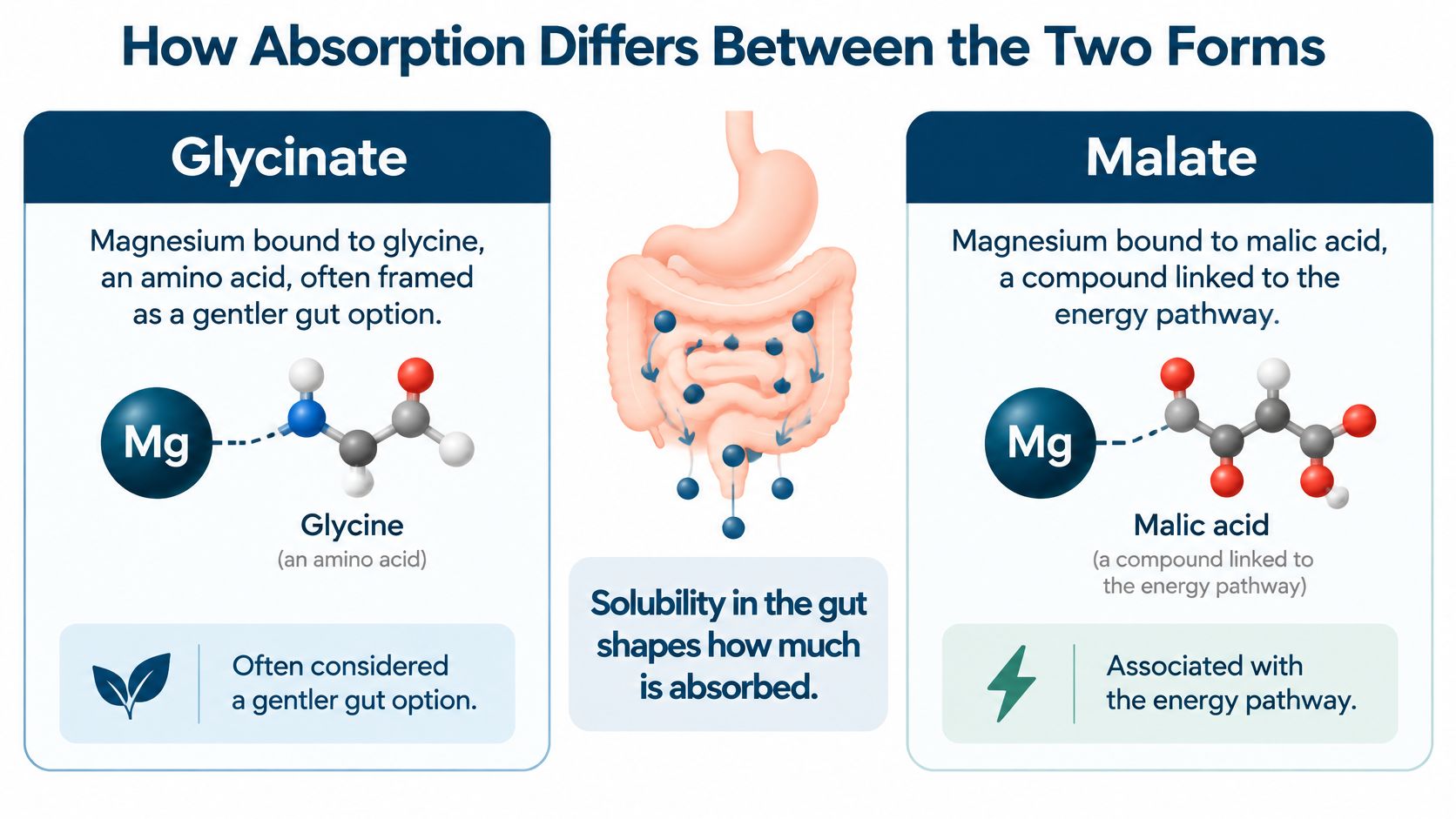
The NIH Office of Dietary Supplements lists magnesium aspartate, citrate, lactate, and chloride among forms it describes as more easily absorbed. Glycinate and malate do not appear on that list. Public-health guidance gives no absorption winner between the two. Uptake still shifts with formulation, dose, food, and the individual digestive tract, so a label cannot translate the carrier name into a fixed percentage.
A 2019 human study in Biological Trace Element Research compared organic-acid-bound magnesium, including malate, with amino-acid-bound forms, including glycinate, and tracked dose-dependent tissue distribution and bioavailability. The design answers tissue questions. It cannot rank the two compounds for a shopper deciding between bottles.
What the 2019 comparison cannot settle
Pooling both families in one project is not a head-to-head test of glycinate against malate. The study did not compare those two forms for sleep, energy, muscle soreness, or digestive tolerance. Tissue distribution shows where magnesium goes, not whether a person feels better. The result leaves both forms viable and neither one proven superior.
Judge a bottle on elemental dose, formulation quality, how your gut handles it, and the job you want it to do. Those four checks outperform the word printed above the ingredient line.
What the Malate Evidence Shows for Energy and Muscle
Malate's energy reputation outruns its human trial evidence. Malic acid sits in the citric acid cycle, the pathway cells use to make ATP, which is why the salt gets attached to fatigue and training recovery. A biochemical role establishes plausibility, while performance needs an outcome trial.
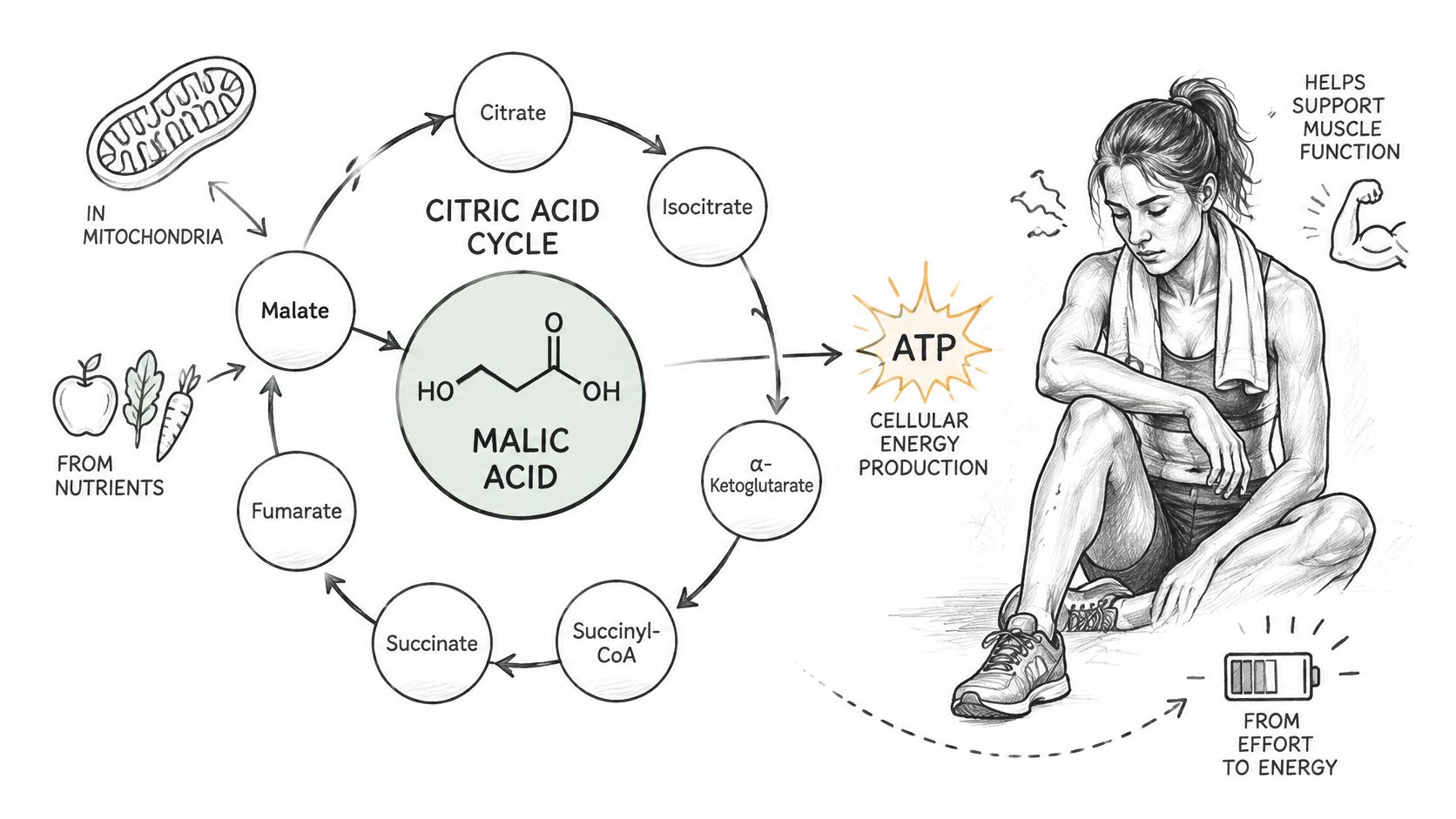
The human data are narrow. A placebo-controlled study in 91 adults tested a timed-release formula of dimagnesium malate plus B vitamins. People taking 250 mg twice daily showed a 6% rise in red-blood-cell magnesium after 30 days and 30% after 90 days, and 91% of the intervention group tolerated the product well, according to the Journal of the American College of Nutrition paper. The study tested one sustained-release product and included no glycinate arm.
What the trial measured
Red-blood-cell magnesium is a status measure; energy, strength, and soreness are performance outcomes, and the trial reported only the first. That distinction matters when a label implies malate will fix training fatigue. The result is a tolerability and status signal for a blended product.
If you want to try malate, require three label facts: dimagnesium malate, the release type, and the elemental dose. The elemental number lets you compare a malate tablet with glycinate or any other salt; compound weight includes the malate carrier, so it overstates the magnesium you get. Give it a multi-week window. A month matches the first status check in the trial better than a three-day experiment.
Muscle pain and headache do not always share a cause. If jaw tension is in the mix, explore TMJ-related headache care before you assign every ache to a magnesium gap. For a plain malate tablet, KAL Magnesium Malate 400 is one labeled malate option to read against a timed-release blend. NatureWise Magnesium 300mg Supplement 90 Softgels is a different product: 300 mg of elemental magnesium in softgels aimed at muscle relaxation, nerve function, and restful sleep, without the malate-plus-B-vitamin design.
Glycinate, Sleep and Gentler Digestion
Glycinate has the stronger case on digestion and the weaker case on sleep. Any magnesium salt can loosen stools at a high enough dose. Glycinate is the common fallback after oxide or citrate has already been rough, but that is a tolerability pattern, not a guarantee that every serving will be gentle.
Sleep support is a separate claim, and it rests on indirect evidence. Interest in glycine itself supplies part of the rationale; there is no trial here that pits glycinate against malate for insomnia. A 2025 systematic review calls both salts organic compounds that are generally more soluble than inorganic forms. Its practical lean toward glycinate and citrate rests on tolerability and accumulated use, not a direct clinical comparison. A "highly bioavailable" label is not a head-to-head result.
Bioavailability, serum magnesium changes, and clinical benefit are not interchangeable. A higher blood measure does not automatically mean better sleep, and a calmer evening does not prove superior absorption.
Products that share the glycinate name are not identical formulations. Bisglycinate is the same chemical family as glycinate, and two products can differ in formulation enough to change how much magnesium is available. The label line that matters is elemental magnesium per serving, not the weight of the glycinate compound. That number, not the form name on the front of the bottle, predicts how the product fits your daily total.
Take a magnesium oxide tablet with dinner that produces loose stools. Switching to a glycinate capsule at bedtime, at a smaller serving, changes three variables at once: salt, timing, and dose. If sleep improves, you cannot tell whether glycinate, the bedtime slot, or the lower elemental dose did the work. A one-variable test would hold the dose and timing steady and change only the salt.
An evening product framed for that routine is easy to inspect if you browse the Mag Evening supplement. NOW Magnesium Glycinate is sold as a highly absorbable form in veggie tablets, which makes the elemental line the first thing to read. Life Extension Magnesium 100 Veggie Caps 500mg Cardiovascular Health provides 500 mg of high-absorption magnesium in vegetarian capsules for cardiovascular health, muscle relaxation, and bone strength, so that 500 mg figure belongs in your daily total before it belongs in a cart.
Dosing Limits, Side Effects and Who Should Check First
Adult reference amounts and the supplemental ceiling answer different questions. Food is not capped by the supplemental figure. The ceiling applies to elemental magnesium from supplements and medicines, so add the panel's magnesium line, not the weight of glycinate or malate powder. The figures below come from the National Institutes of Health Office of Dietary Supplements magnesium fact sheet.
| Group | Recommended daily amount | Upper limit from supplements |
|---|---|---|
| Men 19-30 years | 400 mg | 350 mg |
| Men 31 years and older | 420 mg | 350 mg |
| Women 19-30 years | 310 mg | 350 mg |
| Women 31 years and older | 320 mg | 350 mg |
| Pregnant, 19-30 years | 350 mg | 350 mg |
| Pregnant, 31 years and older | 360 mg | 350 mg |
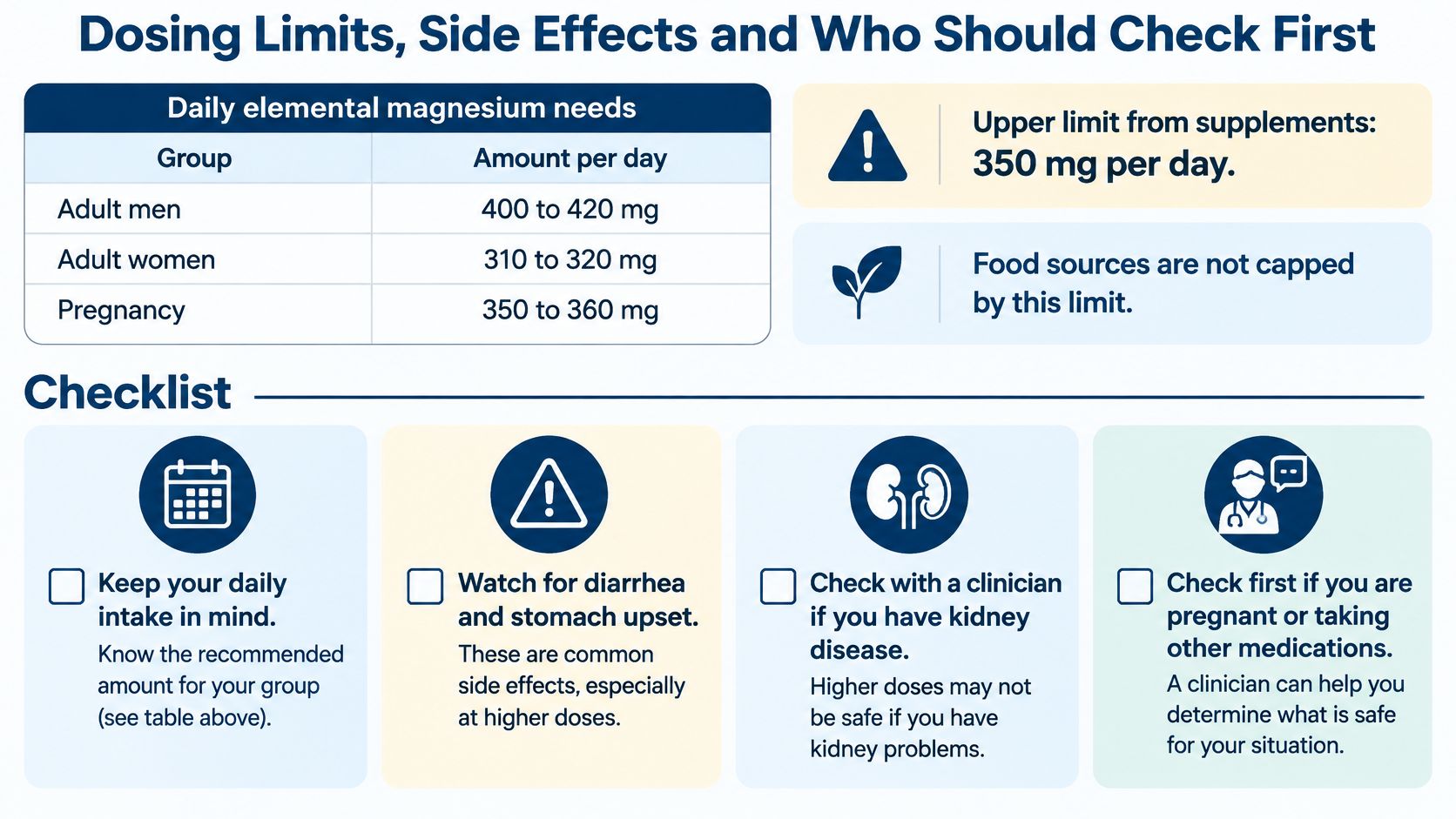
The first warning sign of too much supplemental magnesium is loose stools or diarrhea. It is usually dose-related and typically settles when you lower the serving or stop. Stomach upset can show up alongside it. Neither symptom is a reason to push the dose to "make the form work."
Who should pause before the first dose
- Reduced kidney function: clearance of extra magnesium is impaired, so a clinician should set or refuse the dose.
- Quinolone or tetracycline antibiotics: magnesium can interfere with absorption, and the prescriber should set the gap between doses.
- Bisphosphonates for bone conditions: the same spacing problem applies.
- Any medicine where timing matters: take magnesium apart from it exactly as the prescriber says, not on a guess from a forum.
Pregnancy belongs on that list too. The reference amount and the supplemental ceiling sit close together, so stacking products is easy to do by accident.
Before the first dose, the medical screen matters more than another label comparison: kidney function, current antibiotics or bisphosphonates, pregnancy status, and any medicine with a timing instruction. Your clinician should set the gap or the dose. Amazing Formulas Magnesium Oxide 500mg is a useful contrast here. A 500 mg oxide capsule isn't automatically 500 mg of elemental magnesium, and oxide is a poor model for how a glycinate or malate panel should be read.
Supplemynts.com sells vitamins and minerals and organizes products by health purpose. For any magnesium listing there, read the elemental line and the partner molecule before you commit to a bottle. That comparison does more for sleep, training recovery, or stomach tolerance than the salt name alone.







Please complete your information below to login.
Sign In
Create New Account