


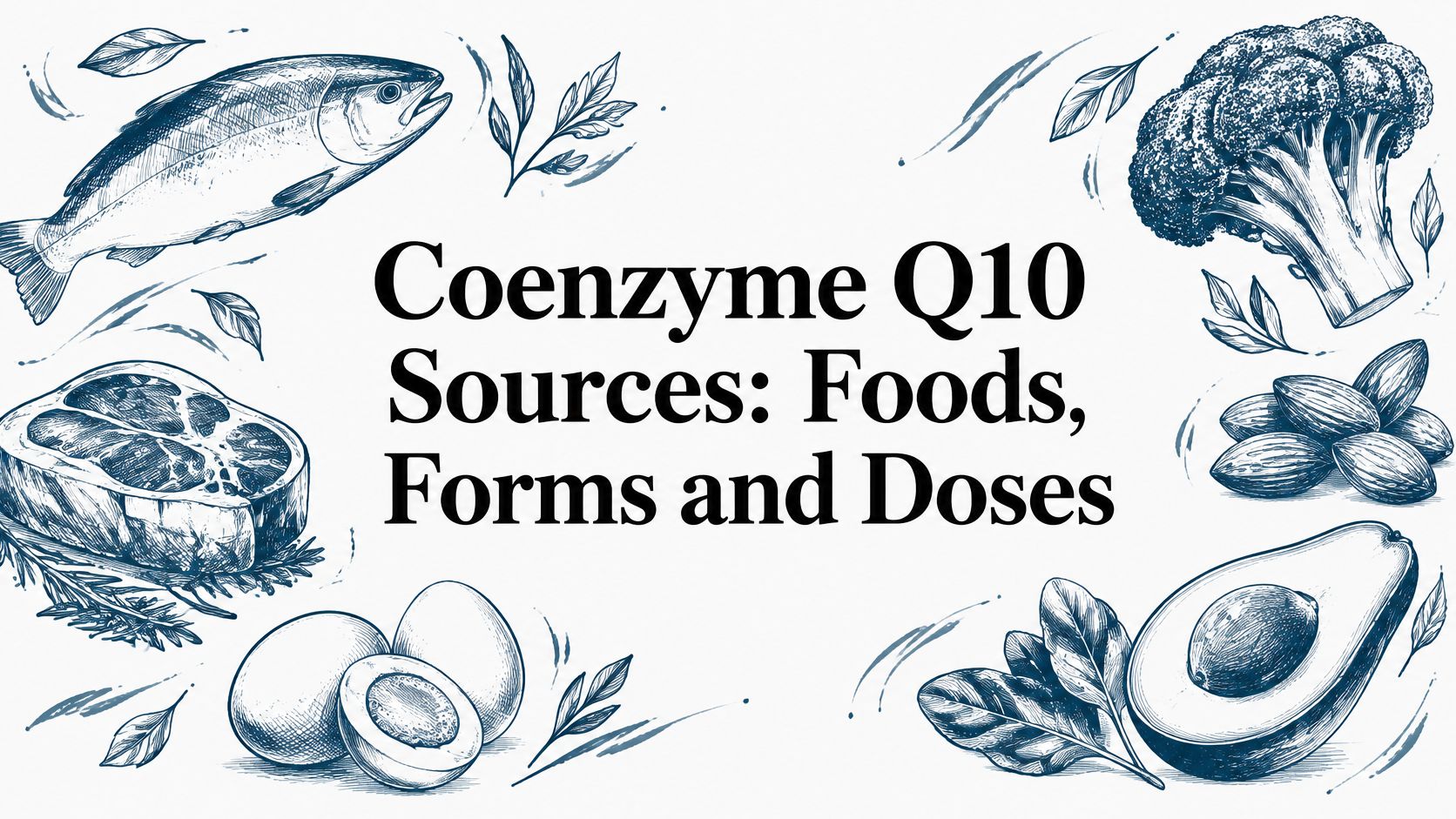
Beef heart contains 11.3 mg of CoQ10 per 100 g, compared with 3.9 mg in the same weight of beef liver, according to WebMD's CoQ10 guide. That contrast captures something food lists often miss: even closely related foods can provide very different amounts. Understanding coenzyme Q10 sources means looking at the portion, preparation method, and, for supplements, how the product delivers it.
Table of Contents
- Food Sources of CoQ10 Ranked by Amount
- Plant Sources and How Cooking Changes Them
- How Much Comes From Food Versus Your Body
- Absorption and the Ubiquinol Versus Ubiquinone Question
- Typical Supplement Doses Compared With Food
- Interactions, Safety and Your Next Step
Food Sources of CoQ10 Ranked by Amount
Organ meats lead this food comparison, followed by everyday meat and fish portions, selected oils, and nuts. Your body makes CoQ10, too, so food intake is only part of the picture, not a direct measure of everything available to your cells.
The Linus Pauling Institute's CoQ10 reference supplies the everyday food measurements below, including 2.6 mg in a three-ounce serving of fried beef and 1.3 mg in a tablespoon of soybean oil. The organ-meat values come from the WebMD guide linked above; all amounts are approximate.
CoQ10 content in common foods
| Food | Serving | CoQ10 (mg) | Food Group |
|---|---|---|---|
| Beef heart | 100 g | 11.3 | Meat |
| Beef liver | 100 g | 3.9 | Organ meat |
| Fried beef | 3 oz | 2.6 | Meat |
| Marinated herring | 3 oz | 2.3 | Fish |
| Fried chicken | 3 oz | 1.4 | Poultry |
| Soybean oil | 1 tbsp | 1.3 | Oil |
| Canola oil | 1 tbsp | 1.0 | Oil |
| Roasted peanuts | 1 oz | 0.8 | Nut |
| Boiled broccoli | 1/2 cup | 0.5 | Vegetable |
| Boiled cauliflower | 1/2 cup | 0.4 | Vegetable |
| Medium orange | 1 fruit | 0.3 | Fruit |
| Strawberries | 1/2 cup | 0.1 | Fruit |
How to read the ranking
This is a ranking by the listed portion, not a laboratory comparison using identical weights. The organ-meat servings are measured in grams, meat and fish in ounces, and oils by the tablespoon. You can use the table to compare realistic eating occasions, but you shouldn't interpret it as a precise ranking of concentration across every food.
Preparation matters, too. Fried beef and marinated herring describe particular prepared foods, not every beef cut or herring recipe. A raw ingredient, a cooked ingredient, and a drained serving aren't automatically interchangeable.
Practical rule: Match the food, portion, and preparation before treating a published CoQ10 value as an estimate of your own meal.
For everyday eating, the useful distinction is between main contributors and supporting contributors. A meat or fish portion can contribute substantially more than a fruit serving. Cooking oil and peanuts can also make a meaningful contribution without becoming the central ingredient on the plate.
That doesn't make fruit or vegetables less valuable foods. It means CoQ10 is the wrong reason to choose strawberries over another fruit or to build an entire diet around organ meat. Keep the rest of your nutritional needs in view.
A practical mixed-diet meal might combine herring with vegetables dressed in an appropriate oil, with nuts eaten elsewhere in the day. You're combining several contributors rather than expecting a single ingredient to supply everything.
Plant Sources and How Cooking Changes Them
Plant-based doesn't mean CoQ10-free. Soybeans, selected oils, nuts, seeds, and legumes deserve more attention than a generic instruction to eat more produce.
A review of CoQ10 in food and supplementation identifies soybean, canola, olive, and corn oils, alongside nuts, seeds, spinach, broccoli, parsley, and legumes, as plant contributors. It also reports that tofu, soy milk, and soy yogurt may contain considerably less CoQ10 than whole soybeans, while eggs contain approximately 1–4 mg/kg and dairy products are comparatively poor sources.
Whole foods and processed foods aren't equivalent
Whole soybeans and soy drinks serve different purposes in the kitchen, and their CoQ10 content isn't interchangeable. Choose tofu or fortified soy milk for the reasons they fit your diet, but don't assume their soybean origin guarantees the same contribution as whole beans.
Nuts offer another practical option. If you're comparing snack ingredients, you can find organic cashews from 2die4 through Saporia, but that listing shouldn't be read as evidence of a particular CoQ10 amount or an absorption advantage. A food's organic or activated description doesn't establish its CoQ10 content.
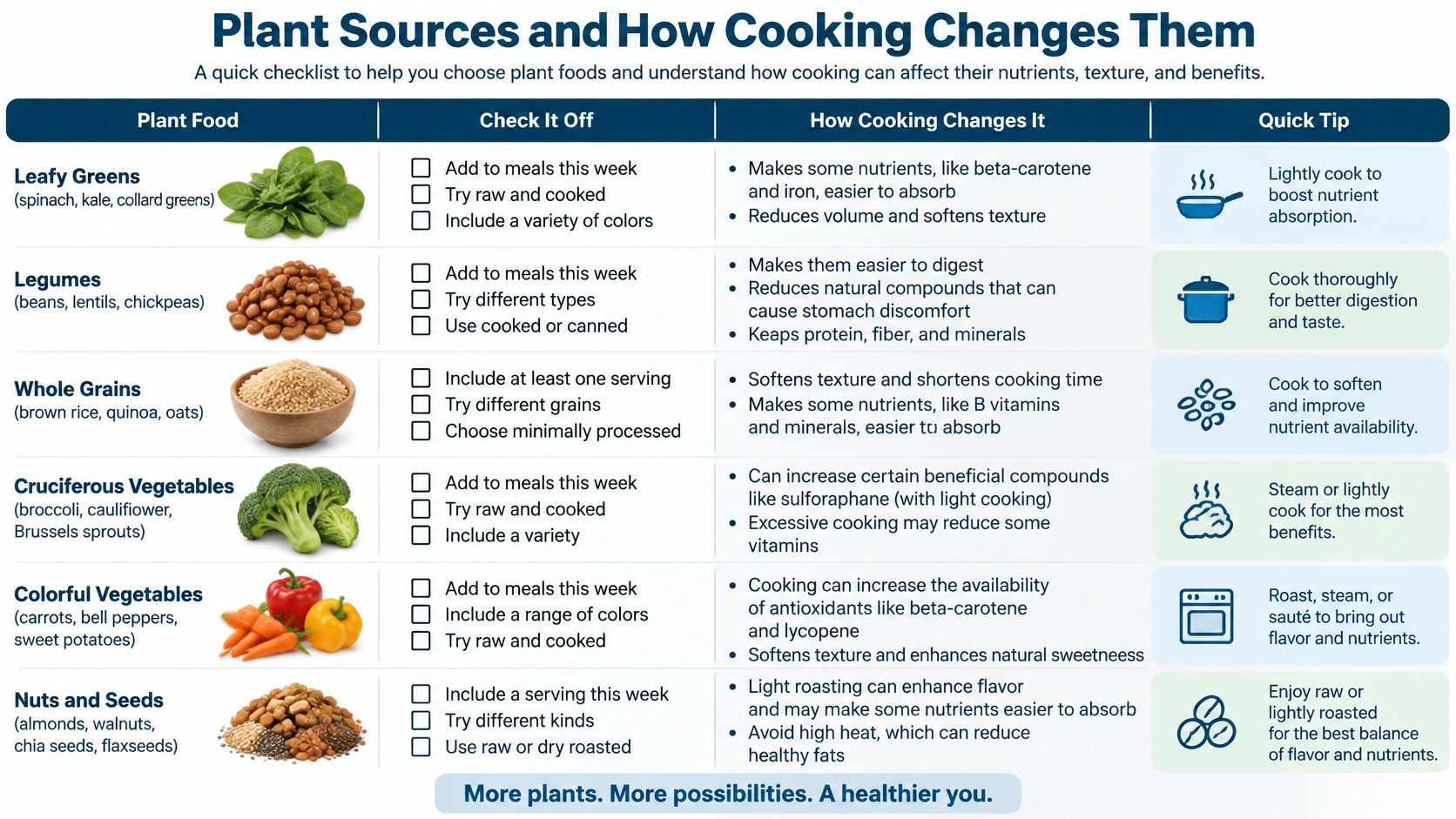
Use this visual as a meal-planning checklist rather than a precise nutrient calculator.
Cooking losses need context
The StatPearls overview of CoQ10 describes losses during cooking, including reductions of 14–32% associated with frying, and notes that boiling can destroy CoQ10. Those observations don't establish a universal retention percentage for every vegetable or recipe.
A broccoli stir-fry made with canola oil includes a CoQ10-containing ingredient beyond the vegetable itself. That doesn't prove it retains more of the broccoli's original CoQ10 than every boiled preparation. Temperature, cooking time, and the specific food prevent that simple conclusion.
For a practical plant-based approach:
- Choose whole soybeans regularly. Don't treat every processed soy food as a nutritional equivalent.
- Count oils and nuts. They're ingredients worth considering, not incidental extras.
- Avoid unnecessary overcooking. Cook vegetables until they're ready to eat rather than leaving them boiling.
- Keep fruit in perspective. Avocado can contribute, but most fruits and berries are supporting foods rather than leading CoQ10 sources.
How Much Comes From Food Versus Your Body
CoQ10 works inside mitochondria, the structures cells use to produce energy. Its presence in food is therefore only part of its biology: your body also manufactures it.
The National Cancer Institute's CoQ10 overview describes its isolation from beef-heart mitochondria in 1957 and identification of its chemical structure in 1958. It also explains why CoQ10 attracts scientific interest: it's present throughout human tissues, with high concentrations in energy-demanding organs and tissues such as the heart, kidneys, liver, brain, and skeletal muscle.
Dietary intake isn't a daily requirement
Food-intake estimates describe what people consume. They don't tell you how much you personally need to supplement, nor do they measure your body's production.
Germany's Federal Institute for Risk Assessment places normal dietary intake at 3–6 mg per day. A 2024 study in Frontiers in Nutrition found an average of 5.4 mg per day among Chinese adults, with meat and meat products as the most important sources.
Daily CoQ10 intake benchmarks
| Intake Benchmark | Daily Amount | What It Tells You |
|---|---|---|
| Average Western diet | 3–6 mg | Typical food-only intake |
| Chinese adults, 2024 study | 5.4 mg | Meat and meat products were the main source |
The similar scale of these estimates is useful, but neither is a personal target. Food patterns, portions, and ingredient choices differ between individuals, even within the same population.
A usual intake describes eating habits. A recommended intake would answer a different question.
What your body's contribution changes
Your own synthesis supplies most of the CoQ10 available in circulation, with food adding a smaller contribution. That makes CoQ10 different from a nutrient you must obtain entirely through eating.
It also explains why a low-CoQ10 meal doesn't automatically imply deficiency. A plate of beans, vegetables, and grains can't tell you how much CoQ10 your tissues contain or whether a supplement would help.
No formal recommended dietary allowance has been established by the U.S. National Academy of Medicine. Without that benchmark, there isn't a justified food-tracking exercise in which everyone subtracts their intake from a universal target and fills the gap with capsules.
Food can provide a meaningful baseline. A decision to supplement needs a separate reason, a defined goal, and an assessment of the person's health and medicines.
Absorption and the Ubiquinol Versus Ubiquinone Question
Swallowing CoQ10 isn't the same as absorbing it. The molecule is relatively large and fat-soluble, which makes its journey through digestion more complicated than dissolving in water.
A review of CoQ10 absorption and bioavailability describes how bile and pancreatic secretions help incorporate it into mixed micelles, small structures that carry fat-soluble material through digestion. CoQ10 then enters chylomicrons, travels through the lymphatic system to the liver, and circulates mainly in lipoprotein particles called VLDL, LDL, and HDL.
The practical consequence is straightforward: take an appropriate CoQ10 supplement with a meal containing fat rather than fasting, unless your clinician or product directions specify otherwise. A lunch with olive-oil dressing is a more suitable context than swallowing it with water before breakfast.
What the form names actually mean
Ubiquinone is the oxidized form of CoQ10. Ubiquinol is the reduced form. Your body can convert between them, so these aren't unrelated ingredients competing to perform entirely different jobs.
The absorption review reports that approximately 95% of circulating CoQ10 is ubiquinol. That doesn't establish that every person should buy ubiquinol: the form found in blood isn't, by itself, proof of which finished supplement is absorbed best.
A review of CoQ10 stability and delivery systems describes oral bioavailability as generally low, around 5% or less, and reports no significant absorption or bioavailability difference between 150-mg doses of ubiquinol and ubiquinone in an adult comparison. It also discusses improved solubilization and bioavailability with some nano-sized preparations compared with conventional formulations.
CoQ10 forms compared on what the evidence supports
| Form | Chemical State | Absorption Evidence | Label Check |
|---|---|---|---|
| Ubiquinone | Oxidized | Absorption is influenced by fat and formulation | Lipid carrier and serving size |
| Ubiquinol | Reduced | The adult comparison described above found no significant advantage over ubiquinone | Whether the ingredient is identified as ubiquinol |
| Nano-sized formulations | Either form | Some preparations improve solubilization compared with conventional products | Named delivery technology and evidence for the finished formulation |
Why the evidence doesn't produce a universal winner
The stability review proposes that ingested ubiquinol may become oxidized before absorption and then be reduced again afterward. That's an explanation under discussion, not a reason to claim that every product behaves identically.
The important distinction is chemical form versus finished formulation. Oil carriers, dispersion methods, stability, and meal conditions can differ between products. A comparison of particular preparations doesn't settle every comparison between everything labeled ubiquinol and everything labeled ubiquinone.
Don't pay for a form name alone. Look for a clearly described formulation and evidence relevant to that formulation.
Likewise, improved solubility isn't a medical outcome. A preparation that raises circulating CoQ10 more efficiently hasn't automatically demonstrated a greater benefit for your particular goal.
A useful label-reading checklist
When reviewing a CoQ10 ubiquinone product listing, use the ingredient panel and directions rather than relying on the product name's absorption language.
- Chemical form. Identify whether the actual ingredient is ubiquinone or ubiquinol.
- Delivery matrix. Look for the carrier oil or a clearly named delivery system.
- Serving size. Check how many capsules or softgels make up a serving.
- Food directions. Plan the dose around a normal meal containing fat.
- Storage. Follow the stated temperature, light, and container instructions.
- Evidence match. Ask whether any cited comparison tested the finished preparation, not merely the ingredient category.
Studies also use different participants, meal conditions, and sampling schedules. Those differences make broad rankings less reliable than advertisements sometimes suggest.
Typical Supplement Doses Compared With Food
Supplement labels operate on a very different scale from ordinary food intake. A prominent milligram amount tells you how much ingredient the serving contains, not whether that amount is necessary for you.
An absorption-study dose isn't a recommended daily intake. Researchers choose doses to investigate particular questions; shoppers shouldn't convert those choices into personal requirements.
Calculate the daily amount correctly
Start with the Supplement Facts serving size, then read the amount per serving and the suggested use. If a serving contains multiple softgels, the listed amount may apply to the group, not each softgel.
Don't divide milligrams per serving by the number of servings in the bottle. That would mix up dose and package size.
Use this calculation instead:
Daily supplemental amount = amount per serving × servings taken each day.
For a hypothetical product, if the label lists an amount per softgel and the directions call for a single softgel daily, that amount is the daily supplemental intake. If the label defines a serving differently, calculate from that definition before comparing products.
Package strength doesn't establish suitability
A CoQ10 softgel listing is a place to inspect strength, serving size, and directions, not a substitute for choosing a dose with a clinician. A higher-strength preparation may be less suitable when the goal calls for a smaller amount.
Also check other supplements you already take. CoQ10 may appear in combination products, so reading only the front of each bottle can obscure your total.
Bring the full labels to a pharmacist or prescriber. Ask what outcome you're trying to achieve, how you'll judge whether the supplement is useful, and when you should reassess it rather than continuing indefinitely.
Interactions, Safety and Your Next Step
If you take warfarin, speak with your prescriber before adding CoQ10. The concern is a possible reduction in warfarin's anticoagulant effect. Don't start, stop, or adjust prescribed medicine to accommodate a supplement on your own.
Other medicines and health circumstances also deserve a review. Supplement exposure differs from eating a CoQ10-containing meal, so being comfortable with the food doesn't establish that a concentrated product is appropriate.
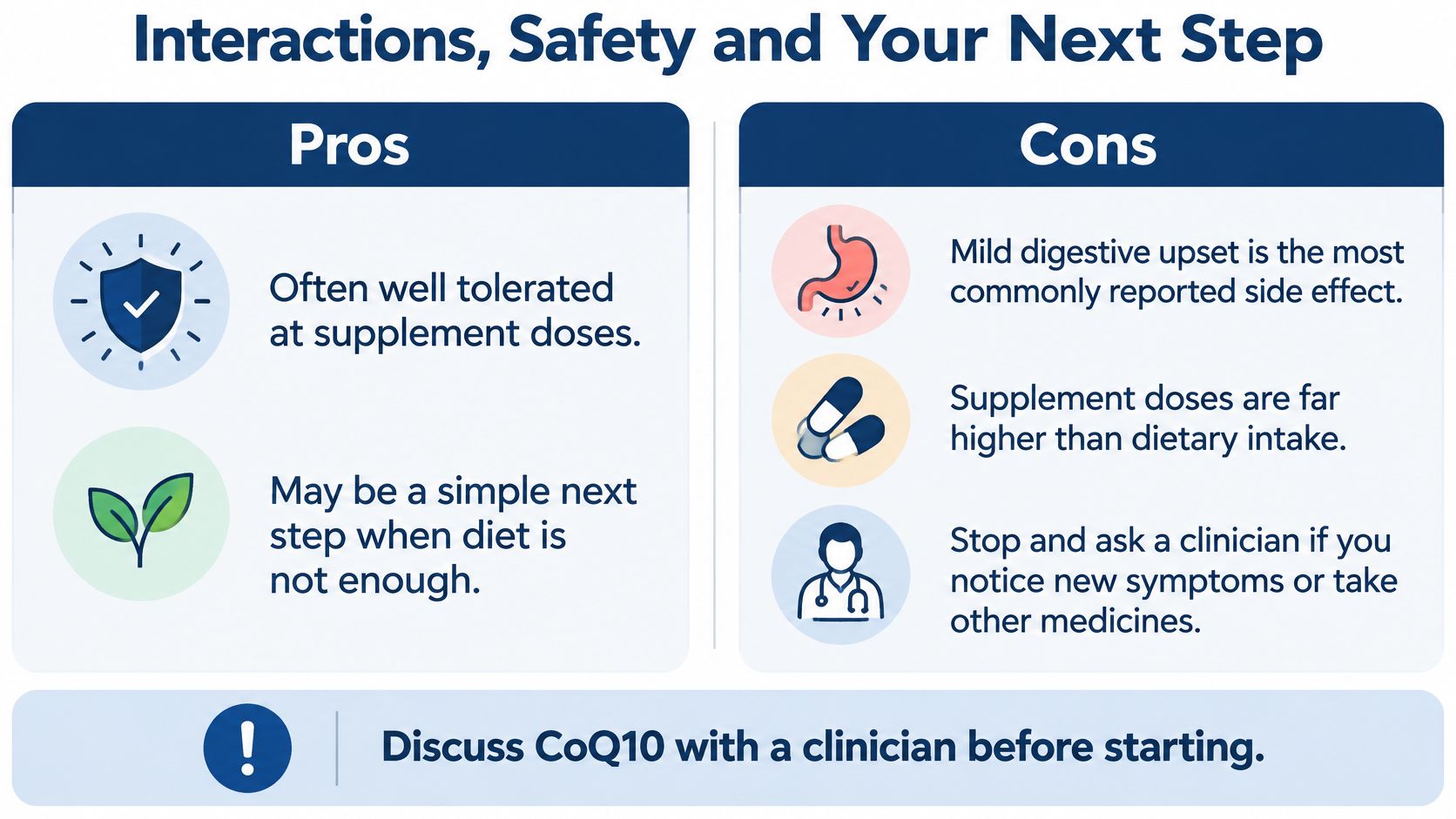
Use the visual below as a prompt for a medication discussion, not as medical clearance to start.
Situations that call for a clinician check
| Situation | Why It Matters | What to Do |
|---|---|---|
| Warfarin or other blood thinners | CoQ10 may reduce warfarin's effect; other blood thinners need their own interaction assessment | Ask the prescriber whether clotting monitoring or another precaution is needed |
| Blood pressure medicines | Potential additional blood-pressure lowering needs consideration | Agree on a home-reading plan before starting |
| Diabetes medicines | Potential blood-sugar effects may affect monitoring needs | Ask about glucose checks; don't change medicine doses yourself |
| Chemotherapy or radiation | Compatibility and treatment timing require specialist judgment | Discuss the exact supplement with the oncologist |
| Pregnancy or breastfeeding | Safety information isn't sufficient for self-directed use | Get clinician approval first |
These are reasons to ask, not proof that every person in these groups will experience an interaction. The medication name, treatment goal, and full supplement formulation all matter.
Digestive discomfort is another reason to reassess use. If you develop persistent stomach upset or other new symptoms after starting, stop taking the supplement and contact a clinician or pharmacist for advice. Seek urgent care for severe symptoms rather than assuming they're a routine supplement effect.
Prepare a useful medication review
Make a complete list. Include prescriptions, over-the-counter medicines, herbal products, vitamins, and combination supplements. Record what you take, not only what's listed in your medical record.
Bring the formulation details. A CoQ10 product with an additional ingredient needs assessment as a whole product. The front-label ingredient isn't the only information your pharmacist needs.
Agree on a plan before starting. Ask your clinician to choose an appropriate starting amount and identify what to monitor. That might include symptoms, home readings when relevant, and a clear point for reviewing whether to continue.
This video can provide another starting point for questions to bring to your appointment.
Choose a next step that fits your diet
If you regularly eat fish or meat, you may already include substantial dietary contributors. You don't need to add organ meat just because it ranks highly, and a food ranking doesn't diagnose a need for supplementation.
For plant-based eating, build practical meals around whole soybeans, legumes, nuts, seeds, and suitable oils. Keep a varied selection of vegetables and fruit rather than narrowing your diet around a single compound.
If you're considering a supplement, choose it for a defined reason rather than a vague promise of more energy. Compare the form, serving amount, carrier, meal directions, and complete ingredient list, then review that choice with someone who knows your medicines.
Write down your current diet, every medicine and supplement you take, and the goal you hope CoQ10 will address. Bring that list and the proposed product label to your next appointment so you can make a specific decision together.
We offer vitamins, minerals, herbs, proteins, and purpose-based supplement categories to help you compare options relevant to your routine. Visit Supplemynts Inc to review supplement listings and ingredient information, then bring your preferred CoQ10 label to your clinician or pharmacist before starting.





Please complete your information below to login.
Sign In
Create New Account