



The most popular advice about casein whey protein is also the least complete: take whey after training, casein before bed, and the problem is solved. That rule recognizes a real difference in digestion speed, but it turns an acute biological response into a universal purchasing recommendation. For muscle gain, the more important questions are usually whether your daily protein intake is adequate, whether you distribute it sensibly, whether the product suits your age and training status, and whether its quality can be verified.
Casein and whey aren't interchangeable powders. They're distinct fractions of bovine milk with different structures, processing histories, amino-acid profiles, and digestion kinetics. Those distinctions matter, but they matter within the context of an entire diet, not as isolated reasons to buy one tub over another.
Table of Contents
- Moving Beyond the Fast and Slow Protein Myth
- Digestion Kinetics and Amino Acid Profiles
- Muscle Protein Synthesis Across Different Populations
- Evaluating Protein Powder Safety and Purity
- Strategic Timing and Practical Stacking Methods
- Making Your Final Protein Selection
Moving Beyond the Fast and Slow Protein Myth
Milk contains two different protein fractions
The standard whey-fast, casein-slow story is real, but it is too narrow to guide a buying decision on its own. Casein whey protein products begin as the two principal protein fractions in bovine milk, and that starting point matters more than supplement marketing. According to this review of milk proteins and human nutrition, casein represents approximately 80% of milk's true protein, while whey proteins account for approximately 20%. Cow's milk contains about 3.5% total protein, and roughly 94–95% of that protein is classified as true protein.
That ratio reflects the native structure of milk before filtration and drying create retail products. Casein is also not one uniform protein. Its major fractions are approximately 38% alpha-s1-casein, 10% alpha-s2-casein, 36% beta-casein, and 13% kappa-casein. Those structural differences help explain why casein behaves differently during cheesemaking and digestion, while whey remains in the liquid portion.
Whey's commercial role also started as a processing problem, not as a sports nutrition product. FAO historical data show global whey production grew from roughly 57 million metric tons in 1966 to over 70 million by 1973, much of it a disposal challenge for dairies. In France, production reached approximately 6 million metric tons in 1973, with about 20% reported as wasted at that time.
Processing changes what reaches the consumer
Liquid whey is mostly water, which is why manufacturing defines the final supplement more than the simple fast-versus-slow label. Its dry matter contains primarily 70–73% lactose, 12–13% protein, and 7–11% mineral salts, from the same FAO account. Filtration, concentration, isolation, and drying turned a difficult dairy by-product into ingredients that could fit foods, beverages, and powders.
So whey concentrate, whey isolate, and micellar casein are not interchangeable names for the same thing. They describe processed fractions with different lactose content, texture, digestion behavior, and practical use. For some buyers, that affects tolerance and meal planning more than any abstract claim about absorption speed.
Practical rule: Treat protein type as a tool for solving a dietary problem, not as a ranking system in which one fraction always wins.
Daily adequacy matters more than simplistic timing claims
A faster amino-acid rise does not automatically make a protein superior across a full training week. What matters first is whether total daily intake is high enough, whether doses are distributed across the day in a way the person can maintain, and whether the product fits the user's age, appetite, and digestion.
That changes the decision.
A younger lifter already meeting daily protein targets may notice little benefit from replacing a convenient powder with a more aggressively marketed one. An older adult may care more about getting enough protein in repeatable servings across the day. Someone with irregular meals may benefit most from the product they will use consistently. In practice, those questions often matter more than a single post-workout spike.
There is also a separate issue that marketing rarely addresses clearly. Protein quality is not just digestion speed. It is also whether the powder has been processed well, tested for contaminants such as heavy metals, and matched to the user's routine. A technically appealing protein is less useful if its purity is uncertain or if it makes adherence harder.
The better question is “Which fraction helps this person meet a sustainable daily plan?” That framing fits the physiology, leaves room for age-specific differences in muscle protein synthesis, and keeps attention on safety and long-term use rather than a simple fast-versus-slow myth.
Digestion Kinetics and Amino Acid Profiles
The stomach handles them differently
The practical difference between micellar casein and whey starts in the stomach, not in a marketing slogan. Intact micellar casein coagulates in acidic gastric conditions, which slows gastric emptying and spreads amino-acid delivery over a longer period. Whey stays more rapidly digestible, so amino acids appear in circulation sooner.
That timing difference is measurable. In a clinical comparison of casein and whey digestion, plasma amino-acid concentrations were higher after whey at about 100 minutes, while casein produced higher concentrations around 300 minutes. For athletes, that matters less as a verdict on which protein is “better” and more as a clue about how each one fits between meals, around training, or during longer gaps without food.
Amino-acid composition adds another layer
Kinetics are only part of the picture. Amino-acid composition also shapes how a protein behaves in practice, especially when daily intake is uneven or serving sizes are modest. Whey generally provides more branched-chain amino acids, while casein still delivers a strong indispensable amino-acid profile. The practical implication is not that one source wins outright. It is that whey tends to create a sharper leucine-rich signal per serving, while casein tends to maintain amino-acid availability for longer.
That distinction matters most when meals are poorly distributed. If someone eats protein-rich meals regularly across the day, the kinetic gap often becomes less important than total intake, digestibility, and adherence. If the next substantial meal is far away, slower release can be useful. If training ends and food will be delayed, faster delivery can be useful.
Processing changes the equation further. The same kinetic review indicates that casein hydrolysate is digested more rapidly than intact casein, while hydrolysis changes whey less because intact whey is already absorbed quickly. Product labels therefore deserve close reading. “Casein” and “whey” are broad categories, not single fixed ingredients.
| Protein Type | Gastric Behavior | Peak Amino Acid Time | Primary Benefit |
|---|---|---|---|
| Whey | Rapid digestion and absorption | Approximately 100 minutes | Fast amino-acid delivery and convenience |
| Micellar casein | Coagulates under acidic gastric conditions | Around 300 minutes | Sustained amino-acid availability |
| Casein hydrolysate | Faster digestion than intact casein | Earlier than intact casein | A more rapid casein delivery profile |
| Whey hydrolysate | Similar broad rapid-digestion role to whey | Rapid | Convenience where rapid digestion is preferred |
For a concrete example of ingredient format, this whey protein isolate product description shows the kind of rapidly digesting whey form often used when convenience and mixing ease matter. Still, choosing a format is only one step. The better question is whether that format helps the user hit repeatable protein targets across the day, without digestive problems and with enough confidence in product quality to use it consistently.
Muscle Protein Synthesis Across Different Populations
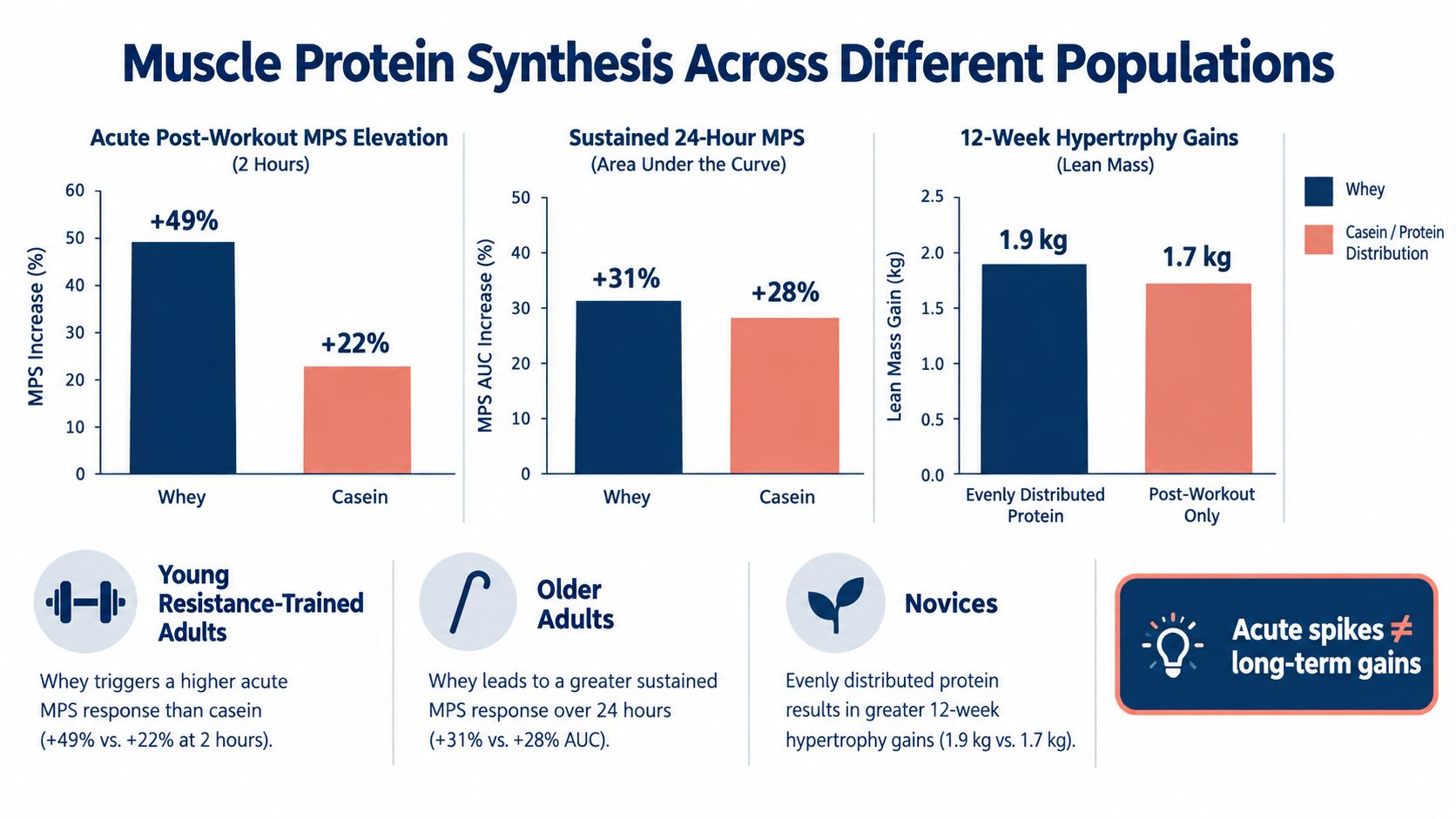
A rapid amino-acid peak is not the same thing as a larger long-term muscle gain. That distinction becomes clear when researchers compare different populations and measurement windows rather than treating one post-workout result as a permanent verdict.
In a tracer study of young men who consumed protein immediately after heavy resistance exercise, whey produced a faster, larger, and shorter amino-acid and insulin response. Casein produced a more moderate but prolonged response. Yet cumulative myofibrillar protein synthesis over the following 1–6 hours was statistically similar for the two proteins and higher than control, according to this comparative resistance-exercise study.
Age changes the response
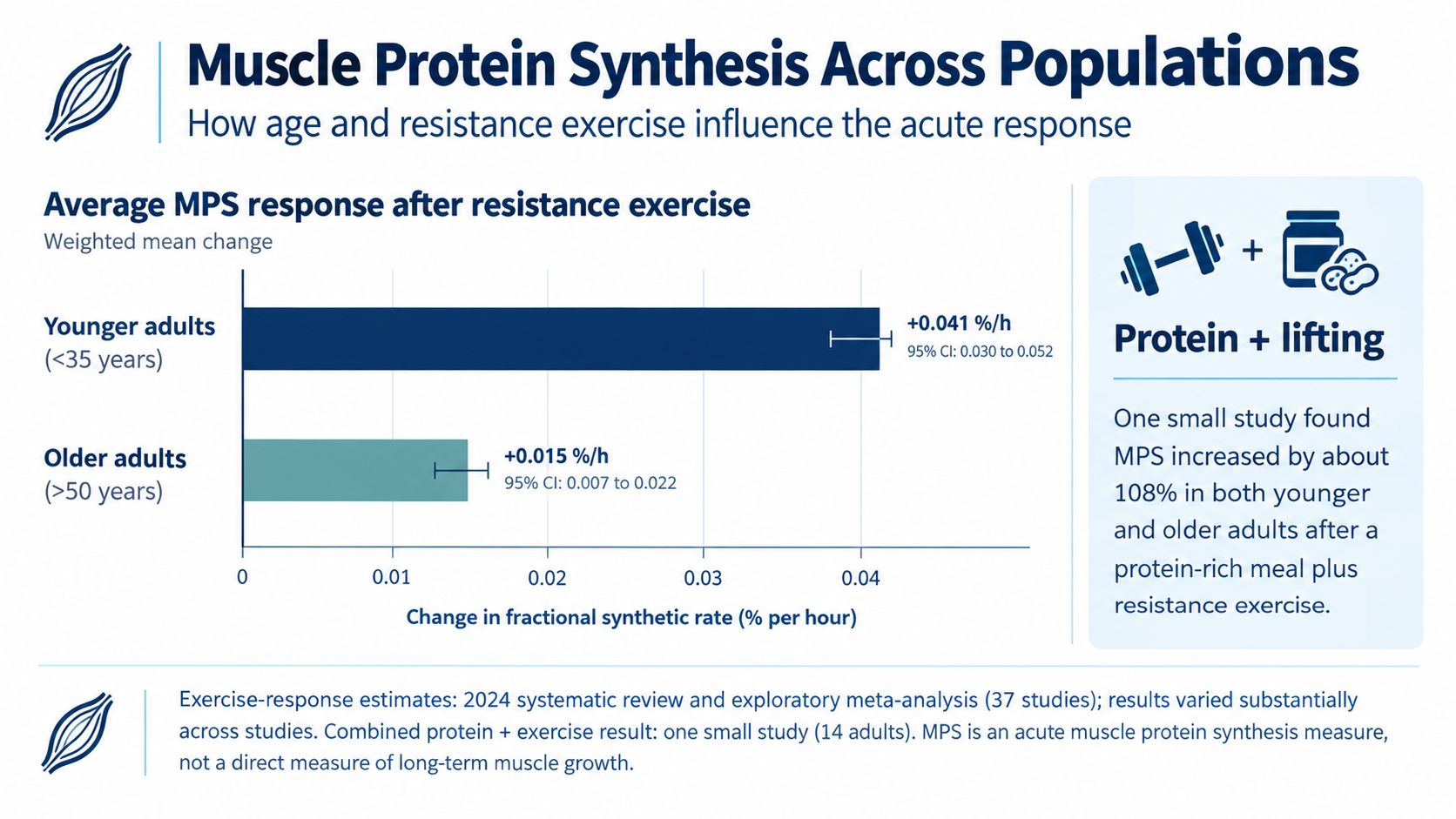
The same source reports a different result in elderly men. Resistance-exercise-stimulated myofibrillar protein synthesis was approximately 0.059% per hour after whey isolate versus 0.035% per hour after micellar casein, with whey also producing higher peak essential-amino-acid and leucine concentrations at 60 minutes. That finding supports positioning whey as a higher-velocity post-exercise option for older adults, but it doesn't establish whey as a universal long-term winner.
The interpretation depends on the population. A young trained adult, an older adult, and a novice may respond differently to the same protein, dose, exercise stimulus, and recovery schedule. This is why a product recommendation based only on digestion speed can be too broad.
An acute synthesis measurement answers what happened during the measured window. It doesn't automatically answer what will happen to muscle size after months of training.
Long-term outcomes need a wider lens
A summary of a 2025 randomized trial involving 30 untrained older men reported that participants completed 12 weeks of supervised resistance training while receiving either 40 g of protein after exercise, 40 g before sleep, or no supplement. Muscle thickness and strength improved, but the groups didn't show significant differences, according to this summary of the trial.
That result challenges the blanket claim that nighttime casein or immediate post-workout whey is universally superior. It doesn't make timing irrelevant. It means timing should be considered alongside total daily protein, distribution across meals, dose, tolerance, training experience, age, and convenience.
Readers comparing dairy proteins with alternatives may also benefit from this practical resource on plant based protein for muscle building from Louisville Jerky Co. The broader lesson is that protein selection involves more than the speed at which one fraction enters circulation.
For older adults and beginners, the best choice may be the product that supports regular meals and adequate intake without digestive problems. For regular lifters, whey can be convenient after training, while casein can help fill a longer gap between meals. Neither recommendation should be presented as proof that one powder determines the final hypertrophy outcome.
Evaluating Protein Powder Safety and Purity
Safety often matters more than digestion speed once total daily protein intake is already adequate. For casein and whey powders, the practical question is less "fast or slow" and more whether the product is accurately labeled, tolerable, and screened for contaminants at the batch level.
A 2025 analysis reported that 47% of 160 tested protein products exceeded California Proposition 65 thresholds for at least one heavy metal. In that sample, plant-based products contained about three times as much lead as whey products, while 28% of whey products exceeded the cited lead threshold, according to this CNN report on heavy metals in protein powders. Those figures describe the tested products only. They do not prove that whey, casein, or any other category is uniformly safe or unsafe.
A separate 2025 cross-sectional study of 22 commercially available powders found arsenic, cadmium, mercury, and lead were undetectable or below regulatory limits in the sampled products. The contrast between those findings is the real takeaway. Category labels are weak proxies for safety, because contamination risk depends on sourcing, processing, flavor ingredients, and lot-to-lot quality control.
That distinction matters for athletes who use powder daily.
What to look for on a label
Casein-specific safety data are rarely isolated from the broader dairy protein market, so buyers usually have to judge the exact product in front of them. Detection alone is also an incomplete metric. Exposure depends on serving size, frequency of use, and whether the tested batch matches the one being sold.
A better screening approach is simple:
- Batch-level documentation: A certificate of analysis should identify the exact lot and the contaminants tested.
- Third-party testing: Independent verification carries more weight than a generic purity claim on the front of the tub.
- Serving-size context: A lab result has to be interpreted in the amount consumed.
- Allergen and lactose information: Milk allergy rules out dairy proteins, while lactose tolerance can differ across concentrates, isolates, and casein products.
- Clear contaminant limits: Proposition 65 and other regulatory thresholds provide context, but they do not guarantee every production batch is identical.
Even a lactose-free option, such as this concentrated whey supplement listing, should be judged by the same standards. "Dairy," "whey," and "casein" describe the protein source. They do not certify purity, dose accuracy, or manufacturing consistency.
Strategic Timing and Practical Stacking Methods
The most useful timing plan starts with the gap your diet needs to cover. If you need a rapidly digestible option after training, whey is practical. If you expect a long interval without food, intact micellar casein offers a slower release pattern. If both situations occur in the same day, using both can be rational, but it isn't mandatory.

Match the protein to the schedule
A simple decision sequence works better than a rigid clock-based rule:
- Check the next meal. If a normal meal is close, the difference between whey and casein may matter less than convenience and tolerance.
- Identify the fasting interval. A longer gap makes casein's sustained profile more relevant.
- Consider digestion. Hydrolyzed casein may suit someone who finds intact casein heavy, while hydrolyzed whey may offer a different texture and tolerance profile.
- Audit the whole day. Don't add a second protein powder if the first already solves the dietary shortfall.
Blending whey and casein creates a mixed delivery profile, but that doesn't automatically create an extra training adaptation. The blend may be useful because it is convenient, tastes better, or helps someone cover a long interval with one serving. Its value is practical unless stronger evidence shows a specific long-term advantage for the individual using it.
Use complementary products carefully
Collagen peptides and gelatin can have a place in a broader connective-tissue strategy, but they shouldn't be treated as direct replacements for a complete dairy protein when the goal is to supply the amino acids associated with muscle-protein synthesis. The same principle applies to branched-chain amino-acid supplements. If your daily protein intake is already adequate, adding isolated amino acids may complicate the plan without solving its central problem.
For readers comparing recovery beverages and timing ideas, this post-workout recovery drink guide from Thermo Recovery Wear provides additional practical context. The drink should serve the training plan, not become a substitute for food quality, hydration, sleep, or progressive resistance training.
Someone considering a branched-chain amino-acid product can review this BCAA recovery supplement listing, but the decision should follow a dietary audit. A protein powder that helps meet daily needs is usually easier to justify than a stack built around multiple overlapping products.
Making Your Final Protein Selection
The best casein whey protein choice is rarely determined by one impressive phrase on the label. It emerges from five questions: What protein gap are you filling? How long until your next meal? How do you digest the product? What does your age and training status suggest? Can the manufacturer document quality for the product you'll consume?
Whey is the logical first choice when speed, portability, and a post-exercise serving matter. Its rapid digestion and earlier amino-acid peak make it a practical option, especially when the next meal isn't convenient. That recommendation describes use case and velocity, not guaranteed superiority in long-term muscle gain.
Micellar casein fits a different problem. Its gastric coagulation and sustained amino-acid release make it useful between meals or before a longer fasting period. It may also be appealing when a thicker, slower-digesting serving helps a person stay consistent. However, a buyer shouldn't purchase casein solely because marketing presents overnight intake as essential.
Build a decision around the person
| Your main constraint | More useful starting point | What to verify |
|---|---|---|
| You need a convenient post-training serving | Whey concentrate or isolate | Protein amount, lactose tolerance, ingredient list |
| You regularly face long gaps between meals | Micellar casein | Texture, digestion, serving practicality |
| You're an older adult focused on resistance training | Compare whey and casein within the full diet | Total intake, meal distribution, training consistency |
| You already meet daily protein needs | Buy only if it improves convenience | Whether the purchase solves a real dietary problem |
| You're concerned about purity | Choose a product with transparent testing | Batch documentation and contaminant screening |
| You avoid dairy | Consider a clearly labeled plant-based alternative | Amino-acid profile, tolerance, and third-party testing |
A retailer's operating standards matter too. Clear supplier curation, accessible customer support, transparent refund and shipping policies, and a straightforward product search reduce purchasing friction, but they don't replace product-specific testing. The buyer still needs to read the label and confirm that the product matches their dietary restrictions.
The strongest conclusion from the evidence is deliberately unglamorous. Total daily protein and consistent resistance training deserve priority over perfect timing. Whey and casein can then be assigned different jobs according to digestion, schedule, preference, age, and tolerance. That approach avoids both extremes, treating whey as a miracle post-workout solution and casein as a mandatory nighttime intervention.
Supplemynts Inc offers a curated selection of proteins, powders, vitamins, and wellness products for US customers, with product categories and support tools designed to make comparison easier. Visit Supplemynts Inc to compare casein and whey options, review product details, and choose a supplement that fits your daily nutrition plan rather than a marketing shortcut.








Please complete your information below to login.
Sign In
Create New Account