


For most standard bacterial probiotics, taking them with or just before a meal containing some fat offers the best survival rate. Daily consistency matters more than hitting a perfect hour, and the right schedule still depends on the strain, capsule design, and product label.
The popular advice to take every probiotic first thing in the morning on an empty stomach is too rigid. A probiotic isn't a single type of organism in a single type of capsule. It may be a non-enteric-coated bacterial product that benefits from the buffering effect of food, an enteric-coated capsule designed to delay release, or a yeast probiotic with different survival characteristics.
The practical question isn't “morning or night?” It's what conditions give this formulation the best chance of reaching the intestine, and which routine will you maintain? That shift takes the pressure off the clock and puts attention where it belongs, on stomach conditions, strain-specific evidence, storage, and adherence.
Table of Contents
- The Myth of the Perfect Time of Day
- How Meals and Dietary Fats Protect Bacteria
- Spacing Probiotics During Antibiotic Treatment
- Timing Rules for Specific Strains and Formats
- Building a Sustainable Daily Supplement Routine
- Storage Requirements and Common Troubleshooting
The Myth of the Perfect Time of Day
A probiotic does not become more effective just because you take it at sunrise or before bed. People may set an alarm, avoid coffee, or worry about missing a narrow window, yet human evidence does not establish one universally best hour. A clinical-practice review reports insufficient evidence for recommending a specific time, while regular daily use appears more important than choosing morning or evening.
The clock is only a rough guide. Delivery depends on the product's coating, the organism or organisms inside it, the meal beside the dose, and any separation required from antibacterial medication. Those factors can outweigh the difference between taking a supplement at 7 a.m. or 9 p.m.
Use a reliable anchor
Choose a point in the day you can repeat. If breakfast is the meal you rarely miss, a label-approved probiotic may fit there. If dinner is more dependable, use dinner instead. A product intended for an empty stomach may suit waking or bedtime, provided that schedule remains practical.
Practical rule: Choose the most dependable daily anchor that follows the product instructions, then protect the habit.
As with brushing before or after breakfast, the right answer depends on the product and the habit, not the clock. The Mouthology oral care guide makes that routine-focused point without turning timing into a source of anxiety.
Format can support adherence. A strawberry-flavored gummy, such as the Zenwise women's organic probiotic, may be easier to remember alongside an established meal. That convenience does not override the label or the formulation's requirements. It does, however, address a practical trade-off: a suitable product taken consistently is more useful than one with an ideal schedule that stays in the cupboard.
How Meals and Dietary Fats Protect Bacteria
The search for a perfect hour misses the main delivery problem. Before a bacterial probiotic reaches the intestine, stomach acid, digestive enzymes, and mechanical mixing can reduce viability, particularly for products without an enteric coating. A meal may buffer that environment and give some strains a more protective food matrix.
A foundational in-vitro study using a laboratory model of the human upper gastrointestinal tract found the highest survival when a commercial multi-strain probiotic was taken with food or approximately 30 minutes before eating. Survival was substantially lower when the product was taken 30 minutes after the meal (foundational probiotic timing study). The result supports a practical meal-based schedule, while still leaving room for product-specific instructions.
The food itself matters
The meal's composition also affects exposure. In the same trial, the probiotic survived better with milk containing 1% fat or an oatmeal-and-milk meal than with apple juice or spring water. That points toward a useful rule: when the label permits, take a standard bacterial product with an ordinary meal that includes some fat. Dietary fat may help buffer gastric conditions, but it does not make every strain or formulation interchangeable.
A later in-vitro study of Lactobacillus rhamnosus GG examined realistic meals containing durum-wheat pasta and soy milk. Viable counts were approximately 5.39–5.92 log CFU/g with a meal, 5.19–6.38 log CFU/g after a meal, and 4.93–6.04 log CFU/g under empty-stomach conditions (2025 in-vitro study and clinical-practice review). Because the ranges overlap, these findings do not establish one universal timing rule. They show why strain, food matrix, and formulation matter more than clock-watching.
Use familiar foods rather than designing a special “probiotic meal.” A practical guide on how to feed your gut bacteria with olive oil can help place olive oil within a broader eating pattern. Keep the supplement's label directions in control, especially when the product specifies an empty stomach or a particular meal relationship.
Spacing Probiotics During Antibiotic Treatment
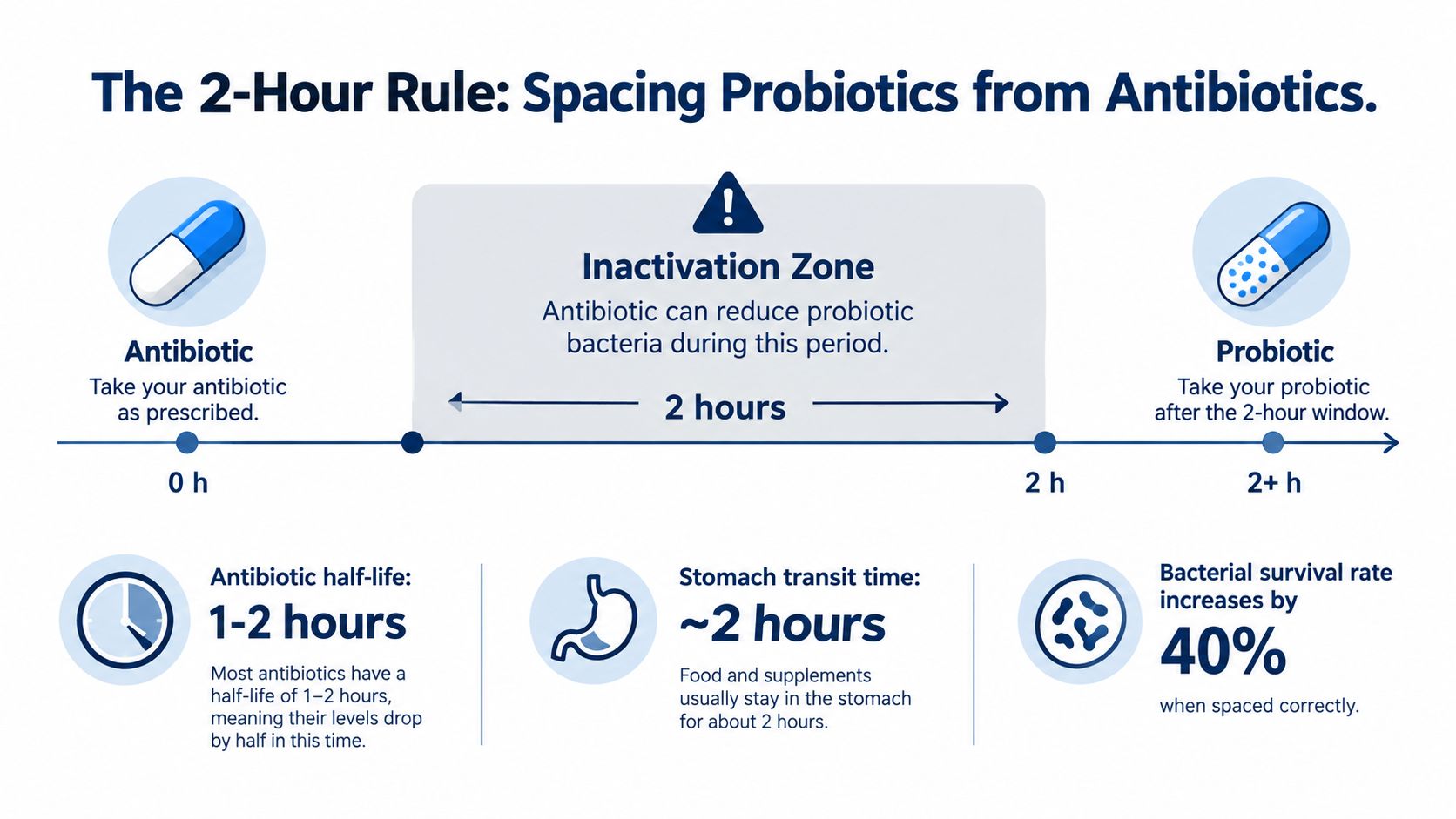
Antibiotics create a different timing problem. A bacterial probiotic taken with an antibacterial dose may encounter the medication before moving through the digestive tract. Separating the doses can reduce direct overlap, but an overly complicated schedule increases the chance of missed doses.
For antibiotic-associated diarrhea prevention, choose a strain-specific product with clinical evidence for the indication. Use this practical protocol:
- Identify the studied strain and dose. Products are not interchangeable because they are labeled “probiotic.”
- Start on the first antibiotic day or within 48 hours. In pooled adult evidence, probiotics reduced antibiotic-associated diarrhea, with a relative risk of 0.62 and a 95% confidence interval of 0.51–0.74. Starting within the first two days performed better than starting later, with relative risks of 0.54 versus 0.79 (NIH Office of Dietary Supplements probiotic fact sheet).
- Separate bacterial probiotics from the antibiotic by about two hours when feasible. A practical interval is 2–3 hours. This spacing reduces direct contact without requiring an impractical dosing routine.
- Continue through the antibiotic course and afterward as directed. Additional use of 7–14 days is commonly tested. The appropriate duration depends on the product, patient risk, and clinician advice.
The exception is Saccharomyces boulardii, a yeast probiotic. Antibacterial antibiotics do not affect it in the same way as bacterial organisms, although the product label and clinician guidance still determine whether it is appropriate.
Keep the schedule simple enough to follow. A delayed probiotic dose does not justify doubling the next one. Resume the planned timing unless the label or prescriber provides different instructions.
Timing Rules for Specific Strains and Formats
The clock is rarely the deciding factor. Strain identity, stomach-acid exposure, delivery system, and label instructions determine whether a probiotic should accompany food, precede it, or be taken independently. “Take with food” is a sensible starting point for many non-enteric-coated bacterial products, not a universal command.
Match timing to the formulation
| Product characteristic | Practical timing question |
|---|---|
| Non-enteric-coated bacterial capsule | Does the label allow it with or shortly before a meal, preferably one containing some fat? |
| Enteric-coated or delayed-release capsule | Is it designed to pass through the stomach before releasing its contents? Follow the manufacturer's instructions rather than adding a personal food rule. |
| Saccharomyces boulardii | Is the yeast formulation relatively unaffected by meal timing or food buffering? |
| Gummies, powders, or liquids | Does the format require refrigeration, mixing, or a particular meal context? |
Laboratory findings indicate that meal timing and food buffering had little effect on Saccharomyces boulardii, while the bacterial product tested performed better with food or shortly before eating. That contrast matters because a schedule suitable for one organism may be inappropriate for another. The foundational probiotic timing study supports the broader point: delivery conditions can matter as much as the hour selected.
Read beyond the headline CFU count. Check the genus, species, strain designation, coating or release system, storage conditions, serving instructions, and expiration guidance. A multi-strain formula is not automatically suited to every digestive concern, and a higher count does not establish that its timing requirements match another product.
Parents and caregivers should also avoid treating adult and child products as interchangeable. Guidance on comparing kids probiotic doses can help frame the label questions, but age, medical history, formulation, and clinician advice still determine the appropriate choice.
For a multi-strain example, the 100 billion CFU Ultimate Probiotic shows why the strain count should be considered alongside delivery format, storage, and the manufacturer's serving instructions. Before buying, check three label lines: strain designation, storage, and serving context. Those details set the schedule, not the clock.
Building a Sustainable Daily Supplement Routine
The best schedule is the one that survives ordinary life. Work changes, travel disrupts breakfast, and some people eat at inconsistent times. A routine that depends on a narrow window can fail even when the underlying timing theory is sound.
Start with an existing behavior, not an aspirational one. Pair the dose with the first meal you reliably eat, placing the product where that meal happens, or set a reminder tied to the same daily event. If the product needs refrigeration, keep the habit anchored to the moment you open the refrigerator rather than leaving the supplement somewhere warm.
Build around constraints
Ask three practical questions:
- Which meal is dependable? Choose breakfast, lunch, or dinner based on your real schedule.
- What does the label require? Separate food, refrigeration, mixing, or medication instructions from optional preferences.
- What happens on a disrupted day? Decide in advance whether you can take the dose with another meal or at the next suitable opportunity.
Consistency isn't a lesser version of precision. In supplement routines, consistency is often what makes the intended schedule possible.
A phone reminder can help during the first part of habit formation, but environmental design is often stronger. Put a shelf-stable product beside a daily item you already use, or keep a refrigerated product at eye level in the refrigerator. Don't store it beside something you rarely touch.
Evaluate the routine based on whether you follow it and tolerate it, not on whether it resembles someone else's morning ritual. If a product repeatedly causes discomfort, conflicts with medication timing, or makes adherence difficult, ask a pharmacist or clinician whether a different strain or format is more appropriate.
Storage Requirements and Common Troubleshooting
A perfect schedule cannot compensate for damaged bacteria. Heat, moisture, and poor handling can reduce product quality, while some freeze-dried or shelf-stable formulations are designed for ordinary room-temperature storage. Follow the label first, because requirements depend on the formulation, packaging, and strain.
Inspect the bottle when it arrives. Confirm that the expiration date is clear, the seal and packaging are intact, and the storage directions match the product description. Refrigerated products should have been handled according to the manufacturer's shipping requirements. A shelf-stable product does not need refrigeration unless its label specifically says so.
Solve the common disruptions
You missed a dose. Do not automatically double the next serving. Resume the labeled schedule with the next dose, unless a healthcare professional advises otherwise.
You're traveling. Keep the product in its original packaging and protect it from temperatures outside the stated range. Shelf-stable products can simplify travel, but they still need protection from excessive heat and moisture. A shelf-stable vaginal probiotic formula is one example of a format designed for easier storage, not a reason to ignore its label.
The product got hot or wet. If storage conditions were clearly exceeded or the packaging was compromised, contact the manufacturer before continuing. Smell and appearance cannot reliably confirm potency.
You're taking antibiotics. If refrigeration makes the probiotic difficult to carry safely, ask a pharmacist whether a shelf-stable option suits your situation. Do not leave a refrigerated bottle in a hot car or transfer capsules into an unmarked container.
You're immunocompromised or critically ill. Seek medical guidance before using a probiotic. Safety depends on the person's health status, and a product appropriate for a healthy adult may not suit someone medically vulnerable.
Storage advice also applies to specialized products. “Shelf-stable” describes handling design, not a guarantee that a product is appropriate for every person. Check the label and obtain relevant medical advice when health conditions or treatment could affect suitability.








Please complete your information below to login.
Sign In
Create New Account