


You're standing in the supplement aisle, comparing a joint formula that pairs MSM with glucosamine and a beauty product that promises support for hair and skin. Both labels make MSM sound useful, but they don't tell you whether the evidence is equally strong for each claim. The short answer is that researchers have mainly studied MSM for knee-joint symptoms, while hair, skin, and exercise-recovery claims are much less established.
MSM may be a reasonable short-term adjunct for some people with mild knee discomfort, but it hasn't been shown to repair cartilage or treat the cause of osteoarthritis. This guide separates what human studies have found from what's mostly a theory or marketing claim, then helps you think through dose, label details, safety, and when to check with a clinician.
Table of Contents
- Why Shoppers End Up Asking About MSM
- What MSM Actually Is and How It Works
- The Joint and Osteoarthritis Evidence
- Hair, Skin, Recovery, and Anti-Inflammatory Claims
- Typical Dosing and How to Read a Label
- Side Effects and the Real Safety Profile
- Medications, Conditions, and Who Should Avoid MSM
- A Short Decision Checklist Before You Buy
Why Shoppers End Up Asking About MSM
MSM often shows up in two very different places: beside glucosamine on a joint-health shelf, or in a product marketed for hair, skin, and nails. A shopper might reasonably wonder whether the same ingredient can help both, and whether either promise is worth paying attention to.
The most evidence-supported use is joint-symptom relief, particularly for knee osteoarthritis and mild knee pain. Researchers have proposed that MSM's sulfur content may influence inflammatory signaling and connective-tissue metabolism. Those mechanisms offer a possible explanation, but they don't prove that taking MSM rebuilds cartilage or changes the course of arthritis.
Beauty and workout claims need a more cautious reading. Sulfur is involved in proteins found in hair and skin, and MSM is marketed for recovery and anti-inflammatory effects. But a plausible biological role isn't the same as evidence that a supplement improves hair growth, skin appearance, or athletic performance.
A useful starting point: Ask what result you're hoping for. Mild knee comfort has some human study data behind it. Hair growth, cartilage regeneration, and performance enhancement aren't established uses.
The practical question isn't, "What is MSM supplement used for?" It's whether the product matches a goal for which there's relevant evidence, whether the dose is reasonable, and whether your health or medications call for professional advice. For some shoppers, MSM may be worth discussing as an optional addition to a joint-care plan. For others, especially those considering it for beauty or recovery, the evidence may not justify the expectation.
What MSM Actually Is and How It Works
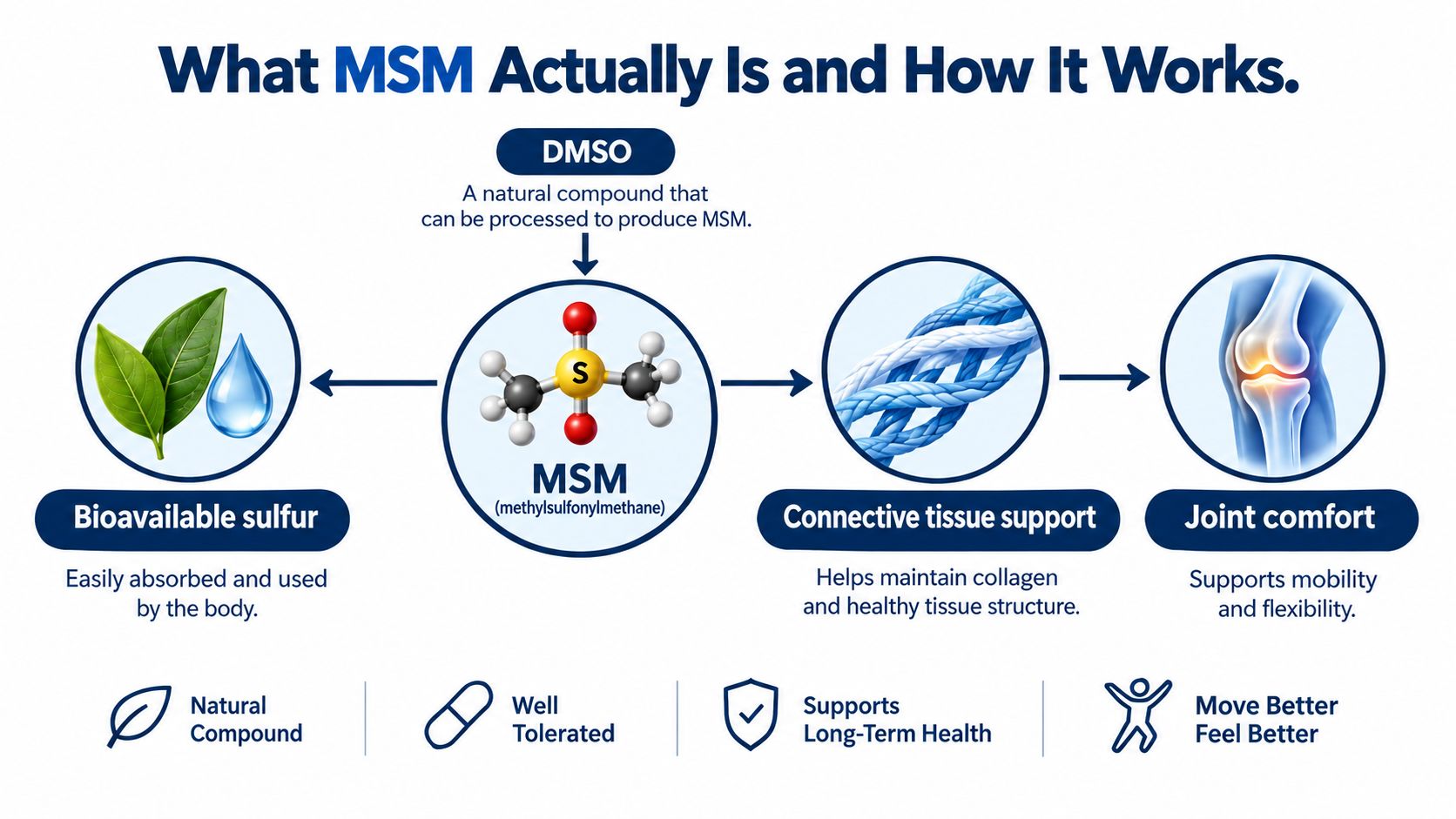
MSM, short for methylsulfonylmethane, is a small sulfur-containing compound. It's related to dimethyl sulfoxide, or DMSO, and is used as an oral dietary supplement. Sulfur is part of several molecules and proteins the body uses, including components associated with connective tissue and normal cellular processes.
A helpful analogy is to think of MSM as a building-supply truck. It can deliver a material the body uses in its everyday work, but delivering supplies doesn't guarantee that a particular structure will be repaired or improved. The body still has to use those materials in complex processes, and a supplement can't promise a specific outcome just because it contains sulfur.
MSM's proposed roles include supplying sulfur for compounds involved in protein structure, supporting pathways related to glutathione, and possibly influencing inflammatory signaling. These are biological explanations researchers consider, not proof that MSM directly creates more cartilage, strengthens hair, or reliably reduces inflammation in people.
Food sources and the supplement question
Sulfur is present in the diet through sulfur-containing amino acids in protein foods, and small amounts of MSM occur naturally in foods such as onions, garlic, and coffee. Supplement products can provide a more concentrated amount than someone would typically get from food, but that doesn't automatically make the added amount beneficial.
For people comparing products or looking for help navigating supplement categories, neutraceuticals at Restore offers a resource to explore alongside advice from a qualified healthcare professional. The central point remains simple: MSM's role as a sulfur-containing compound helps explain why it's marketed for tissues, but it doesn't establish every advertised benefit.
The Joint and Osteoarthritis Evidence
The clearest human research on MSM concerns knee pain and physical function, not cartilage repair. Results suggest that some people may get modest symptom relief, but the studies are small and don't establish MSM as a disease-modifying treatment.
In a randomized, double-blind trial, 50 adults aged 40–76 with knee osteoarthritis took 3 g of MSM twice daily for 12 weeks. Compared with placebo, the MSM group had statistically significant reductions in WOMAC pain and physical-function impairment. Stiffness and total symptom scores didn't change significantly. A separate trial enrolled 49 adults with radiographically confirmed knee osteoarthritis and used 1.125 g three times daily for 12 weeks. Pain and physical function improved, but investigators described the effects as small and uncertain in clinical importance. The studies and review findings are summarized in this systematic review of MSM for osteoarthritis.
| MSM Knee Osteoarthritis Trials at a Glance | Daily MSM dose | Duration | Participants | Main result |
|---|---|---|---|---|
| Randomized, double-blind trial | 6 g | 12 weeks | 50 adults with knee osteoarthritis | WOMAC pain and physical function improved versus placebo; stiffness and total symptom scores didn't change significantly |
| Randomized trial | 3.375 g | 12 weeks | 49 adults with radiographically confirmed knee osteoarthritis | Pain and function improved, but the investigators considered the effects small and uncertain in clinical importance |
| Randomized trial of MSM with or without glucosamine | 1.5 g | Not specified in the available verified data | 118 people with mild-to-moderate osteoarthritis | MSM alone had analgesic and anti-inflammatory effects; the combination with glucosamine showed faster and greater improvements than either ingredient alone |
The table's combination trial tested 500 mg three times daily. Although its findings are encouraging, they don't show that every MSM-and-glucosamine product will produce the same result. If you're comparing ingredient combinations, you can review this glucosamine and MSM joint-support formula as an example of how products pair the two ingredients.
The wider evidence remains limited. A 2008 systematic review identified only two MSM clinical trials involving 168 patients, and it noted methodological limitations and uncertainty about dose and treatment duration. A broader meta-analysis also found a non-significant average pain reduction, with the overall effect neither statistically nor clinically significant. These findings support a measured conclusion: MSM may help some people with knee symptoms, but it's not a proven treatment for osteoarthritis itself.
Exercise therapy, physical therapy, weight management where appropriate, and clinician-directed care remain important parts of joint care. For readers comparing other ingredients, Herbswell's turmeric science overview offers another perspective, but ingredient claims should still be weighed against the quality of human evidence.
Hair, Skin, Recovery, and Anti-Inflammatory Claims
MSM's proposed role in supplying sulfur helps explain its popularity in beauty products. It doesn't prove that an MSM supplement improves hair growth, skin quality, or nail strength. For these outcomes, the evidence presented here is much weaker than the evidence for modest knee-symptom relief.

There is some human research on mild knee discomfort beyond diagnosed osteoarthritis. In a placebo-controlled study, 88 healthy Japanese adults with mild knee pain took 2 g of MSM daily for 12 weeks. Their knee-health questionnaire improved significantly compared with placebo, and the primary outcome also differed significantly. That finding concerns knee comfort. It doesn't establish that MSM improves skin, hair, or exercise recovery.
Match the claim to the evidence
| Claim | What the evidence supports |
|---|---|
| Mild knee discomfort | Some human trial data exists, though it doesn't establish a reliable benefit for everyone |
| Hair and skin support | Sulfur biology gives a possible rationale, but the evidence here doesn't establish a supplement benefit |
| Exercise recovery | MSM is marketed for recovery, but reliable benefits haven't been established |
| Cartilage regeneration | Not proven by the symptom studies described above |
| Broad anti-inflammatory effects | Plausible mechanisms don't amount to proof of a meaningful clinical benefit |
A broader evidence review found a non-significant average reduction in pain, with an overall effect that was neither statistically nor clinically significant. That's a reason to be cautious about broad promises of anti-inflammatory action or performance enhancement. It's also why a product's explanation of a mechanism shouldn't be mistaken for proof of a result.
If you're researching scalp care, this tea tree oil scalp care guide covers a different approach, but it shouldn't be read as evidence for oral MSM. Likewise, a hair, skin, and nails product containing MSM reflects how the ingredient is marketed, not proof that MSM itself improves those outcomes.
The video below is another overview to consider alongside the limits of the clinical evidence.
Typical Dosing and How to Read a Label
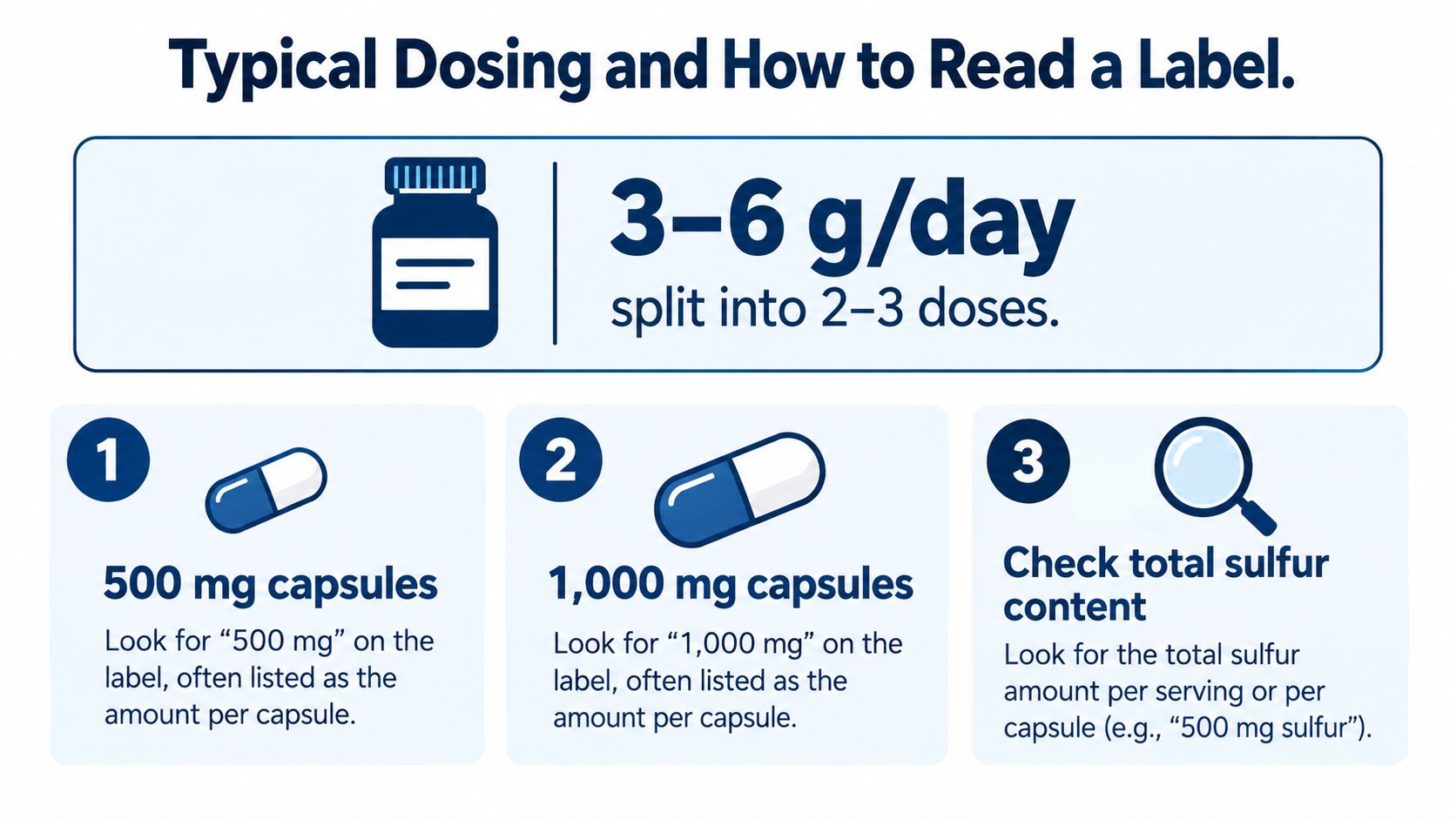
The MSM regimens described in osteoarthritis research commonly fall around 3.4 to 6 g per day for 12 weeks. That's a description of studied regimens, not a personal prescription or proof that everyone needs that amount. The studies don't show that a higher dose works better.
Start with the serving size and total daily MSM, not phrases such as “maximum strength.” A label might list the amount per capsule, tablet, scoop, or serving. Check how many units make up a serving, then calculate how much MSM you'd take in a day according to the label.
A practical label check
- Confirm the ingredient amount. Look for the quantity of MSM itself, rather than relying on the product's front-label claims.
- Check the serving calculation. If a serving requires multiple capsules or scoops, account for all of them before comparing products.
- Compare with the research range. Studied joint regimens commonly used roughly 3.4–6 g per day, but more isn't known to be better.
- Choose a form you can use consistently. Capsules are convenient to portion; powder lets you measure a serving, but requires careful preparation.
- Ask about duration and timing. Trial regimens commonly lasted 12 weeks. Ask a clinician or pharmacist whether to take a product with food, especially if you have digestive symptoms or use medications.
Practical rule: A larger number on the front of a bottle doesn't mean stronger evidence. The label tells you what's in the product, not whether it's likely to work for your goal.
Side Effects and the Real Safety Profile
“Natural” doesn't mean risk-free. Reported MSM adverse effects include digestive upset, skin rash, and allergic reactions. Trial reports have also included mild gastrointestinal effects and occasional symptoms such as insomnia, headache, fatigue, or difficulty concentrating. Those reports don't prove MSM commonly causes these symptoms, but they're a reason to pay attention to how you feel after starting it.
A 16-week study using 6 g per day found no significant differences from placebo in white-cell count, platelets, liver enzymes, creatinine, weight, or blood pressure. That provides some short-term laboratory reassurance for the people studied. It doesn't establish safety during pregnancy or breastfeeding, for people with kidney or liver disease, alongside every medication, or with prolonged high-dose use. The NCCIH information on MSM and osteoarthritis advises consulting a healthcare provider because safety research is limited.
When to stop and ask for help
If you develop a rash or significant digestive symptoms, stop taking the supplement and contact a healthcare professional. Don't try to push through symptoms by changing the dose on your own. Seek advice before continuing if symptoms persist, feel unusual, or coincide with a new medication or treatment.
Some trials describe MSM as generally well tolerated, but tolerability isn't the same as proof of safety for everyone. People with chronic conditions, people taking multiple medications, and anyone considering long-term use should discuss the product and its dose with a clinician or pharmacist. Bring the actual bottle or a clear photo of its Supplement Facts panel so the professional can review the ingredients and serving size.
Medications, Conditions, and Who Should Avoid MSM
The available safety information doesn't establish that MSM is safe for every health condition or medication combination. If you're pregnant or breastfeeding, have kidney or liver disease, or take multiple medications, ask a healthcare professional before using it. Safety research is limited in these situations, so a clinician can help weigh your circumstances rather than assuming that a supplement is suitable.

The available verified evidence doesn't establish specific interactions between MSM and warfarin, other anticoagulants, blood-pressure medicines, diabetes drugs, or topical DMSO. Don't assume that the absence of an established interaction means a combination is safe for you. Ask a pharmacist or prescriber to review your medication list, including topical products and supplements.
Bring the full picture to your clinician
Before adding MSM, tell your clinician or pharmacist:
- The exact product and dose. Bring the bottle or show the full label, including other active ingredients.
- Your medication and supplement list. Include prescriptions, over-the-counter products, herbal supplements, and topical DMSO if you use it.
- Relevant health conditions. Mention kidney or liver disease, a history of allergic reactions, pregnancy or breastfeeding, and any planned treatment or surgery.
- What you hope it will do. Explain whether you're considering MSM for knee discomfort, hair or skin, or another reason.
If you have a known sulfur allergy or a history of reacting to the product, seek medical advice before using MSM rather than testing it on your own. For surgery or a new treatment, disclose all supplements to the care team and ask what to stop and when. A specific review of your situation is more useful than a blanket assurance that MSM is safe or unsafe.
A Short Decision Checklist Before You Buy
Before purchasing, check that your goal is mild joint comfort, not hair growth, cartilage repair, or athletic performance. Compare the product's stated daily MSM amount with the studied range discussed above, and look for clear disclosure of MSM per serving. Plan any trial with a clinician rather than taking the product indefinitely.
- Check quality information. Look for transparent ingredients and information about independent testing.
- Set a review point. The joint studies commonly lasted 12 weeks, but that doesn't mean everyone should take MSM for that long without advice.
- Know when to stop. A rash, significant or persistent digestive symptoms, an upcoming procedure, or a change in medication calls for a stop-and-check conversation.
- Keep core care in place. MSM shouldn't replace exercise therapy, physical therapy, weight management where appropriate, or clinician-directed treatment.
If you're comparing joint products, this glucosamine sulfate joint-support option is one example to evaluate by its label and your needs. See a clinician if joint pain persists, you develop swelling, or your range of motion is limited.
Supplemynts Inc is an online retailer of vitamins, minerals, herbs, proteins, and other wellness products, with categories that include joint support. If you're comparing supplement labels or browsing options for a specific wellness goal, visit Supplemynts Inc to explore its product categories and support information.







Please complete your information below to login.
Sign In
Create New Account