


You've settled into eating plant-based meals, but lately you're unusually tired. Your concentration feels patchy, and sometimes your fingers get pins and needles. You wonder whether it's stress, poor sleep, or something missing from your diet.
Vegan vitamin B12 deficiency symptoms deserve attention, but they aren't a diagnosis. The useful response is neither panic nor guessing which supplement to buy. It's understanding why B12 matters, recognizing signs that need medical attention, and checking whether your daily routine provides a dependable source.
Table of Contents
- Why Vegans Need to Pay Attention to B12 From Day One
- What Vitamin B12 Actually Does in the Body
- How Common B12 Deficiency Really Is in Vegans
- The Symptom Clusters Vegans Should Recognize
- Why Normal Blood Work Can Still Miss Early Deficiency
- Preventing Deficiency Through Smart Supplementation
- Questions Vegans Commonly Ask About B12
Why Vegans Need to Pay Attention to B12 From Day One
A newly vegan eater might carefully plan beans, vegetables, whole grains, and nuts while assuming that a varied diet covers everything. That's an understandable assumption. B12, however, needs a separate plan.
Natural vitamin B12 occurs mainly in animal foods, so people who exclude those foods depend on fortified foods or supplements. This isn't a judgment about vegan eating. It's a practical difference between choosing nutritious plant foods and making sure your diet supplies this particular vitamin.
A nutritious diet still needs a B12 source
Consider a typical meal of lentils, brown rice, vegetables, and tahini. The relevant B12 question isn't whether the meal looks balanced. It's whether anything you regularly eat has B12 deliberately added, or whether you take a B12-containing supplement.
A useful routine check includes:
- Your actual source: Identify a supplement or food label that specifically lists vitamin B12.
- Your consistency: Think about what you consume, not what you bought intending to use.
- Your previous intake: Tell your clinician if you were already eating few animal foods before becoming vegan.
- Your symptoms: Record unexplained changes rather than assuming they're part of adjusting to a new diet.
Feeling well is encouraging, but it's not a substitute for checking your intake. Equally, feeling tired doesn't prove that your vegan diet has caused a deficiency. Keeping those ideas separate helps you respond sensibly.
Prevention and treatment are different decisions
A prevention routine is something you establish before there's evidence of a problem. Treatment is a medical decision made after considering symptoms, testing, and the circumstances behind a possible deficiency.
You might encounter information about injections while searching for answers. ProMD Health Tysons Corner's explanation of what B12 shots treat can help you prepare questions about that option, but a treatment page shouldn't replace an assessment of your own needs.
Practical rule: Make B12 part of your vegan routine from the beginning. Don't use the arrival of symptoms as your reminder to start planning.
For now, your most useful action is simple: locate your B12 source and check how consistently you use it. If you have symptoms, bring that information to a clinician rather than treating a dietary change as proof of the cause.
What Vitamin B12 Actually Does in the Body
B12, also called cobalamin, supports processes that affect both blood cells and nerves. Inadequate intake can impair DNA synthesis and maintenance of myelin, the insulating material around nerves, as described in the NIH explanation of B12's roles and deficiency effects.
Think of a cell as a workshop with several production lines. B12 isn't the finished product or a general-purpose fuel. It's more like an essential tool that workers need to complete particular jobs properly.
Blood cells and nerve insulation
DNA synthesis is the process cells use to make their genetic material. When B12-dependent processes aren't working properly, the body can have difficulty producing normal blood cells. This helps explain why deficiency can affect blood counts rather than making someone feel vaguely unwell.
Myelin maintenance is a different job. Myelin surrounds nerves much as insulation surrounds an electrical wire. This analogy isn't a complete description of nerve biology, but it helps explain why a nutrient deficiency can affect sensation, movement, or coordination.
The illustration below connects B12's functions with food sources and possible signs of deficiency.
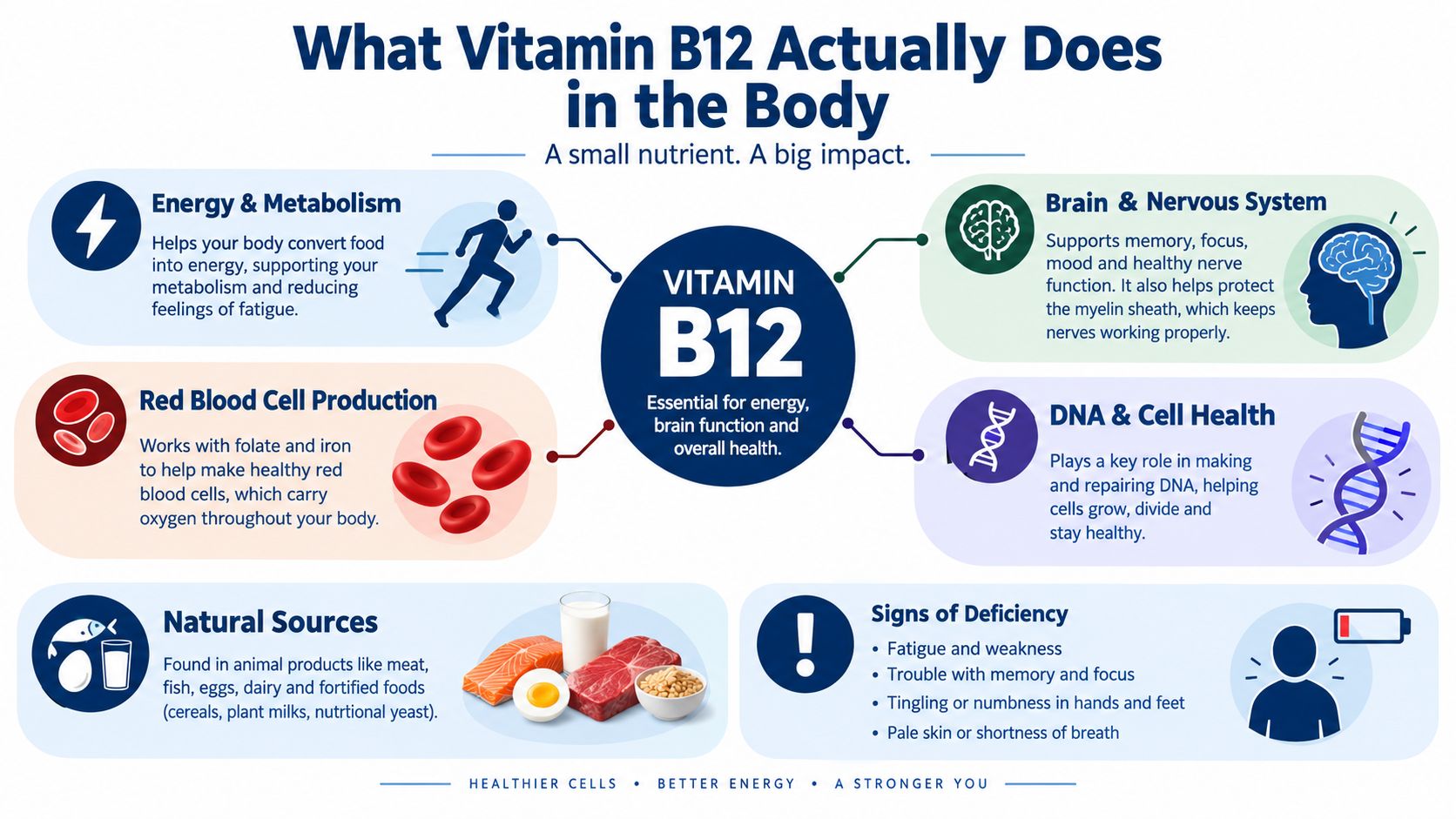
These jobs are related, but they aren't interchangeable. A blood test that examines blood cells answers a different question from an examination that evaluates sensation or balance.
Understanding energy claims
Because fatigue can accompany deficiency, B12 is often marketed around energy. Don't reverse that relationship: a symptom associated with low B12 doesn't establish that B12 will fix every instance of that symptom.
If you're reading ProMD Health Easton's guide to B12 injection energy, use it to frame questions about whether a proposed treatment addresses a confirmed need. Product descriptions and treatment claims shouldn't decide the cause of your fatigue.
The same distinction applies to oral products. A listing such as NOW B-12 lozenges for nervous system health identifies a supplement option, not a diagnostic test or an individualized treatment plan.
Keep these questions separate:
- Biology: What does the body need B12 to do?
- Diagnosis: Is inadequate B12 contributing to my symptoms?
- Management: Which approach fits my intake, test results, and medical circumstances?
That separation helps you understand the nutrient without expecting a product to answer a medical question.
How Common B12 Deficiency Really Is in Vegans
There isn't one deficiency percentage that describes every vegan. Research includes people with different diets, supplement habits, ages, and testing methods. Combining those groups into a single headline can make the findings sound more certain than they are.
A 2022 review of B12 status in plant-based populations reported published deficiency estimates ranging from 0% to 86.5% among vegetarian adults and older adults, 0% to 33.3% among children and adolescents, up to 45% among infants, and 17% to 39% among pregnant women following vegetarian diets. These are ranges across studies, not a prediction of what will happen to an individual reader.
Why the estimates vary so much
The review's reported range reflects differences in testing methods, duration of the diet, supplementation, and the populations studied. Vegetarian and vegan are not equivalent categories: a vegetarian participant may eat animal foods that a vegan participant excludes.
That means you should ask several questions before interpreting a prevalence figure:
- Who was included? Adults, children, pregnant people, and older adults shouldn't be treated as one interchangeable population.
- How was deficiency defined? Different laboratory approaches can identify different groups of people.
- Were participants supplementing? Regular supplementation changes the meaning of a diet-based risk estimate.
- What did they eat? A dietary label doesn't describe fortified-food intake or the consistency of a person's routine.
A study of people who rarely use B12 supplements doesn't tell you the exact risk for someone following a dependable supplementation plan. Likewise, a reassuring estimate in one supplemented population doesn't mean every plant-based eater can ignore B12.
Childhood and pregnancy need particular care
The same review also cited a U.S. analysis in which deficiency was more frequent among children who had followed a vegetarian diet throughout life than among other vegetarian children. It identified vegan status and starting a plant-based diet from birth as higher-risk circumstances.
Those findings support extra attention during pregnancy, infancy, and childhood. They don't support applying adult supplement habits to a child or assuming that a family's shared meals meet everyone's needs.
Risk isn't destiny. The useful takeaway is to check the reliability of B12 intake, not to assume that every vegan will become deficient.
For a newly vegan adult, the practical interpretation is reassuring but specific. You can address the dietary availability issue deliberately. If you're pregnant, planning pregnancy, or feeding a child a vegan diet, make the B12 plan part of professional nutrition or medical guidance rather than relying on general advice aimed at adults.
The Symptom Clusters Vegans Should Recognize
A grouped symptom list is more useful than a long checklist because it helps you describe what's changed. You might notice reduced stamina, altered sensation, or trouble concentrating. Those experiences belong in a clinical conversation, but none proves B12 deficiency by itself.
The NIH Office of Dietary Supplements symptom guidance identifies blood-related, neurological, cognitive, and digestive manifestations. The categories below translate that guidance into plain language.
Use this visual as an orientation aid, not as a self-diagnostic checklist.
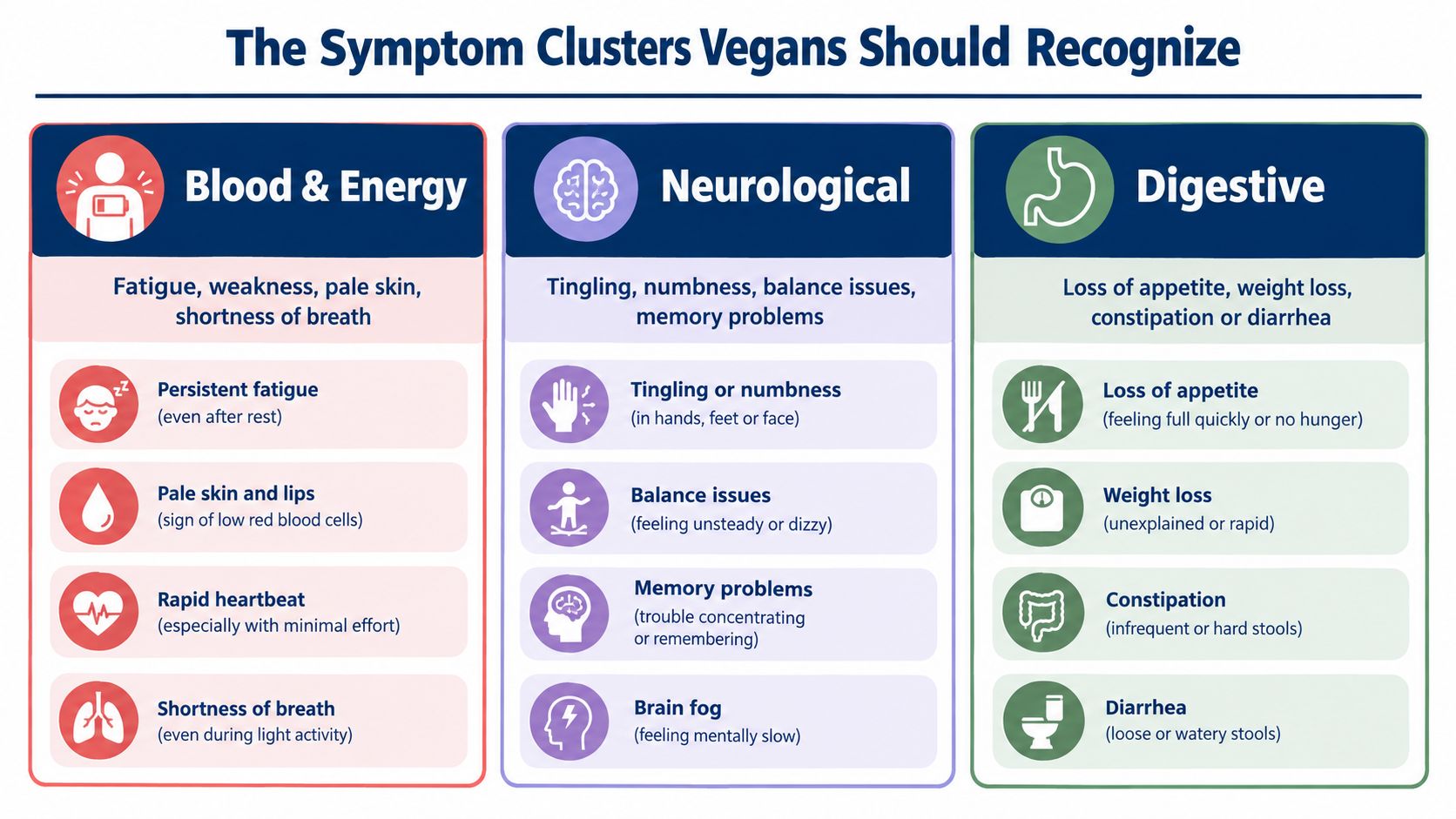
Blood and energy changes
Possible manifestations include fatigue, weakness, pale skin, heart palpitations, low blood-cell counts, and megaloblastic anemia. Megaloblastic anemia describes abnormal blood-cell development associated with impaired DNA synthesis.
In everyday language, you might say you feel unusually drained or that ordinary activities feel harder than they used to. That description is useful, but fatigue has many possible explanations. A clinician needs to interpret it alongside your history and test results.
Don't automatically reach for an iron product because tiredness sounds like anemia. A combination listing such as MegaFood Blood Builder with iron, folic acid, and vitamin B12 isn't evidence that you need every ingredient it contains.
Sensation, strength, and balance changes
Neurological symptoms can include numbness or tingling in the hands and feet, muscle weakness, and balance or walking changes. Neurological symptoms can occur without prominent anemia, so looking healthy or having no obvious pallor doesn't make these changes unimportant.
Be concrete when reporting them. Describe whether the sensation affects fingers, toes, or a larger area, whether it's new, and whether you've noticed a change in walking or coordination. Don't assume that every episode of pins and needles has the same cause.
New tingling, numbness, balance changes, or cognitive symptoms warrant prompt medical assessment rather than watchful waiting. Prolonged B12 deficiency can cause neurological injury that remains persistent or only partly reversible.
For an additional explanation, you can watch the video below, while keeping your own symptoms and assessment separate from general educational material.
Thinking, mood, mouth, and appetite changes
The NIH also lists depression, confusion, poor memory, and dementia among possible neurological or cognitive manifestations. Anxiety can also occur in the clinical pattern of deficiency described in its guidance.
Mouth and digestive signs include glossitis, meaning an inflamed or sore tongue, appetite loss, and weight loss. A person might describe concentration problems as brain fog, but that everyday term isn't specific enough to identify the cause.
You don't need to experience every cluster before asking for help. Bring the pattern you notice, including when it began and whether it's affecting daily activities. Avoid adding symptoms to your account because they appeared on a checklist.
Why Normal Blood Work Can Still Miss Early Deficiency
You've been told that your blood count looks normal, but you still have concerning symptoms. The next question isn't whether the laboratory made a mistake. It's what that particular test can and can't tell you.
A complete blood count, or CBC, evaluates blood cells. A serum B12 measurement evaluates circulating B12. Neither should be interpreted in isolation when symptoms and dietary history raise concern.
Circulating B12 and functional deficiency
Functional deficiency means there may be inadequate B12 activity in the body's biochemical processes, rather than only a low intake reported on paper. The Merck Manual discussion of B12 diagnosis and functional markers supports evaluating symptoms alongside laboratory findings, particularly when serum B12 is borderline.
A borderline result isn't automatically reassuring, and a concerning symptom isn't automatically proof of deficiency. The clinician's job is to decide whether additional testing would clarify the situation and whether another explanation needs investigation.
| Test | What it helps assess | Important limitation |
|---|---|---|
| CBC | Blood-cell changes associated with anemia | Doesn't independently assess nerve function |
| Serum B12 | Circulating vitamin B12 | Can be insufficient as a standalone assessment |
| Methylmalonic acid, or MMA | Biochemical evidence supporting functional deficiency | Kidney disease can also raise it |
| Homocysteine | A biochemical marker that may rise with deficiency | Can rise with either B12 or folate deficiency |
| Holotranscobalamin | An additional B12 marker where available | Needs interpretation within the broader clinical assessment |
The caveats matter. A raised MMA result doesn't let you ignore kidney function, and a raised homocysteine result doesn't establish that B12 is the only relevant nutrient.
Preparing for a useful appointment
If you have symptoms despite a normal CBC or borderline serum B12 result, ask whether functional testing would add useful information. You don't need to demand every test in the table. Ask what question the clinician is trying to answer and how the result would change your care.
Bring practical details:
- Your dietary pattern: Explain what you exclude and which fortified foods you regularly consume.
- Your supplements: Bring the label or a photo, including how consistently you take the product.
- Your symptom history: Note the location, timing, and effect on daily activities.
- Your previous results: Share the actual report if available, rather than recalling only that it was normal.
Screening identifies possible concerns; diagnosis requires interpretation. If neurological symptoms are present, don't spend weeks comparing laboratory cutoffs online or trying different products before seeking medical assessment.
Preventing Deficiency Through Smart Supplementation
The most workable prevention plan is one you can follow consistently and explain clearly. It should identify your B12 source, how you use it, and how you'll review the plan if your needs change.
Don't choose a schedule solely because a product has a large number on the front label. Prevention dosing and treatment dosing aren't interchangeable, and an individualized recommendation is more useful than copying another person's routine.
Choose a routine you can maintain
Some people find a daily habit easier to remember. Others prefer a less frequent schedule chosen with professional guidance. Fortified foods can contribute, but check that the specific product lists B12 rather than assuming that all plant milks, cereals, or nutritional yeasts contain it.
Common B12 Supplementation Approaches for Vegans
| Form | Typical Frequency | Notes |
|---|---|---|
| Oral tablet or capsule | Daily or a clinician-selected schedule | Review the B12 content and serving instructions |
| Lozenge | According to the chosen product and plan | Treat it as a supplement format, not proof of superior treatment |
| Fortified foods | As part of regular meals | Verify B12 on each product's label |
| Injection | A medically determined schedule | Discuss the reason for choosing injections with the treating clinician |
Build the routine around a dependable cue, such as breakfast or another established habit. Keep a record of the product you use so that a clinician can assess your intake without guessing.
If you repeatedly forget a supplement, treat that as a planning problem rather than a personal failure. Change the reminder, storage location, or agreed schedule instead of assuming that occasional use is equivalent to a consistent plan.
Read the whole label
You may encounter cyanocobalamin and methylcobalamin on labels. Don't select a product based only on which name sounds more natural or advanced. Ask whether its B12 content and directions fit your intended use.
Combination products require an extra check. For example, NOW Folic Acid with Vitamin B12 vegan tablets contain more than one nutrient, so review the complete formula rather than choosing solely because B12 appears in the name.
Pregnancy, infancy, childhood, older age, and a history of prolonged low intake deserve an individualized discussion. Don't transfer an adult routine to an infant or child, and don't assume that a prevention product is sufficient treatment for an established deficiency.
If injections come up during that discussion, ProMD Health Washington, DC's science-backed B12 shot insights can provide questions to bring to your clinician. Keep the decision tied to your clinical situation, not to a general promise of energy or wellness.
A good plan leaves you able to answer plainly: what's my source, how do I use it, and who should I contact if symptoms develop or persist?
Questions Vegans Commonly Ask About B12
How quickly will symptoms improve?
Don't judge treatment by a fixed deadline. Ask your clinician what improvement to expect and when to review persistent symptoms, especially neurological changes.
Can changing my diet fix deficiency?
Adding a reliable B12 source addresses intake, but suspected or confirmed deficiency needs a treatment plan. Don't assume that eating more varied plant foods resolves it.
Can I use oral supplements if I have nerve symptoms?
Don't choose the route yourself based on a product page. A clinician should assess the symptoms and decide which treatment approach is appropriate.
When should I seek medical help promptly?
Seek prompt assessment for new neurological symptoms, particularly walking changes, significant numbness, or confusion. Symptoms in an infant or during pregnancy also warrant professional evaluation rather than self-treatment.
Supplemynts Inc offers dietary supplements and wellness products, including vegan-labeled options organized by category and health purpose. Visit Supplemynts Inc to compare labels and find a B12 product that fits the plan you've discussed with your clinician, with free continental U.S. shipping and a 60-day return policy.







Please complete your information below to login.
Sign In
Create New Account