


That heavy, sluggish feeling after a meal can be frustrating, especially when the meal looked healthy on paper. A large serving of beans, cruciferous vegetables, whole grains, or a dairy-free alternative may leave you with pressure, gas, or the sense that digestion has halted.
Vegan digestive enzyme supplements can sound like an obvious answer, but they aren't a universal bloating remedy. The useful question isn't, “Which blend supports digestion?” It's, “Which enzyme targets the food or symptom causing my problem, and does the label prove that the product contains an effective amount?”
Table of Contents
- Understanding Vegan Digestive Enzyme Supplements
- Key Enzyme Types and Their Vegan Sources
- What the Evidence Actually Says About Benefits
- How to Read Supplement Labels Like a Pro
- Dosing, Timing, and Safety Considerations
- Choosing the Right Product at Supplemynts Inc
Understanding Vegan Digestive Enzyme Supplements

Digestive enzymes are proteins that break food into smaller components so your body can absorb nutrients. Your saliva, stomach, pancreas, and small intestine produce enzymes naturally, including enzymes involved in breaking down carbohydrates, fats, proteins, and lactose. Supplementation adds enzymes from an outside source, but that doesn't automatically mean your body needs a broad blend.
“Vegan” describes the source and manufacturing standard, not the product's strength or suitability for a particular symptom. A vegan formula avoids animal-derived ingredients such as pancreatin, which is commonly associated with pancreatic enzyme replacement, and instead may use enzymes extracted from fruit or produced through microbial fermentation. Plant-derived enzymes include bromelain from pineapple and papain from papaya, while fungi and purified yeasts can provide enzymes such as amylase, protease, lipase, and lactase. Mayo Clinic Proceedings describes the types of enzymes used in plant-based formulations and the food components they may target00520-5/fulltext).
Why plant-based diets can create specific challenges
A vegan meal often contains more beans, lentils, vegetables, whole grains, nuts, and seeds. Those foods provide valuable nutrients, but they can also contain fermentable carbohydrates, complex starches, fiber, and phytic acid. If a product contains the right enzyme for the relevant food component, it may support more complete digestion before fermentation creates gas.
That distinction matters. A product with lactase won't address gas from chickpeas, and a product with protease won't break down lactose. A long ingredient list may look thorough while offering little help for the meal that causes your symptoms.
What to expect from a supplement
Think of vegan enzymes as meal-specific tools, not a replacement for medical assessment. They may be useful when a clear food trigger exists, but they won't diagnose food intolerance, repair an underlying condition, or guarantee relief from unexplained abdominal discomfort.
Practical rule: Start with the food you struggle to digest, then choose the enzyme that matches it. Don't start with the most crowded ingredient panel.
Key Enzyme Types and Their Vegan Sources
The ingredient panel becomes much easier to understand when you connect each enzyme with its target. Plant and microbial sources can be useful for vegan shoppers, but the source alone doesn't tell you whether a product will work for your concern. The enzyme, activity level, timing, and food target all matter.
Fruit-derived enzymes
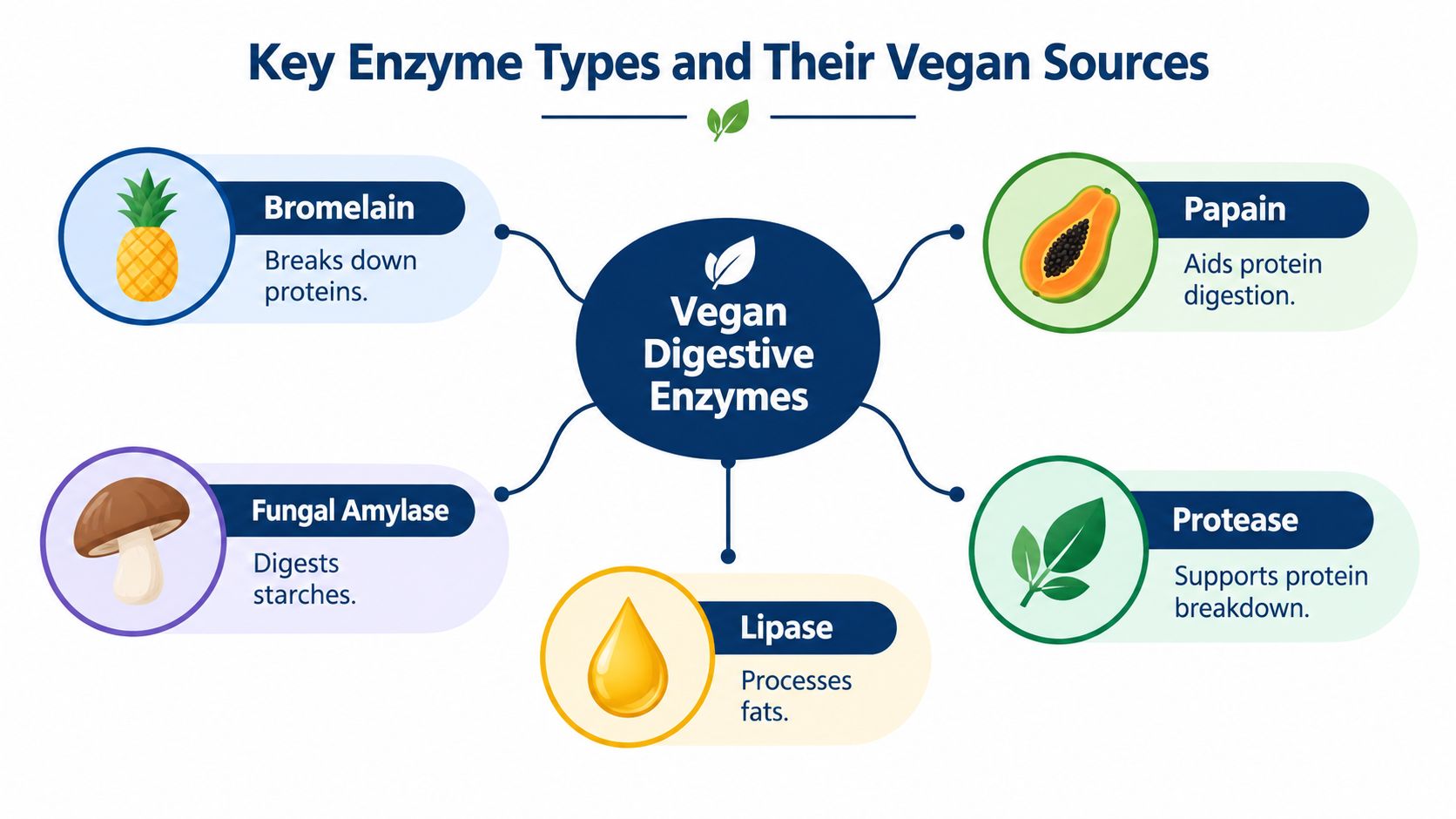
Bromelain comes from pineapple and is primarily included for protein digestion. Papain, sourced from papaya, has a similar role. These enzymes may appeal to people who prefer recognizable plant sources, although a fruit-derived ingredient isn't automatically more effective than a carefully produced microbial enzyme.
Fungal-derived protease also targets proteins. It may appear alongside bromelain or papain in a broad formula designed for meals containing tofu, tempeh, seitan, legumes, or other protein-rich foods. A label that lists several protein-digesting enzymes still needs to show meaningful activity information, not just a combined weight.
Carbohydrate and starch support
Amylase helps break down starches. A fungal-derived amylase may be included for meals built around rice, potatoes, bread, pasta, grains, or starchy vegetables. Cellulase is used to target certain components of plant cell walls, while phytase acts on phytic acid, a compound found in foods such as grains, legumes, nuts, and seeds.
Alpha-galactosidase deserves special attention for bean-heavy diets. Beans and some vegetables contain oligosaccharides that can reach the colon without being fully digested, where gut bacteria ferment them and produce gas. A product containing alpha-galactosidase is more logically matched to this situation than a generic “detox” or “daily bloating” blend.
Specialty enzymes
Lactase breaks down lactose, the sugar in dairy milk. Some vegan supplements use lactase produced by purified yeasts or fungi, which can suit people who avoid animal-derived ingredients while still needing support for accidental dairy exposure or meals containing milk ingredients. A vegan label doesn't mean a product can digest every dairy alternative, because almond, oat, soy, and coconut beverages contain different ingredients from dairy milk.
Lipase targets fats, and protease targets proteins. A formula containing amylase, lipase, protease, cellulase, alpha-galactosidase, phytase, and lactase may cover several food categories, but that breadth can also make it harder to know which ingredient is doing the work. For a product example, you can review the ingredient positioning of NOW Plant Enzymes and compare its listed enzymes with your own meal triggers.
Read the label before assuming that “plant enzymes” means fruit-derived enzymes. Microbial fermentation can produce vegan enzymes too, and those may offer useful stability across the changing pH conditions of digestion.
What the Evidence Actually Says About Benefits
The strongest reason to be cautious is that not all digestive symptoms come from a lack of digestive enzymes. Prescription pancreatic enzymes are an established treatment for diagnosed pancreatic insufficiency and related digestive disease. Over-the-counter blends are different products, with different levels of evidence and less consistent information about dose, activity, and clinical outcomes. A review of digestive enzyme supplementation discusses the established role of prescription pancreatic enzymes and the more limited evidence for common over-the-counter uses.
That doesn't make vegan supplements useless. It means the benefit is more credible when the enzyme matches a defined food component.
Where a targeted approach makes sense
Lactase is the clearest example of matching an enzyme to a trigger. If lactose causes symptoms, a lactase product is more rational than a broad formula containing unrelated enzymes. The same principle applies to alpha-galactosidase and gas associated with beans or certain vegetables. These choices don't prove that every product will work, because activity and timing still matter, but they give you a specific mechanism to evaluate.
For protein-heavy meals, bromelain, papain, or protease may appear relevant. For starch-heavy meals, amylase is the more logical ingredient. Lipase may be included for fat digestion. Those associations help you read a label, but they shouldn't be turned into promises that a capsule will prevent all discomfort after eating.
Where marketing gets ahead of evidence
Claims about broad gut health, routine bloating, heartburn, or improved nutrient absorption often sound stronger than the available evidence. A healthy person with occasional post-meal fullness may respond to an enzyme, may respond to a smaller portion, or may have a trigger unrelated to enzyme activity. Harvard Health Publishing notes that over-the-counter digestive enzyme supplements aren't regulated like drugs and that evidence for routine heartburn relief is limited.
The useful test is specific: Does the product contain the enzyme your meal requires, in a disclosed activity level, and does your symptom reliably follow that food?
Persistent diarrhea, unexplained weight loss, bleeding, severe pain, recurrent vomiting, or symptoms that wake you at night deserve medical attention rather than repeated supplement trials. Irritable bowel syndrome, functional dyspepsia, lactose intolerance, and pancreatic disorders can overlap in how they feel, but they don't have the same cause or treatment.
How to Read Supplement Labels Like a Pro
A professional-looking bottle can still leave out the information you need. Start with the Supplement Facts panel, then inspect the serving instructions, source statement, allergen information, testing claims, and manufacturer details.
The most important distinction is between ingredient weight and enzyme activity. A label may state that it contains a certain weight of bromelain, but weight doesn't tell you how much enzymatic work that ingredient can perform. Activity units, such as GDU for protease or DCU for cellulase, are more useful because they describe function rather than mass. Units aren't directly interchangeable across different enzymes, so compare the same enzyme using the same type of activity measurement.
A practical label comparison
| Feature | What It Means | Why It Matters |
|---|---|---|
| Named enzyme source | The label identifies pineapple, papaya, fungi, yeast, or another origin | You can confirm whether the formulation fits your vegan requirements |
| Activity units | The product reports functional enzyme activity | You have more useful potency information than a weight-only claim |
| Full blend disclosure | Individual enzymes and amounts are listed | You can match the formula to beans, lactose, starch, protein, or fat |
| Third-party testing | An independent organization or laboratory checks specified qualities | This can provide additional assurance about identity or contaminants |
| GMP manufacturing | The manufacturer follows recognized production controls | It supports consistency, though it doesn't prove that the product will relieve your symptom |
| Allergen statement | The label identifies relevant allergens and facility information | It helps shoppers avoid ingredients or cross-contact that matter to them |
| Clear directions | The serving size and meal timing are easy to find | You can use the product as formulated instead of guessing |
A product that says “proprietary digestive blend” without individual amounts gives you less control. It may contain useful ingredients, but you can't tell whether the formula emphasizes lactase, alpha-galactosidase, protease, or something else. A long list also isn't a substitute for a disclosed activity level.
Vegan doesn't answer every quality question
A vegan certification or clear vegan statement addresses animal-derived ingredients, but it doesn't automatically confirm potency, stability, allergen controls, or third-party testing. Look for source transparency, activity units, lot or expiration information, and a manufacturer willing to explain its testing process.
For a product that combines digestive enzymes with other ingredients, Zenwise Daily Digestive Enzymes can serve as a label-reading example. Review what the formula lists, which components have individual quantities, and whether the product's stated purpose fits your actual concern.
Dosing, Timing, and Safety Considerations
Use digestive enzymes with the meal they are intended to support, following the product's directions. Taking a capsule long after eating may not provide the same practical benefit as taking it immediately before or with the first part of the meal, depending on the formulation.
Start with the label's lowest suggested serving when the product allows that choice. Test it with a familiar meal rather than combining it with several new foods, probiotics, fibers, or herbal products at once. That makes it easier to identify whether the supplement helps, causes irritation, or has no noticeable effect.
A sensible first-use routine
- Choose one target: Test a product for a defined concern, such as bean-related gas or lactose exposure.
- Use it consistently: Follow the serving instructions for comparable meals instead of changing the amount each time.
- Track the context: Note the food, portion, timing, symptoms, and any other supplements used.
- Stop if it causes problems: Abdominal pain, nausea, diarrhea, constipation, rash, or mouth irritation are reasons to discontinue and seek advice if symptoms persist.
- Review the result: If there is no meaningful change after a reasonable label-directed trial, don't keep escalating blindly.
Bromelain and papain may be unsuitable for people with allergies to their source foods or related plants. Enzyme products can also contain additional herbs, probiotics, sweeteners, or excipients that create the actual problem. Check the full panel rather than focusing only on the word “vegan.”
Ask a pharmacist or clinician before using an enzyme supplement if you're pregnant, managing a diagnosed digestive disorder, preparing for a procedure, or taking prescription medicines. People who have been prescribed pancreatic enzymes should not replace that treatment with an over-the-counter vegan blend. If you miss a dose, don't double the next serving. Instead, return to the product's normal directions with the next relevant meal.
Choosing the Right Product at Supplemynts Inc
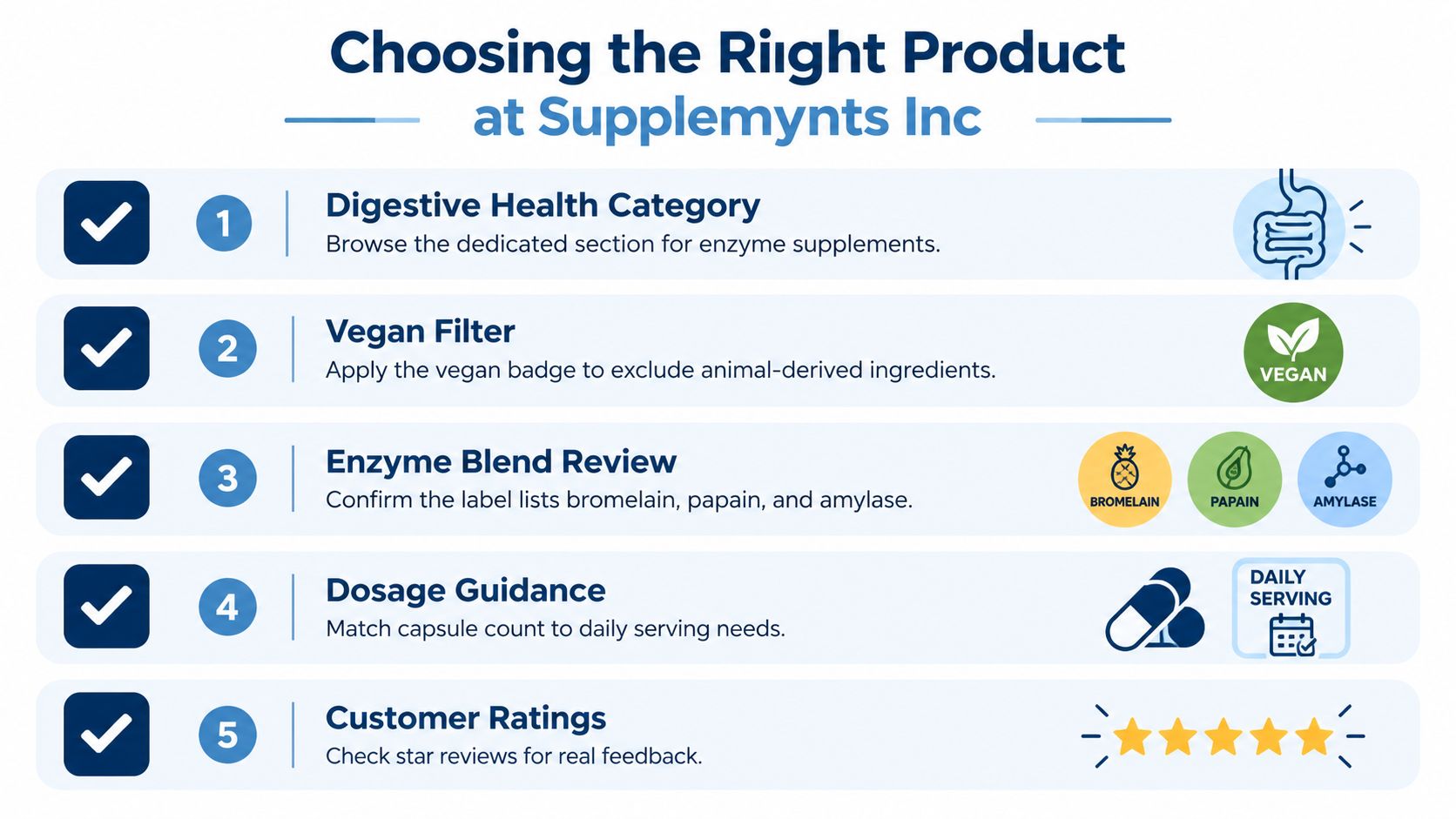
Shopping becomes easier when you treat the store's categories and filters as research tools rather than as a shortcut to the largest blend. Start in the digestive health category, apply the vegan filter, and then compare products by their actual enzyme panels. A purpose-based collection can narrow the options, but the final choice should still come from the ingredient and activity information.
Match the product to the problem
If beans, lentils, or certain vegetables trigger gas, look for alpha-galactosidase. If lactose is the issue, prioritize lactase. If you want support for a protein-rich meal, compare bromelain, papain, and protease. For meals dominated by grains or starchy vegetables, amylase is more relevant than a vague “detox enzyme” claim.
A broad blend can make sense when your meals vary and the label clearly identifies multiple enzyme activities. It may be unnecessary when you have one well-defined trigger. More ingredients can also mean more opportunities for allergens, unnecessary extras, or confusion about what you're testing.
Apply a quality filter
Look for a vegan-certified statement or a clear explanation of animal-free sourcing. Then check whether the product discloses activity units, individual enzyme amounts, manufacturing controls, allergen information, and independent testing. “Non-GMO,” “clean,” and “natural” may appeal to shoppers, but none of those phrases replaces potency or source transparency.
For comparison beyond one retailer, shoppers can find Allmax digestive enzymes in Canada and use the same checklist. The point isn't to select a product because of its brand name. It's to compare the source, enzyme targets, serving instructions, and available label detail on equal terms.
Supplemynts Inc organizes digestive products by health purpose and offers vegan-labeled options, which can make the initial search more manageable. Its stated policies include free shipping within the continental United States and a 60-day return window, giving customers practical purchase information while they evaluate whether a product fits their needs. You can also review a vegan digestive option such as AbsorbAid Platinum Super Digestive Blend against the criteria above.
Use this decision sequence before buying:
- Name the trigger: Identify the food or symptom you want to address.
- Match the enzyme: Choose lactase, alpha-galactosidase, amylase, lipase, bromelain, papain, or protease based on that trigger.
- Verify the label: Prefer disclosed enzyme activity and source information over a proprietary blend.
- Check fit and safety: Review allergens, added ingredients, medication concerns, and directions.
- Evaluate objectively: Keep the product only if it provides a noticeable, relevant benefit without unwanted effects.
Supplemynts Inc offers categorized digestive health products and vegan-labeled supplement options for shoppers comparing enzyme sources and formulas. Visit Supplemynts Inc to review the available choices, apply the relevant filters, and compare each label with your specific digestive concern before ordering.






Please complete your information below to login.
Sign In
Create New Account