


You're comparing a resistant starch supplement with the powder already in your pantry. The label says “serving size,” but the number may describe the weight of the whole powder, not the resistant starch itself. That difference matters: the ingredient, the amount that reaches your colon, and your own gut's response all shape what you might notice.
Resistant starch is a fermentable carbohydrate, not a guaranteed fix for blood sugar or digestion. A useful starting point is to understand how it behaves in the gut, then check the product's type and actual resistant-starch grams before deciding how to use it.
Table of Contents
- How Resistant Starch Gets Past Your Stomach
- Resistant Starch Types and Where They Come From
- What the Research Shows for Blood Sugar and Gut Health
- Why Results Differ From Person to Person
- How to Judge a Quality Resistant Starch Supplement
- How Much to Take and When to Take It
- Side Effects and When to Hold Off
- Pairing, FAQs and Your Four-Week Plan
How Resistant Starch Gets Past Your Stomach
Two spoonfuls of cooked rice and two spoonfuls of cooled potato salad can look alike on your plate, yet the starch in them doesn't necessarily behave the same way during digestion. Ordinary starch is like a sugar cube: digestive enzymes break it down in the small intestine into glucose, which your body absorbs. Resistant starch is more like a sealed parcel. The enzymes can't fully open it there.
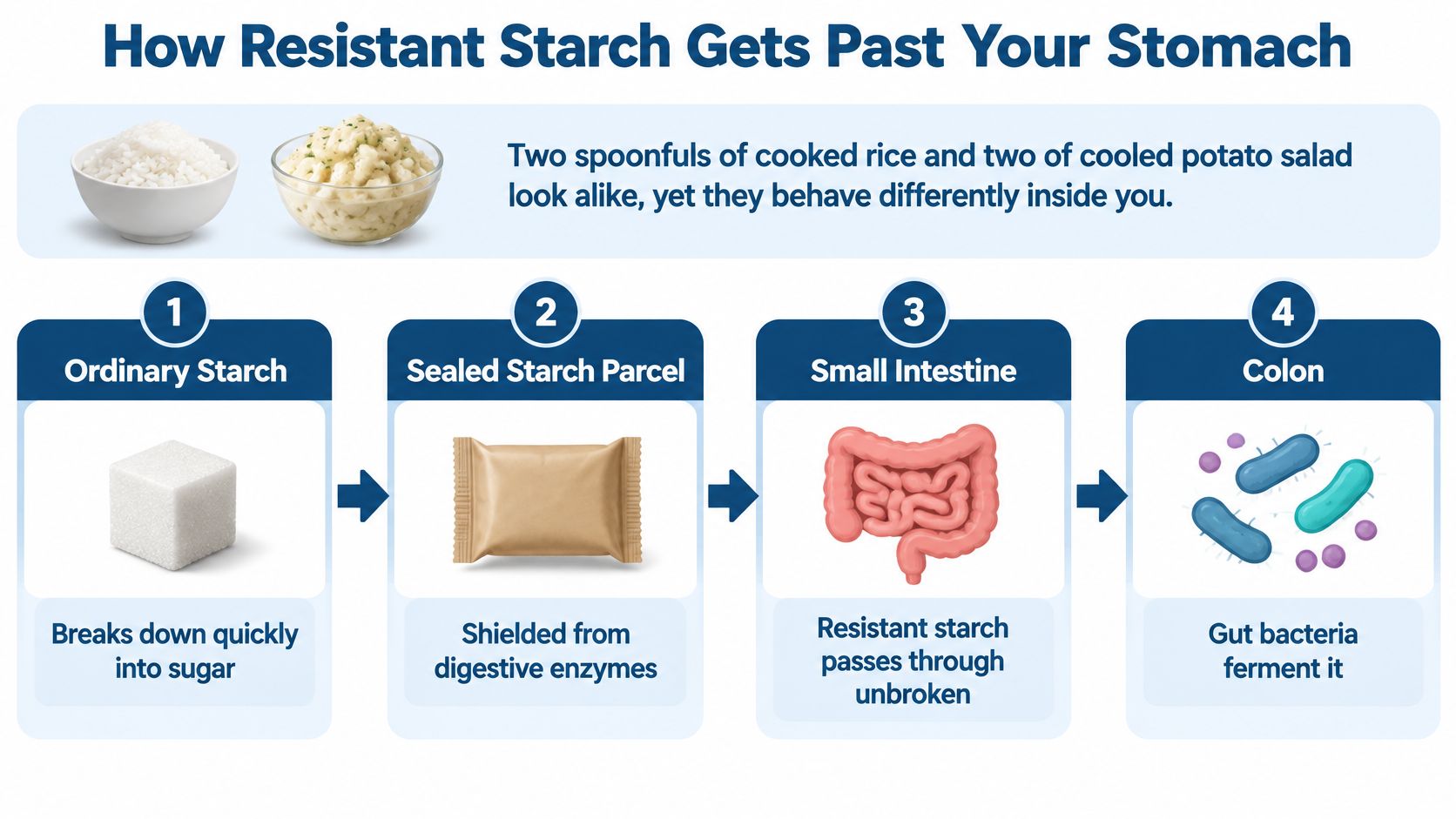
The three stages of digestion
First, some starch escapes breakdown by digestive enzymes in the small intestine. It then travels into the colon largely intact. There, gut microbes ferment it, producing short-chain fatty acids such as butyrate, along with gas.
Butyrate is one of the fermentation products researchers measure. In a meta-analysis of healthy-adult trials using roughly 22 to 45 grams per day, with an average dose of 33 grams daily, pooled results found higher fecal weight and fecal butyrate, as well as a change in fecal pH, compared with control diets, according to a clinical review of resistant-starch research. Those are measurable changes in bowel physiology and fermentation, not a promise that everyone will feel better.
For a long time, starch was treated mainly as a quickly digested energy source. Recognition that some starch reaches the colon and ferments there came later. Today, a resistant starch supplement offers a concentrated source of this fermentable fraction, sold as powders, capsules, or blended fiber products.
Practical rule: The powder's total weight doesn't tell you how much resistant starch can reach the colon. Check the actual resistant-starch grams.
Resistant Starch Types and Where They Come From
The starch's source and structure influence how it behaves. That's why potato, green banana, and high-amylose maize products aren't interchangeable, even when their labels show the same number of grams. The table gives you a quick way to match common types with their sources and supplement forms.
| Type | Typical sources | Where it appears in supplements | Practical note |
|---|---|---|---|
| RS1 | Whole grains, seeds, legumes, with starch trapped in cell walls | Rarely sold alone; occasionally in fiber blends | Digestion is slowed by the food matrix, so food form matters |
| RS2 | Raw potato, green banana, high-amylose maize | Most common supplement powder form | Granules resist digestion until cooked; check the label for the named source |
| RS3 | Cooked and cooled potato, rice, pasta | Less common as a standalone powder | Cooling increases its content; reheating can lower it |
| RS4 | Chemically modified starches, such as cross-linked starch | Some commercial powders and fiber blends | Regulatory filings exist; confirm the subtype and gram count on the label |
| RS5 | Amylose-lipid complexes | Specialty ingredients | Heat-stable; rarely the main ingredient in consumer products |
What the type tells you
RS1 is physically protected within a food's structure, so it's rarely isolated as a supplement. RS2, found in raw starch granules, is the form most often sold as a powder. Cooking can change the structure of RS2 starch. RS3 forms when cooked starch cools, which is why cooled leftovers can contain more of it. RS4 is chemically modified and appears in some commercial products. RS5 is a specialty form created by complexes between amylose and lipids.
Look for the subtype and source in the ingredient list or supplement facts panel, not just the phrase “resistant starch.” A table can help with the first check, but it can't tell you how a particular product will feel in your body. For everyday ideas on fitting a range of prebiotic foods into a busy routine, see this guide to gut-friendly eating for busy schedules.
What the Research Shows for Blood Sugar and Gut Health
In a 2019 systematic review and meta-analysis, people with overweight or obesity who took resistant starch had lower fasting insulin than control groups. The analysis covered 13 studies involving 428 adults and found a standardized mean difference of −0.72, with a 95% confidence interval from −1.13 to −0.31.
A standardized mean difference puts results from different measurement scales onto a shared scale. Here, it indicates a measurable group difference, not the number of units an individual's insulin level might change.
What the group results mean
Among participants with diabetes, the reported fasting-insulin effect was larger, with a standardized mean difference of −1.26, compared with −0.64 among those without diabetes. Across diabetic trials, fasting glucose also decreased, with a standardized mean difference of −0.28 and a 95% confidence interval from −0.54 to −0.01.
These findings suggest a modest, measurable effect in the studied groups. They do not show that every product or dose will have the same result. The studies varied in formulation, duration, and participants.
The group results also do not tell you how to translate a supplement label into a dose. A 5 g starting dose is a practical way to begin, but the amount of powder is not the same as the amount of resistant starch. Check how many grams of resistant starch the serving provides, then judge the dose by that figure. For broader context on everyday habits that support gut health, see a nutrition-focused guide to gut health.
Confidence, in practical terms: The insulin and glucose findings are encouraging, but the evidence base is small and varied. Gut-health outcomes are measured in trials, yet those measurements alone do not establish disease prevention. If you are comparing options for glucose support, blood sugar support products offer another point of comparison. The grams of resistant starch, rather than the headline serving size, are the useful starting point for interpreting a label.
Why Results Differ From Person to Person
Two people can take the same resistant starch and notice different effects. Their gut microbes, usual diet, tolerance for fermentation, and health goals all shape the response. The grams listed on a supplement label show how much resistant starch is provided, but they cannot predict how each person's microbiome will use it.
A 2025 randomized, placebo-controlled study in people with metabolic dysfunction-associated steatotic liver disease found that 30% of participants had limited benefit, with the result replicated in a multicenter trial. Baseline microbiome composition was a major determinant. In particular, higher Prevotella activity appeared to interfere with bacteria that break down resistant starch, according to the study on microbiome-related response differences.
A response isn't a simple product test
The study's predictive model combined microbiome and clinical features. Its reported area-under-the-curve values ranged from 0.74 to 0.87, suggesting that microbiome information could help personalize predictions in the future. These values do not provide a test for choosing a supplement now.
Several factors can affect what you notice:
- Tolerance: Gas or bloating may limit how much you can comfortably take.
- Fermentation capacity: Your gut microbes may process the starch differently from another person's.
- Habitual diet: Your usual foods help shape the gut environment in which the starch is fermented.
- Health goal: Findings in generally healthy adults may not apply to people with obesity, prediabetes, diabetes, or fatty liver disease.
A limited response may reflect how your microbiome processes the ingredient, your digestive tolerance, or the health goal you have in mind. If you are also considering a probiotic, keep in mind that probiotics and resistant starch have different roles, and combining them does not guarantee a stronger response. This guide to prebiotic and probiotic digestive support can help you compare the categories.
How to Judge a Quality Resistant Starch Supplement
A useful label checklist starts with what the product actually identifies: the resistant starch amount, the starch type, and its source. These details help you compare products and judge whether the label gives enough information to plan a serving.
The FDA identifies high-amylose starch, commonly classified as RS2, among isolated or synthetic carbohydrates that may be treated as dietary fiber under enforcement discretion while rulemaking proceeds. That regulatory treatment is not proof that the ingredient prevents disease. The FDA says evidence linking high-amylose maize resistant starch with reduced type 2 diabetes risk is limited and does not establish a generally applicable intake level or clear level of effect, according to its dietary fiber questions and answers.
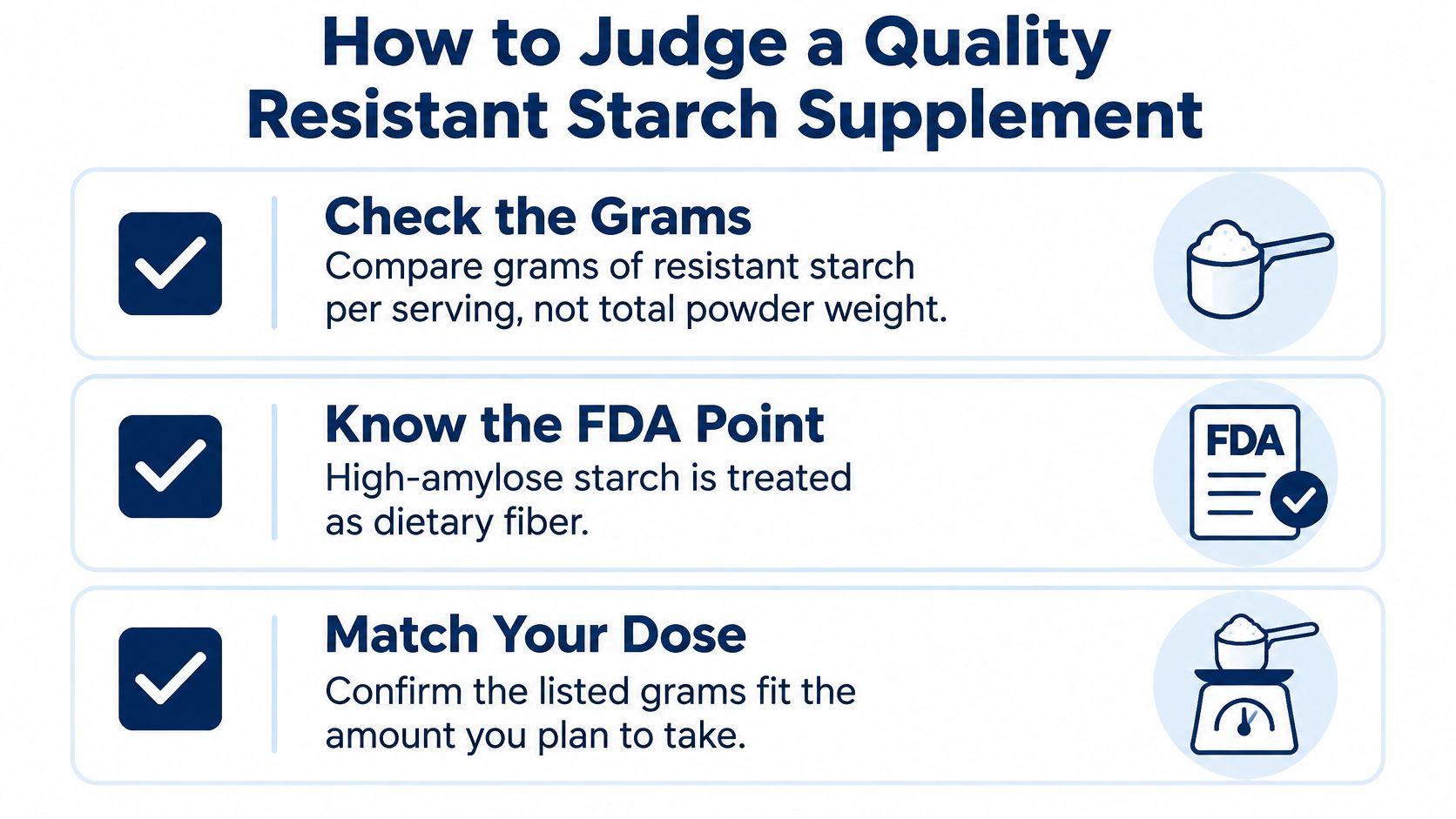
Use a label checklist
Potato, high-amylose maize, green banana, and chemically modified starch are different sources and types. Look for a named subtype and source, then check the remaining details against this list.
| Criterion | What to verify | Red flag |
|---|---|---|
| Resistant starch per serving | Grams of resistant starch listed in the supplement facts | Only total powder weight is shown |
| Starch type and source | Named subtype, such as RS2, RS3, or RS4, and a source such as potato or high-amylose maize | Generic “resistant starch blend” with no source |
| Third-party testing | Seal from an independent lab such as USP, NSF, or ConsumerLab | No independent seal and only in-house claims |
| Certificate of analysis | Lot-specific document showing identity and purity results | No lot number or certificate available on request |
| Contaminant testing | Heavy metal and microbial results | Silence on contaminants |
| Titration guidance | Written starting dose and increase schedule | One large suggested serving with no ramp-up |
| Allergen and additive statements | Clear gluten, corn, potato, and filler disclosure | Vague “proprietary blend” with no ingredient amounts |
| Seller policies | Return window, shipping terms, and contact channels | No refund or contact information |
Use the checklist to assess how clearly a product describes its contents and testing. Clear allergen information also helps you assess whether the starch source or other ingredients fit your needs. For example, the listing for Nature Made Kids First Vitamin D 110 Gummies Tooth Health Support identifies the product as a chewable vitamin D supplement. That kind of product description is distinct from the details needed to assess resistant starch, so look for the starch amount and source on the resistant-starch product's own label.
Finally, check the seller's contact options, sourcing statements, shipping terms, and return policy. These details provide a way to ask questions or address a purchase issue; they do not establish that a particular product is suitable for you. Supplemynts Inc lists a digestive-health category, free shipping within the continental United States, and a 60-day return policy. Treat these as purchasing terms when comparing sellers, alongside the ingredient and label details that matter for your choice.
How Much to Take and When to Take It
The same scoop can contain different amounts of resistant starch, so the useful starting point is the grams of that starch per serving. Check the supplement facts and named subtype before measuring. A controlled study found improved gastrointestinal symptom scores at about 5 grams per day, while trials examining glucose or insulin outcomes have tested higher amounts.
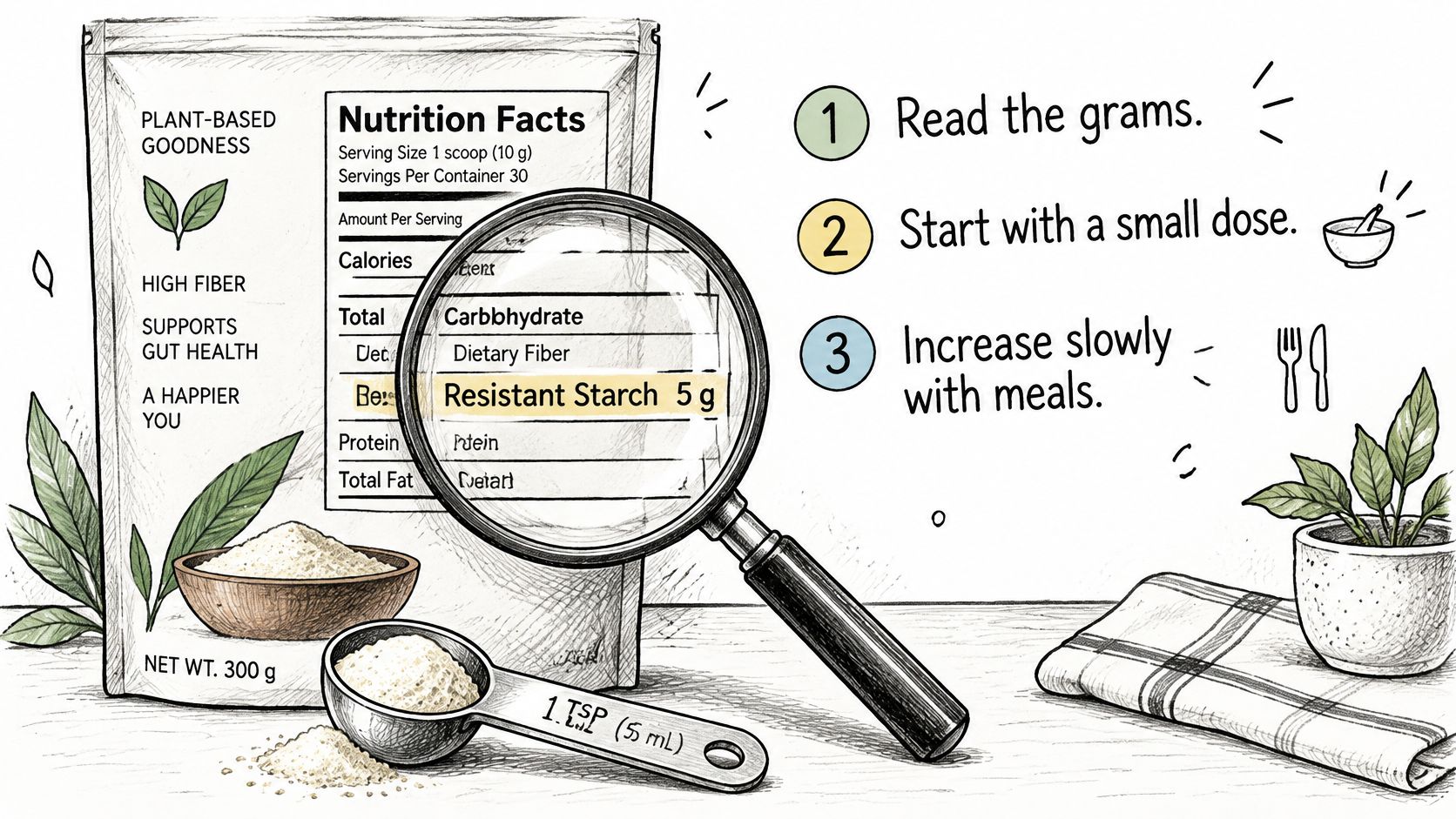
Increase gradually, using your digestion as a guide. Start with about 5 g per day with a meal, then hold that amount for 3 to 7 days and notice any changes in gas, bloating, or stools. If symptoms remain mild, add about 5 g and give your body time to adjust before increasing again. Keep to the highest amount you tolerate comfortably, and split larger daily amounts into two servings. Drink water through the day.
A systematic review of glycemic-control trials covered 19 trials involving 503 participants, with doses from 5 to 66 g per day and study durations of 2 to 12 weeks. The analysis found a statistically significant reduction in fasting plasma glucose compared with digestible starch. The effect was larger in trials using more than 28 g per day and lasting longer than 8 weeks. Those study doses describe research conditions, not a sensible amount to start with.
Higher doses may not suit everyone. A person's gut microbes help determine how resistant starch is fermented, so a weak response does not necessarily mean the product is defective. Give each dose time, and let comfort and any noticeable benefit guide whether to continue increasing.
People with diabetes or bowel disorders should seek professional guidance before increasing beyond the starting amount. Resistant starch can complement dietary management, but it should not replace prescribed treatment.
For a visual overview of serving information and use, see the illustration above. The video below offers another way to think through supplement use.
Side Effects and When to Hold Off
Gas and bloating can occur when gut microbes ferment more starch than they are accustomed to. Loose or harder stools may also follow. These changes can reflect how an individual gut responds, rather than a problem with the product itself. The amount of resistant starch in a serving matters more than the total weight of powder listed on the label.
A clinical study reported that 10 adults tolerated a single 30-gram dose of type-4 resistant starch without reported adverse effects. That short-term finding does not establish long-term safety for every formulation or person.
Who should check first
Talk with a clinician before starting or increasing a dose if you take glucose-lowering medication, have inflammatory bowel disease, irritable bowel syndrome, or another bowel disorder, or are pregnant or breastfeeding. If you have an allergy to a source ingredient such as potato or corn, check the label and avoid products containing it.
Use these signs to decide when symptoms need more than routine attention:
| Situation | When to seek help |
|---|---|
| Gas or bloating | Contact a clinician if symptoms persist for more than two weeks at a stable dose |
| Loose stools | Seek medical advice if diarrhea lasts more than a few days or includes blood |
| Abdominal cramping | Get medical advice if pain is severe or ongoing |
| Low blood glucose symptoms while taking medication | Contact your prescriber about shakiness, confusion, or readings below your target |
| Hives, facial swelling, or breathing difficulty | Stop the product and seek emergency care at once |
Severe pain, blood in diarrhea, or signs of an allergic reaction warrant prompt medical attention. Mild digestive changes can be monitored, but persistent or serious symptoms should not be ignored.
Pairing, FAQs and Your Four-Week Plan
Change one thing at a time. Start resistant starch first, find an amount you tolerate, and only then consider adding a probiotic. Both can affect gut microbes, but there's no established best pairing. Other fiber products, including psyllium, can add to gas or bloating, so keep track of your overall intake. If you take diabetes medication, coordinate dose changes with your prescriber.
For help understanding probiotic basics before combining products, see this probiotic guidance from a Bedford health shop. You can also compare other fiber options, such as healthy fiber powder, while checking its ingredients and serving details.
Common questions
Can I mix resistant starch into drinks? Cool or room-temperature liquids are a practical choice. Drink enough water through the day.
Does cooking change resistant starch? Cooling cooked potato, rice, or pasta can increase RS3; reheating can lower it.
How long before I notice an effect? Give it several weeks. The trials have generally run for weeks, rather than days.
Is more better? No. Higher trial doses aren't automatically appropriate for you. Follow the titration steps and stop at the amount you tolerate.
A four-week routine
Choose a product with a named source and clear resistant-starch grams, then follow the titration ladder. Keep a simple daily log of your dose, bloating, gas, stool changes, and any relevant glucose readings for four weeks. At the end, decide with your clinician if needed whether to continue, adjust, or stop.
Supplemynts Inc offers dietary supplements and wellness products organized by category, including digestive health and probiotic products, along with customer support and published store policies. If you're comparing options, visit Supplemynts Inc and use the label checklist to assess each product's ingredients, serving details, and seller terms.








Please complete your information below to login.
Sign In
Create New Account