



The usual advice is to choose the purest magnesium supplement you can find. That's the wrong starting point. Pure doesn't tell you which magnesium compound you're buying, how much elemental magnesium a serving delivers, or whether that formulation suits your purpose.
A better purchase starts with the label, not the adjective. Compare the mineral dose, the evidence for absorption, and the digestive trade-off. Then ask whether you need a supplement at all, rather than treating sleep trouble, cramps, or constipation as proof that magnesium is missing.
Table of Contents
- Reading Magnesium Labels Beyond the Word Pure
- Comparing Magnesium Forms Side by Side
- Matching Magnesium Forms to Sleep, Cramps, and Digestion
- How Much Elemental Magnesium to Take Daily
- What Purity Claims Do and Do Not Prove
- How to Choose the Right Product for Your Needs
- Starting Your Magnesium Plan This Week
Reading Magnesium Labels Beyond the Word Pure
A bottle's front panel can emphasize a large milligram figure while leaving the serving's magnesium dose unclear. The useful comparison starts with the elemental magnesium amount, the magnesium itself rather than the full weight of its compound.
Magnesium supplements may contain oxide, citrate, chloride, aspartate, or lactate. The NIH magnesium fact sheet for health professionals explains that the Supplement Facts panel lists elemental magnesium, not the total weight of the compound. The word pure does not identify the form or tell you the amount supplied.
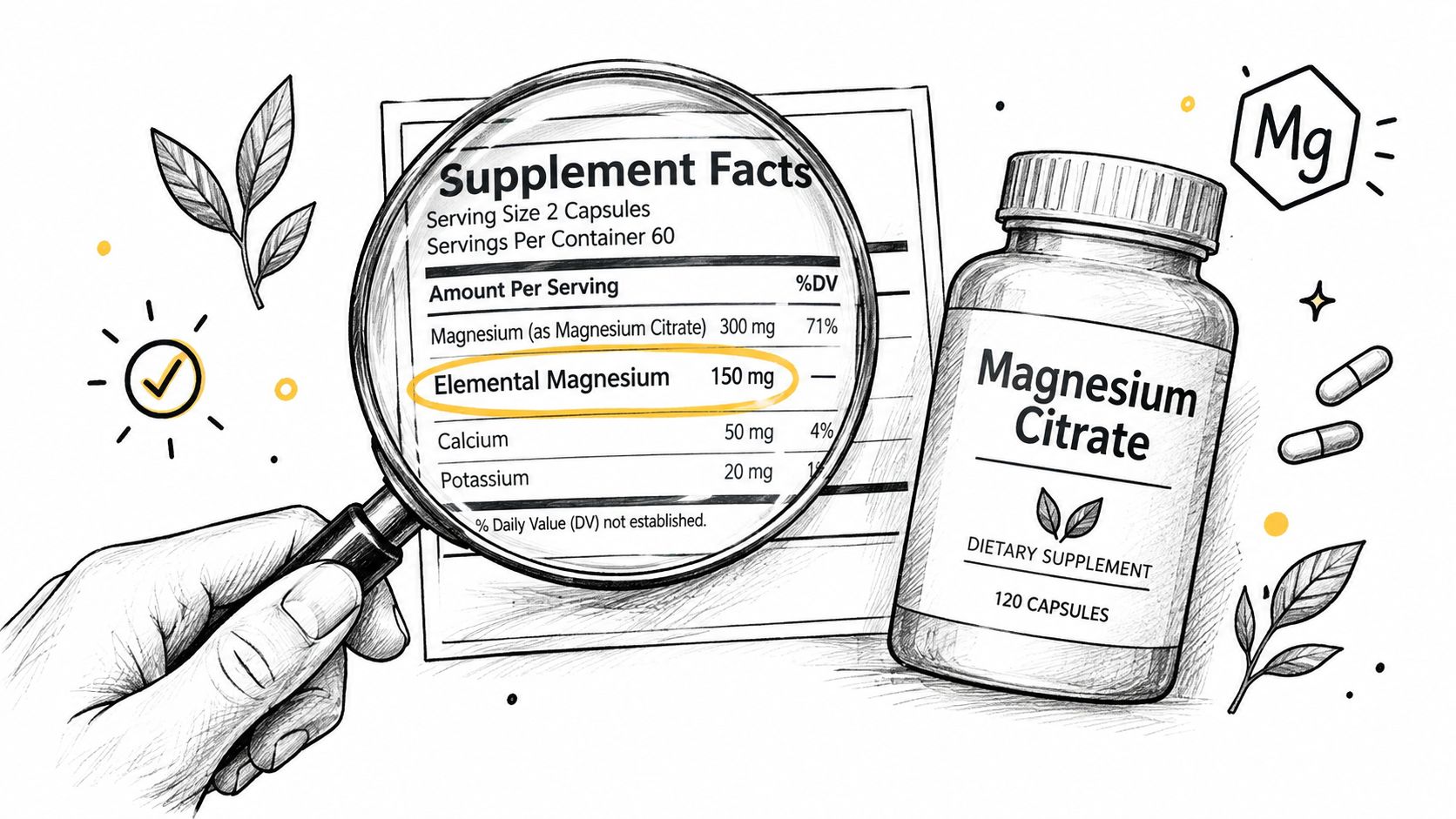
Read the bottle in a consistent order
Check the ingredient statement alongside the Supplement Facts panel. Record the form and dose before comparing products.
- Identify the form. Find the named magnesium salt or chelate. “Magnesium” or “pure magnesium” alone does not specify it.
- Check elemental magnesium. Use the quantity listed per serving in Supplement Facts.
- Confirm the serving size. Note how many capsules, tablets, or scoops make one serving, then check the servings per container.
Those details show what each product provides. A compound's listed weight does not establish its elemental magnesium dose, and capsule size does not show how much magnesium a serving contains.
Compare servings, not package impressions
For each option, note the compound, elemental magnesium per serving, serving size, and servings per container. This makes products with different capsule counts and formats easier to compare on the same basis.
Label-reading rule: Record the magnesium form and elemental amount per serving before comparing products.
Inspect the rest of the ingredient list for any specific additives you want to avoid. Treat pure as a label claim to investigate, not evidence of a particular formulation, dose, or tolerance.
Comparing Magnesium Forms Side by Side
Magnesium oxide illustrates why a high mineral concentration isn't the same as strong absorption. It provides a relatively high elemental share by weight, but poor solubility can limit bioavailability. A systematic review of magnesium supplement bioavailability found that inorganic formulations generally had lower bioavailability than organic formulations and that absorption declined as dose increased.
That finding supports a directional preference, not an absolute ranking of every product. A formulation still has to dissolve, provide an appropriate serving, and be tolerable enough to use.
Where the comparison is strongest
Human absorption work summarized in the NIH discussion of magnesium supplement forms found approximately 4% fractional absorption for magnesium oxide, while chloride, lactate, and aspartate were significantly better absorbed. The same guidance identifies citrate among the forms generally absorbed more completely than oxide.
That figure shouldn't become a calculator for every oxide product. It describes a study finding, not a guaranteed absorption rate for any bottle carrying the same salt name.
For example, use the Amazing Formulas magnesium oxide listing as a candidate for label inspection, not as a reason to equate a prominent milligram claim with absorbed magnesium. Confirm the Supplement Facts panel before making a comparison.
Magnesium Forms at a Glance
The table distinguishes supported comparisons from areas where the evidence available for this review doesn't justify a firm conclusion.
| Form | Elemental Magnesium Share | Absorption Profile | Typical Trade-Off | Often Chosen For |
|---|---|---|---|---|
| Oxide | Relatively high by compound weight | Poor solubility generally limits absorption | Concentrated mineral content doesn't ensure efficient uptake; laxative effects may matter | Cost-conscious selection or a laxative purpose |
| Citrate | Check the elemental amount on the label | Generally better absorbed than oxide | Absorption advantage doesn't eliminate gastrointestinal symptoms | Magnesium intake when its digestive effects are acceptable |
| Glycinate | Check the specific formulation | No direct ranking established by the evidence used here | Don't assume superior tolerance or sleep benefits from the name alone | Consider only after checking the dose and support for the intended use |
| Chloride | Check the elemental amount on the label | Better absorbed than oxide in the cited comparison | Better absorption doesn't establish symptom-specific superiority | An alternative when absorption is a priority |
| Malate | Check the specific formulation | No direct ranking established by the evidence used here | Claims about energy or cramps require separate evidence | Consider only when the product's stated purpose has adequate support |
Glycinate and malate deserve particular caution in a comparison like this. The evidence summarized above doesn't establish their elemental percentages across commercial formulations, a reliable tolerability ranking, or superiority for particular symptoms. Filling those gaps with familiar marketing claims would create a false sense of precision.
My buying conclusion: citrate and chloride have a clearer absorption rationale than oxide in the cited evidence. That doesn't make either universally best, and it doesn't establish glycinate or malate as poor choices. It means the confidence behind the comparison differs.
Matching Magnesium Forms to Sleep, Cramps, and Digestion
A shift worker looking for help falling asleep and a runner worried about calf cramps may both search for magnesium. They're asking different clinical questions, however. Neither question can be settled by finding the most absorbable salt.
The useful distinction is between delivering magnesium and demonstrating a benefit for a specific symptom. Evidence for the former doesn't automatically establish the latter.
If your goal is better sleep
Consider a shift worker who sees glycinate described as the nighttime option. Before choosing it, separate the product's magnesium content from the promise attached to its name.
The evidence used for this comparison doesn't establish that glycinate treats difficulty falling asleep or outperforms other forms for sleep. I wouldn't turn its reputation into a recommendation without symptom-specific evidence.
A practical discussion with a clinician should start with the sleep problem itself. Describe when it occurs, what has changed, and what you hope a supplement will accomplish. That's more useful than starting with a preferred compound.
If your goal is fewer cramps
A runner who develops calf cramps after demanding sessions shouldn't assume the symptom proves magnesium deficiency. The absorption findings above don't demonstrate that switching salts will prevent cramps.
Before buying, ask whether the problem calls for assessment of training, diet, fluid intake, medications, or another explanation. This is a decision safeguard, not a diagnosis or a claim that any particular factor caused the cramps.
- Define the outcome. Record what you mean by improvement, such as less disruption during activity.
- Avoid stacking changes. If you change training, several supplements, and meal patterns together, you won't know which change mattered.
- Escalate persistent symptoms. Don't keep increasing magnesium just because the first attempt didn't help.
If your goal is digestive regularity
Here, a gastrointestinal effect may be part of the intended purpose rather than an unwanted side effect. The form comparison above supports considering that trade-off for oxide and citrate, while also recognizing that excessive stool loosening isn't a desirable endpoint.
A product such as the KAL magnesium citrate powdered drink mix should still be assessed by its label directions and elemental serving, not by the convenience of a drink format. Don't assume a powder is automatically gentler or more effective.
Choose the form only after defining the problem. A plausible absorption profile isn't proof of a sleep, cramp, or digestive outcome.
Persistent constipation, recurring cramps, and continuing sleep disruption deserve more than repeated supplement substitutions.
How Much Elemental Magnesium to Take Daily
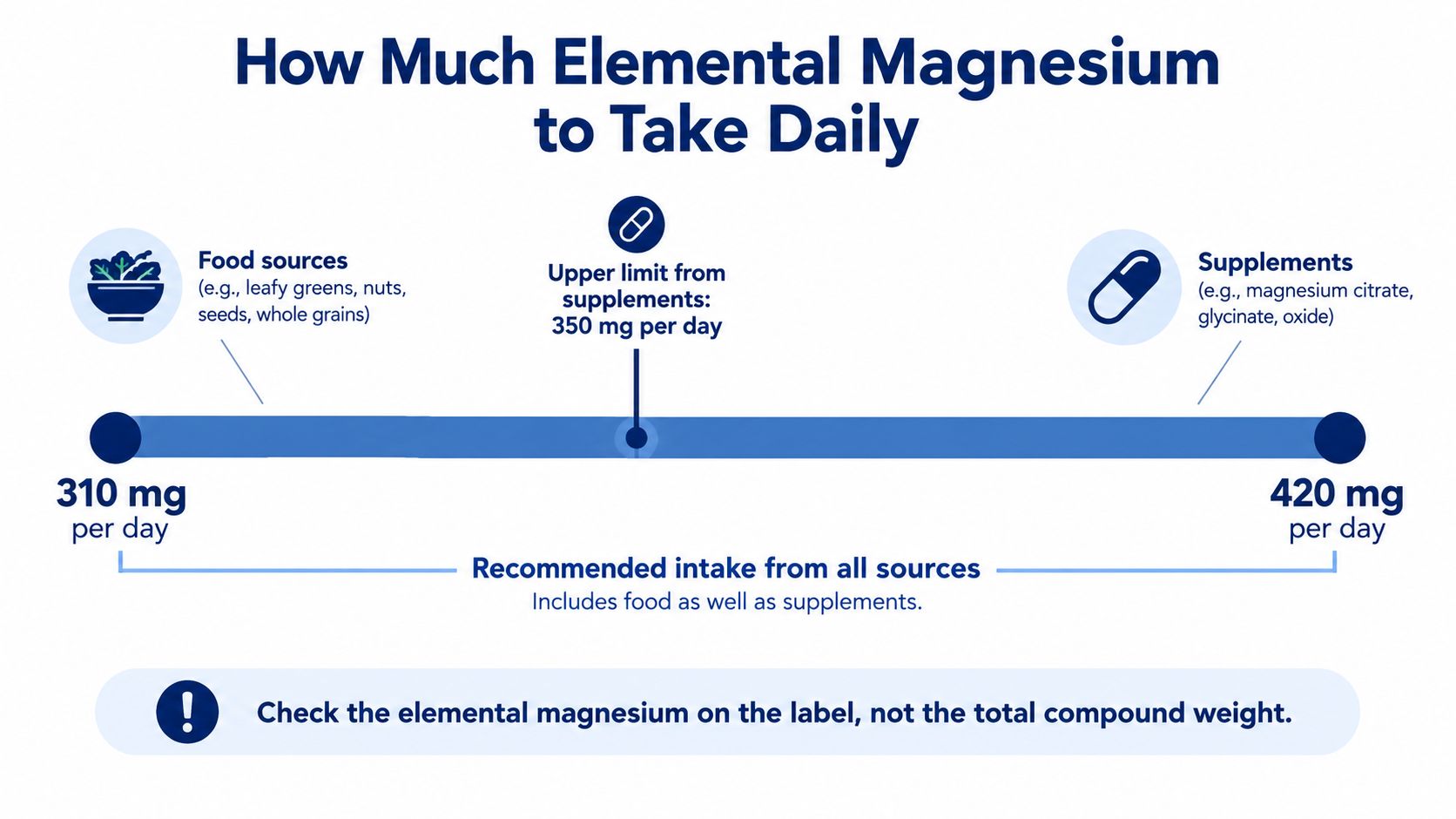
Recommended intake and the supplemental upper limit measure different things. Recommended intake is the total magnesium needed from all sources. The tolerable upper intake level applies to magnesium from supplements and medications, not magnesium naturally present in food.
The NIH consumer guidance on magnesium lists adult recommended intakes of approximately 310–420 mg daily, depending on age and sex, and an adult upper limit of 350 mg daily from supplements and medications. These figures do not conflict: one covers total intake, while the other limits supplemental sources.
The infographic separates intake from food and supplements.
Calculate the dose you take
A label might declare 200 mg of elemental magnesium per serving, an example consistent with the NIH explanation of elemental supplement labeling. If one serving requires several capsules, taking one capsule does not provide the full labeled serving.
If each capsule supplies that full example amount, taking more than one could exceed the adult supplemental limit. Multiply the elemental amount per serving by the number of servings taken, then count magnesium from other supplements and medications.
- Check the unit. The amount per capsule may differ from the amount per serving.
- Check overlapping products. Add magnesium across products rather than assessing each bottle separately.
- Keep food separate for the ceiling. Include dietary magnesium when considering total intake, but the supplemental limit does not apply to food.
Children need age-specific limits
The NIH consumer guidance on magnesium sets supplemental limits at 65 mg daily for ages 1–3, 110 mg for ages 4–8, and 350 mg for ages 9–18. These are safety limits, not recommended doses for children. Seek professional guidance before giving a child magnesium.
Excess supplemental magnesium may first cause diarrhea. Nausea and abdominal cramping are also recognized effects, and extremely high exposures can cause serious cardiac problems.
The video may help with reviewing a product label, but it cannot replace individualized advice.
Treat the upper limit as a ceiling, not a target. If you have a medical condition, kidney concerns, or take medication, ask a clinician or pharmacist to review the proposed dose before starting.
What Purity Claims Do and Do Not Prove
“Pure” is a label claim, not a complete quality assessment. Its meaning depends on what the manufacturer tested, which product the results cover, and whether the documentation supports the claims on the bottle.
Even after you choose a magnesium salt, the product still needs scrutiny. A shared compound name does not establish that two products have the same elemental dose per serving, absorption, or tolerability. The earlier bioavailability evidence is relevant to formulation performance, but it does not verify an individual product's label or clinical effects.

Ask what was tested
Treat “third-party tested” as a prompt to request the documentation. Ask the manufacturer for records identifying the product, batch, laboratory, and testing scope.
A certificate of analysis can help, but its title alone says little. Check what the report covers:
- Identity. Does the testing address the magnesium ingredient named on the label?
- Potency. Does it support the stated elemental magnesium amount?
- Contaminants. Does it name the contaminants assessed, including any heavy metals?
- Product match. Can you link the results to the product and batch you would receive?
- Testing scope. Was the finished supplement tested, or only an ingredient or another sample?
This checklist describes questions to ask, not tests every certificate necessarily includes. If the manufacturer cannot clarify the report, account for that uncertainty.
Separate test results from health claims
A potency result supports the amount reported in the sample. It does not establish better sleep. A contaminant report addresses the contaminants tested, not absorption. A dissolution result describes performance under test conditions, not whether the supplement will resolve recurring cramps.
Testing seals also have defined scopes. Check what a program evaluates before applying its seal to claims beyond that scope.
Verification checkpoint: Ask what a test demonstrates, which product it applies to, and what it leaves unanswered.
“Pure” can conceal several distinct questions behind one reassuring word. A useful assessment connects each claim to evidence: ingredient identity, elemental dose, contaminant testing, product and batch, and test scope.
Clear manufacturing records can strengthen confidence in what a product contains, while leaving clinical questions open. They do not show that magnesium is necessary for you, suited to a particular symptom, or appropriate at any dose.
How to Choose the Right Product for Your Needs
The right product is the one that survives a sequence of checks, not the one with the most attractive form name. My preferred order is goal, formulation, usable serving, tolerability, and verification.
That sequence prevents a common purchasing error: choosing a fashionable compound first, then looking for a reason to take it. It also gives you a defensible reason to reject a product even when its ingredient is reasonable.
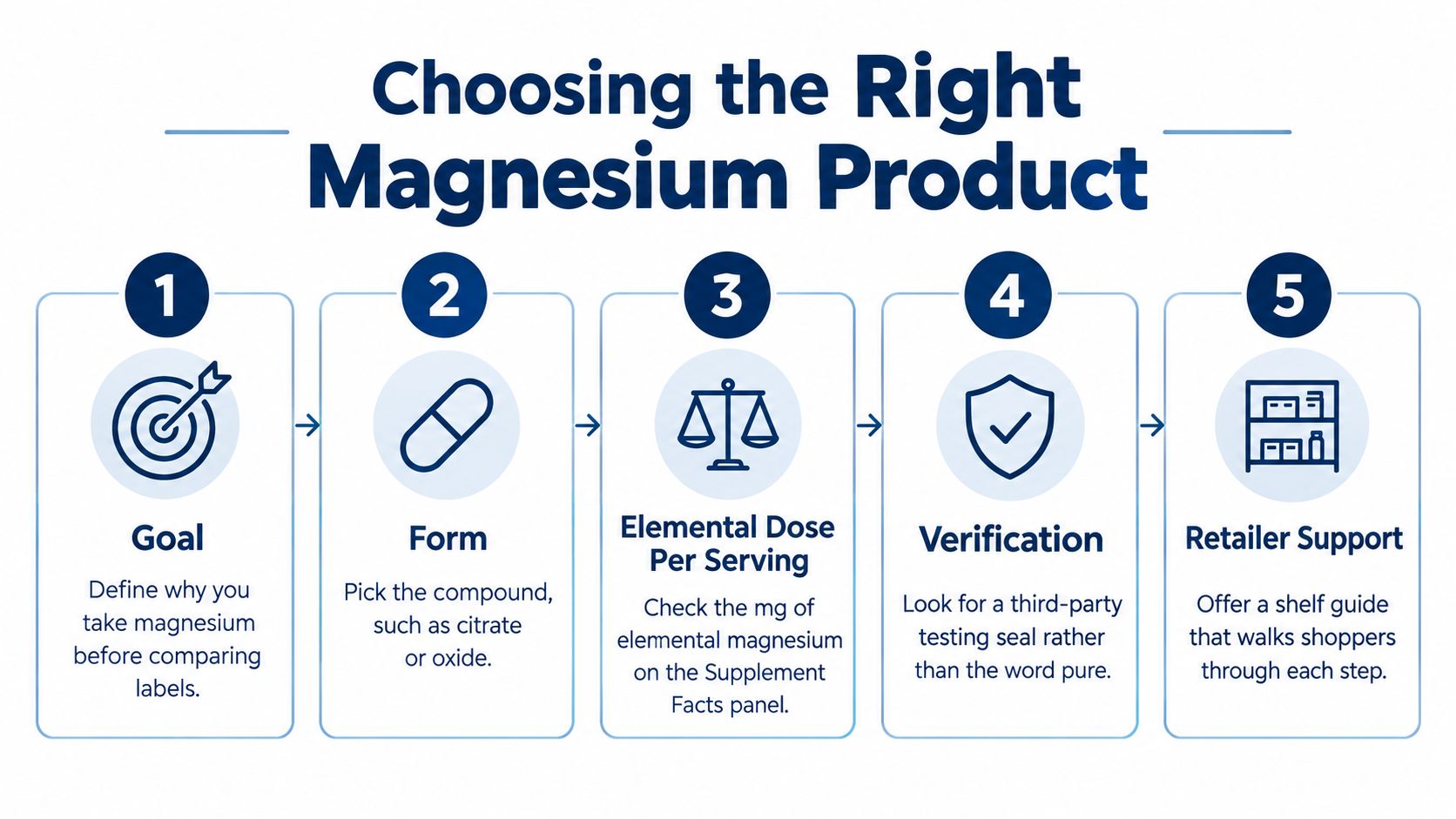
Build a shortlist around constraints
Start by writing down your primary reason for considering magnesium. Then identify what would make a product unsuitable: an unclear panel, a serving you can't follow, unwanted ingredients, a digestive effect you don't want, or inadequate documentation.
Use the earlier form comparison to narrow candidates, while retaining its uncertainty. For instance, the NOW magnesium glycinate product page is a place to inspect a glycinate option, not evidence that glycinate is the correct choice for your symptoms.
Don't infer capsule burden, elemental dose, or current testing status from the product name. Inspect the current label and ask for missing information.
- Reject ambiguity. An unclear serving or unspecified form makes comparison harder than it needs to be.
- Prefer a workable routine. Choose directions you can follow consistently rather than planning to improvise.
- Separate preferences from evidence. A preference for a powder, tablet, or plant-based formulation is legitimate, but it doesn't establish better absorption.
- Document the unknowns. Missing information should remain visible in your decision, not disappear because the marketing sounds confident.
Use retailer support without treating it as verification
An online supplement retailer is one shopping option alongside a pharmacy or direct manufacturer purchase. Category navigation, purpose-based collections, advanced search, and ingredient filters can help you find candidates.
Those tools don't establish suitability. A placement under digestive health or brain support is a browsing aid, not clinical evidence.
Supplier-selection statements and accessible shipping, refund, and compliance policies provide purchasing context. They don't replace manufacturer documentation or a readable Supplement Facts panel.
Before ordering, inspect the retailer's current terms and ask whether any return restrictions apply to the product you're considering. A return policy may reduce purchasing friction, but it shouldn't become a reason to run an unsupervised dose experiment.
The final decision should be explainable in plain language: this formulation fits my purpose, the serving fits my plan, I understand the tolerance trade-off, and I know what has been verified. If you can't complete that sentence truthfully, keep comparing.
Starting Your Magnesium Plan This Week
Begin with a decision, not a purchase: are you trying to fill an identified intake gap, follow professional advice, or investigate a symptom? If the answer is only that magnesium is popular, pause before adding it.
For a symptom-driven decision, write down what you're experiencing and what would count as a meaningful improvement. That record can make a conversation with a clinician more specific, even if you ultimately decide not to supplement.
Make the first change interpretable
If a clinician agrees that supplementation is appropriate, choose a formulation and dose that follow that advice and the product directions. Don't start at the upper boundary just because it appears on a safety chart.
Keep the rest of the experiment simple.
- Use a single primary goal. Track the issue that prompted the decision rather than expecting improvements across unrelated symptoms.
- Keep a brief log. Note what you took, whether you followed the serving directions, what changed, and any digestive effects.
- Change one variable at a time. Avoid switching forms and increasing the serving together.
- Set a review point. Decide in advance when you'll assess the plan with your clinician rather than continuing indefinitely without a clear reason.
A log can help organize observations, but it can't prove that magnesium caused an improvement. Symptoms may change for other reasons, and an informal trial isn't a substitute for diagnosis.
Know when not to continue
Don't respond to a lack of benefit by repeatedly increasing the amount. Revisit the original assumption: was magnesium an appropriate answer to the problem?
Persistent diarrhea, nausea, or abdominal cramping warrants stopping the self-directed trial and seeking advice. If you have kidney disease, are pregnant, or take medications, obtain individualized guidance before beginning rather than relying on a general shopping guide.
Bring the product label and your complete supplement and medication list to that discussion. That gives the clinician or pharmacist something concrete to evaluate.
The most useful outcome may be finding a suitable supplement, choosing a different approach, or deciding that supplementation isn't needed. A careful magnesium plan should allow all of those conclusions.
Supplemynts Inc offers magnesium products within its online supplement selection, with category navigation and advanced search to help you compare candidates. Visit the store to inspect each product's magnesium form, elemental serving, and available label information, then confirm any missing details before ordering.








Please complete your information below to login.
Sign In
Create New Account