


The familiar advice to drink a scoop immediately after every workout skips the most useful question: how much protein is missing from your day? A shake can be convenient, but it isn't a required step for muscle gain, and the scoop inside the tub isn't a personalized prescription.
Useful protein powder instructions start with food, then account for the product's protein source, serving size, and ingredient list. Measure the gap first. Choose the powder and timing second.
Table of Contents
- Daily Protein Targets and Scoop Size
- How to Mix One Serving
- Recipe Ideas for Shakes and Meals
- When to Drink the Shake
- Using Whey and Plant Powders Differently
- Storage Safety and When to Stop
- Run a One-Week Scoop Trial
Daily Protein Targets and Scoop Size
A scoop is useful only after you know how much protein your day still needs. For adults doing resistance training, a planning range is 1.4–2.0 g/kg of body weight per day, as described in the International Society of Sports Nutrition position stand. A meta-analysis of resistance-training studies found no additional fat-free-mass benefit above approximately 1.62 g/kg/day (meta-analysis).
Treat your target as an estimate to adjust over time. Training demands, age, appetite, and medical circumstances can affect what is appropriate. Count protein from food and supplements toward the same daily total.
Daily protein targets by body weight
The table applies the exercising-adult range to different body weights. The scoop column shows a typical amount of protein supplied per serving. Powder weight and protein weight differ because a product may also contain flavorings, carbohydrates, fats, or minerals.
| Body weight | Active range 1.4–2.0 g/kg | Typical scoop |
|---|---|---|
| 50 kg (110 lb) | 70–100 g | 20–40 g protein |
| 60 kg (132 lb) | 84–120 g | 20–40 g protein |
| 70 kg (154 lb) | 98–140 g | 20–40 g protein |
| 80 kg (176 lb) | 112–160 g | 20–40 g protein |
| 90 kg (198 lb) | 126–180 g | 20–40 g protein |
| 100 kg (220 lb) | 140–200 g | 20–40 g protein |
Use the nutrition panel's protein line to count a serving toward your target. A scoop measures powder; the label tells you how many grams of protein that powder provides.
Calculate what food leaves unfinished
- Convert your body weight to kilograms. Use a scale's kilogram setting or convert from pounds.
- Choose a daily target. For resistance training, use the range above as a starting point unless a clinician or dietitian recommends otherwise.
- Estimate protein from food and drinks. Include meals, snacks, milk, yogurt, and other beverages.
- Compare the total with your target. Use measured powder only to help fill any remaining gap, alongside food.
For example, a person weighing 70 kg who chooses 1.6 g/kg sets a target of 112 g per day. If planned meals provide 70 g, the remaining gap is 42 g. Food and measured powder can both contribute to that amount.
For broader meal planning that accounts for protein alongside carbohydrate, fat, and total food intake, see macro planning with Calorie Genie AI. A protein target is one part of a balanced eating pattern.
Before opening the tub: Estimate how much protein your meals will provide, then compare that with your target. A small or nonexistent gap may leave little reason to use powder that day.
Older adults and people with medical conditions should seek individualized advice rather than relying on an online calculation. Anyone with kidney disease should consult a clinician before substantially increasing protein intake.
How to Mix One Serving
Start with the panel on the container, not the photograph of the shake on the front. Your useful tools are a clean shaker bottle or blender, the supplied scoop, and preferably a kitchen scale when the label lists serving weight.
The International Society of Sports Nutrition position stand describes protein feedings of approximately 20–40 g and emphasizes consistent intake rather than an urgent post-workout drink. A practical serving still needs to come from your product's actual label, because scoop size and protein concentration aren't interchangeable.
Measure, mix, and count
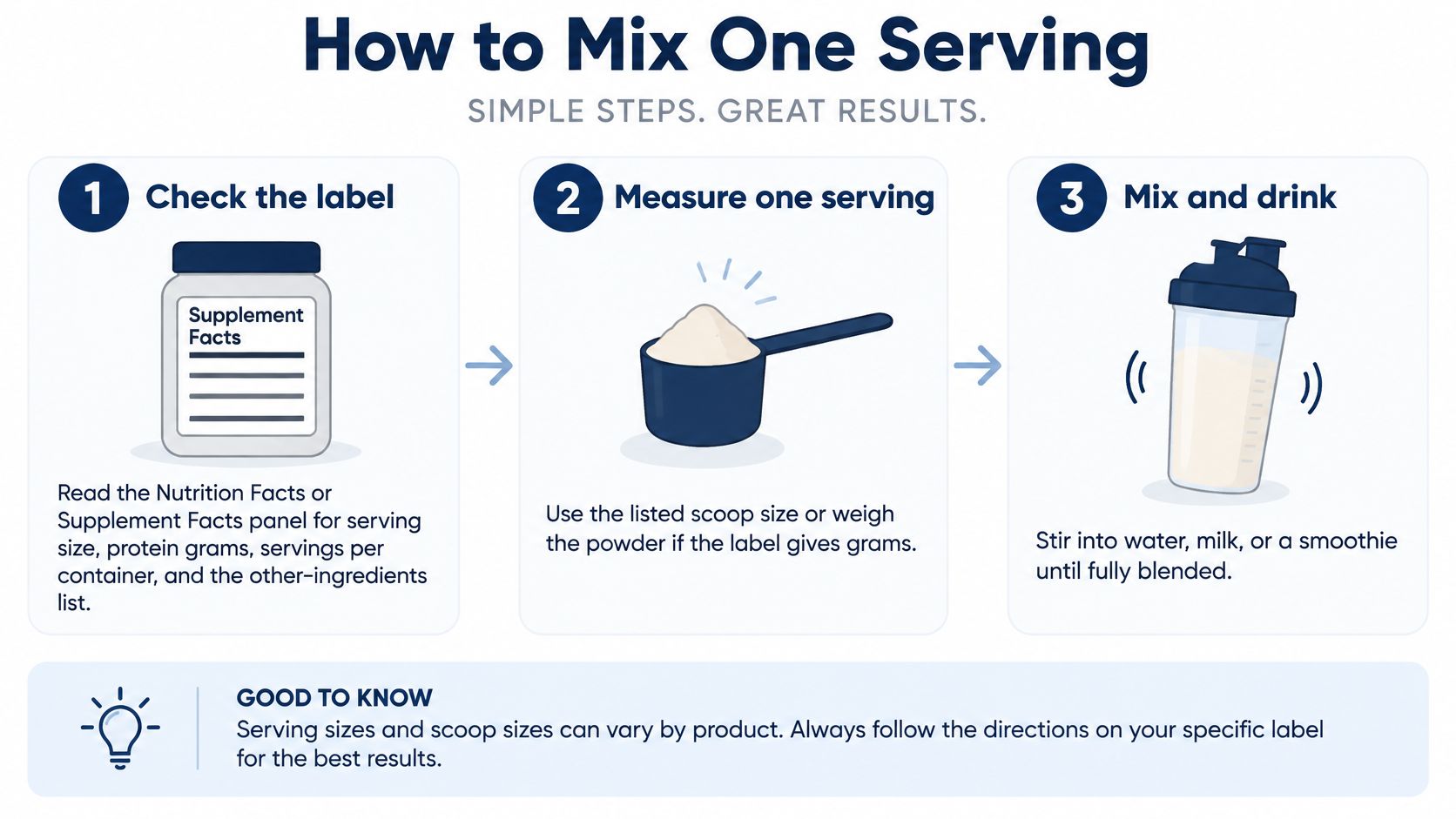
Read the complete serving description. Check serving size, protein grams, servings per container, and the ingredients list. Confirm whether a serving means a level scoop, multiple scoops, or a stated powder weight.
Measure the powder. If using a scale, put the empty mixing container on it, tare it, and add the labeled amount. If you're using the scoop, level it rather than making a mound.
Choose the liquid for your purpose. Water keeps the mixture simple. Dairy milk adds food energy and protein, while a fortified plant beverage may suit someone avoiding dairy. Check the beverage's label rather than assuming every plant drink contributes the same nutrition.
Add liquid before powder. Close the shaker securely and shake until no dry pockets remain. A blender is useful when adding fruit, oats, or a powder that stays gritty.
Record the finished serving. Count the powder's protein and any protein from the liquid or other ingredients. Don't log a complete smoothie and then add its powder again as a separate entry.
Rinse the equipment promptly. Clean around the lid, seal, and mixing ball, where residue can collect.
Use this visual as a counter-top reminder of the sequence.
Fix texture without changing the dose
If the shake is too thick, add liquid gradually. If dry powder sticks underneath the lid, loosen it with a spoon and shake again rather than adding more powder to change the texture.
Plant blends may benefit from blending and a brief rest before drinking. For a yogurt bowl, mix the powder with a little yogurt first to make a smooth paste, then stir in the rest.
Check ingredients beyond protein. Milk and soy matter for allergies, while gluten-containing additions may matter for someone who needs to avoid gluten. Added sugars, caffeine, and other stimulant ingredients can change whether a powder suits breakfast, evening use, or your medical circumstances.
Before drinking, make a quick final check: protein per serving, powder weight, allergens, and added sugar. A larger-looking scoop isn't evidence of a better serving.
Recipe Ideas for Shakes and Meals
A measured serving doesn't have to become a drink. Choose a format you'll enjoy, then count the powder and the accompanying foods together.
Simple builds for different appetites
Vanilla breakfast blend. Blend a labeled serving of vanilla whey with milk, banana, and rolled oats. Add the oats gradually so the drink stays pourable, and adjust with more milk if it becomes too thick.
Chocolate plant-based smoothie. Combine a labeled serving of a soy-pea blend with fortified soy milk, frozen berries, and peanut butter. Blend until smooth. Check the peanut butter ingredients if you're trying to limit added sugar.
Spoonable yogurt bowl. Stir unflavored whey into plain Greek yogurt, then add cinnamon and sliced fruit. Start with a small amount of yogurt to dissolve the powder before combining the rest.
For a warm option, cook oatmeal first and let it cool slightly before stirring in powder. Add a splash of liquid as needed, because the mixture can thicken quickly.
Count the finished meal, not just the scoop. Milk, yogurt, oats, and nut butter can contribute protein too.
Fruit can provide sweetness without requiring syrup or sweetened yogurt, although a flavored powder may already contain added sugar. Don't add another scoop just because the recipe looks large; adjust the portion to the amount you need.
When to Drink the Shake
There's no universally required post-workout deadline. A shake is useful when it fits your food intake and schedule, not because you managed to drink it before an imagined countdown expired.
The International Society of Sports Nutrition position stand places most exercising adults seeking to build or maintain muscle at approximately 1.4–2.0 g/kg/day, with protein feedings distributed roughly every 3–4 hours. Total daily intake matters more than precise timing, so use the schedule below to place a serving rather than to create additional servings.
Where one protein serving fits
| Situation | Practical timing | Role of the serving | Limit |
|---|---|---|---|
| Pre-workout | Before training when comfortably tolerated | Covers a long gap before training | Skip if it causes nausea |
| Post-workout | After training when a meal isn't ready | Convenient protein during recovery | No mandatory immediate deadline |
| Between meals | Between reasonably spaced meals | Contributes a feeding to the daily total | Don't stack shakes close together by habit |
| Low-protein meal | With breakfast or lunch | Adds protein to the meal | Count food protein plus powder once |
| Partial meal replacement | When a full meal is impossible | Protein alongside fruit, oats, or yogurt | Powder alone isn't a balanced meal |
| Evening gap | With or after dinner if intake remains short | Finishes the calculated gap | Don't add it automatically |
The best pre-workout choice is something your stomach already tolerates. If a milky shake makes you feel heavy during exercise, move it earlier, use a different liquid, or eat your protein afterward.
After training, consider what's happening next. If lunch is ready, eat lunch. If you're commuting, attending meetings, or unable to face a meal, a shake may be the more practical option.
Fit the serving around an ordinary day
Say you eat breakfast before work, train around midday, and then discover that lunch will be delayed. A portable shake can cover that disruption without requiring you to redesign dinner.
On a different day, lunch may arrive on time and contain an adequate protein source. The same workout doesn't automatically justify the same shake, because your food intake has changed.
An evening serving can also make sense when daytime eating was incomplete. It shouldn't become a compulsory bedtime ritual regardless of what you ate.
Keep recovery products separate from protein accounting. A listing such as branched-chain amino acid recovery capsules shouldn't be treated as interchangeable with a measured serving of food protein. Check what the product contains and what role, if any, it has in your plan.
If the shake replaces part of a meal, include more than powder and water. Fruit, oats, yogurt, or another suitable food can make the eating occasion more substantial and varied.
Let convenience choose the clock. Let your planned food intake choose whether a serving belongs there at all.
Using Whey and Plant Powders Differently
Equal protein grams don't guarantee that powders are nutritionally interchangeable. Source, processing, digestibility, and amino-acid composition all matter, particularly when a powder supplies a substantial share of your diet.
Use this comparison to identify the source before choosing how to prepare it.
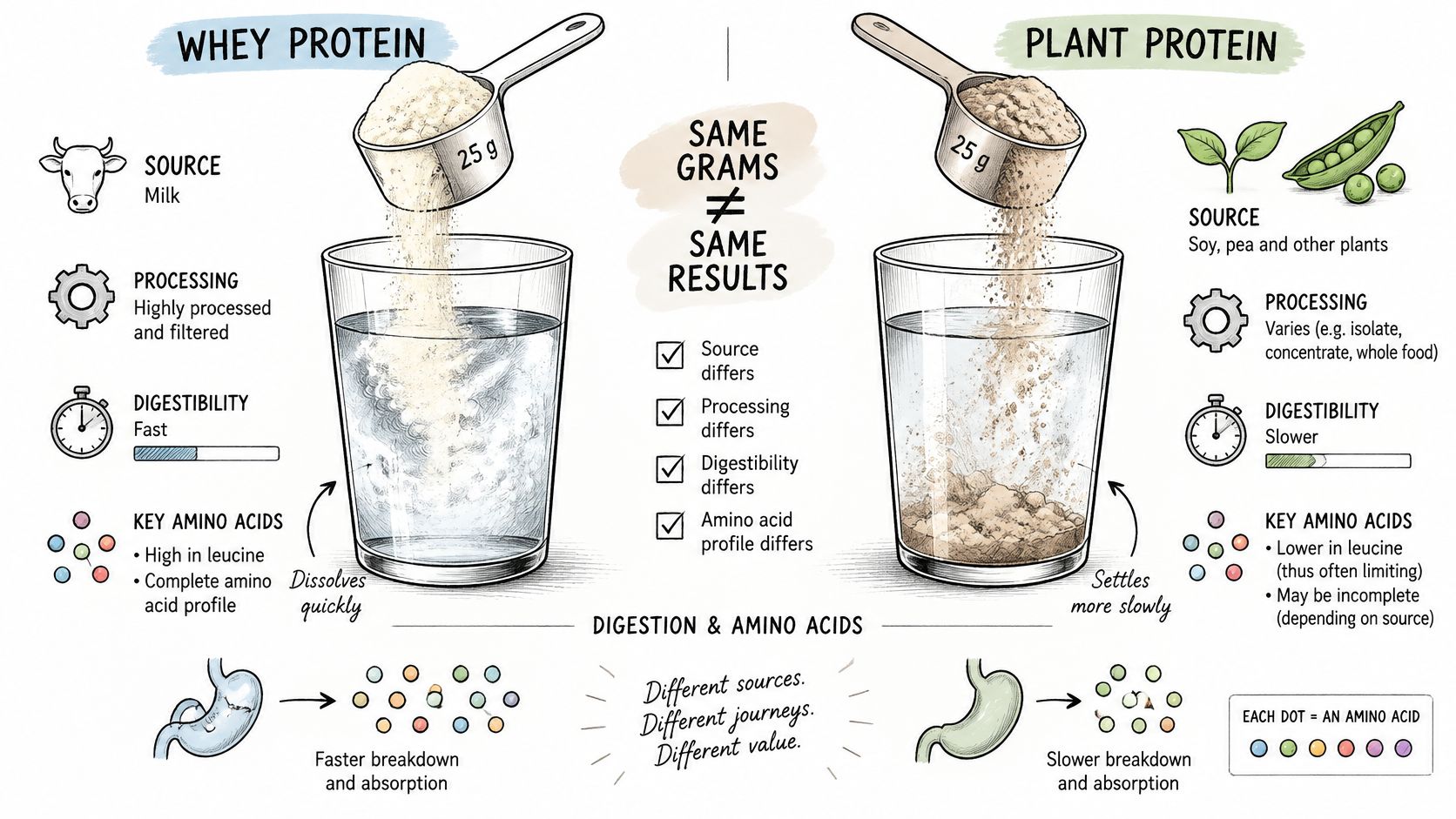
A study of plant proteins during simulated digestion found 61.8% gastric-phase hydrolysis for soybean meal, compared with 14.0% for corn gluten meal. These laboratory findings aren't direct absorption scores for retail shakes, but they illustrate why treating all plant sources as identical is misleading.
Protein powder sources compared by use
| Source | Best use | Mixing | Watch for |
|---|---|---|---|
| Whey | Dairy-tolerant users after training or between meals | Often straightforward in water | Milk allergy; lactose tolerance depends on the product |
| Soy | A practical plant choice for breakfast or a meal component | Use water or a suitable beverage | Soy allergy; amino-acid information when available |
| Pea | A complementary blend or a varied food-based diet | May benefit from blending and resting | Don't rely on the name alone to judge amino-acid balance |
| Rice | A complementary blend rather than the default sole source | Some products remain gritty | Check the blend's composition rather than doubling the serving |
Whey can be a straightforward choice for someone who tolerates dairy. Milk allergy and lactose intolerance are different issues, however, so a product described as low in lactose still isn't appropriate for someone with a milk allergy.
Soy is a useful starting point for vegan shoppers. With pea and rice products, examine the combination of sources rather than assuming that either must be nutritionally inadequate or that every blend is well designed.
Read beyond the plant-based label
When available, compare leucine and essential-amino-acid information alongside total protein. If the label doesn't disclose that information, favor a clearly identified source or complementary blend rather than guessing from marketing terms.
Don't try to repair uncertain protein quality by heaping the scoop. That changes the amount of every ingredient without establishing whether the overall amino-acid profile suits your use.
Different protein categories also need different expectations. When comparing a collagen peptide powder listing, inspect the source and amino-acid information rather than assuming it serves the same purpose as whey or soy.
For another way to consider protein choices, this video provides an additional visual reference.
A dairy-tolerant lifter might choose whey when a meal is delayed. A vegan commuter might use a soy-pea breakfast blend and rely on tofu, legumes, or other foods later.
Neither scenario requires choosing the powder with the longest ingredient list. Plant-based isn't a single nutritional category, so useful instructions should name the source.
Storage Safety and When to Stop
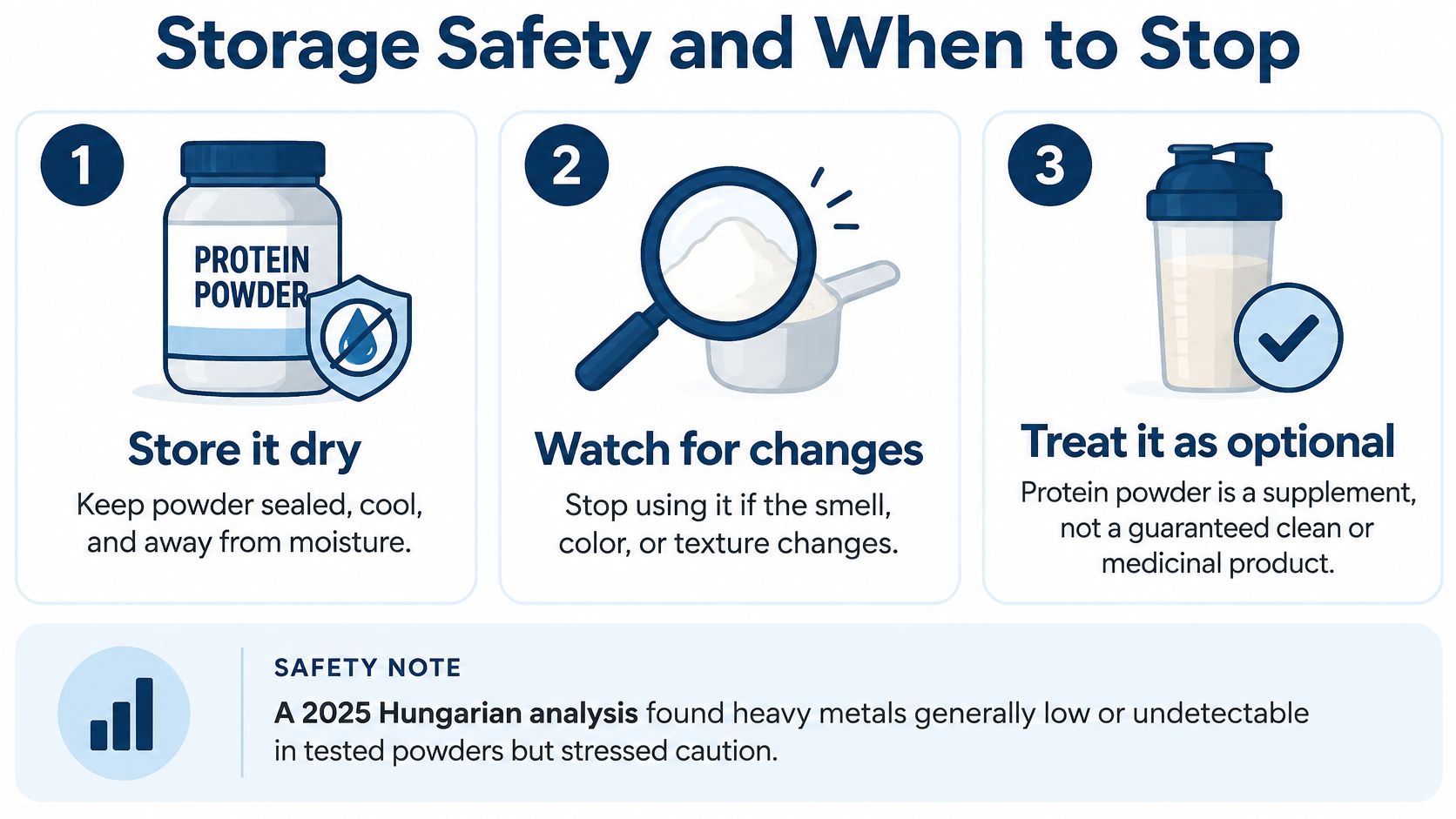
Protein powder is an optional supplement, not a guaranteed contaminant-free or medicinal product. Assess the label, testing information, and storage conditions with the same care you use to assess protein grams.
A 2025 analysis of protein powders sold in Hungary found heavy-metal levels were generally low or undetectable in the tested products, while noting uncertainty around consumer safety when compliance is partly voluntary. That finding supports proportionate caution, not the assumption that every powder is dangerous or that every tub is equally well verified.
Buy and store deliberately
Look for credible independent certification or batch-testing information that identifies what was tested. A broad statement about quality isn't the same as accessible evidence about a particular product.
Choose a container you can realistically finish, and check the seal when it arrives. Keep the product's original label so you retain the ingredient list, storage instructions, and identifying details.
- Keep powder dry. Close the lid securely and store the tub away from stove heat, steam, and damp cupboards.
- Use clean equipment. A wet scoop can introduce moisture into the container.
- Refrigerate prepared shakes promptly. Follow the product's instructions and account for perishable additions such as milk or yogurt.
- Discard suspicious products. Mold, an unusual smell, discoloration, or a compromised seal warrants stopping use rather than tasting to investigate.
This checklist summarizes the storage habits worth making routine.
Clumping can occur after moisture exposure, but appearance alone can't establish safety. If the product has changed unexpectedly or you can't determine whether it was stored properly, don't try to rescue it by blending harder.
Know when to pause
Persistent bloating, diarrhea, or nausea is a reason to review the product and your serving size, not to push through indefinitely. Lactose, sweeteners, added fibers, or other ingredients may be relevant, but symptoms shouldn't be diagnosed from a label alone.
Stop using a product if a rash or another suspected allergic reaction develops. Breathing difficulty or swelling of the mouth or throat requires urgent medical attention.
Ask a clinician or pharmacist before substantially increasing intake if you have kidney disease, are pregnant, take anticoagulants, have diabetes, or experience continuing gastrointestinal symptoms. Bring the actual ingredient panel, including any added vitamins, herbs, or other active ingredients.
Also review the rest of your supplement routine. Combining fortified shakes, multivitamins, and other powders can duplicate ingredients without an obvious benefit.
A useful decision rule: Use a product you can identify, measure, tolerate, and store properly. If any of those conditions fails, pause and reassess.
Run a One-Week Scoop Trial
Treat the coming week as a trial of convenience and tolerance, and measure how well the routine fits your eating. The scoop is a measured way to fill a protein gap when food does not cover your planned intake.
Keep the rest of your supplement routine stable where practical. Introducing several products at once makes it harder to identify which one may be linked to an unpleasant symptom.
Set up a simple record
Use a notebook or phone note to track these details:
| What to record | What it tells you |
|---|---|
| Planned protein from food | Whether meals are likely to cover your target |
| Remaining gram gap | Whether powder has a useful role |
| Product and measured serving | What you consumed |
| Liquid and meal additions | What goes into the finished serving |
| Digestive comfort | Whether the combination suits you |
| Final daily total | Whether the serving addressed the shortfall |
Begin by writing your body weight, chosen target, and expected food intake. Assign a labeled serving to the eating occasion that is hardest to manage, rather than automatically tying it to exercise.
Repeat the routine through the week before adding other products. If food covers the gap on a particular day, record that and skip the powder.
Review the source, not just the flavor
A powder that tastes acceptable in water may be unpleasant in oatmeal, while a gritty blend may work better in a smoothie. Try a different preparation method before changing the amount.
If the label is unclear, don't compensate with a heaped scoop. Choose a product whose serving instructions you can interpret and whose ingredients fit your needs.
Track other sports supplements separately. A sports recovery HMB capsule listing is a different product from protein powder, so record it on its own line.
At the end of the week, review whether you met your planned intake, whether the routine fit your training schedule, and whether digestion remained comfortable. A short trial can help you assess whether the routine is practical for you.
For product information or help identifying a listing, contact Supplemynts at info@supplemynts.com or 1-888-333-8070. Ask your clinician or dietitian about medical suitability and an individualized protein target.
Choose the smallest practical amount that fills the remaining need. You may find that regular use, occasional use, or no powder fits your routine best.
Supplemynts Inc offers protein, powder, and vegan supplement categories. Visit Supplemynts Inc with your calculated protein gap and ingredient requirements in hand, then compare serving information before choosing a product.







Please complete your information below to login.
Sign In
Create New Account