



You've already tried the usual advice. You're drinking more water, adding fiber, and waiting patiently, but your bowel movements are still hard, infrequent, or incomplete. Then you see probiotics for constipation relief and wonder whether they can make a noticeable difference, or whether every supplement promises more than it delivers.
The honest answer is somewhere between hype and dismissal. Probiotics may improve stool frequency and consistency, but benefits vary by strain, constipation type, and the outcome you care about. They aren't a guaranteed overnight fix, and the evidence doesn't show that every probiotic improves transit time or quality of life.
Table of Contents
- Why Constipation Sufferers Are Turning to Probiotics
- How Probiotics Work to Ease Constipation
- What the Clinical Evidence Actually Shows
- Probiotic Strains With the Best Clinical Support
- Dosages Timelines and Realistic Expectations
- How to Choose a Quality Probiotic Supplement
- Safety Side Effects and When to See a Clinician
- Complementary Habits and Your Next Steps
Why Constipation Sufferers Are Turning to Probiotics
Constipation can disrupt more than a bathroom routine. You may spend the morning feeling uncomfortable, postpone plans because you're worried about finding a restroom, or strain without feeling fully relieved. Even when you're eating more fiber and staying hydrated, symptoms can continue because constipation has several possible contributors, including slow movement through the digestive tract, changes in routine, medications, or difficulty coordinating the muscles involved in evacuation.
That frustration explains the interest in probiotics. These live microorganisms are intended to influence the gut environment, rather than force a bowel movement in the way a stimulant laxative can. For some people, that gentler approach sounds appealing, especially when constipation keeps returning.
The important question isn't “Do probiotics work?” It's what do they improve, for whom, and by how much?
A useful way to judge a product is to separate the outcomes:
- Stool frequency: Some adult trials report more bowel movements per week.
- Stool consistency: Softer, easier-to-pass stools may be a meaningful improvement.
- Transit time: Results are encouraging in some reviews but inconsistent across newer evidence.
- Quality of life: A change in bowel movements doesn't automatically mean that daily life feels better.
- Strain performance: A product containing one researched strain isn't equivalent to every product on the shelf.
You'll also need to distinguish chronic idiopathic constipation from IBS with constipation, often called IBS-C, and from pediatric constipation. The evidence isn't equally strong across these groups. A probiotic may be reasonable to test as one part of a broader plan, but persistent symptoms, warning signs, or major changes in bowel habits deserve clinical attention rather than indefinite supplement experimentation.
How Probiotics Work to Ease Constipation
Think of the gut as a busy commuter system. Stool is the traffic moving along the intestinal road, while the microbiome influences the road surface, signaling lights, and local conditions. Probiotics introduce selected microorganisms, but they don't permanently redesign the entire system in one dose.
Key concept: Probiotics shift gut conditions. They don't act like a conventional laxative.
Several biological pathways may explain why a well-matched probiotic helps some people.
Fermentation can change the local environment
Gut bacteria ferment portions of food that the small intestine doesn't fully digest. This process produces compounds, including short-chain fatty acids, that can affect the colon's environment. Fermentation may also help alter stool texture and acidity, which can make the contents of the bowel easier to move.
That doesn't mean a probiotic “adds water” to stool in the same direct way as some laxatives. Instead, it may influence the conditions surrounding stool formation and passage. The practical result, when it occurs, may feel like less straining or a more manageable consistency.
Signals can influence intestinal movement
The intestinal wall contains muscles that contract in coordinated waves. Microbial activity can interact with the chemical signals that help regulate those contractions. If movement is sluggish, changes in this signaling environment may support more regular propulsion.
The gut also communicates with the nervous system through the gut-brain axis. This network helps coordinate motility, sensation, and digestive responses. Stress, sleep disruption, and changes in routine can affect bowel function, so a gut intervention may interact with more than stool itself. The mechanism is complex, and a plausible biological pathway doesn't prove that every commercial product will produce a noticeable result.
Why products behave differently
A probiotic's effects depend on its specific strain, dose, formulation, and the person taking it. Two products may both list “Lactobacillus” or “Bifidobacterium,” yet contain different strains with different clinical evidence. A broad strain count on the front of a bottle doesn't automatically indicate stronger constipation support.
For readers comparing products, a purpose-based option such as Havasu Advanced Prebiotics Probiotics Digestive Support should still be evaluated by its full label, named strains, storage instructions, and intended use rather than by its product category alone.
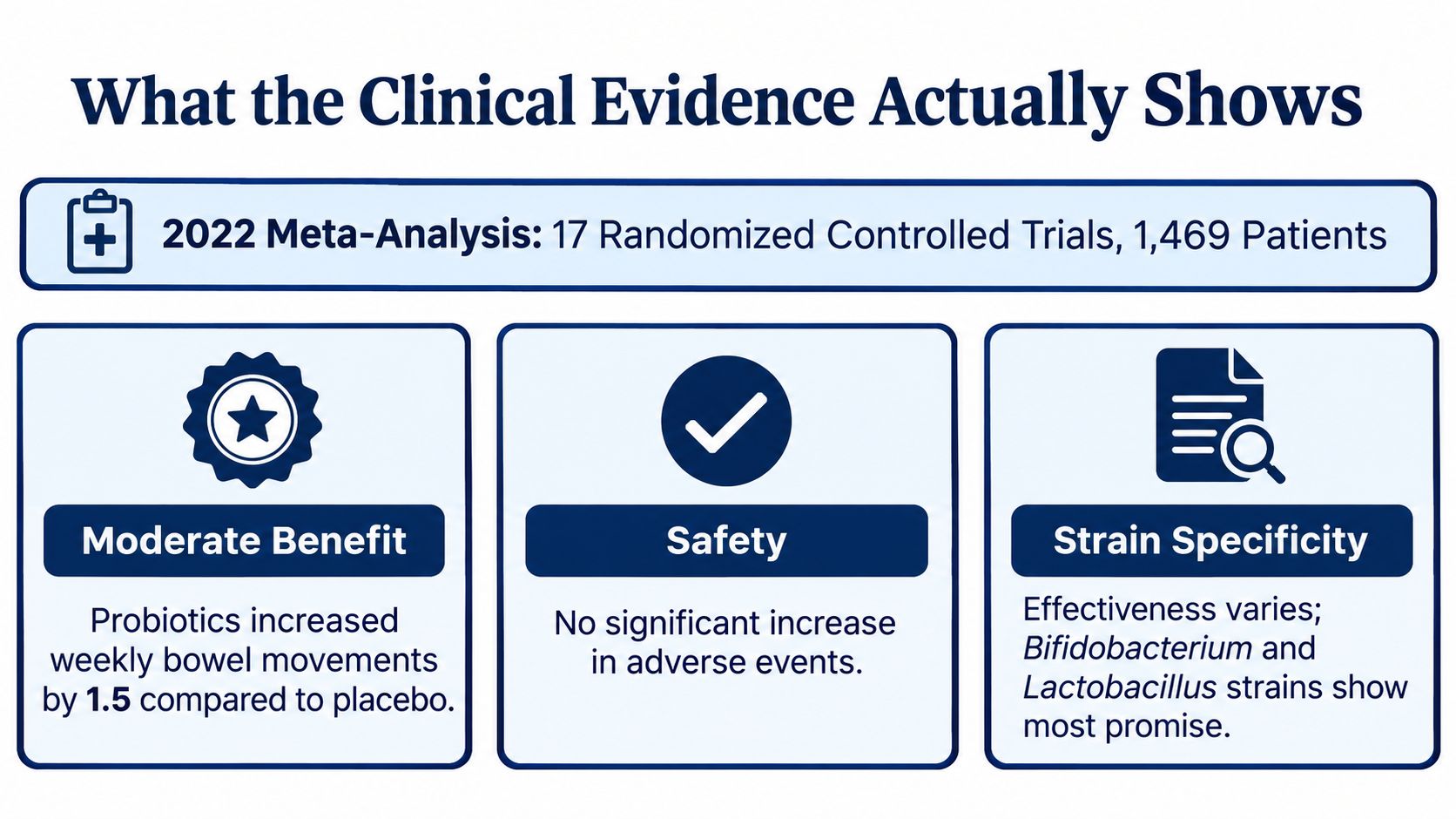
The research visual below summarizes the main clinical themes, but its displayed figures should be checked against the underlying evidence, especially where the graphic simplifies or rounds results.
A short educational video can provide another overview of how probiotic products are commonly discussed:
What the Clinical Evidence Actually Shows
The strongest useful evidence comes from pooled randomized controlled trials, but even pooled research has limits. Different studies may use different strains, doses, treatment periods, constipation definitions, and outcome measures. Combining them can show an overall direction while still leaving uncertainty about which product will work for one individual.
A 2022 systematic review and meta-analysis pooled 17 randomized controlled trials involving 1,469 adults with chronic constipation. It found that probiotics increased stool frequency by 1.29 bowel movements per week, improved stool consistency, and shortened whole-gut transit time by 12.36 hours. The review also reported no serious adverse events, although that finding doesn't mean every person is an appropriate candidate for self-treatment. The full PubMed record provides the methods and results.
Those outcomes translate into changes a reader might notice. A bowel movement may occur more often, stool may be easier to pass, and the time contents spend moving through the gut may decrease. They don't necessarily translate into complete relief, a normal bowel pattern for everyone, or an improvement in the broader experience of living with constipation.
A separate 2020 meta-analysis of randomized controlled trials reported a reduction in whole-gut transit time of 13.75 hours and an increase of 0.98 bowel movements per week in adults with functional constipation. It found the strongest apparent benefit with multispecies probiotics, though the authors also emphasized variation between formulations. You can review that analysis on PubMed.
The outcome gap matters
More recent evidence adds an important qualification. A 2025 meta-analysis found improvements in spontaneous bowel movements and stool consistency, but it didn't find significant improvements in gut transit time or quality of life. That distinction matters because consumers often use “relief” to mean feeling less bloated, less restricted, and more comfortable, not just producing another bowel movement. The 2025 review discusses these different outcomes.
So, the most defensible summary is narrow:
- Probiotics may increase bowel movement frequency.
- They may improve stool consistency.
- Transit-time benefits are not consistent across all syntheses.
- A measurable stool change doesn't guarantee better quality of life.
- Results depend heavily on the specific strain or blend.
That's encouraging enough to justify a careful trial for some adults, but not strong enough to treat all probiotics as interchangeable or to promise a universal cure.
Probiotic Strains With the Best Clinical Support
“Probiotics” describes a category, not a single intervention. The relevant unit is often the strain, identified by a genus, species, and strain designation. Evidence for one strain shouldn't automatically be transferred to another just because both belong to the same species.
A 2022 systematic review found the strongest stool-frequency signal for Bifidobacterium lactis, rather than for mixed blends or particular products containing Bacillus coagulans Unique IS2 and Lactobacillus casei Shirota. The review's overall standardized mean difference for stool frequency was 0.71, with substantial statistical support. See the strain-focused review on PubMed.
| Strain or Blend | Best-Supported Outcome | Evidence Confidence |
|---|---|---|
| Bifidobacterium lactis | Stool frequency in adults with chronic constipation | More promising than the compared strains in the cited review, but product-specific evidence still matters |
| Lactobacillus casei Shirota | Several constipation symptoms in some evidence syntheses | Suggestive, but not proof that every product containing the species will work |
| Bacillus coagulans Unique IS2 | Constipation outcomes studied in clinical research | Less consistent than the strongest B. lactis signal |
| Multispecies blends | Stool frequency and some functional constipation outcomes | Potentially useful, with the strongest benefit in one earlier analysis, but formulations vary widely |
This table isn't a ranking of products. It's a reminder to match the label to the evidence. A blend may contain a researched species without containing the exact strain, dose, or combination tested in a trial.
The evidence also changes by population. For IBS-C, probiotics may improve stool consistency, but certainty is low to very low and the reported benefit is modest. In children, a 2025 umbrella review found a statistically significant but small overall effect, with an odds ratio of 1.17 and a 95% confidence interval of 1.01 to 1.37. The review is available through Nutrients.
That makes the practical choice fairly clear: prioritize a product that names its strains and has human randomized trial evidence relevant to your constipation pattern. Don't assume a higher strain count means a better result.
Dosages Timelines and Realistic Expectations
The label may advertise CFUs, or colony-forming units. This is an estimate of the number of viable microorganisms in a serving under the product's stated conditions. A large CFU number can sound persuasive, but it doesn't tell you whether the included strains have evidence for constipation.
Look for the strain designation, not only the genus and species. Then check whether the company states the CFU amount through expiration, rather than only at the time of manufacture. Follow storage instructions carefully, because heat, moisture, and handling can affect viability.
Give the trial enough time
There isn't one universally established dose or schedule that applies to every constipation-focused probiotic. The clinical studies use different formulations, and recent guidance has acknowledged uncertainty about the most effective strains and treatment durations. A practical approach is daily use according to the product label, with a consistent routine that makes it easier to judge the effect.
Evaluate changes over several weeks, rather than deciding after a single serving. Track:
- Stool frequency
- Stool hardness or ease of passage
- Straining
- Bloating and abdominal discomfort
- Whether you feel completely emptied
A reasonable expectation is a modest change, not an instant transformation. The adult meta-analyses found increases close to roughly one additional bowel movement per week, depending on the population and analysis, alongside possible improvements in consistency. Those results describe averages across groups, not a promise for your body.
If nothing changes after a fair, consistent trial, don't keep increasing the dose indefinitely. Recheck your fiber, fluids, medications, and constipation type with a clinician or pharmacist. If a probiotic remains appropriate, switching to a product with a different strain profile may make more sense than abandoning the entire category. A high-count product such as 100 Billion CFU Ultimate Probiotic still needs to be judged by its named strains and suitability, not by CFU count alone.
How to Choose a Quality Probiotic Supplement
Start with the label, not the marketing headline. A useful product should make it possible to identify what you're taking and how the manufacturer expects you to store it.
Use this label checklist
- Named strains: Look for full designations where available, rather than a vague proprietary blend.
- CFUs at expiration: Prefer a label that explains how viability is measured and guaranteed.
- Storage instructions: Follow refrigeration or room-temperature guidance exactly.
- Serving directions: Check whether the stated amount refers to one capsule, multiple capsules, or a powder serving.
- Testing information: Look for transparent quality-control or third-party testing details, while remembering that a testing logo doesn't prove constipation effectiveness.
- Purpose alignment: Choose a formula connected to digestive support and relevant human evidence, not merely the largest number on the bottle.
Combination products can suit shoppers who want several daily functions in one format. For example, SmartyPants Organics Men's Formula Multivitamin & Probiotics gummies pair probiotics with a multivitamin, but that combination doesn't make them a constipation-specific treatment. Read the Supplement Facts panel to determine whether the strains and doses fit your goal.
The same careful approach applies when a digestive product is part of a broader supplement routine. People managing several medications, mobility limitations, or complex health needs may benefit from practical medication coordination resources, including explore med management for homebound from Life Primary Care.
A product such as Vital Performance Strawberry Protein Powder – Grass-Fed Recovery Formula with Collagen Peptides | 25g Protein | NSF Certified for Sport | 26.8 oz is a lactose-free, strawberry-flavored powder providing 25 g of complete protein, including 10 g of collagen, per serving. It's a protein product, not a probiotic, so it shouldn't be selected as a substitute for a strain-supported constipation formula.
Safety Side Effects and When to See a Clinician
“Natural” doesn't mean risk-free. Probiotics can cause temporary gas, bloating, or abdominal discomfort, particularly when someone starts a new product. These effects may settle, but worsening symptoms are a reason to stop and reassess rather than push through automatically.
People with compromised immune systems, serious underlying illness, or significant medical complexity should ask a clinician before using a probiotic supplement. The same applies if you're taking medications that require careful timing or monitoring. A pharmacist can review your complete medication and supplement list, including products that seem unrelated to digestion.
Clinical trial findings can reassure us about the studied groups, but they don't eliminate individual risk. The 2022 meta-analysis reported no serious adverse events, yet that result shouldn't be read as a guarantee of safety for every person or every commercial formulation.
Know when constipation needs evaluation
Arrange medical care instead of relying on self-directed probiotics if you notice:
- Blood in the stool or rectal bleeding
- Unexplained weight loss
- Severe or persistent abdominal pain
- A lasting change in your usual bowel pattern
- Alternating constipation and diarrhea
- Vomiting, inability to pass gas, or marked abdominal swelling
- A sudden new pattern of constipation later in adulthood
A clinician can look for medication effects, thyroid problems, IBS-C, pelvic floor dysfunction, obstruction, or other causes that a supplement won't correct. Don't use a probiotic to delay evaluation of symptoms that feel severe, unusual, or rapidly progressive.
Complementary Habits and Your Next Steps
Probiotics work best as one lever in a larger bowel-health routine. If stool is dry because fluid intake is inadequate, or if a medication is slowing motility, changing the microbiome alone may not solve the problem. A practical plan addresses several contributors without changing everything at once.
Build the routine gradually
Increase fiber slowly, especially if you already experience bloating. Beans, lentils, vegetables, fruit, oats, and other whole-food sources can support stool bulk, but a sudden increase may make discomfort worse. Pair fiber changes with appropriate fluid intake, unless a clinician has given you a fluid restriction.
Regular movement can also support digestive rhythm. A walk, gentle mobility work, or brief movement breaks during a sedentary day may be more realistic than an intense new exercise program. Try to respond to the urge to go instead of repeatedly delaying it, and notice whether your symptoms began after a medication or routine change.
Some constipation is related to pelvic floor coordination rather than slow stool movement. If you strain, feel blocked, or can't empty despite soft stool, ask a healthcare professional whether pelvic floor therapy for constipation could be relevant.
For added dietary support, a product such as Futurebiotics Colon Green Fiber Supplement should be considered alongside your total fiber intake, fluid needs, and personal tolerance. More fiber isn't automatically better if your body can't handle a rapid increase.
A simple evaluation plan looks like this:
- Identify the pattern: Note frequency, consistency, straining, incomplete evacuation, and warning symptoms.
- Choose deliberately: Select a product with named strains and evidence relevant to your constipation type.
- Use it consistently: Follow the label and avoid changing several supplements at the same time.
- Review the result: After several weeks, decide whether frequency, consistency, or comfort has meaningfully changed.
- Escalate appropriately: Contact a clinician if symptoms persist, worsen, or include red flags.
Realistic success may mean softer stools, less straining, or a modestly more regular pattern. It doesn't have to mean perfect daily bowel movements, and a lack of improvement isn't a personal failure. It may indicate that the selected strain isn't a match or that another cause needs attention.
Supplemynts Inc offers purpose-based categories for digestive health, probiotics, fiber, vitamins, minerals, herbs, and proteins, with product information, direct support, free shipping within the continental United States, and a 60-day return policy. Visit Supplemynts Inc to compare strain-labeled digestive products and choose your next step with a clearer understanding of what probiotics can and can't do.









Please complete your information below to login.
Sign In
Create New Account