


Pick the probiotic with the most strains and the highest count, and take it every day forever. That's the advice many shoppers hear, and it's a poor way to judge probiotic supplements benefits. Probiotics aren't interchangeable vitamins. You're choosing live microorganisms, and whether one helps depends on the exact strain, the dose that was studied, your health goal, and your own risk profile.
Table of Contents
- Why Probiotic Benefits Depend on the Product
- Understanding What Probiotics Are
- Exploring the Best-Supported Digestive Benefits
- Assessing Immune and Mental Health Claims
- How to Choose a Probiotic Supplement
- Recognizing Safety Risks and Higher-Risk Groups
- Storing and Using Probiotics Wisely
- Making a Final Probiotic Decision
Why Probiotic Benefits Depend on the Product
A label that says Lactobacillus tells you very little. It names a broad group, not the specific organism researchers tested. Just as buying seeds labeled only as "vegetable" would not lead you to expect every seed in that packet to grow the same plant, thrive in the same soil, or solve the same problem in your garden, so too does this situation apply here.
Probiotics work in a similar matching way. Researchers don't study "probiotics" as one uniform thing. They study a named strain, at a particular dose, in a particular group of people, for a defined outcome such as preventing diarrhea during antibiotic use. Change any part of that match and the result may change too.
What a broad claim leaves out
Packages often lean on wide language about digestive balance or immune support. Those phrases don't answer the questions that matter for a purchase decision.
- Which organism is it: Is the strain identified beyond genus and species, or is it hidden inside a blend?
- What outcome was measured: Was the goal prevention, shorter symptoms, or something vaguer like general wellness?
- Who took it: Were participants children, healthy adults, older adults, or people taking antibiotics?
- How much stayed viable: Does the count apply at manufacture or through the end of shelf life?
Matching rule: A benefit belongs to a specific strain used for a specific purpose in a specific person, not to every capsule on the shelf.
That doesn't mean probiotics have no value. It means the useful question isn't "Do probiotics work?" It's "Does this product, at this dose, have evidence for what I want, and is it appropriate for me?" When you ask it that way, label reading gets easier and disappointment gets less likely. You'll also spot the moment a claim stretches beyond its evidence, because the strain, population, or endpoint won't line up with your situation.
Understanding What Probiotics Are
Your gut already contains a large community of bacteria, yeasts, and other microbes. Picture it as an established garden rather than an empty plot. A probiotic adds live microorganisms to that garden. It doesn't clear the plot and start over, and it doesn't replace what was already growing there.
Many probiotic organisms pass through your digestive tract without taking up permanent residence. That's normal, and it's an important distinction. Transient passage means the organisms are present while you're taking the product and for a period afterward. Permanent colonization would mean they've settled in long term, which you shouldn't assume from a label.

Reading the names and numbers
Probiotic names work like a narrowing address. The genus is the broad neighborhood, the species narrows it to a street, and the strain is the house number. Two products can share a genus and species yet contain different strains, and you can't assume they'll behave identically.
Dose is expressed in colony-forming units, or CFU. That number estimates how many organisms are viable, meaning alive and able to grow. A bigger number isn't automatically better. What matters is whether the amount resembles what researchers used for your goal, and whether the organisms are still viable when you take them.
Foods, supplements, and prebiotics
Fermented foods can contain live microbes, but the organisms and amounts often vary and may not be identified to strain level. Supplements can offer a more defined identity and dose, though labels don't all provide the same detail. Prebiotics are different again. They're substrates, often fibers, that microbes can use, rather than live organisms themselves. A shopper comparing categories might look at a prebiotic powder listed in the Supplemynts catalog alongside probiotic products, but the two shouldn't be treated as the same purchase.
Put together, identity, viability, dose, purpose, and your own health context form one picture. If any piece is missing, you don't yet have enough information to predict a benefit.
Exploring the Best-Supported Digestive Benefits
The clearest evidence for probiotic supplements benefits concerns defined digestive outcomes, not all-purpose gut support. Two examples show why precision matters. Both involve diarrhea, but they're different problems, studied in different people, with different roles for a supplement.
Acute infectious diarrhea
This is diarrhea caused by an infection, and the evidence here centers largely on children. A 2020 Cochrane review of probiotics for acute infectious diarrhea covered 82 randomized controlled trials and 12,127 participants, and it found probiotics reduced the risk of diarrhea lasting at least 48 hours by 36%, with a pooled risk ratio of 0.64 and a 95% confidence interval of 0.52 to 0.79, while shortening episodes by an average of 21.3 hours.
Read those numbers carefully. A shorter episode can matter, especially for a child, but the average effect is modest rather than dramatic. Earlier analyses in the same evidence base found an average reduction of approximately 0.67 days in children, as reported in the Cochrane review linked above in textual discussion of prior work. When the reviewers limited their analysis to studies at low risk of bias, the benefit was no longer statistically clear. That's not a reason to dismiss the findings. It's a reason not to turn them into a guarantee for every product or every illness.
Probiotics in this setting are an adjunct, an add-on. They don't replace oral rehydration, which addresses fluid loss, and they don't replace medical assessment when a child or adult is worsening. Cause matters too, since not every episode of diarrhea has the same origin or severity.
Antibiotic-associated diarrhea
Antibiotics can disturb gut microbes while they treat an infection, and diarrhea sometimes follows. Here the goal is prevention during a defined window of risk. A 2021 systematic review and meta-analysis on probiotics with antibiotics reported that co-administering probiotics with antibiotics reduced the risk of antibiotic-associated diarrhea in adults by 37%, with a pooled risk ratio of 0.63 and a 95% confidence interval of 0.54 to 0.73. A separate review described in that evidence base, covering 23 studies and 3,938 children, found an absolute risk reduction of 11% and a number needed to treat of 10. Another pooled analysis in the same body of evidence found diarrhea in 8.0% of probiotic users versus 17.7% of controls, a risk ratio of 0.49.
That number needed to treat is worth pausing on. It means many people take the product without being the one case prevented, because not everyone would have developed diarrhea anyway. Effects also depend on strain, timing, dose, age, and baseline risk, and evidence is less consistent in adults aged 65 years and above. Digestive enzyme products, such as an AbsorbAid digestive enzyme option in the store catalog, belong to a different category and shouldn't be confused with live probiotic organisms.
Digestive benefits and their limits
| Health context | Evidence summary | Practical interpretation |
|---|---|---|
| Acute infectious diarrhea | Risk of diarrhea lasting at least 48 hours fell by 36% and episodes shortened by 21.3 hours on average in the Cochrane findings cited above | Possible adjunct, mainly studied in children, never a substitute for rehydration or care |
| Antibiotic-associated diarrhea in adults | Risk fell by 37% when probiotics were co-administered with antibiotics in the 2021 analysis cited above | Prevention during antibiotic use, with results varying by strain and person |
| Antibiotic-associated diarrhea in children | Absolute risk reduction of 11%, number needed to treat of 10, in the separate review cited above | Helpful for some, but most treated children aren't the prevented case |
Assessing Immune and Mental Health Claims
Step outside those digestive outcomes and the language on packages gets broader while the reasoning gets thinner. You'll see immune support, mood, focus, and stress claims sitting beside digestive ones as if they all rest on the same footing. They don't, and treating them as equal is where shoppers most often overpay for hope.
Three kinds of statement that look alike
A useful habit is to sort any claim into one of three buckets before you believe it.
- A mechanism: Scientists can describe a plausible pathway, such as microbes interacting with immune tissue in the gut. A pathway shows something could happen.
- An association: People with a certain microbial pattern also tend to report a certain outcome. Association doesn't show that adding a capsule changes the outcome.
- A demonstrated effect: A defined strain, given to a defined group, changed a measured clinical endpoint compared with a control. Only this bucket supports a treatment style claim.
Immune claims frequently live in the first two buckets. The gut and immune system interact constantly, so the research interest is real. But "supports immune health" doesn't tell you which endpoint improved, in whom, or by how much. Without a strain, a population, and an outcome, you can't judge whether the product matches you.
The gut and brain connection
The gut-brain axis describes signaling between the digestive tract and the brain. It's a genuine area of active research, and it's often used in marketing as if the map were the destination. Knowing two systems communicate doesn't establish that a supplement treats depression, anxiety, or cognitive conditions. Those are clinical diagnoses that need clinical evidence and, when symptoms are present, professional care.
A biological connection is an invitation to study something, not proof that a product treats it.
None of this makes immune or mental health research worthless. It means you should hold those claims to the same standard you'd apply to diarrhea outcomes. If a seller can't point to a specific strain and a specific measured result, treat the claim as exploratory rather than established, and don't let it drive your choice.
How to Choose a Probiotic Supplement
Start with your goal, not with a brand. "I want better digestion" is too loose to shop with. "I want to lower my chance of diarrhea while I take this antibiotic" is a goal you can match to evidence, timing, and a stopping point.
The checklist below gives you a visual order for that process before you compare individual labels.
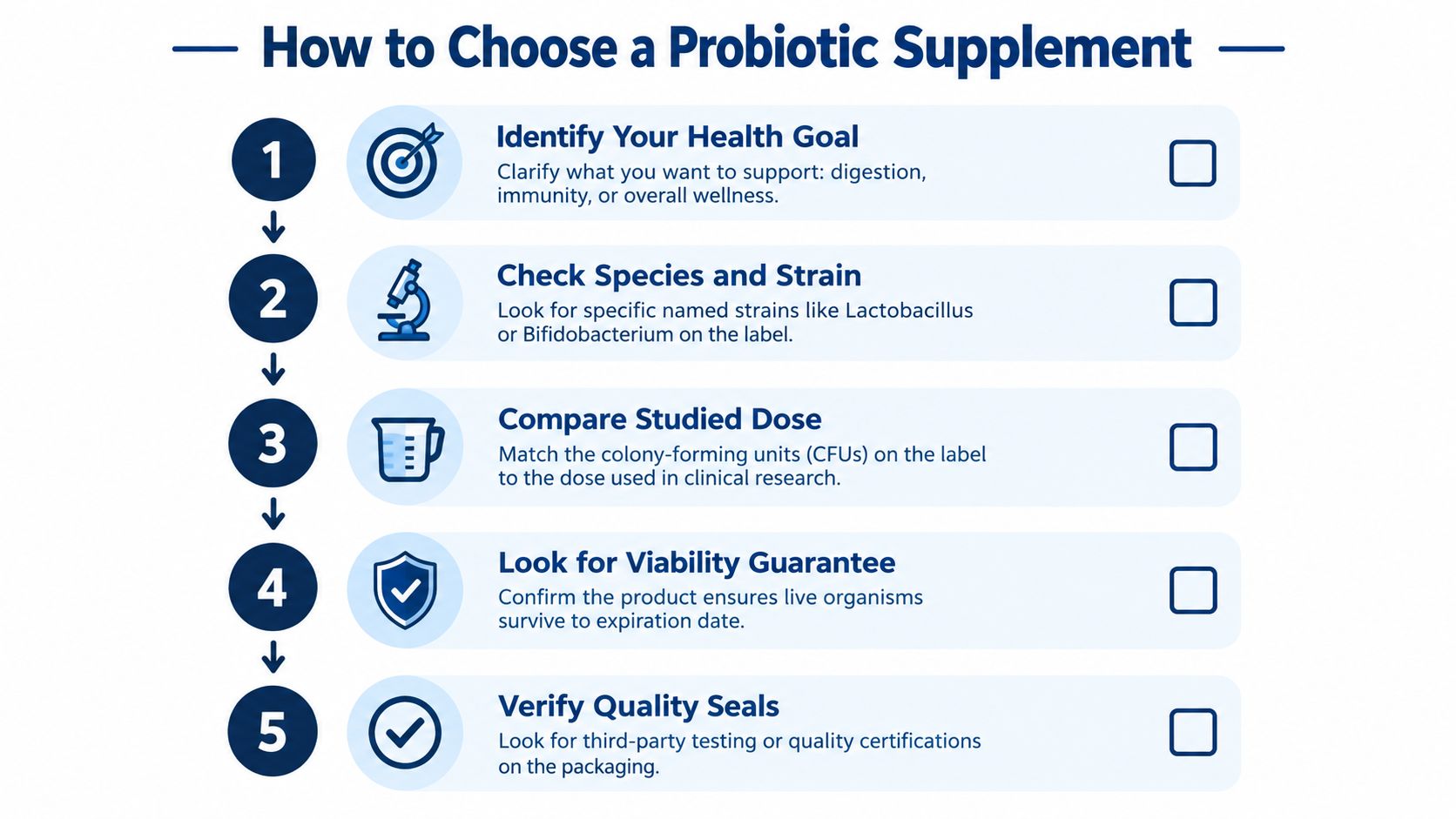
A strain first buying sequence
- Name the outcome: Write down the single result you want and the period you'll judge it over.
- Identify the organism: Look for genus, species, and strain, especially inside blends where amounts per strain may be unclear.
- Compare the dose: Check whether the labeled CFU resembles the studied regimen rather than chasing the largest number.
- Check viability wording: Prefer a guarantee through the end of shelf life over a count given only at manufacture.
- Read the practical details: Confirm storage directions, serving instructions, allergens, and whether extra ingredients fit your dietary needs.
Lactobacillus rhamnosus GG, usually shortened to LGG, shows why step two matters. A meta-analysis summarized in the NIH probiotics fact sheet for health professionals covered 12 randomized controlled trials and 1,499 children and adults, and it reported that studied LGG regimens reduced antibiotic-associated diarrhea incidence from 22.4% to 12.3%, an absolute reduction of 10.1 percentage points and an approximate number needed to treat of 10. The same summary describes studied doses of approximately 4 × 10^8 to 1.2 × 10^11 CFU daily for 10 days to 3 months. An unspecified Lactobacillus on another label isn't interchangeable with that strain or those regimens.
For a general orientation to combining categories, AloeCure's pre and probiotic supplement tips offer useful background reading alongside label checks. When you're browsing actual listings, you'll encounter products positioned for particular audiences, including NatureWise Time Release Probiotics Women Care 90 Billion 40 Capsules and a daily probiotic listing aimed at feminine balance. Treat audience positioning as a starting filter only. The strain identity, dose, viability statement, and your goal still decide whether either listing fits.
The short video below is a helpful pause point to review the sequence before you look at safety screening.
Recognizing Safety Risks and Higher-Risk Groups
"Its natural, so it can't hurt me" is the most dangerous shortcut in supplement shopping. Probiotics are living organisms. For most healthy adults the common complaint is mild, but that's not the whole story, and it isn't the story for everyone.
Consumer guidance from the NIH Office of Dietary Supplements notes that probiotics can cause gas in healthy individuals, that serious infections have been reported in people with weakened immune systems or severe illness, and that the FDA has warned about potentially life-threatening infections in preterm infants. That same guidance makes clear there are no recommendations covering probiotic use by all healthy people, which should temper any claim that everyone ought to take one daily.
Screen yourself before you buy
Work through these questions. A yes to any of them means a clinician conversation comes first, not a checkout.
- Age extremes: Is the product for an infant, especially a preterm infant, or for a very young child?
- Immune status: Do you have a weakened immune system, or take treatment that suppresses it?
- Serious illness: Are you severely ill, hospitalized, or recovering from major surgery?
- Central venous access: Do you have a central line or similar device in place?
- Underlying disease: Do you live with severe underlying conditions that affect infection risk?
- Pregnancy or infancy: Are you pregnant, or choosing a product for a baby?
- Concurrent treatment: Are you mid treatment for an infection or another condition where timing matters?
Symptoms that aren't a supplement problem
Some situations call for care, not experimentation. Don't self-treat with a probiotic if you have fever, worsening illness, severe abdominal pain, or persistent diarrhea. Those signs can point to conditions where delay carries real cost, and a capsule won't clarify what's happening.
There's also a quieter limitation you should understand. Safety reporting in probiotic research can be inconsistent, follow-up is often short, and samples are frequently small. That combination may miss rare or strain-specific harms. So "no increase in adverse events was observed" isn't the same as "zero risk is proven."
Safer default: A short, defined trial for a clear purpose is easier to justify than indefinite daily use with no outcome in mind.
In the United States, over the counter probiotics are sold as supplements rather than drugs, so their claims and effectiveness aren't established the way prescription medicines are. That gap puts more of the screening burden on you, which is exactly why the checklist above matters.
Storing and Using Probiotics Wisely
A well chosen strain can still disappoint if the organisms aren't viable when you swallow them. Storage isn't glamorous, but it's where label promises meet your kitchen counter, your mailbox in summer, and a bathroom cabinet full of steam.
Heat and moisture are the usual enemies of viability, and products differ in how they handle both. Some require refrigeration, others are formulated to be shelf stable. Don't guess from the category. Follow the storage directions printed on the product you bought, because those directions reflect that formulation, not probiotics in general.
The photo below is a useful reminder to pair the product with its storage location and its date, rather than treating it like any other bottle.
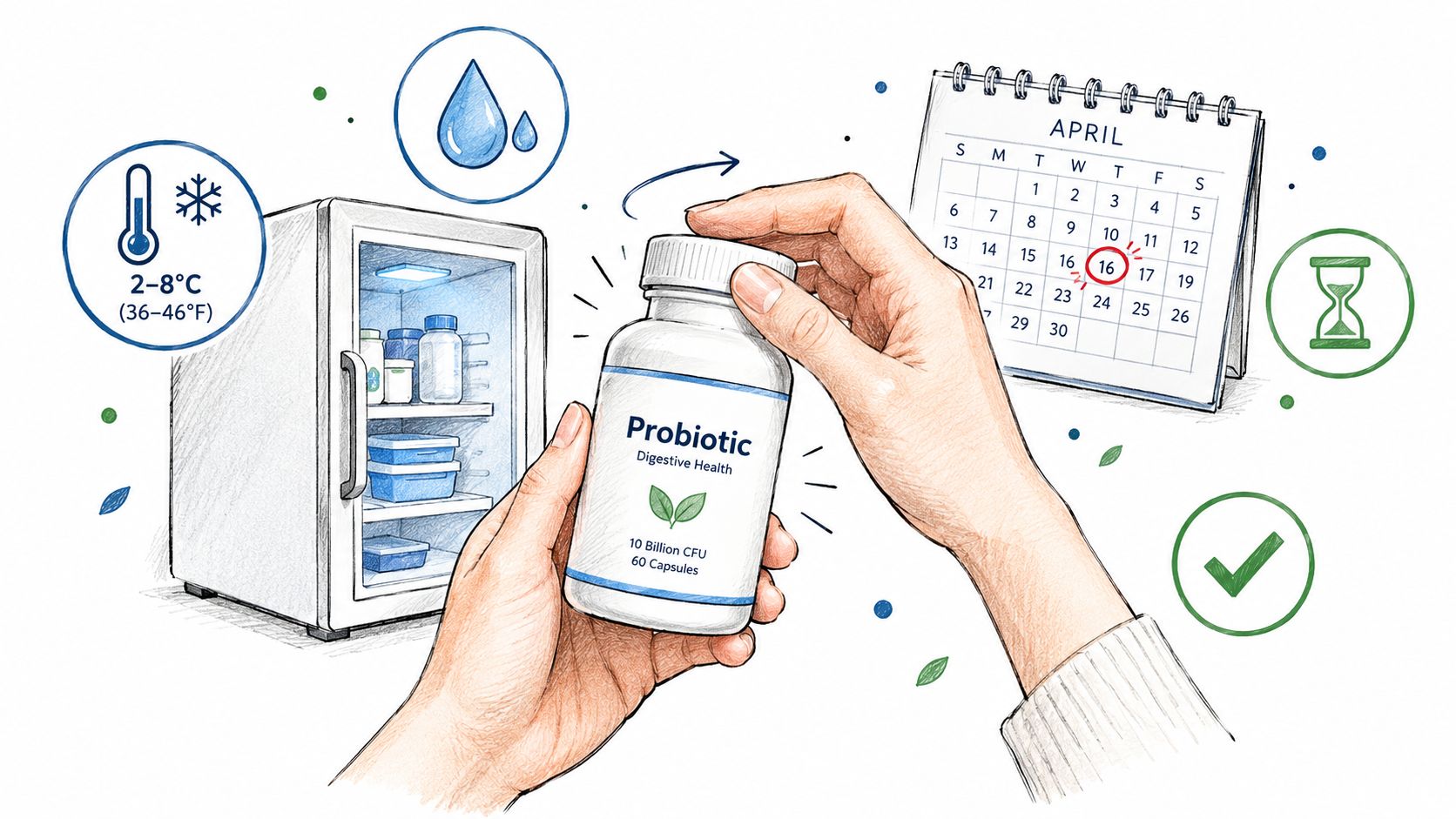
A practical home routine
- Check the date first: Note the expiration date and whether the CFU guarantee runs to that date.
- Store as directed: Refrigerate only if the label says so, keep the container sealed, and reseal it promptly after each use.
- Keep it dry: Avoid steamy spots when the label calls for a cool, dry place, and don't transfer capsules into unsealed containers.
- Follow serving instructions: Take it with or without food as directed, and don't stack extra products unless a clinician advises it.
- Track your trial: Write down your goal, start date, and planned review date so continued use is a decision, not a habit.
Consider a shopper comparing two bottles. One states its count through expiration and gives clear storage directions. The other gives a count without saying when it applies and says little about storage. She doesn't need to invent specifications for either. The first label gives her more verifiable information, and she can store it with confidence that she's following its conditions.
Replace a product when it's past its date, when packaging is damaged, or when it's been left in conditions the label warns against. When in doubt, follow the packaging rather than hoping the organisms survived.
Making a Final Probiotic Decision
Bring the pieces together in order. Name one health goal, find the evidence that addresses it, then verify the exact strain and a comparable dose on the label. Check the viability guarantee and storage directions, and run the higher-risk screening before money changes hands.
The best probiotic for you isn't the one with the boldest generic claim or the longest strain list. It's the one whose evidence, labeling, and intended use align with a purpose you can state in one sentence.
Decide in advance whether you're running a defined trial with a review date or defaulting to indefinite daily use. The defined trial usually makes more sense. If you're in a higher-risk group, pregnant, choosing for an infant, severely ill, or dealing with warning symptoms, professional medical advice takes priority over self-selection every time.
Supplemynts Inc organizes probiotic supplements alongside digestive health, vitamins, minerals, herbs, and proteins, so you can compare labels by strain, dose, and intended use rather than by headline claims alone. Browse the categories, use the screening and storage checks from this guide as you shop, and visit Supplemynts Inc to review product details before you decide.







Please complete your information below to login.
Sign In
Create New Account