


Prebiotic fiber supplements get sold like a one-size-fits-all gut fix, but that's the wrong mental model. They're more like a targeted tool, and whether they help depends on what your diet already looks like, how your microbiome is set up, and how much fermentable fiber your gut can tolerate without complaining.
That's why two people can take the same product and have very different results. One person may already eat a high-fiber, plant-diverse diet and notice little change, while another, starting from a low-fiber processed diet, may feel a clear shift in bowel habits, gas, or comfort, sometimes all at once.
At the simplest level, prebiotic fiber supplements are non-digestible carbohydrates that reach the colon and selectively feed beneficial microbes. That makes them different from probiotics, which add live organisms, and different from generic fiber blends, which may bulk stool without strongly feeding the bacteria you're trying to support.
Table of Contents
- Why Prebiotic Fiber Supplements Are Not a Universal Fix
- Understanding the Main Types of Prebiotic Fibers
- What the Evidence Shows About Prebiotic Benefits
- Whole Food Sources Versus Supplement Forms
- Dosing Strategies and Managing Digestive Tolerance
- How to Read Labels and Choose a Quality Product
- Key Takeaways and Frequently Asked Questions
Why Prebiotic Fiber Supplements Are Not a Universal Fix
The biggest mistake people make is assuming that a prebiotic works the same way in every body. The evidence points in the opposite direction, response varies with baseline fiber intake, existing gut ecology, and digestive tolerance, which means the supplement is only part of the story.
A low-fiber eater may create a very different fermentation environment than someone already eating legumes, oats, vegetables, and whole grains. In the 2026 report on fiber response, people with higher baseline fiber intake showed a more pronounced microbiome response to a soluble prebiotic, while low-fiber participants didn't benefit as strongly, which is a reminder that who should take it matters as much as what it is (NutraIngredients summary of the 2026 study).
What a prebiotic actually does
Prebiotics are not bacteria, and they're not a generic digestive shortcut. They're food for certain microbes, and once those microbes ferment the fiber, they produce metabolites that can influence bowel function and gut signaling.
Practical rule: if your current diet is already rich in diverse fiber, a supplement may add only a small extra effect. If your diet is sparse in plant foods, the same supplement may feel much more noticeable, for better or worse.
That's also why “more” isn't automatically “better.” A person with a processed, low-fiber eating pattern may be more likely to feel bloating when they jump in too fast, because the microbiome hasn't had time to adapt. The point of prebiotic supplementation isn't to overwhelm the gut, it's to nudge it in a direction your body can tolerate.
Understanding the Main Types of Prebiotic Fibers
“Prebiotic” describes a function, not a single ingredient. The fiber's structure affects its food source, fermentation speed, the microbes it may support, and the likelihood of gas or bloating. Your baseline diet and gut status also matter, so the same product can feel quite different from one person to another.
Common label terms include inulin, fructooligosaccharides (FOS), galactooligosaccharides (GOS), resistant starch, and partially hydrolyzed guar gum (PHGG). A clear explanation of what prebiotics and probiotics do can help separate fibers that feed existing microbes from probiotic products that contain live microorganisms.
| Fiber Type | Common Source | Target Bacteria | Typical Dose | Tolerance Level |
|---|---|---|---|---|
| Inulin | Chicory root | Often used to support bifidobacteria | Usually in the gram range, with trials showing effects around 5 to 8 g/day (peer-reviewed review) | Lower tolerance for many people |
| FOS | Chicory, onions, and related plant sources | Commonly bifidogenic | Human review data show 10 g/day was enough to trigger a bifidobacterial bloom, while 2.5 g/day was not | Often gas-producing at lower doses |
| GOS | Legume-derived and manufactured sources | Often used to favor bifidobacteria | Effective gram-level intake in the same review range | Usually moderate, but still dose-sensitive |
| Resistant starch | Cooked-and-cooled potatoes, rice, legumes | Supports broader fermentation patterns | Product-dependent, often used as part of a higher-fiber strategy | Often gentler than inulin-type fibers |
| PHGG | Processed guar bean fiber | Used for bowel comfort and regularity support | Commonly used in gram-level supplements | Often better tolerated than highly fermentable fibers |
Fermentability is the practical dividing line. Inulin and FOS tend to ferment quickly, so they may produce more gas. PHGG and some resistant starch products are often easier to tolerate. This difference can matter more than front-label claims, particularly for someone whose diet contains little plant fiber.
Dose response is not universal. A person already eating legumes, vegetables, oats, and whole grains may have a different starting point from someone adding a concentrated fiber to a low-fiber diet. Start with the product's ingredient and serving information, then assess tolerance before increasing intake.
For a concrete example, NOW NutraFlora FOS Pure Powder 4 oz Prebiotic Fiber Supplement is a concentrated FOS powder. Its clearly identified ingredient makes it easier to evaluate the fiber type separately from the product's marketing.
What the Evidence Shows About Prebiotic Benefits
Prebiotic fiber supplements are not a universal health fix. Their clearest effects occur in the gut: a fermentable fiber reaches the colon, feeds certain microbes, and changes stool bulk, gas production, and short-chain fatty acid formation. Bowel regularity is therefore often the first noticeable outcome.
The biological mechanism is well established, but clinical outcomes still depend on individual fiber tolerance and baseline diet. Short-chain fatty acids are associated with gut and metabolic functions, including insulin sensitivity, but the result varies with fiber type, dose, and the person's existing eating pattern (2024 meta-analysis on SCFAs and insulin sensitivity). Someone eating legumes, vegetables, oats, and whole grains may respond differently from someone adding concentrated fiber to a low-fiber diet.
Where the evidence is clearer
Bowel function has the most consistent practical relevance. Inulin-type fibers have been associated with increased fecal bifidobacteria at about 5 to 8 g/day. One review found that 2.5 g/day of short-chain FOS or GOS did not increase bifidobacteria, while 10 g/day did. This dose pattern explains why an underdosed product may produce little visible change, while a rapid increase can cause gas or bloating.
Mineral absorption, particularly calcium and magnesium, is another area of interest. The mechanism is credible, but results are less predictable than bowel effects. Age, hormonal status, baseline intake, and the type of fermentable fiber can all influence the response.
Immune and microbiome outcomes remain harder to interpret. Studies often combine different fibers, doses, and participant groups, so a change in bacterial composition does not automatically mean better symptoms or broader health benefits.
The most useful conclusion is practical: prebiotics can alter the microbiome, but that alteration does not produce the same clinical benefit for everyone. Product selection and gradual dosing matter because the supplement is being added to an existing diet, not used in isolation.
The infographic's themes, including bowel regularity, mineral absorption, and microbiome diversity, are useful for education. They should not be treated as guarantees, especially when a person already consumes substantial fiber or has limited tolerance for rapidly fermented ingredients.
Whole Food Sources Versus Supplement Forms
Whole foods and supplements solve different problems. Whole foods give you fiber in a package of vitamins, minerals, water, and plant compounds, while supplements give you a measured dose of one specific fermentable ingredient. That's the trade-off.
Garlic, onions, leeks, asparagus, bananas, oats, legumes, and cooked-and-cooled starches can all contribute prebiotic substrates, but in everyday eating the amount is usually uneven. A meal may bring in a useful amount, then the next meal may bring in almost none. That variability is fine for general nutrition, but it makes it harder to hit a repeatable prebiotic dose.
When food makes more sense
Whole foods are the better first step if you're trying to build a broad pattern of gut support rather than chasing one symptom. They also fit better when you want other nutrients at the same time. A bowl of oats, for example, isn't just fiber, it's a food with a completely different metabolic context than a scoop of isolated inulin.
When a supplement makes more sense
Supplements help when a person can't reliably eat enough prebiotic-rich foods, or when food intolerances make it hard to reach a useful intake. They also make sense when you want a standardized gram amount, because the evidence around prebiotic activity is dose-sensitive, as noted earlier in the review showing effects around 5 to 10 g/day (peer-reviewed review).
If you're trying to find a supplement strategy that matches a specific bowel goal, Bummed's guide to find the right fiber supplement is a practical comparison resource, especially when constipation is part of the picture.
| Factor | Whole Food Sources | Supplement Forms |
|---|---|---|
| Dose control | Variable from meal to meal | Measurable per serving |
| Nutrient package | Includes vitamins, minerals, water, and polyphenols | Usually focused on one fiber |
| Tolerance | Often gentler when spread through meals | Can be rough if started too high |
| Convenience | Depends on cooking and food access | Easier to standardize and track |
| Best use case | Long-term dietary pattern | Targeted support or symptom-specific use |
A useful middle path is often both. A person can build the base with food, then use a supplement to reach an amount that's hard to get from meals alone. For a gummy-format example, Phytoral Advanced Fiber 60 Gummies Prebiotic Adult Formula sits in the convenience-oriented category, which some consumers prefer when powders are a hassle.
Dosing Strategies and Managing Digestive Tolerance
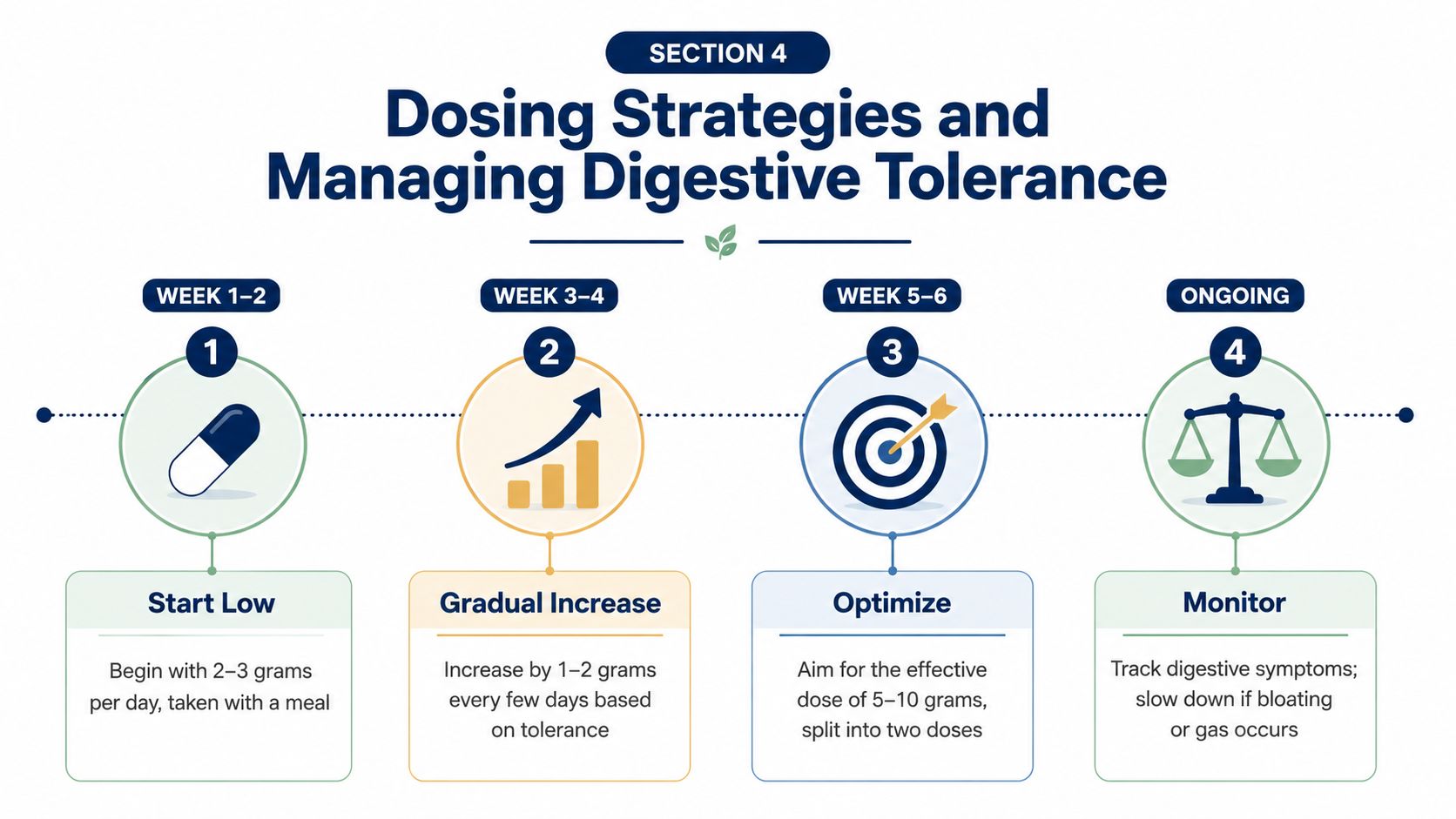
The supplement itself is only half the equation. A person who already eats plenty of fermentable plants may react very differently from someone whose baseline diet is low in fiber or whose gut is sensitive. Start with the least glamorous strategy: begin low and increase slowly.
Colon bacteria ferment prebiotic fibers, producing gas along with short-chain fatty acids. A rapid increase can therefore feel like turning up the volume on a fermentation process before the gut has adapted. A practical starting point is 2 to 3 grams daily for the first week, followed by an increase of 1 to 2 grams weekly if symptoms remain manageable. The maintenance range may be around 5 to 10 grams, but the appropriate amount depends on the fiber type and individual tolerance, as noted in the earlier review (peer-reviewed review).
How to reduce side effects
Taking prebiotics with meals may be easier than taking them on an empty stomach. Dividing the daily amount between two meals also spreads the fermentation load, much like adding fuel gradually rather than all at once.
Practical rule: mild, temporary stool changes can improve as the gut adapts. Intense or disruptive symptoms are a reason to hold the dose steady or reduce it, not to follow the label upward automatically.
People with IBS, SIBO, or clear FODMAP sensitivity may need a lower starting point and a gentler fiber type, such as PHGG or another less rapidly fermented option. Adequate fluid intake matters because fiber needs water to move through the digestive tract.
Individual response remains unpredictable. In a British Journal of Nutrition pilot trial of a diverse prebiotic fiber blend, the product was generally well tolerated, yet participants reported wind, bloating, mild constipation, abdominal pain, mild diarrhea, and burping (British Journal of Nutrition pilot trial). “Natural” describes the source, not a guarantee of symptom-free use.
If symptoms persist, are severe, or include warning signs such as bleeding, seek medical advice rather than continuing to experiment with dose. A tolerable amount that fits the person's usual diet is more useful than a higher dose that cannot be maintained.
How to Read Labels and Choose a Quality Product
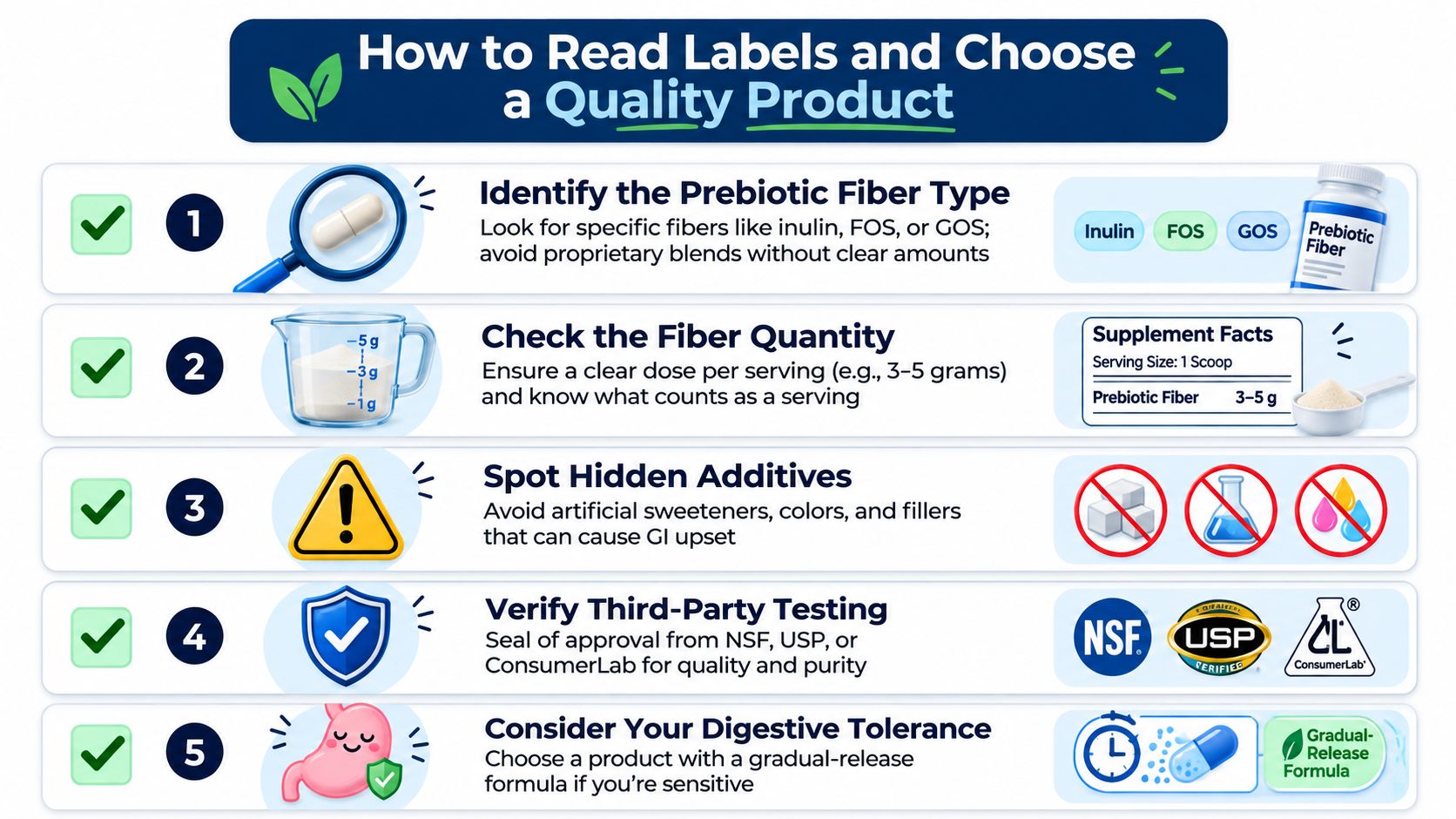
A supplement can be well formulated and still feel wrong for your gut. Your baseline diet, usual fiber intake, and sensitivity to fermentation affect the result as much as the product name. Read the ingredient panel before trusting the front label, and look for a specifically named fiber rather than a broad promise such as “digestive support.”
What to check first
- Identify the exact fiber type. Labels may list inulin, chicory root fiber, FOS, GOS, resistant starch, or PHGG. A proprietary blend hides the amount of each ingredient, making it harder to match the product to your tolerance.
- Check the fiber amount per serving. Read the serving size alongside the grams of fiber. A large-looking container may provide little fiber per capsule or scoop.
- Review the complete formula. Added sugars, sugar alcohols, artificial sweeteners, colors, and bulky fillers can add digestive triggers or make symptoms harder to interpret.
- Look for third-party testing. NSF, USP, or ConsumerLab certification can indicate additional checks of purity and whether the contents match the label. Certification does not guarantee that a particular fiber will suit your gut.
- Choose a manageable format. Powders allow smaller dose adjustments, while capsules and gummies may be more convenient but can provide less fiber per serving. The best format is the one you can take consistently without exceeding your tolerance.
Why sourcing matters
The source and processing of the ingredient can influence what else appears in the formula. Chicory-root inulin presents a different choice from a blend containing several fibers, flavoring agents, and sweeteners. You do not need technical expertise, but you should be able to identify the fiber, its amount, and the other ingredients.
For an example of a combined digestive formula, Havasu Advanced Prebiotics Probiotics Digestive Support 60 Veggie Caps shows how prebiotic and probiotic ingredients may appear together on a product listing.
Use this checklist:
- Specific fiber named
- Clear grams per serving
- Limited additive burden
- Third-party quality testing
- A dose your gut can handle
If the label leaves these points unclear, choose a more transparent product. A supplement should fit your diet and tolerance, not ask your digestion to adapt to marketing claims.
Key Takeaways and Frequently Asked Questions
Prebiotic fiber supplements are tools, not magic bullets. They work best when the fiber type, dose, and your baseline diet all line up with the goal you have. That's why start low and go slow isn't just cautious advice, it's the most practical way to avoid unnecessary bloating while you test whether the product helps.
Can prebiotics be taken with probiotics? Yes, many people combine them. The prebiotic can serve as fuel for microbes already present in a probiotic product, but the combo still depends on the strains, the fiber type, and how your gut responds.
How long until I notice benefits? Some people notice bowel changes first, while microbiome-related effects take longer to judge. If you're not tolerating the product or you're already eating plenty of fiber, the change may be subtle.
Are prebiotics safe for IBS or SIBO? Sometimes, but dose and fiber type matter a lot. People with sensitivity often do better with lower doses and gentler fibers, and some need a clinician's help to sort out what's causing symptoms.
Do prebiotics help with weight management? The research is still mixed. They may influence satiety and gut signaling, but they're not a stand-alone weight-loss strategy.
The most useful way to think about prebiotic fiber is as one piece of a larger gut-health plan. Dietary diversity, hydration, stress management, and symptom tracking still matter, and persistent digestive issues deserve professional evaluation.
Supplemynts Inc offers a wide range of dietary supplements and wellness products, including digestive-health options that fit into a broader gut-support routine. If you're comparing prebiotic fiber supplements and want to browse a curated online selection with clear category navigation, visit Supplemynts Inc.










Please complete your information below to login.
Sign In
Create New Account