


You're probably staring at two bottles right now. One says magnesium malate, the other says magnesium citrate, and both labels act like they're the obvious answer.
They're not.
If your real question is “Which one should I buy for fatigue, muscle cramps, or constipation?”, the answer isn't “whichever has better branding.” It depends on the symptom you came in with, how your gut handles magnesium, and whether the label shows elemental magnesium clearly. Most buyers miss that last part, and that's where bad magnesium products hide.
Table of Contents
- Why the Form of Magnesium Matters
- What Magnesium Malate and Magnesium Citrate Actually Are
- Bioavailability and Absorption Compared
- Matching the Form to Your Symptom
- Typical Dosages and Where the Line Gets Drawn
- Side Effects, Tolerance, and Safety Considerations
- How to Choose and Buy a Quality Supplement
- Quick Recommendations and Common Questions
Why the Form of Magnesium Matters
Magnesium is the active mineral. The form tells you what it's attached to, and that attachment changes how it behaves in the body. That's the part supplement marketing keeps muddy on purpose.
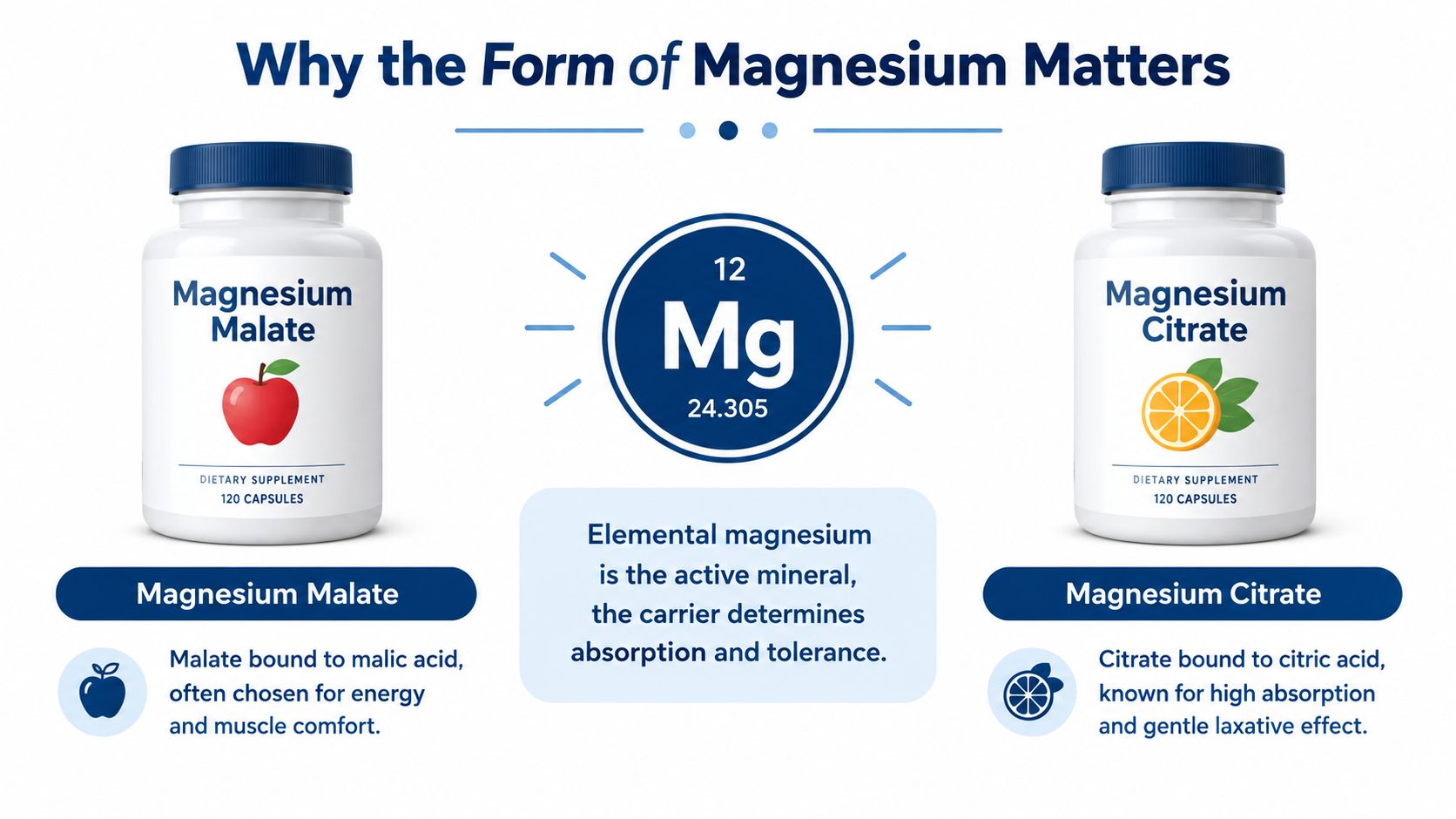
Why buyers get confused
Two products can both say “magnesium” on the front and act like they do the same job. They don't. The carrier molecule affects absorption, gut tolerance, and what the product is usually best suited for.
Citrate is the familiar default. Malate gets sold as the “energy” version. Both claims have some logic behind them, but they're often pushed far past what the evidence can support.
A lot of people supplement magnesium because they're not consistently getting enough from food. Around 48% of U.S. adults don't meet recommended intake levels of magnesium, according to the NIH figure quoted in a practitioner education summary from Metagenics (reviewed summary). That makes magnesium a real buying decision, not a niche one.
What actually changes from one form to another
Here's the short version:
- Citrate usually makes more sense when constipation is part of the problem.
- Malate is often chosen for daily use when people want magnesium support without leaning into the bowel effect.
- Neither form deserves magic status for energy, recovery, or cramps.
Bottom line: The best magnesium form is the one that matches your symptom and gives you a usable amount of elemental magnesium without wrecking your stomach.
If you're comparing a magnesium malate citrate product, or a label that blends both, don't assume “more ingredients” means better results. In many cases, a blend is just a different delivery format for the same mineral. The useful question is simpler: What symptom are you trying to solve?
Start with the symptom, not the sales pitch
Use this rule before you buy:
- Constipation first? Lean citrate.
- General supplementation with a touchy gut? Malate often makes more sense.
- Fatigue? Don't buy the “energy” story blindly. Fixing low magnesium may help, but malate-specific fatigue claims are mostly mechanistic.
- Cramps or tightness? Either can work. Consistency matters more than the form war.
That's the framework worth using. Everything else is label noise.
What Magnesium Malate and Magnesium Citrate Actually Are
You bought magnesium for a reason. Fatigue, cramps, or constipation. Before you let the label sell you a story, get clear on what these forms are.
Magnesium citrate is magnesium attached to citric acid. Magnesium malate is magnesium attached to malic acid. A magnesium malate citrate product usually means a mixed salt or blend that includes both citrate and malate.
The first practical point is simple. The compound name is not the same thing as the amount of magnesium you get.
A regulatory review of magnesium citrate malate describes it as a mixed magnesium salt and notes that it contains only about 12 to 15% elemental magnesium by weight. So a capsule can look substantial while delivering far less actual magnesium than many buyers assume.
Why elemental magnesium matters more than the front label
If a bottle says “200 mg magnesium citrate malate,” that usually refers to the weight of the compound, not 200 mg of pure magnesium. Part of that weight comes from the citrate and malate attached to it.
Check the Supplement Facts panel first. Find the line that says Magnesium and look for the amount in milligrams per serving. That number matters. The long chemical name on the front does not.
| Attribute | Magnesium Malate | Magnesium Citrate |
|---|---|---|
| What it is | Magnesium bound to malic acid | Magnesium bound to citric acid |
| Main reputation | Daily-use option with less bowel push, often marketed for muscle comfort and energy | Common choice for broad magnesium use and bowel support |
| Label trap | Large compound weight can hide a modest elemental magnesium dose | Same issue, though some labels state elemental magnesium more clearly |
| Gut effect | Often picked by people trying to avoid a stronger laxative effect | More commonly used when constipation is part of the problem |
| Best buying focus | Elemental magnesium per serving | Elemental magnesium per serving |
Malate also gets sold hard on the “energy” angle because malic acid is involved in energy metabolism. Keep that claim on a short leash until you see symptom-specific evidence, not just biochemistry.
Citrate has a longer public track record
Magnesium citrate has been around for a long time in U.S. product and regulatory history. FDA Notices of Judgment records include a case involving magnesium citrate, and later FDA-linked records show it continuing in marketed products (FDA record history).
That does not make citrate superior. It does make one thing clear. Citrate is a well-established form, not a novelty ingredient dressed up with modern branding.
Bioavailability and Absorption Compared
If you only read one sentence in this section, read this one: stop chasing a fake bioavailability crown.
Both forms are credible. Neither gives you a clean, universal win in every person.
What the direct comparisons suggest
A controlled comparison reported that magnesium malate had the highest area under the curve and kept serum levels raised longer, while magnesium citrate and magnesium oxide were the least bioavailable in that model. But another clinical comparison found that magnesium citrate produced the greatest mean serum magnesium after acute and chronic dosing versus other preparations (human comparison data).
That sounds messy because it is messy. Different models and endpoints can point in different directions.
| Form | Relative Absorption | Evidence Base |
|---|---|---|
| Magnesium malate | Strong absorption profile in available comparisons | Smaller direct evidence base, but favorable pharmacokinetic signal |
| Magnesium citrate | Strong absorption reputation and benchmark status in common use | Better-known and widely used in clinical and consumer settings |
What matters more than internet rankings
In real buying decisions, these factors often matter more than trying to declare one “most absorbable”:
- Your dose: More isn't automatically better if your gut won't tolerate it.
- Your reason for taking it: Constipation and fatigue aren't the same problem.
- Your personal tolerance: Some people do fine on citrate. Others end up sprinting to the bathroom.
- How the product is built: Capsule count, serving size, and elemental magnesium all matter.
If you're comparing forms for training support, it helps to look at practical discussions of natural muscle recovery support, but keep your standards high. Recovery marketing often outruns the actual form-specific evidence.
My practical take
Citrate and malate are both reasonable absorption choices. I wouldn't pick between them based on hype about one being dramatically superior. I'd pick based on the symptom and your gut.
If your current product is oxide and you're wondering why it feels underwhelming, that's a separate issue. A quick comparison with products like magnesium oxide options for digestive health shows why form selection matters in the first place. Oxide is not the benchmark you want if your goal is dependable daily supplementation.
Matching the Form to Your Symptom
The decision gets easy.
If you came in for constipation, the answer is usually citrate. If you came in for fatigue, the answer is not “malate, automatically.” If you came in for cramps, either form can work, and your tolerance often decides it.
If your problem is constipation
Citrate has the clearest practical role here. It's the form widely associated with bowel support because citrate-containing magnesium products can have a laxative effect at higher doses. That's part of the trade-off, not a side note.
If you're constipated and want magnesium to do double duty, citrate is the obvious first pick.
If your problem is fatigue
The supplement aisle gets slippery.
Malate gets marketed as the “energy” form because malic acid participates in energy metabolism. Fine. But the direct evidence for malate beating other bioavailable forms for fatigue relief is limited. The cleaner interpretation is this: if low magnesium is part of why you feel run down, correcting that low intake may help. The malate part is a plausible add-on, not a proven edge.
The malate-for-energy pitch is biochemically reasonable and clinically underproven. Treat it that way.
If your problem is cramps or tight muscles
For cramps, I'd stop obsessing over citrate versus malate and focus on regular intake, tolerance, and whether the dose is meaningful.
Both forms deliver magnesium. Both are used for muscle-related complaints. In practice, people often do better by taking a form they'll stick with. If bowel sensitivity is an issue, many people prefer a gentler option such as glycinate, and that's where something like NOW Magnesium Glycinate Highly Absorbable Form 180 Veggie Tablets may fit better than either citrate or malate.
| Symptom | Better Form | Why | Evidence Strength |
|---|---|---|---|
| Constipation | Magnesium citrate | More likely to support bowel movement due to its gut effect | Strong practical use case |
| General fatigue | Magnesium malate or citrate | Fixing magnesium intake may help, but malate-specific energy claims are mostly mechanistic | Limited for form-specific advantage |
| Muscle cramps | Tie, often tolerance-based | Magnesium delivery matters more than the ligand in many cases | Moderate practical support |
| Sensitive digestion | Magnesium malate | Often chosen when citrate feels too bowel-active | Practical rather than decisive trial evidence |
When a mixed mineral product makes sense
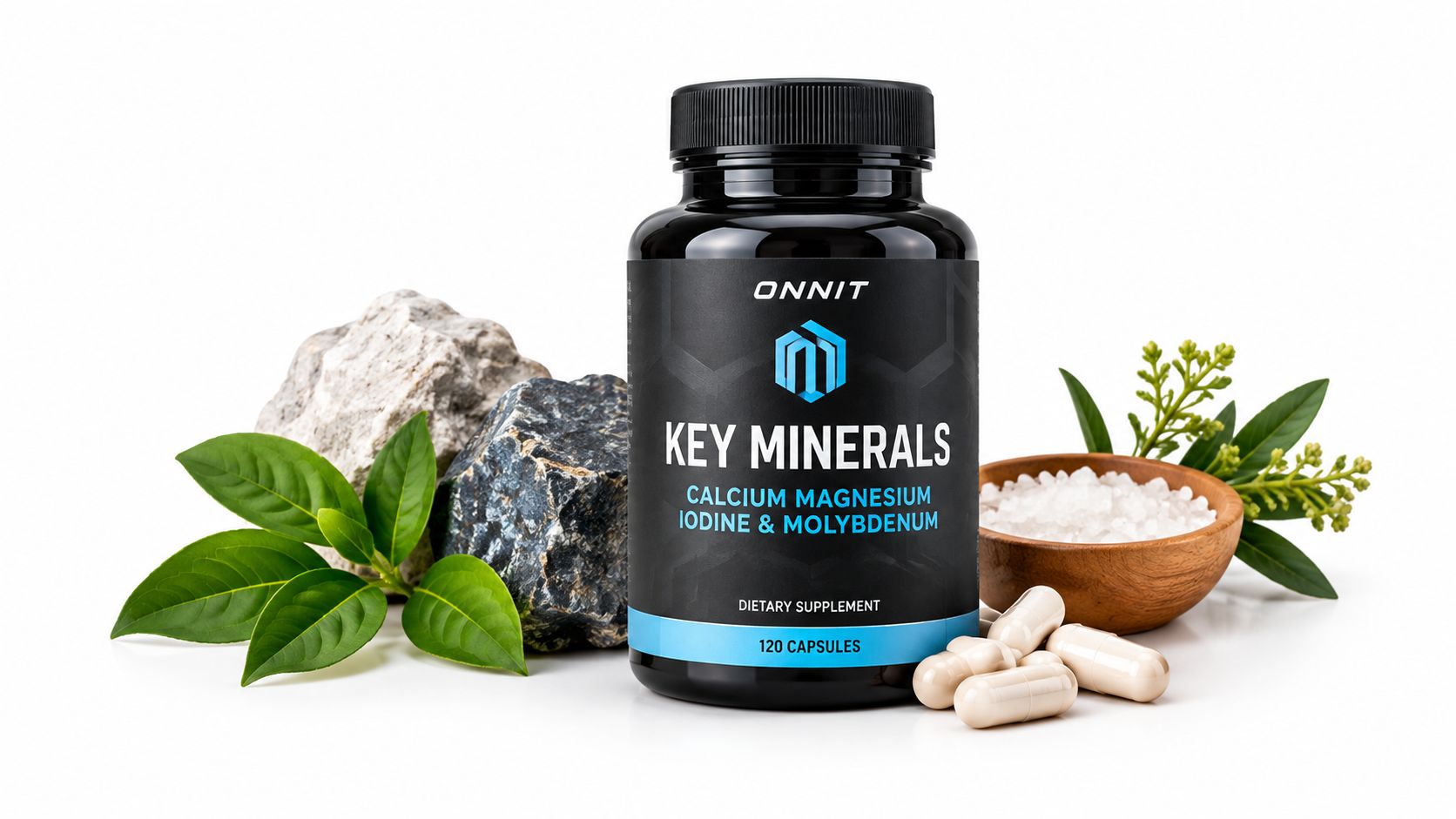
A broader mineral formula can be useful if magnesium isn't the only thing you're trying to cover. For example, Onnit Key Minerals Calcium Magnesium Iodine Molybdenum 120 Caps is a vegan capsule formula designed to support bone health, thyroid balance, and nervous system function. That's a different use case from buying a dedicated magnesium malate citrate product for one symptom.
Typical Dosages and Where the Line Gets Drawn
You buy a bottle for fatigue, cramps, or constipation, follow the front label, and end up judging the form by the side effects. That is the wrong way to dose magnesium.
The first thing to check is elemental magnesium per serving. Magnesium citrate malate can sound heavy on the label while delivering a modest amount of actual magnesium, because the compound itself includes a relatively small percentage of magnesium by weight, as noted earlier. Some regulatory assessments have also used a conservative upper-level context for supplemental magnesium. The practical takeaway is simple. High compound weight does not mean high magnesium intake.
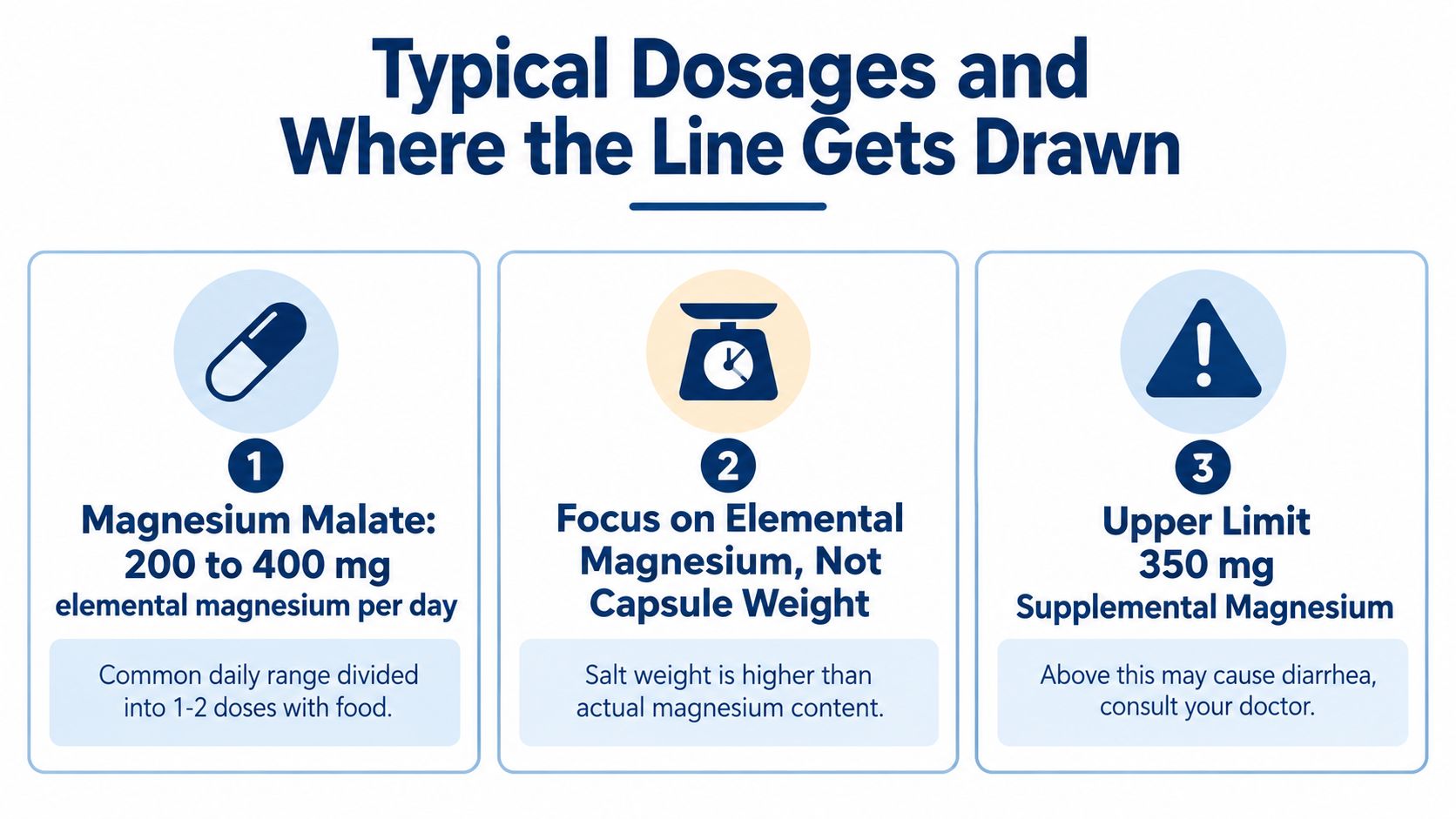
The number that matters
Ignore the flashy front label. Read the Supplement Facts panel.
If the product does not clearly list elemental magnesium per serving, skip it. Capsule count, serving size, and total milligrams of the full compound do not tell you what you need to know. This matters even more with malate-focused products, because buyers chasing “energy support” often pay for a large serving that looks impressive but does not deliver much magnesium.
That trade-off gets missed all the time. Malate may fit better for someone who came in with fatigue and wants to avoid a bowel-active form, but the malate-for-energy pitch is still mostly mechanistic, not a proven clinical edge. Dose to correct magnesium intake first. Do not dose based on marketing claims about ATP.
How to dose without causing problems
Use a symptom-first approach:
- For constipation: Citrate usually needs more respect. Start low, because the bowel effect you want can become loose stools fast.
- For cramps: Start with a moderate elemental dose and judge the result over several days, not one serving.
- For fatigue: Do not jump to high-dose malate expecting a noticeable energy lift. If low magnesium is part of the problem, correcting intake may help. The malate angle itself is not a guarantee.
A few practical rules work better than brand promises:
- Start with the lowest useful serving
- Split the dose if the full serving hits your gut too hard
- Take it with food if your stomach is touchy
- Increase only for a clear reason tied to the symptom
The line gets drawn at tolerance. If the dose helps the symptom and your digestion stays stable, you are in the right range. If your stool changes, your “optimal” dose was too high, regardless of what the bottle suggests.
This explainer may help if you want a visual walkthrough before comparing labels:
My dosing advice
Start conservatively and earn the higher dose.
For citrate, increase slowly if constipation is the target. For malate, do not overpay for oversized servings sold as energy support if the elemental magnesium is underwhelming. For either form, count total supplemental magnesium across everything you take, including multivitamins, sleep blends, and electrolyte products.
Practical rule: Buy based on elemental magnesium per serving, then adjust based on symptom response and stool tolerance.
Side Effects, Tolerance, and Safety Considerations
Most magnesium side effects are dose problems dressed up as form problems.
Yes, form matters. But the biggest issue is still simple: too much too fast.
The real diarrhea question
Consumers often hear a crude version of the story. “Citrate causes diarrhea, malate doesn't.” That's too simplistic.
A consumer-facing safety review notes that magnesium citrate and other organic salts can have laxative effects at higher doses, but it also summarizes more recent clinical evidence in which several trials using 400 to 500 mg/day for 8 to 23 weeks did not show a statistically significant increase in diarrhea, and it cites a 2023 review arguing that the upper limit for supplemental magnesium may deserve reevaluation (dose and diarrhea nuance).
That's the nuance buyers usually miss. The right question isn't “Which form causes diarrhea?” It's “At what elemental dose, for how long, and in which person?”
| Factor | Magnesium Malate | Magnesium Citrate |
|---|---|---|
| Loose stools risk | Often viewed as lower at comparable daily use | More likely to push bowel activity |
| Best fit for sensitive gut | Often the safer first trial | Less ideal if you already run loose |
| Constipation support | Less direct | Stronger practical fit |
| Dose sensitivity | Still important | Very important |
| Main caution | Don't assume “gentle” means unlimited dosing | Don't confuse intended bowel effect with better tolerance |
Who needs extra caution
Some people should not treat magnesium like a casual add-on.
- Kidney impairment: Magnesium clearance depends on the kidneys.
- Heart conduction issues or neuromuscular conditions: This deserves clinician input first.
- Prescription drug use: Magnesium can interfere with absorption of some medications.
If you take certain antibiotics or other interaction-prone drugs, spacing magnesium away from them is the standard common-sense move. If you have a diagnosed condition, get personalized advice before starting. That's not hand-wringing. That's basic safety.
My tolerance rule
If citrate loosens stools too quickly, lower the dose first before blaming magnesium altogether. If you still need bowel support, citrate may still be the right form, just not at the amount you started with. If you need daily magnesium and your digestion gets annoyed easily, malate is often the smarter trial.
How to Choose and Buy a Quality Supplement
Most bad magnesium purchases happen because people shop the front label.
That's backwards. Shop the panel.
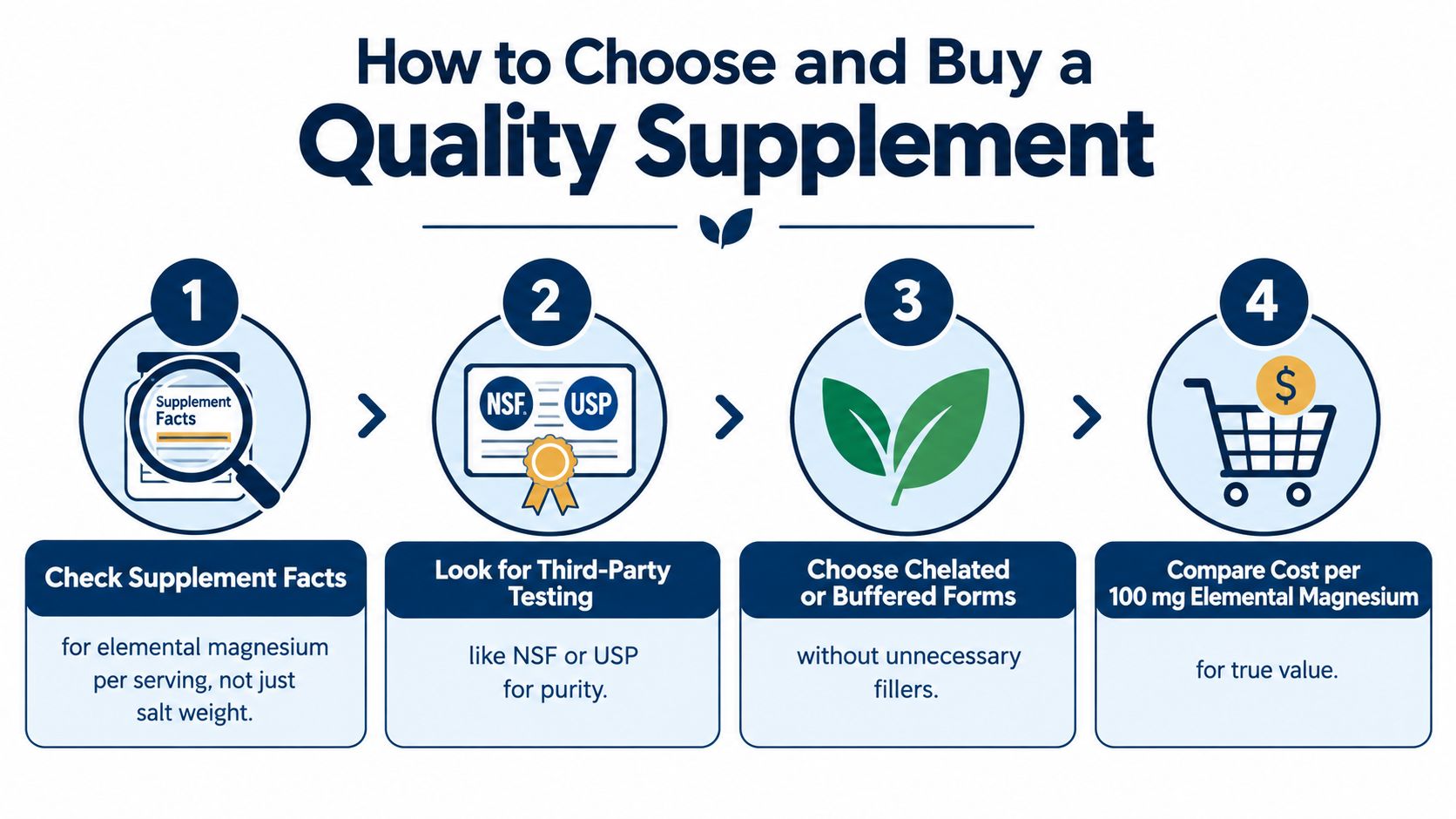
The buying checklist that actually matters
Check elemental magnesium first
Ignore flashy terms like “high potency” unless the Supplement Facts panel tells you exactly how much elemental magnesium you're getting per serving.Count capsules like an adult
A label can look impressive until you realize the serving is several capsules. If the usable magnesium is low per capsule, the product may be more hassle than help.Skip proprietary blend nonsense
If magnesium is buried inside a blend, pass. You need transparency, not fairy dust.Watch for form confusion
Some products lean on the word citrate or malate while using other cheaper magnesium forms more heavily. Read carefully.
If the label makes it hard to know how much elemental magnesium you're getting, assume that's intentional and buy something else.
What else I'd look for
Third-party verification and clear manufacturing standards matter, especially in minerals where dose accuracy counts. I'd also avoid products stuffed with stimulants, herbal extras, or “metabolism” blends unless you have a very specific reason to want those add-ons.
If you're comparing unusual forms for a different goal, such as cognition-focused magnesium, a product page like Life Extension Neuro-Mag Magnesium L-Threonate Powder shows how far magnesium labeling can vary by form and intended use. That's exactly why you shouldn't lump all magnesium products together.
When to ask a clinician before buying
Talk to a clinician first if you have kidney disease, chronic diarrhea, active cardiac treatment, a complicated medication list, or a condition where mineral balance is already being monitored. For everybody else, the main job is simpler: buy a form that matches the symptom and a label that tells the truth.
Quick Recommendations and Common Questions
Here's the shortest useful answer.
Use magnesium citrate if constipation is one of the main reasons you're shopping. Use magnesium malate if you want daily magnesium support and you'd rather avoid a stronger bowel effect. If your main complaint is fatigue, don't fall for the idea that malate has proven superiority. It hasn't.
Fast picks by symptom
| Symptom | Preferred Form | Starting Dose | Expected Timeline |
|---|---|---|---|
| Constipation | Magnesium citrate | Start low and assess stool response | Often noticed quickly |
| Daily muscle support | Magnesium malate | Start with a conservative daily serving | Usually gradual |
| General low-magnesium support | Either malate or citrate | Start with the label's lower end | Varies by person |
| Fatigue with suspected low intake | Either, often malate if tolerated well | Start low and stay consistent | Usually not instant |
Common questions people actually ask
Can you take both forms together
Yes, you can, but there's usually no need to get fancy. A magnesium malate citrate blend is still just a way to deliver magnesium through mixed ligands. The smarter move is to keep track of your total elemental magnesium and your gut response.
Does timing matter
Sometimes. If magnesium upsets your stomach, take it with food. If you're using citrate for bowel support, timing may affect convenience. Daily consistency matters more than obsessing over the perfect hour.
What if coffee or meals are part of the routine
For most individuals, meals help tolerance. Coffee isn't the key issue here. Dose is. If your stomach is sensitive, don't take a bold first dose on an empty stomach and then blame the form.
How long until you notice anything
Constipation support from citrate can show up fast. General magnesium repletion, muscle support, and fatigue changes usually take longer and depend on whether low magnesium was part of the problem in the first place.
What if stools loosen too fast
Lower the dose. Split it. If the problem continues and you don't specifically need the bowel effect, switch from citrate to malate or another gentler form.
Track the symptom you're trying to fix. If you came in for cramps and all you gained was looser stools, that form or dose isn't serving you.
Is symptom tracking worth it
Yes. A basic note in your phone is enough. Record the form, dose, timing, bowel changes, cramp frequency, and energy level. That beats guessing after two weeks.
My final take is simple. Citrate for constipation. Malate for everyday use when tolerance matters. Either for general magnesium support if the label is honest and the dose is sensible. The “energy” halo around malate is still more mechanism than proof, so don't pay a premium just for that story.
Supplemynts Inc carries magnesium and other mineral products in a category-based online store, which makes it easier to compare forms, label styles, and broader wellness options in one place. If you want to sort through magnesium products with this symptom-first approach in mind, visit Supplemynts Inc and start by checking elemental magnesium, form, and serving size before anything else.









Please complete your information below to login.
Sign In
Create New Account