



What if the magnesium supplement you chose isn't failing because magnesium doesn't work, but because the form, dose, or evidence doesn't match your goal? That question matters when evaluating magnesium glycinate benefits, especially for sleep, anxiety, muscle tension, or a sensitive stomach.
Magnesium glycinate has become popular because it combines magnesium with glycine, an amino acid. Supporters describe it as gentle and calming, while skeptics point out that many claims about sleep and anxiety apply to magnesium generally, not necessarily to glycinate itself. The most useful answer sits between those extremes. Glycinate may be a practical, well-tolerated option, but it isn't a magic sedative, and it hasn't been proven superior for every purpose.
Table of Contents
- The Magnesium Deficiency Puzzle
- What Is Magnesium Glycinate
- Top Benefits for Sleep and Anxiety
- How Glycinate Compares to Other Forms
- How to Take It Safely and Effectively
- Side Effects and Who Should Avoid It
- Final Verdict and Key Takeaways
The Magnesium Deficiency Puzzle
You eat reasonably well, take a supplement for a few nights, and expect a noticeable change. Instead, nothing happens, or your stomach objects before you can decide whether the product is helping. That frustrating experience doesn't automatically mean magnesium is useless. It may mean your intake wasn't low enough to produce a clear effect, the form wasn't comfortable for you, or the symptom has another cause.
Magnesium supports basic processes involving nerve signaling, muscle contraction, energy production, and cardiovascular function. Your body uses it behind the scenes, so a mild shortfall may not announce itself with one unmistakable symptom. Fatigue, muscle tension, poor sleep, and feeling on edge can have many explanations, which makes self-diagnosis unreliable.
The scale of inadequate intake helps explain why magnesium supplements have such a strong foundation. A 2026 analysis of U.S. population data estimated that 67.8% of adults had serum magnesium below the threshold used to indicate chronic latent deficiency, including 65.8% of men and 69.8% of women. The analysis is documented through the registered magnesium research record. Earlier national dietary surveys also found that about half of Americans consumed less than the Estimated Average Requirement, including 61% of adults in NHANES 2003-2006, as summarized in the same verified research record.

Why a gap can remain hidden
A person can consume enough calories and still miss magnesium-rich foods. If meals contain few legumes, nuts, seeds, leafy vegetables, or whole grains, the diet may look adequate while supplying less magnesium than the body needs. A blood result can also provide an incomplete picture because serum magnesium doesn't represent every magnesium store in the body.
That doesn't mean everyone with restless sleep or tiredness should start supplementing immediately. It means magnesium glycinate has a plausible role when dietary intake is low, when another form causes digestive discomfort, or when a clinician identifies a relevant nutritional concern.
Practical rule: Treat magnesium glycinate as a way to address a possible nutrient gap, not as a universal explanation for every sleep or mood complaint.
What Is Magnesium Glycinate
Magnesium glycinate, also called magnesium bisglycinate or diglycinate, is magnesium bound to glycine. The word chelated describes that attachment. Instead of delivering magnesium as an unpaired mineral compound, the manufacturer combines it with an amino acid that changes how the compound behaves in the digestive tract.
A useful analogy is a travel case. Magnesium is the mineral you want to deliver, while glycine acts as part of the case that carries it through digestion. The analogy has limits, though. Glycinate isn't a guaranteed “Trojan horse,” and it doesn't bypass every digestive process. Absorption still depends on the compound, the person, the dose, and the condition of the gut.
The absorption question
The strongest head-to-head evidence in the verified material comes from a small double-blind crossover trial involving 12 patients with ileal resection. Overall absorption of labeled magnesium was similar between the chelate and magnesium oxide, 23.5% versus 22.8%, but the subgroup with the poorest oxide absorption absorbed substantially more from the chelate, 23.5% versus 11.8%. The chelate also reached peak isotope enrichment earlier by about 3.2 ± 1.3 hours and was better tolerated, according to the published absorption study.
Those findings support a careful conclusion. Glycinate can perform better than oxide in some malabsorption settings, particularly among people who absorb oxide poorly. They don't prove that glycinate is always more absorbable for every healthy adult.
Researchers proposed that part of the chelate may be absorbed intact through a dipeptide transport pathway, which would help explain its behavior in the gut. That mechanism is biologically plausible, but it shouldn't be turned into a promise that glycinate never competes with other nutrients or always crosses into the nervous system more effectively.
What glycine adds, and what it doesn't
Glycine is a naturally occurring amino acid, but the presence of glycine doesn't make a capsule equivalent to a standalone glycine treatment. The amount supplied depends on the product's formulation, and the verified evidence doesn't establish that the glycine attached to magnesium glycinate makes this form uniquely calming.
So the clearest description is simple: magnesium glycinate is a chelated magnesium form selected mainly for its practical balance of absorption and tolerance. It may be especially appealing when magnesium oxide or another product upsets your digestion, but “gentle” doesn't mean risk-free.

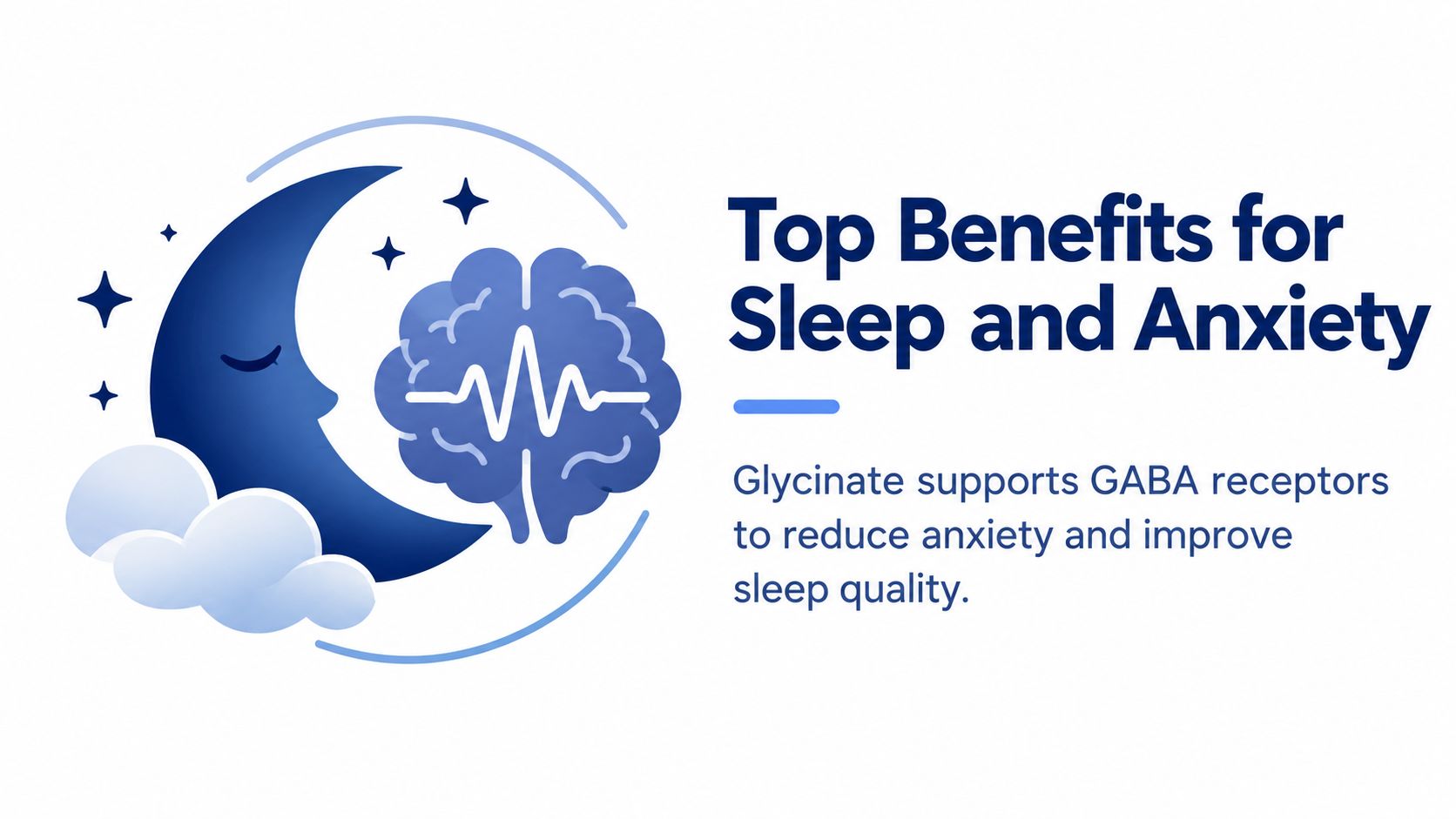
Top Benefits for Sleep and Anxiety
Sleep is where enthusiasm often outruns the evidence. Magnesium participates in processes related to nerve and muscle function, so correcting a low intake could support a more settled physical state. But the available evidence doesn't show that glycinate is uniquely superior to every other magnesium form for sleep or anxiety.
A 2025 randomized placebo-controlled study of 155 adults with self-reported poor sleep quality found that 250 mg per day of elemental magnesium bisglycinate, taken 30 to 60 minutes before bedtime, improved sleep quality after four weeks. The verified summary describes the effect as modest and short-term, not as a cure for insomnia. It also doesn't establish that the same result would occur in every person or that glycinate outperforms citrate, oxide, or another well-tolerated form. The study details are included in the review of magnesium and sleep evidence.
Sleep quality rather than instant sedation
That distinction changes how you evaluate the product. A reasonable expectation is a possible improvement in perceived sleep quality when magnesium intake is inadequate, not an immediate sedative effect after one capsule. If poor sleep continues, look beyond supplements. Persistent insomnia can involve stress, medication effects, breathing problems, pain, mood symptoms, or an inconsistent sleep schedule.
The research on blood pressure also shows why context matters. A 2025 randomized double-blind trial is studying 480 mg per day of magnesium glycinate for 12 weeks in 120 adults with specified high systolic blood pressure, while another double-blind trial tested the same dose for 12 weeks in 60 adults with high blood pressure or stage 1 hypertension. These trials demonstrate active clinical interest, not a guaranteed result for shoppers. A registered magnesium glycinate blood-pressure trial provides the relevant research context.
Anxiety claims need restraint
Magnesium and glycine are often presented online as if they directly switch off an overactive brain. The verified evidence doesn't justify that certainty. A recent review found that magnesium may help sleep quality and anxiety symptoms overall, while the specific glycinate form hasn't been clearly proven superior. The 2025 sleep trial showed a modest short-term result, not proof that glycinate treats an anxiety disorder.
This makes magnesium glycinate more appropriate as a nutritional support option than as a replacement for psychotherapy, prescribed treatment, or an evaluation of persistent anxiety. If worry disrupts your relationships, work, or sleep, address the underlying problem rather than relying on a supplement alone.
For a readable overview that distinguishes established uses from more cautious claims, see backed magnesium glycinate benefits from Lila.
The same caution applies to muscles. Magnesium is involved in contraction and relaxation, so people with inadequate intake may notice less tension or fewer symptoms after correcting the gap. That biological role doesn't prove that supplementation will resolve every cramp, twitch, or recovery complaint.
Here is a short explanation of how magnesium glycinate is commonly discussed in relation to sleep and relaxation:
How Glycinate Compares to Other Forms
Choosing a magnesium form is less like choosing a winner and more like choosing the right tool. The same mineral appears in different compounds, and those compounds differ in elemental magnesium content, digestive tolerance, and the evidence available for specific uses.
The most defensible advantage of glycinate is tolerability combined with a potentially useful absorption pattern. The verified crossover trial found a meaningful absorption advantage over oxide in the subgroup with the poorest oxide absorption, but not across the entire study group. That result argues against calling glycinate universally superior.
| Form | Absorption | Best For | Common Side Effects |
|---|---|---|---|
| Magnesium glycinate | May be better tolerated, with an absorption advantage over oxide in some malabsorption settings | General supplementation when digestive comfort matters | Nausea, cramping, diarrhea, low blood pressure, or buildup in high-risk users |
| Magnesium oxide | Lower effective absorption than glycinate in the relevant malabsorption subgroup | Situations where oxide is specifically selected for its formulation | Digestive upset and diarrhea |
| Magnesium citrate | Often used as a soluble magnesium form | People who may also value a laxative effect | Loose stools, cramping, or diarrhea |
| Magnesium L-threonate | Human evidence for superiority remains limited in the provided data | People interested in a form marketed for brain-related uses, with expectations kept cautious | Product-specific digestive effects and cost concerns |
The practical trade-off
Magnesium oxide can look attractive on a label because shoppers may focus on the compound amount rather than the amount of elemental magnesium that the body receives. That comparison can mislead. The better question is whether the product delivers a tolerable amount that you can use consistently.
Citrate may suit someone who also wants help with constipation, while glycinate may suit someone who wants to avoid a laxative effect. L-threonate shouldn't be treated as automatically better for cognition or sleep because the verified evidence here doesn't establish that advantage.
For a focused discussion of the sleep-related differences between glycinate and citrate, SleepHabits magnesium sleep guidance offers another reference point. If you're comparing oxide products for digestive health, review the magnesium oxide supplement listing alongside the label's elemental magnesium information.
The best choice depends on your goal. A person with a sensitive stomach may reasonably prioritize glycinate. A person who needs a laxative effect may prefer citrate. A person considering L-threonate should ask what human evidence supports the specific claim they care about.
How to Take It Safely and Effectively
Start with the label, not the front of the bottle. Look for the line that identifies elemental magnesium, usually written as magnesium followed by the form in parentheses. The compound weight isn't the same as the amount of magnesium your body receives, so two products with similar headline numbers may deliver different quantities of the mineral.
The verified sleep research used 250 mg of elemental magnesium bisglycinate daily, taken 30 to 60 minutes before bed, and reported improved sleep quality after four weeks. That dose belongs to a specific study population and shouldn't be treated as a universal prescription. A clinician or pharmacist can help you interpret the product label, your diet, and your medications together.
A simple routine
Choose one consistent time. Evening may make sense if your goal is sleep or if taking the supplement with dinner improves comfort. Consistency matters more than treating magnesium like an instant sleep medicine.
Take it with food if your stomach is sensitive. Food may make the routine easier to tolerate. If the product causes diarrhea, cramping, or nausea, don't keep increasing the amount in the hope that the problem will disappear.
Change one variable at a time. Don't begin magnesium, melatonin, several herbs, and a new sleep schedule on the same night. One change gives you a better chance of recognizing what helps or causes a problem.
Review the result objectively. Look for a meaningful pattern in sleep quality, muscle comfort, or general tolerance. If nothing changes, reassess the target symptom instead of automatically escalating the dose.
Label check: The number that matters is elemental magnesium, not the total weight of magnesium glycinate powder in the capsule.
If you want to compare mineral products while checking serving details and intended use, you can review a once-daily magnesium tablet option. Product labels can differ, so use the actual Supplement Facts panel rather than relying on the product name.
Pregnancy, kidney problems, significant heart conditions, and prescription medicines call for professional guidance before starting. A pharmacist can also help build a schedule that separates magnesium from medicines whose absorption it may reduce.
Side Effects and Who Should Avoid It
“Gentle on the stomach” is a comparison, not a guarantee. Magnesium glycinate can still cause diarrhea, nausea, or cramping, especially when the amount is too high for the individual. Magnesium can also contribute to low blood pressure, and excess magnesium may cause weakness, irregular heartbeat, or confusion in rare situations.
Kidney disease deserves special attention. The kidneys help remove excess magnesium, so impaired kidney function can allow magnesium to accumulate. Anyone with kidney disease shouldn't self-prescribe magnesium glycinate without medical advice, even if a product is marketed as mild.
Medication timing matters
Magnesium can bind certain medicines in the digestive tract and reduce their absorption. People taking antibiotics, bisphosphonates, or thyroid-related medications should ask a pharmacist or clinician how far apart to take each product. The right spacing depends on the medicine, so a general internet schedule may not be sufficient.
Also count magnesium from other sources, including combination supplements, antacids, and laxatives. Stacking products can raise total intake without making the increase obvious.
When to stop and ask for help
Stop the supplement and seek medical guidance if you develop persistent diarrhea, significant weakness, unusual confusion, marked dizziness, or an irregular heartbeat. Those symptoms can have causes unrelated to magnesium, so they shouldn't be managed by merely switching brands.
A nighttime combination product illustrates why label checking matters. Bulletproof Sleep Collagen Protein Powder, Lucuma Vanilla 10.4 oz, Melatonin, Chamomile & Magnesium Nighttime Recovery Support delivers 10 g of protein, 3 mg of melatonin, chamomile, and magnesium. If you already use a separate magnesium product, review the combined ingredients rather than assuming the products are independent.
Magnesium glycinate also shouldn't replace an evaluation for ongoing sleep or anxiety symptoms. A supplement may be reasonable for a suspected dietary gap, but persistent symptoms deserve attention to medication effects, medical conditions, stress, and sleep habits.
Final Verdict and Key Takeaways
Magnesium glycinate makes sense when you want a generally well-tolerated magnesium form and your dietary intake may be low. Its clearest evidence-based distinction is not that it guarantees better sleep or anxiety relief, but that it can outperform oxide in some malabsorption settings and may be easier for some people to tolerate. Sleep research is promising but modest, and glycinate hasn't been proven uniquely superior for mood. Check the elemental magnesium amount, review medication interactions, and ask a clinician first if you have kidney disease or significant health conditions.
Supplemynts Inc offers vitamins, minerals, herbs, proteins, and purpose-based wellness categories that can help you compare products by ingredient and intended use. Visit Supplemynts Inc to review magnesium and sleep-related options, then check each label carefully before choosing a supplement.







Please complete your information below to login.
Sign In
Create New Account