


You bought a bottle of liquid vitamin C because the dropper looked simpler than another tablet. You fill the cup, taste the sourness, and wonder whether a bigger pour puts more vitamin C in your blood. The bottle only helps if you know the milligrams in that sip.
Table of Contents
- Liquid Vitamin C Explained and Its Main Forms
- How Much Vitamin C Your Body Actually Absorbs
- What Liquid Vitamin C Can and Cannot Do
- How Much to Take and How to Measure a Liquid Dose
- Storage, Shelf Life and Safety Limits for Liquids
- Choosing Liquid Over Tablets or Powder by Situation
- Confirm Your Dose Before You Start Liquid Vitamin C
Liquid Vitamin C Explained and Its Main Forms
In 1747, Scottish naval physician James Lind showed that oranges and lemons could prevent or cure scurvy among sailors. The Nobel Prize account of how vitamins were discovered treats that shipboard test as one of the earliest controlled dietary interventions. The active compound wasn't named until 1932, when Albert Szent-Györgyi isolated hexuronic acid and it was renamed ascorbic acid for its anti-scurvy action. Norman Haworth worked out the structure in 1933, which opened the door to made vitamin C, and Szent-Györgyi received the 1937 Nobel Prize in Physiology or Medicine.
Liquid vitamin C is that same ascorbic acid, or an ascorbate salt, dissolved in water. A tablet is sugar pressed into a cube. Liquid is sugar already stirred into tea. You can sip a measured amount, and the nutrient is now sitting in water and air, so the bottle has to protect it and still match the label.
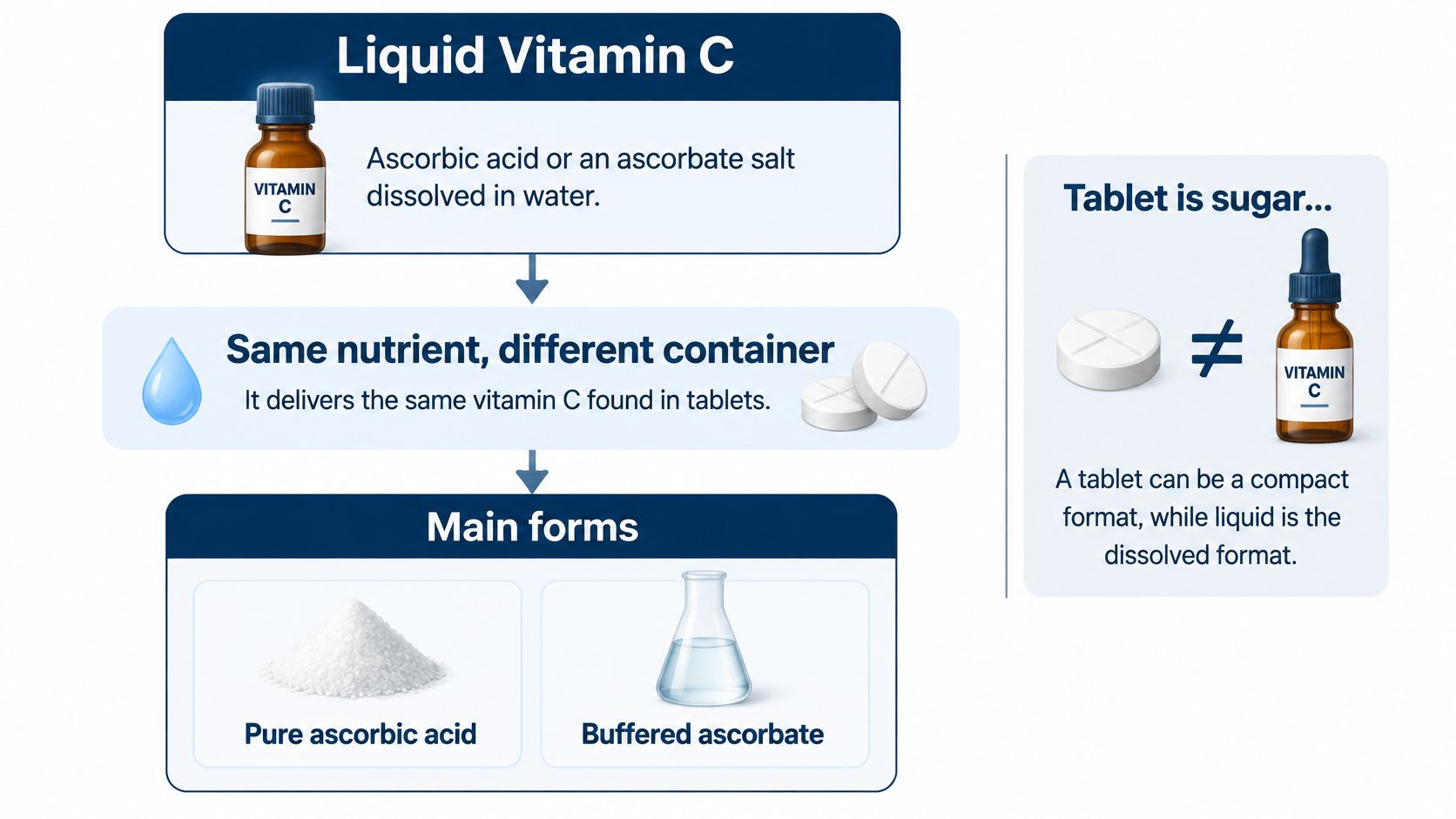
Four bottles that are not the same product
| Form | Typical vitamin C content | Main appeal | Main drawback |
|---|---|---|---|
| Ascorbic acid drops | Example label: 500 mg per 5 mL | Most direct form, precise dosing | Sour taste, acidic for sensitive stomachs |
| Buffered ascorbate liquid | Read milligrams of ascorbate per serving | Milder taste and lower acidity | Sodium or calcium content must be checked |
| Liposomal liquid | Read milligrams of vitamin C per serving | Marketed for enhanced absorption | Human evidence for extra absorption is limited |
| Powder stirred into water | Set by scoop size | Flexible dosing, low cost per mg | Begins losing potency once mixed |
A plain comparison of liposomal versus standard vitamin C supplements is worth a look before you pay extra for a cloudy bottle. The word liposomal on a label isn't proof that more ascorbic acid reaches your blood. A fat-soluble cousin, such as Life Extension Ascorbyl Palmitate 500 mg, is a different molecule in a capsule, not a dissolved drink.
You still need three answers. How much of a dose is absorbed. What the nutrient does. How you'll measure, store, and choose liquid over a pill.
How Much Vitamin C Your Body Actually Absorbs
Absorption is a dose story, not a bottle story. The NIH Office of Dietary Supplements puts the efficient range at moderate intakes and shows how quickly extra milligrams stop paying off.
| Daily intake or dose | Absorption or plasma effect | What it means |
|---|---|---|
| 30 to 180 mg per day | About 70 to 90 percent absorbed | Range where absorption is most efficient |
| 200 to 300 mg per day from foods | Reference plasma level | Baseline for comparing supplement doses |
| Above 1,000 mg per day | Below 50 percent absorbed | Extra is excreted in urine |
| Single 1,250 mg daily oral dose | Mean peak about 135 micromol/L | About twice the food-level peak |
| 3 g every four hours (modelled) | Predicted peak about 220 micromol/L | Diminishing returns at very high doses |
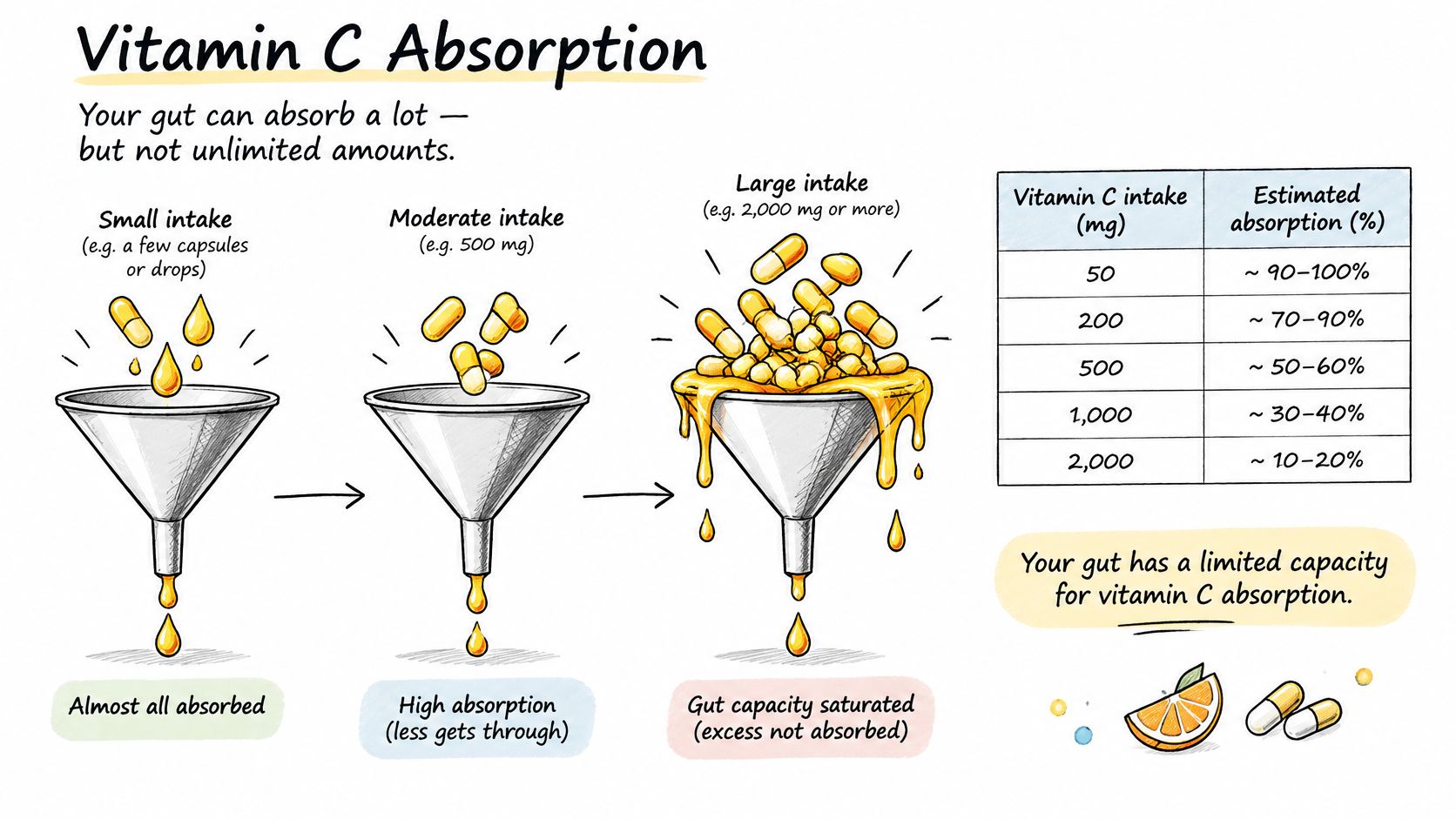
A funnel, not a bigger straw
Think of the intestine as a funnel. A modest pour, in that 30 to 180 mg band, mostly passes through. About 70% to 90% is absorbed. Tip in more than 1,000 mg in a day and less than half gets through. The rest leaves in urine.
That is why a generous splash from a dropper can feel productive and still add little to your blood level. The transporter that pulls ascorbic acid across the gut wall fills up. Once it's busy, extra vitamin C stays in the intestine or is cleared after it's absorbed.
Practical rule: A bigger pour doesn't buy a matching rise in blood level.
What the blood levels actually do
Pharmacokinetic work cited by NIH found that a 1.25-gram daily oral dose produced a mean peak plasma concentration of 135 micromol/L. That's about twice the concentration tied to 200 to 300 mg a day from vitamin-C-rich foods. You doubled the blood peak, not the dose. Food in that range was the baseline, and more than a gram only moved the peak by about that factor of two.
Modeling went further. Taking 3 grams every four hours was predicted to lift the peak only to about 220 micromol/L. That's a huge amount of powder or liquid for a small extra step in the blood. High oral doses run into the same ceiling whether they come from a spoon, a capsule, or a drink.
Liquid vitamin C isn't intrinsically more bioavailable than a tablet or capsule. What sets exposure is the milligrams you swallow and the ascorbic acid the formula contains. A liquid makes those milligrams easy to measure. It doesn't raise the ceiling.
A short walk-through of why oral vitamin C plateaus is here:
If a label invites you to take several grams because the liquid "absorbs better," check the milligrams first. The physiology above still applies.
What Liquid Vitamin C Can and Cannot Do
A lot of people buy vitamin C in winter because they want fewer colds. A daily mega-dose doesn't keep most adults from catching one. Heavy training or extreme physical stress is a narrower case, and even there the change is modest, not a shield. Liquid doesn't change that picture. It only changes how you swallow the dose.
What the nutrient is actually for
Vitamin C is the classic anti-scurvy nutrient. When intake stays too low for too long, collagen repair fails. Gums bleed, wounds close slowly, and old scars can reopen. You don't need a deficiency that severe to care about the same jobs.
Collagen building: Skin, tendons, and the matrix that closes a cut all use vitamin C in that assembly line.
Iron from plants: It helps you absorb non-heme iron from beans, greens, and fortified grains. A glass of produce, or a modest supplement with the meal, does more for that meal than a gram taken alone at night.
Antioxidant backup: It donates electrons and helps restore vitamin E so that vitamin can keep working in cell membranes.
Say one person eats two servings of fruit and vegetables most days. Another gets through a long winter on coffee, bread, and almost no produce. The second person is the one a supplement is built for. The first person is usually already near a useful daily amount from food. Adding a sour shot on top doesn't create a new effect.
Food covers the job for many adults. A supplement covers a gap. It doesn't upgrade a diet that already has produce in it.
Someone sorting portions can use a plain guide on how to balance your meals before they decide a bottle has to do the work. Citrus, peppers, kiwi, strawberries, and broccoli already carry ascorbic acid with fiber and other nutrients a dropper doesn't include.
Liquid adds no benefit that the same milligrams from food or a tablet lack. It only changes how easily you hit the amount you meant to take. If your plate is thin on plants, fix the plate and use a measured dose for the gap. If your plate is already colorful, a large liquid serving is mostly taste and extra urine.
How Much to Take and How to Measure a Liquid Dose
Read milligrams of ascorbic acid per serving, not the fluid ounces on the front. Volume is only the spoon. The NIH fact sheet on vitamin C sets the adult Daily Value at 90 mg and the adult tolerable upper intake level at 2,000 mg per day from food, drinks, and supplements combined. A larger splash isn't a larger share of what your gut can use.
The FDA dietary supplement labeling guide treats "good source" and "high" as label math, not as proof of a stronger effect. A good-source claim needs at least 10% of the reference value. High needs at least 20%. On a 90 mg Daily Value, that's about 9 mg and about 18 mg. Many liquids clear those bars in a fraction of a teaspoon, then keep going into hundreds of milligrams.
A DailyMed listing for a liquid vitamin C supplement, published in 2025, shows 500 mg of ascorbic acid per 5 mL, with a usual adult dose of 5 mL daily. That's about 5.5 times the 90 mg Daily Value in one serving. A scoop-style option such as Emergen-C 1,000 mg vitamin C powder is the same lesson in a different container. You still count milligrams, not how full the glass looks.
| Reference point | Value | How to use it |
|---|---|---|
| Adult Daily Value | 90 mg | Benchmark for percent Daily Value on the label |
| Tolerable Upper Intake Level | 2,000 mg per day | Ceiling for all sources combined |
| Good source claim | At least 10 percent DV, about 9 mg | Minimum per serving for the label claim |
| High in vitamin C claim | At least 20 percent DV, about 18 mg | Minimum per serving for the high claim |
| Example DailyMed liquid | 500 mg per 5 mL, 5 mL daily | About 5.5 times the Daily Value |
| 500 mg daily split | 250 mg twice, 2.5 mL each if the liquid is 500 mg per 5 mL | Smaller single doses, easier on the stomach |
Measure it like a medicine
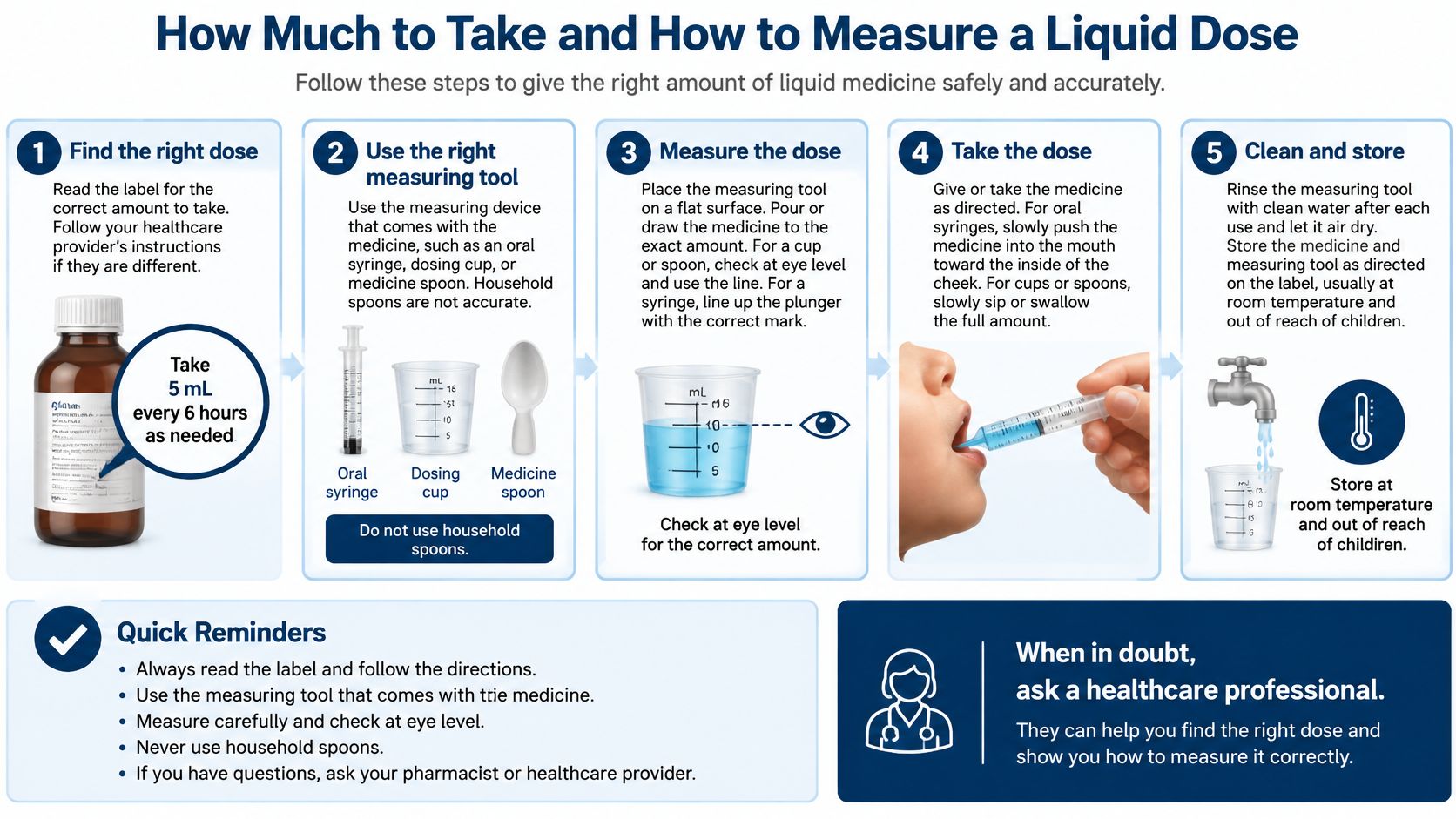
- Shake the bottle so the ascorbic acid isn't sitting in a layer.
- Use the dropper or cup that came with it. A kitchen spoon isn't calibrated, and a "teaspoon" can miss the labeled serving by a wide margin.
- Fill to the line at eye level on a flat counter. Looking down into the cup makes the dose look larger than it is.
- Swallow it with water or with a meal if plain acid bothers your stomach.
Say you want about 500 mg a day and your liquid is 500 mg per 5 mL. Two doses of 2.5 mL give you 250 mg each. Smaller single amounts sit easier, and you aren't asking one sitting to carry the whole serving. High intakes can cause diarrhea, nausea, and abdominal cramps. People with hemochromatosis need extra caution, because vitamin C can increase iron absorption.
If iron itself is the goal, that's a different product. MegaFood Blood Builder Iron Supplement is a daily tablet with iron, folic acid, and vitamin B12, aimed at energy and red blood cell production, not a vitamin C liquid.
Storage, Shelf Life and Safety Limits for Liquids
Ascorbic acid oxidizes once it's in water and oxygen, light, or heat can reach it. A correct assay on the day of bottling doesn't guarantee the same milligrams months later, or after the cap has been off a dozen times.
A 2025 formulation study, published via Hrčak, tracked vitamin losses in storage. In one formula, only 14% of vitamin C remained after three months at 37°C, and just 1% remained after six months at 23°C. That isn't the decay rate of every commercial liquid. Formula and packaging differ. It does show why a "best by" date on an unopened case doesn't answer what happens after you open the bottle on the counter.
The same problem shows up in leave-on skin products. A practical note on how to keep your vitamin C serum effective is useful here, because oxygen and light spoil dissolved ascorbic acid whether you swallow it or put it on skin.
A handling checklist
- Close it now: Don't leave the cap off while you finish breakfast. Each open minute adds air.
- Keep it cool and dark: A cupboard beats a sunny windowsill. A hot car or a warm porch delivery can cook a bottle before you open it.
- Write the open date: Put it on the label the day you break the seal, and follow any "use within" window the maker prints.
- Ask when the label is silent: If there's no post-opening guidance, contact the manufacturer instead of guessing from the color.
- Buy a size you'll finish: An old opened bottle is a weaker dose than the label states, even if you still like the taste.
Darkening or a strange smell is a bad sign. A clear liquid can still have lost potency, so color isn't a lab test. Parenteral vitamin C used in pediatric nutrition has shown measurable loss after extra time at room temperature, which is the same lesson in a clinical bag. Temperature and handling change the delivered amount.
Write the open date on the cap the day you break the seal, and treat a long-opened bottle as weaker than the label.
People who form oxalate kidney stones should talk with a clinician before high-dose use. Part of a vitamin C dose is metabolized to oxalate, and a large daily liquid habit isn't a casual add-on in that history.
Choosing Liquid Over Tablets or Powder by Situation
Liquid wins on flexible measuring and easy swallowing. Tablets win on stability and often on cost per milligram. Powder wins on bulk price and scoop control while it stays dry.
| Criterion | Liquid | Tablet or capsule | Powder |
|---|---|---|---|
| Dose adjustment | Easy, measure any volume | Fixed by tablet count | Easy, scoop size varies |
| Swallowing | Best for pill-averse people | Can be hard for some people | Easy once mixed |
| Taste and additives | Often sour, may contain sweeteners or flavors | Usually tasteless, fewer additives | Mild, depends on flavor |
| Stability once opened | Lowest, exposed to oxygen and light | Highest, sealed unit | Moderate when dry, low once mixed |
| Cost per mg | Often higher | Often lowest | Often low at bulk sizes |
| Portability | Bulky, leak-prone bottle | Compact and sealed | Scoop and bag, simple |
An older adult who gags on pills, or a child old enough for a supplement and cleared by a clinician, usually does better with a measured liquid than with a large tablet. Someone who wants the day split into small amounts can pour 2 mL now and 2 mL later without cutting a pill into crumbs.
Acid-sensitive stomachs sometimes prefer a buffered ascorbate liquid. Read the sodium or calcium that comes with that buffer. On a sodium-restricted diet, that salt can matter more than the vitamin.
Travel is the opposite case. A sealed tablet doesn't leak in a bag and doesn't need a fridge note. A bottle of Amazing Formulas Vitamin C 1,000 mg tablets is the compact choice for a week away, with the dose fixed by the tablet rather than a dropper you might leave at home.
A buyer counting milligrams per dollar usually lands on tablets or a dry powder tub. Liquid packaging, flavor, and a shorter open-bottle life push the price up. Powder is cheap until you mix a tall glass and leave it on the counter, because the clock starts once water hits the powder.
Match the form to the constraint you have: swallowing, splitting, acid, travel, or price. Don't pick liquid because it sounds more "absorbable."
Confirm Your Dose Before You Start Liquid Vitamin C
Turn the label into a number you can defend.
- Read milligrams of ascorbic acid per serving. Ignore the bottle's total fluid volume.
- Estimate food first. Say a medium orange gives you on the order of 70 mg. Two pieces of produce can already cover a modest daily target.
- Subtract that food estimate from the amount you meant to reach. The gap is what the supplement has to cover, not the whole target again.
- Pick liquid, tablet, or powder for the constraint you named, swallowing, travel, stomach, or price. If acid bothers you, split the gap into two smaller doses with a meal.
- Keep food plus supplements under the adult upper limit. A 500 mg liquid plus a "just in case" powder can cross that line without looking like a lot of food.
- Check with a clinician first if you take regular medication, have a kidney-stone history, or have hemochromatosis.
For most healthy adults, liquid vitamin C is a convenience. It works when the milligrams are measured. It isn't a more absorbable form, and it isn't required if a tablet or a plate of produce already covers the gap.
Supplemynts Inc carries vitamins, minerals, and related wellness products for shoppers comparing liquids, tablets, and powders side by side. If you're matching a vitamin C format to a real dose, start with the label math in this guide and then browse the vitamin aisle at Supplemynts Inc. Their support line and written policies are on the site if you need help finding a specific strength.






Please complete your information below to login.
Sign In
Create New Account