


Approximately 1.71 billion people worldwide live with musculoskeletal conditions, a category that includes arthritis, back pain, fractures, and other problems affecting movement, according to the World Health Organization's musculoskeletal health summary. That makes joint health a mainstream health concern, not a niche interest for athletes or older adults. But the size of that burden doesn't prove that a supplement works. The useful question is what helps you move comfortably, preserve independence, and recognize when pain needs medical attention.
Table of Contents
- Why Joint Health Matters in 2026
- The Main Causes of Joint Problems
- Lifestyle Foundations That Actually Protect Joints
- The Four Most-Used Joint Supplements Explained
- Safety, Interactions, and When Supplements Are the Wrong Answer
- Putting It All Together A Realistic 12-Week Plan
- Key Takeaways and Common Questions
Why Joint Health Matters in 2026
Joint health isn't the absence of pain. It's the ability to use your body for the activities that matter to you, whether that's opening a jar, climbing stairs, working, or getting outside.
A helpful starting point is to think of a joint as a supported moving connection, rather than an isolated hinge. The moving surfaces matter, but so do the tissues around them and the muscles controlling their movement.
Think beyond cartilage
In a simplified model, cartilage provides a smooth gliding surface, joint fluid helps movement occur with less friction, and surrounding muscles help guide and support the joint. A knee isn't a door hinge, but the comparison illustrates why looking at only one component can be misleading.
Someone may focus entirely on cartilage while overlooking reduced strength or difficulty controlling movement. Another person may assume that any discomfort means permanent damage. Neither assumption gives a complete picture of how well a joint functions.
The following visual summarizes the everyday reasons to maintain joint health.
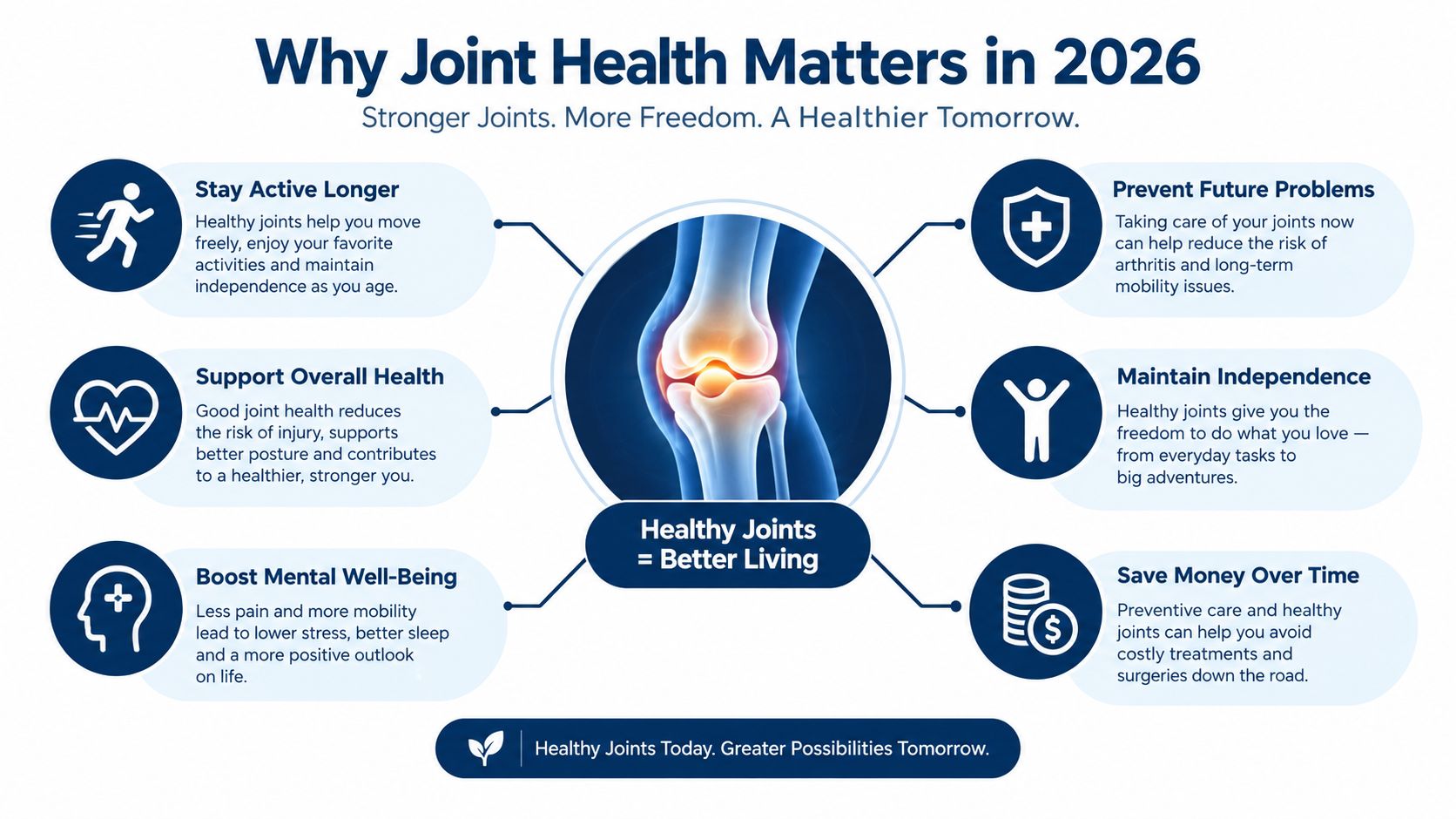
Age matters, but it isn't the whole explanation
U.S. survey data estimated that 53.2 million adults, or 21.2%, had doctor-diagnosed arthritis during 2019–2021; prevalence ranged from 5.4% among adults aged 18–44 to 47.3% among those aged 65 or older, as detailed in the CDC analysis of diagnosed arthritis. These figures describe diagnosed conditions, not supplement demand or supplement effectiveness.
For an individual, the practical priorities are broader than avoiding a diagnosis:
- Comfortable movement: Can you complete ordinary activities without organizing your day around discomfort?
- Useful capacity: Do you have the strength and confidence to handle your usual demands?
- Appropriate attention: Have persistent or changing symptoms received a proper assessment?
Practical perspective: Protecting joint health means supporting the person who uses the joint, not just focusing on an image or a cartilage claim.
Prevention also needs realistic expectations. Healthy habits aren't a guarantee against arthritis, injury, or inflammatory disease. They are part of a sensible strategy for maintaining function and responding early when something changes.
The Main Causes of Joint Problems
Consider a runner whose knee hurts after changing training, a desk worker who feels stiff after sitting, and a parent struggling with pain at the base of the thumb. These are useful hypothetical examples, not diagnoses. Similar descriptions of “joint pain” can lead to very different care decisions.
The first task is therefore identifying the problem, not choosing a supplement.
Different problems need different responses
Osteoarthritis involves a joint condition that shouldn't be reduced to the phrase “wear and tear.” That phrase can make people assume movement is always harmful or that nothing can help. The more useful questions concern symptoms, function, and which treatments suit the person.
Inflammatory arthritis, including rheumatoid arthritis, belongs in a different decision pathway. A supplement-focused approach shouldn't replace evaluation for a suspected inflammatory condition.
Injury-related symptoms need attention to what happened and what changed afterward. A runner with discomfort following an awkward landing needs a different assessment from someone whose symptoms developed gradually without a clear injury.
This visual separates the broad categories people often group together.
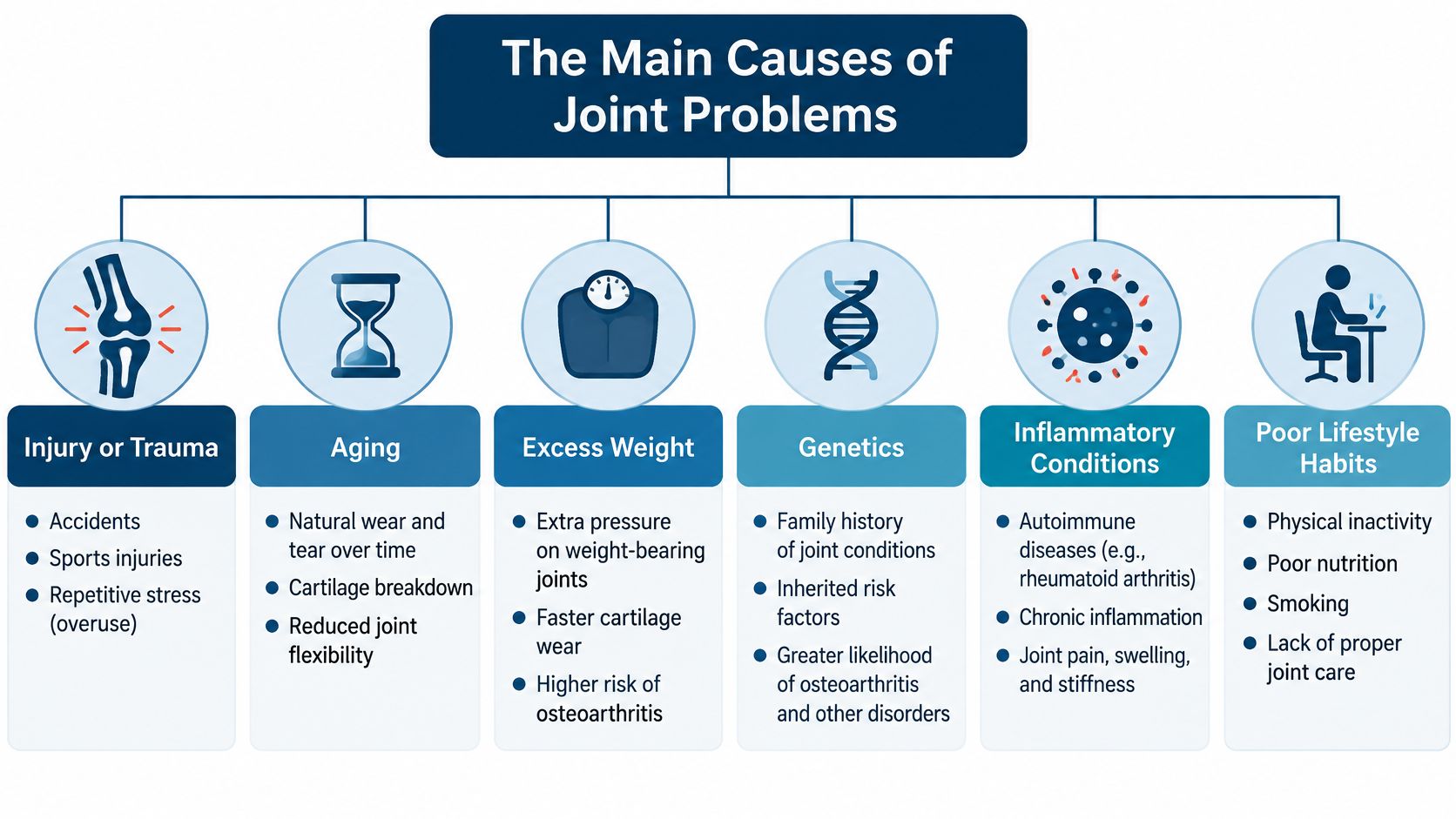
Separate the diagnosis from the demands on the joint
Body weight, repetitive tasks, and activity habits can be relevant without being the entire explanation. For the desk worker, a useful discussion might include movement breaks and physical capacity. For the parent with thumb pain, it might include how gripping and lifting affect daily tasks.
A clinician can use the history and examination to decide what needs investigation. Before an appointment, note:
- Location and pattern: Where does it hurt, and which activities bring it on?
- Changes over time: Is it settling, recurring, or becoming more limiting?
- Functional impact: What can you no longer do comfortably?
- Associated symptoms: Is there swelling, locking, or a recent injury?
For readers considering local care, Midwest Pain & Wellness provides a resource to compare joint pain therapies near Orland Park. Use a treatment overview to prepare questions, rather than to diagnose yourself or assume every listed option fits your situation.
The central distinction is simple: reducing aggravating demands, treating an injury, and managing inflammatory disease aren't interchangeable tasks. Misidentifying the problem can turn an otherwise reasonable wellness routine into a delay in appropriate care.
Lifestyle Foundations That Actually Protect Joints
Build your routine around activities you can repeat and adapt. An ambitious plan that repeatedly leaves you unable to manage ordinary tasks isn't a useful starting point.
This illustration captures the habits to organize around.

Progress movement rather than avoiding it
A review covering 49 studies, including 48 randomized trials, found that exercise for knee pain or osteoarthritis wasn't associated at the group level with worsening pain, reduced function, or osteoarthritis progression; benefits varied by exercise type, as summarized in the Australian Journal of General Practice review of exercise. That doesn't mean every activity suits every person, or that exercise reliably rebuilds cartilage.
A practical starting framework is:
- Aerobic activity: Choose a manageable form of movement, such as walking or cycling.
- Strength work: Select movements appropriate to your current ability, with professional guidance when needed.
- Mobility and control: Include comfortable movement practice or a suitable mind–body activity.
- Recovery checks: Judge progression by how you function afterward, not just what you tolerate during the session.
For complementary ideas to discuss with your practitioner, Bayside Osteopathic Health outlines practical ways to ease joint pain. Treat general advice as a menu to adapt, not a prescription to follow regardless of symptoms.
Address weight without making it a moral judgment
In an 18-month trial involving 240 overweight or obese older adults with knee osteoarthritis, greater intentional weight loss was associated with greater improvements in pain and function, as described in the NIH summary of intensive weight loss and knee arthritis. The findings support individualized weight-management discussions, not a universal target or a reason to postpone other care.
For the rest of your routine, favor workable habits over “anti-inflammatory” promises. Consider regular meals built around foods you enjoy, a consistent sleep routine, and changes of position during prolonged tasks. Don't present a particular food or a supposedly perfect posture as a joint treatment.
The video below offers another format for considering your movement routine.
A realistic weekly template alternates manageable aerobic activity with strength practice, includes comfortable mobility, and leaves room to adjust. During a flare, ask how to modify the activity rather than assuming the only choices are pushing through or stopping everything.
The Four Most-Used Joint Supplements Explained
Symptom relief and disease modification are different outcomes. Less pain doesn't establish that a product preserves cartilage, reverses osteoarthritis, or prevents future disability.
The evidence review discussing joint supplements and conflicting findings describes inconsistent glucosamine and chondroitin findings, including a trial of 1,583 people that found no significant pain reduction from either alone or together. The evidence summaries also describe guidelines advising against these products, fish oil, and vitamin D for osteoarthritis symptoms because adequate high-quality support is lacking. Some standardized ingredients have shown favorable short-term findings, but that doesn't establish a benefit for every formulation.
What each ingredient asks you to believe
Glucosamine is commonly marketed around cartilage support. The leap from a plausible biological role to meaningful pain relief is precisely what clinical trials must test. If you're examining glucosamine, chondroitin, and MSM capsules, review the ingredients separately rather than treating the combination name as proof.
Chondroitin is also promoted for cartilage-related support. Inconsistent results mean consumers shouldn't assume that adding it makes glucosamine effective, or that evidence about an ingredient transfers automatically to a particular bottle.
Omega-3 fatty acids are usually discussed in relation to inflammation. That rationale doesn't make fish oil an established osteoarthritis treatment. Evidence about different joint conditions also shouldn't be treated as interchangeable.
Turmeric or curcumin products are another distinct decision. Extract composition and formulation matter when evaluating any study, and the evidence discussed here doesn't establish a dependable effective dose or cartilage-protective benefit.
Joint Supplement Comparison at a Glance
| Supplement | Proposed Benefit | Evidence Strength | Typical Daily Dose | Key Safety Note |
|---|---|---|---|---|
| Glucosamine | Cartilage-related support and symptom relief | Inconsistent for osteoarthritis symptoms | No dependable effective dose established here | Review the full formulation with a pharmacist |
| Chondroitin | Cartilage-related support and symptom relief | Inconsistent for osteoarthritis symptoms | No dependable effective dose established here | Check combination products for overlapping ingredients |
| Omega-3 fatty acids | Inflammation-related symptom support | Inadequate support for routine osteoarthritis use | Study amounts aren't a personal dosing recommendation | Discuss suitability alongside medicines |
| Turmeric or curcumin | Inflammation-related symptom support | Uncertain in the evidence discussed here | No dependable effective dose established here | Don't assume different extracts are interchangeable |
Guidelines and individual studies can appear to disagree because they address different formulations, outcomes, and levels of certainty. A promising short-term result isn't the same as sufficient evidence for routine clinical use.
Decision rule: Before buying, define the improvement you'd notice in daily life and agree on when you'll stop if it doesn't happen.
The listing for Genius Mobility Natural Joint Support Supplement Powder 4.59 Oz identifies a product, but the name alone doesn't establish ingredients, standardization, or effectiveness. Likewise, HempWell USA's discussion of what works for joint cream can prompt questions about topical options, but cream claims require their own evaluation rather than borrowing evidence from oral supplements.
Safety, Interactions, and When Supplements Are the Wrong Answer
“Natural” isn't a sufficient safety assessment. Neither is having taken a product before without an obvious problem.
A useful review starts with the actual label, your medicines, your medical conditions, and the reason you're considering the product. Safety belongs to the whole combination, not just the headline ingredient.
Make the medication review specific
Ask a pharmacist or prescribing clinician to check the proposed product against prescription medicines, over-the-counter treatments, and other supplements. Rather than relying on a generic warning, ask whether the ingredients raise concerns relevant to you.
Useful questions include:
- Bleeding and procedures: Does this product create concerns alongside my medicines or an upcoming procedure, particularly if I'm considering concentrated omega-3 products?
- Blood sugar or blood pressure: Could any ingredient complicate my existing treatment?
- Pregnancy or breastfeeding: Is there adequate safety information for this exact formulation?
- Chronic illness: Does my medical history change whether a trial is appropriate?
These are screening questions, not claims that every joint supplement causes each problem. The evidence discussed here doesn't provide enough detail to declare a particular product safe for your circumstances.
Topical products need their own review. A listing such as Earth's Care muscle and joint rub isn't a substitute for checking its directions, ingredients, and suitability, and it doesn't establish the cause of the discomfort.
Know when self-treatment should stop
The osteoarthritis patient-care guidance supports progressive activity within an appropriate care plan. A supplement-led routine should never obscure symptoms requiring assessment.
Seek prompt medical evaluation for major swelling, fever with joint symptoms, acute injury, locking, or rapidly worsening pain. If symptoms are severe or you're unsure how urgently to act, contact an appropriate medical service rather than experimenting with another product.
Persistent symptoms also deserve reassessment even when they aren't dramatic. Bring a short record of what you've tried, what changed, and what remains difficult. That gives a clinician something more useful than a growing list of bottles.
A disappointing response is a reason to reconsider the diagnosis and treatment plan, not an automatic instruction to increase the dose.
Before starting a trial, decide how you'll respond to new symptoms and who you'll contact. Don't continue merely because you've already paid for the container. A product that doesn't deliver a meaningful, agreed-upon benefit doesn't need a permanent place in your routine.
Putting It All Together A Realistic 12-Week Plan
Treat this as an organizational framework, not a validated treatment protocol. It's intended for someone with mild, stable concerns whose symptoms don't require urgent evaluation.
Use the roadmap as a reminder to build habits before adding complexity.
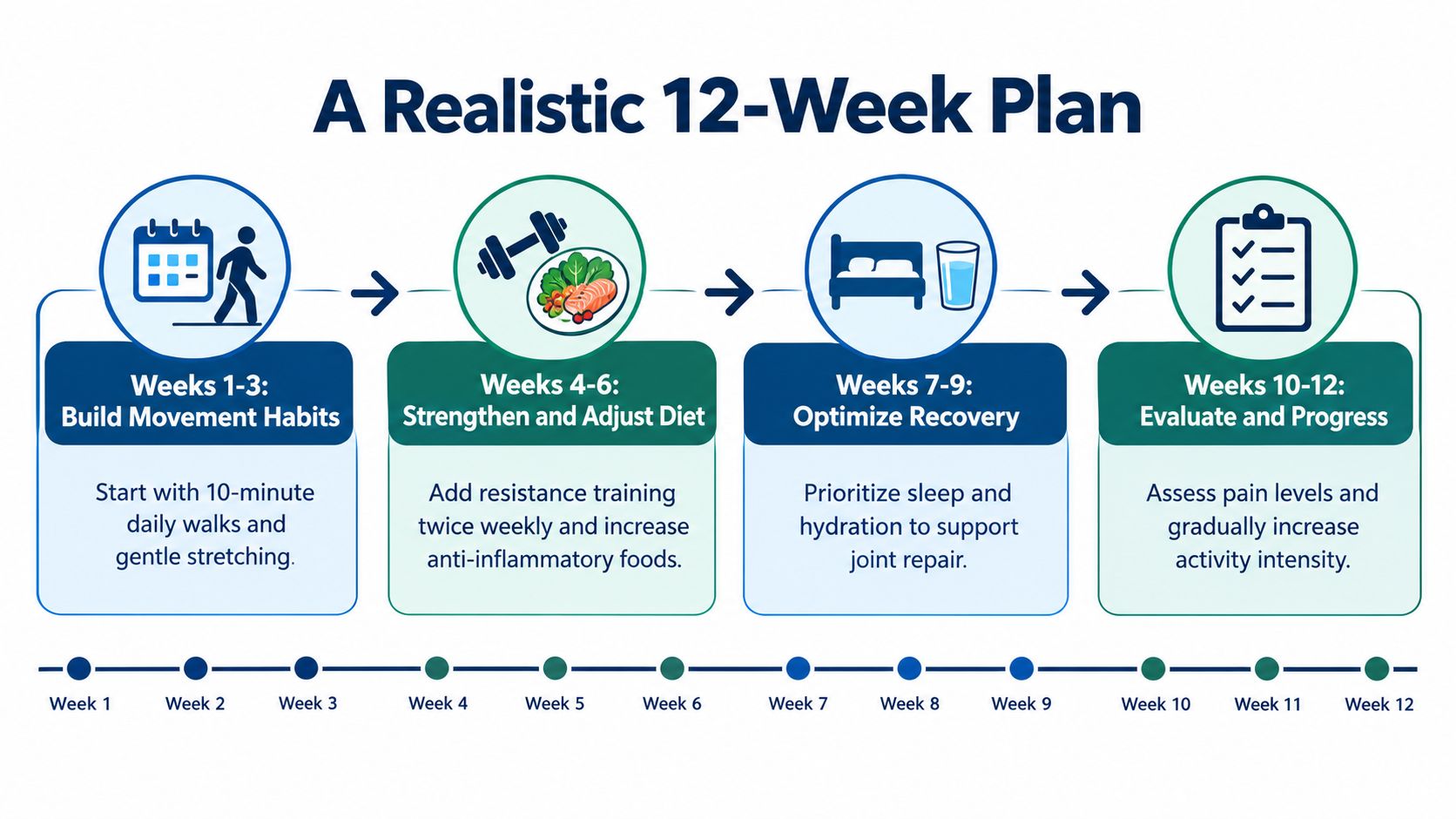
Build, review, and adapt
- Weeks 1–3: Establish manageable movement and record your starting point. Note a familiar walking route, a troublesome task, pain patterns, and sleep.
- Week 4 checkpoint: Review whether the routine is repeatable. Adjust activity demands before adding more, and seek help if the pattern is concerning.
- Weeks 4–8: Develop strength and aerobic activity gradually. If you're considering a supplement, define its purpose and complete the safety review first.
- Week 8 checkpoint: Compare function with your starting point. Avoid interpreting a single unusually good or bad day as the whole result.
- Week 12 checkpoint: Keep useful habits, reconsider ineffective purchases, and arrange assessment if progress has stalled or symptoms have changed.
A catalog entry such as tart cherry extract capsules for joint health shouldn't become an automatic addition to the plan. Its inclusion in a joint-health category doesn't establish that it addresses your goal.
For a hypothetical recreational runner with early knee osteoarthritis, the initial goal might be comfortable everyday walking rather than immediately returning to their usual running. A less active person might begin with tolerating household tasks more comfortably. Both can use meaningful activities as checkpoints without comparing themselves with each other.
Key Takeaways and Common Questions
Protect function, build capacity, and make supplement decisions deliberately. Your routine should help you live more comfortably, not make you dependent on increasingly complicated product combinations.
Common questions
How long should I try a supplement?
Agree on a product-specific review point before starting. There's no universal trial duration established here, and continuing indefinitely without a noticeable benefit isn't a useful strategy.
Does stacking products improve the odds?
Don't assume it does. Adding several products also makes it harder to identify which change, if any, affected your symptoms.
How can I distinguish soreness from damage?
You can't reliably diagnose tissue damage from discomfort alone. Track where symptoms occur, whether they settle, and how they affect function; seek guidance for a new, persistent, or concerning pattern.
What if I feel better after starting a supplement?
Treat that as a useful observation, not proof of cartilage repair. Changes in activity, expectations, and ordinary symptom variation can complicate interpretation.
Choose a daily activity you want to improve, then use that activity to guide your next conversation with a clinician.
Supplemynts Inc offers dietary supplements and wellness products organized by category and health purpose, including joint-health selections. Visit Supplemynts Inc to explore the available options, then review any product you're considering with a pharmacist or clinician against your goals, medicines, and care plan.







Please complete your information below to login.
Sign In
Create New Account