


You're standing in front of a fiber shelf, or scrolling through powder supplements online, trying to decide whether inulin FOS powder is a useful prebiotic or just another sweetener with a health-focused label. The name doesn't help. Inulin and FOS sound interchangeable, yet they're related fibers with different structures and fermentation patterns.
The practical question is less “Is this product good?” and more “How might this particular fiber behave in my digestive system?” A blend can support regularity and provide fuel for selected gut bacteria, but it can also cause bloating or discomfort if the dose rises faster than your tolerance.
This guide breaks down what the powder contains, why manufacturers classify it as a prebiotic fiber, how inulin differs from FOS, and how to use it in drinks and foods. You'll also find guidance for IBS and low-FODMAP diets, comparisons with other fiber forms, and a shopping checklist for reading labels carefully.
Table of Contents
- Introduction to Inulin FOS Powder for Everyday Wellness
- What Inulin FOS Powder Is and How It Differs From Other Fibers
- How Inulin FOS Supports Gut Health and the Microbiome
- Dosage Timing and Everyday Ways to Use Inulin FOS Powder
- Inulin FOS in Foods Versus Supplements and Choosing Your Form
- Safety Side Effects and Who Should Use Extra Caution
- Smart Buying Guide for Inulin FOS Powder at Supplemynts Inc
Introduction to Inulin FOS Powder for Everyday Wellness
A shopper named Maya recently added a fiber powder to her morning smoothie. She expected something similar to a mild thickener, but the label mentioned inulin, FOS, soluble fiber, and prebiotic support. After trying a full serving immediately, she noticed uncomfortable gas and wondered whether the product was helping or upsetting her stomach.
That confusion is common because the word “fiber” covers several very different materials. Psyllium, wheat bran, resistant starch, inulin, and FOS all interact with digestion in their own ways. Some absorb water and add bulk, while others are fermented by bacteria in the colon.
Inulin FOS powder is usually a fermentable, soluble fiber blend, not a conventional sugar or starch. Human digestive enzymes don't fully break these fructan fibers down in the small intestine. Instead, gut microorganisms ferment them farther along the digestive tract, which is why these ingredients are sold as prebiotics.
The distinction matters for anyone browsing digestive health or powder supplements at an online retailer such as Supplemynts Inc. A powder may look simple on the ingredient panel, but its chain length, fiber concentration, serving size, and blend composition can affect how it feels after consumption.
You don't need advanced nutrition training to evaluate one. Start by asking four practical questions:
- What is in the scoop? Look for inulin, FOS, or another fiber listed clearly.
- How much fiber does it provide? Total carbohydrate and dietary fiber aren't always identical on a label.
- How fermentable is it? Faster fermentation can mean a quicker prebiotic effect, but it may also mean more early gas.
- How sensitive is your gut? A dose that's comfortable for one person may be excessive for someone with IBS or FODMAP sensitivity.
The rest of the guide turns those questions into an easy decision process, from basic chemistry to everyday dosing, safety, and product quality.
What Inulin FOS Powder Is and How It Differs From Other Fibers
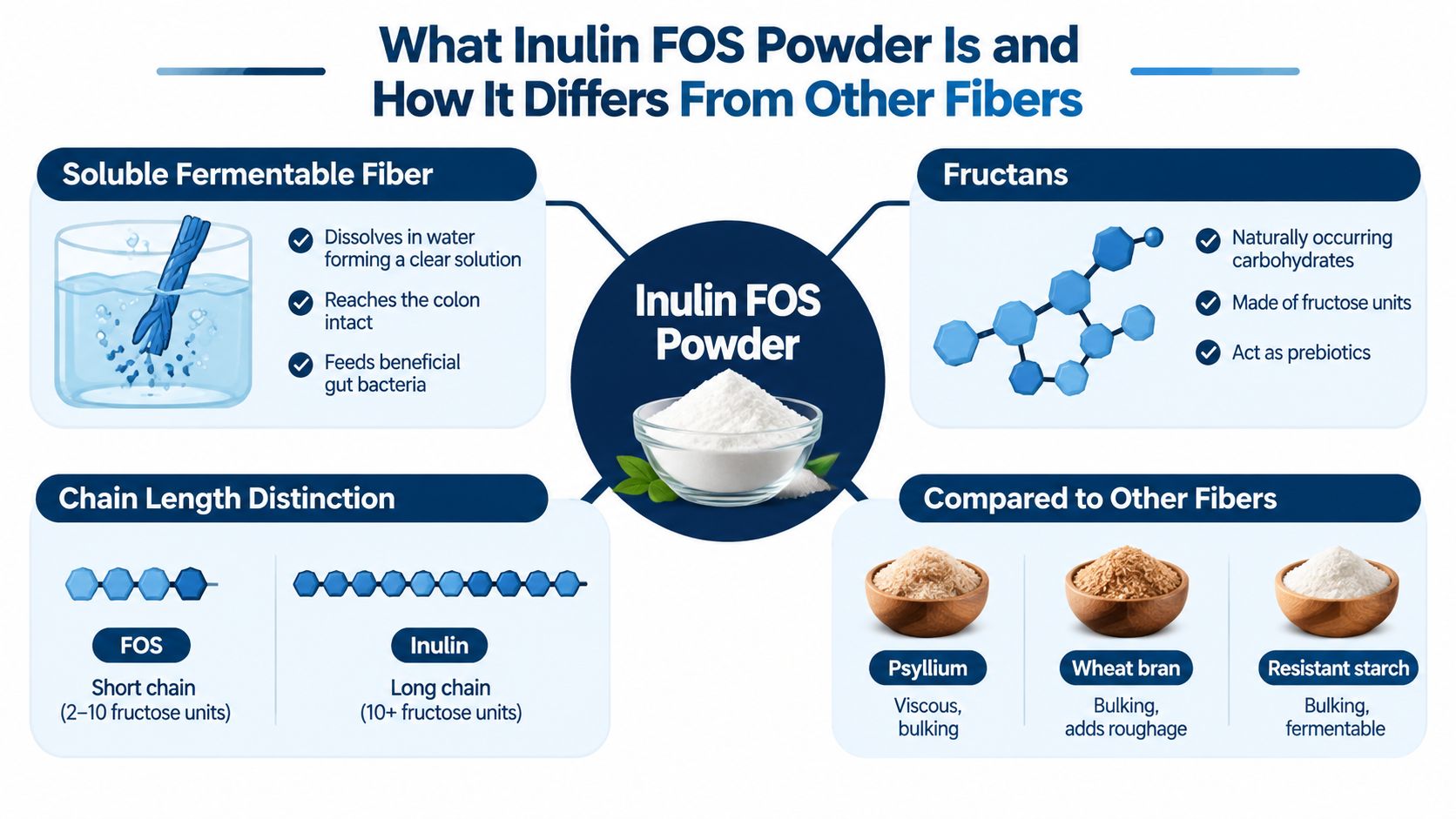
Suppose a powder label lists both inulin and FOS. They are related fibers, yet they do not behave identically in the gut. Both belong to the fructan family, meaning their structure is built from fructose units. Their main difference is chain length, which helps explain differences in fermentation and personal tolerance.
Soluble fiber can interact with water, but solubility alone does not predict how a fiber feels. Inulin and FOS are often compared with a string of beads. Inulin is generally the longer string, while FOS is shorter. Inulin typically has a degree of polymerization, or DP, of at least 10. FOS generally has a DP of 2 to 9, as described in this clinical review of inulin-FOS composition.
Long chains and short chains
Longer-chain inulin usually ferments more slowly and may reach the distal colon, the farther part of the large intestine. Shorter-chain FOS generally ferments faster in the proximal colon, nearer the beginning of the colon. The blend therefore supplies fermentable material along different points of the same route.
That distinction matters when choosing a dose. Faster fermentation may be noticeable sooner, but it can also be harder for a sensitive digestive system to tolerate. A person who handles longer-chain inulin comfortably may still react to a larger amount of FOS, or the reverse. Starting with a small serving and increasing gradually gives the gut more time to adjust.
Inulin and FOS are sold as prebiotics because microorganisms can use them as a food source. A sweetener mainly adds sweetness, while starch is handled differently by human digestion. The prebiotic role comes from the fructan chains reaching gut microorganisms for fermentation.
What the powder looks like
Commercial powders are commonly white to slightly yellow and near-odorless. They may work well in dry blends, capsules, smoothies, or other fortified foods. Technical specifications for one inulin-FOS powder describe around 90% or more inulin, up to 10% simple sugars or fructose, dry matter of 95% to 99%, and a 10% solution pH of 5.0 to 7.0 (technical inulin-FOS product specifications).
The flavor is usually mild, although FOS can add some sweetness. A smoothie or yogurt may hide the texture more effectively than plain cold water, depending on the product and mixing method.
Labels still need careful reading. Serving formats differ, so shoppers can compare the product details for NOW NutraFlora FOS Pure Powder instead of assuming every scoop has the same ratio.
The practical takeaway is clear: inulin and FOS are related, but they differ in chain length, fermentation speed, and possible tolerability.
How Inulin FOS Supports Gut Health and the Microbiome
Your small intestine doesn't completely digest inulin-type fructans. When these fibers reach the colon, resident microorganisms ferment them. That process produces metabolites including short-chain fatty acids, often abbreviated as SCFAs, and changes the local environment where gut bacteria live.
The process is easier to understand as a sequence:
- The fiber travels onward. Inulin and FOS resist ordinary human digestive enzymes and reach the large intestine.
- Microorganisms ferment the substrate. Bacteria use the fructan chains as fuel.
- Fermentation creates SCFAs. These are metabolites associated with activity in the colon.
- Selected bacteria receive an advantage. Reviews and trials describe increases in beneficial bacteria such as Bifidobacterium, though the response varies by person and product.

The useful question isn't whether a prebiotic is “strong.” It's whether the dose supplies fermentable fuel without exceeding your digestive tolerance.
That distinction helps connect microbiome science with everyday outcomes. Some people notice improved bowel regularity or changes in stool consistency. Others mainly notice gas at first. Those aren't necessarily contradictory responses. Fermentation creates the mechanism behind the prebiotic effect, and the same mechanism can produce digestive sensations while the gut adapts.
Why effects aren't instant
Inulin and FOS don't work like a stimulant that produces an immediate, predictable result. The outcome depends on the starting diet, the existing microbial community, the dose, and the person's sensitivity. Research reviews describe increased Bifidobacterium and generally good tolerability in many study settings, while also reporting minor gastrointestinal effects and adaptation over time (systematic review of inulin-type fructans).
A healthy person who already eats a variety of fiber-rich foods may respond differently from someone whose diet is low in fermentable fiber. A person with IBS may also experience symptoms at a lower amount than someone without functional gut sensitivity.
The embedded video offers a visual introduction to how prebiotic fibers interact with the microbiome:
For broader supplement comparisons, shoppers can also review Swanson Dr. Stephen Langer's Ultimate 16 Strain Probiotic FOS, while remembering that a probiotic product and a prebiotic powder serve different roles. A probiotic supplies microorganisms, whereas inulin and FOS supply fermentable substrate for microorganisms already present.
Dosage Timing and Everyday Ways to Use Inulin FOS Powder
A first serving should function as a tolerance test, not a target to reach quickly. Research contexts commonly examine prebiotic doses from about 5 g to 20 g per day, and an overview reports that at least 12 g per day of inulin may improve bowel regularity (reference overview of inulin dosing and uses). These amounts describe study settings, not a personal prescription.
Chain length helps explain why people respond differently. Longer inulin chains generally ferment more gradually, while shorter-chain FOS can reach gut microbes sooner and feel more noticeable. A blend may therefore provide both types of fermentable fiber, but the tradeoff is individual tolerability. Someone who rarely eats this kind of fiber may notice gas or bloating before gaining any benefit.
Start with the smallest amount shown on the label, particularly if your usual diet contains little fermentable fiber. Keep that amount steady while you observe your response, then increase only if it feels comfortable. Persistent bloating, loose stools, or abdominal discomfort are signs to reduce the amount or pause.
Practical mixing ideas
Moist foods and drinks help distribute the powder:
- Coffee or tea: Stir a small amount into a warm drink after it cools slightly.
- Yogurt: Mix it thoroughly so the powder does not remain concentrated in one bite.
- Smoothies: Add it with the liquid and blend fully.
- Oatmeal or cereal: Fold it in after cooking, then consider the meal's total fiber.
- Baking: Use it only when the product label supports that application, since heat and texture can vary.

Consistency matters more than an exact clock time. Taking the powder with a meal may feel gentler than taking it alone, and dividing the daily amount can be easier than consuming it all at once. Drink fluids normally. Extra water does not prevent gas caused by fermentation.
A simple decision check
- Sensitive digestion: Use the smallest practical amount and keep other fiber intake stable.
- Regular fiber intake: A label serving may fit, but consider the meal's total fiber.
- Regularity goal: Increase gradually only when the current amount feels comfortable.
- IBS or low-FODMAP plan: Ask a registered dietitian or clinician how it fits your protocol.
First, find your daily fiber goal so the powder complements, rather than replaces, fiber-rich foods. For an unflavored option, compare the ingredient panel and serving directions for Bulletproof Keto Friendly Innerfuel Prebiotic with your own tolerance.
Inulin FOS in Foods Versus Supplements and Choosing Your Form
If chicory root or another inulin-containing food already fits your meals, you receive the fiber within a wider mix of nutrients and ingredients. A supplement powder concentrates a defined prebiotic fiber into a measured serving. That convenience can simplify dosing, while also making it easier to consume more fermentable fiber than your digestion currently tolerates.
Fortified foods may contain flavors, sweeteners, and other fibers. A standalone powder often has a shorter ingredient list and a more neutral taste. Choose based on whether you want a modest addition to a meal, a measured fiber dose, or a blend whose fermentation pattern differs from a single ingredient.
Choosing between forms
| Form | Typical Fiber per Serving | Best Use Case | Tolerance Note |
|---|---|---|---|
| Inulin-focused powder | Label varies | Prebiotic fiber with a longer chain profile | May still cause gas in sensitive users |
| FOS-focused powder | Label varies | A faster-fermenting prebiotic addition | Effects may feel more noticeable earlier in digestion |
| Inulin-FOS blend | Label varies | Exposure to both chain lengths | Response depends on the ratio and total dose |
| Fiber-fortified food | Label varies | Adding fiber within a meal | Other ingredients may affect tolerance |
| Acacia-containing prebiotic powder | Label varies | Unflavored blending and dietary fiber use | Check the complete formula, not just the word “prebiotic” |
The key difference is chain length. Inulin generally contains longer fructan chains, while FOS contains shorter ones. Shorter chains can ferment sooner, whereas longer chains may move farther through the digestive tract before fermentation. A blend is therefore not merely a stronger version of either ingredient. Its feel depends on the ratio, serving size, and your personal sensitivity.
Start with the form that matches your goal, then judge comfort by your own response. Someone sensitive to fermentable carbohydrates may prefer a smaller amount or a product focused on one ingredient. Someone seeking mixed chain-length exposure may choose a blend, provided the total dose remains manageable.
For constipation-predominant IBS, food choices can matter alongside supplement choices. This guide to worst foods for IBS-C bloating may help identify broader dietary triggers.
A product such as Bulletproof Keto-Friendly InnerFuel Prebiotic Powder contains acacia gum and is not the same as an inulin-FOS blend. Compare the full ingredient panel and fiber amount, rather than choosing based only on the word “prebiotic.”
Safety Side Effects and Who Should Use Extra Caution
If a new scoop of inulin FOS leaves your stomach noisy and swollen, the problem may be the dose, not necessarily the ingredient. Inulin and FOS are fermentable fibers, so gut bacteria break them down and produce gas. A sudden increase can cause bloating, flatulence, abdominal discomfort, and sometimes diarrhea, especially in people who are sensitive to fermentable carbohydrates (WebMD overview of inulin safety and side effects).
Chain length helps explain why two products can feel different. FOS has shorter fructan chains and may ferment sooner, while inulin usually has longer chains that can travel farther before fermentation. Short-chain FOS may therefore trigger symptoms quickly for some people, while a higher-inulin blend may feel gentler at one dose but still cause discomfort if the serving is too large. The blend's ratio, serving size, and your own sensitivity all matter.
Published tolerance ranges are broad. Some adults tolerate roughly 20 g to 30 g per day overall, while symptoms may begin around 10 g per day for others. One cited study found significant gastrointestinal side effects at 20 g of FOS per 70 kg of body weight per day, while 10 g per day did not produce the same significant effects. These figures describe observed responses, not a personal target. The powder's composition, your usual diet, and your digestive history can shift the result.

IBS and low-FODMAP considerations
Inulin-type fructans are fermentable FODMAP carbohydrates. People with IBS or known FODMAP sensitivity may react to an amount that another person handles comfortably. During a structured low-FODMAP elimination phase, adding concentrated fructan powder can also make symptom tracking harder.
A diagnosis of IBS does not automatically mean permanent avoidance. It means the choice and dose deserve individual planning, preferably with a clinician or dietitian who can separate a temporary elimination phase from a long-term eating pattern.
A tolerable dose is more useful than an impressive dose.
Healthy adults in trials have often tolerated inulin-FOS without serious adverse events, and minor symptoms may lessen as the gut adapts. Stop the supplement and seek medical advice for severe, persistent, or unusual symptoms, including dehydration, bleeding, unexplained weight loss, or significant pain. Anyone with a diagnosed gastrointestinal condition, a highly restricted diet, or ongoing unexplained symptoms should seek professional guidance before experimenting.
Smart Buying Guide for Inulin FOS Powder at Supplemynts Inc
You are comparing two powders that both say “gut support.” Their labels may still describe different amounts of fiber, carbohydrates, and fermentable ingredients. Start with the Supplement Facts panel, then check the exact fiber ingredient, serving size, total carbohydrate, and dietary fiber. As noted earlier, serving information can differ: one scoop may list the same amount of carbohydrate and fiber, while another may list slightly more carbohydrate than fiber.
The inulin-to-FOS ratio also affects how the powder may feel. Inulin has longer fructan chains, while FOS has shorter chains that ferment more quickly. That makes FOS a useful option for some routines, but faster fermentation can also mean more gas or bloating for sensitive users. A blend is not automatically easier to tolerate. Choose a product that lets you start with a small amount and increase gradually.
A practical purchase checklist
- Ingredient clarity: Confirm whether the product contains inulin, FOS, a blend, or another fiber.
- Fiber accounting: Compare dietary fiber with total carbohydrate per serving.
- Tolerance fit: Prefer a serving that can be divided or adjusted easily.
- Physical quality: Look for clear information about color, odor, moisture, and testing.
- Routine compatibility: Pick a powder you can mix consistently into food or drinks.
A transparent label is more useful than a broad wellness promise. If the product gives little information about its ingredient identity, serving basis, or testing, comparison becomes harder.
Supplemynts Inc groups products by purpose and category, including digestive health and powder supplements, with search tools for ingredient-based browsing. Its published store policies include free shipping within the continental United States and a 60-day return policy. Supplier information also describes curated sourcing. For recurring supplement purchases, this overview of a Shopify subscription app for supplements explains how subscription systems can support repeat routines.
Store the powder according to its label. Use the included scoop only when the serving is clearly defined, and keep a brief record of your amount and digestive response. The right choice combines clear labeling with a dose you can tolerate consistently.
Browse Supplemynts Inc to compare digestive health and powder supplement options with clear product information. Choose an inulin, FOS, or related prebiotic formula that matches your tolerance, then begin with the label serving guidance and track how your body responds.








Please complete your information below to login.
Sign In
Create New Account