


You've finished a rich meal, taken your digestive enzyme after the last bite, and are now wondering why the capsule didn't help. This is a common mistake. Digestive enzymes work alongside food, so the useful question isn't only whether you took one today. It's whether you chose the right enzyme and timed it to the meal.
The practical approach is straightforward. Match lactase to dairy, lipase to fat, protease to protein, and a broad-spectrum formula to a mixed meal. Take digestive enzymes with food, adjust the timing when a meal runs long, and avoid treating every episode of bloating as an enzyme problem.
This guide focuses on how to use digestive enzymes with real meals, including the difference between a quick snack and a long dinner, condition-specific use, dose adjustment, probiotics, and safety checks. If you're comparing options, a resource such as Bandana Rx enzyme supplements can help you review products before deciding what fits your needs.
Table of Contents
- Introduction to Using Digestive Enzymes Effectively
- Understanding Enzyme Types and When You Need Them
- When to Take Digestive Enzymes for Best Results
- How to Dose and Combine Enzymes With Probiotics
- Practical Tips for Lactose Protein and High Fat Meals
- Safety Precautions and Simple Habits That Make Enzymes Work
Introduction to Using Digestive Enzymes Effectively
You finish a long dinner, take an enzyme with the last bite, and still feel uncomfortable. The problem may be timing rather than the capsule itself. Digestive enzymes are proteins that break food into smaller components for absorption. They are produced in the mouth, stomach, pancreas, and small intestine, while supplementation can support a specific task, such as digesting lactose or supporting pancreatic exocrine insufficiency.
A capsule must meet the food it is meant to digest. Taking a broad-spectrum product on an empty stomach and eating much later separates the supplement from the meal, reducing the practical value of that timing.
Use the symptom pattern to choose a direction. Bloating after milk but not hard cheese may point toward lactase. Heaviness after fried food makes lipase more relevant, while discomfort after a large protein meal may justify examining protease. Those details are more useful than taking a broad formula every morning without a consistent trigger. The food pattern points toward the enzyme type.
Meal length also changes how you use a product. For a meal lasting under 15 minutes, one practical approach places the full dose at the beginning. A 15–30 minute meal may suit a dose split in half, while a meal longer than 30 minutes may call for thirds. Specific pancreatic enzyme dosing requires clinical guidance, as described in practical pancreatic enzyme guidance.
Use Bandana Rx enzyme supplements to compare product formats, then match the formula and timing to the meal. Persistent or worsening symptoms call for a clinician's assessment rather than repeated self-experimentation.
Understanding Enzyme Types and When You Need Them
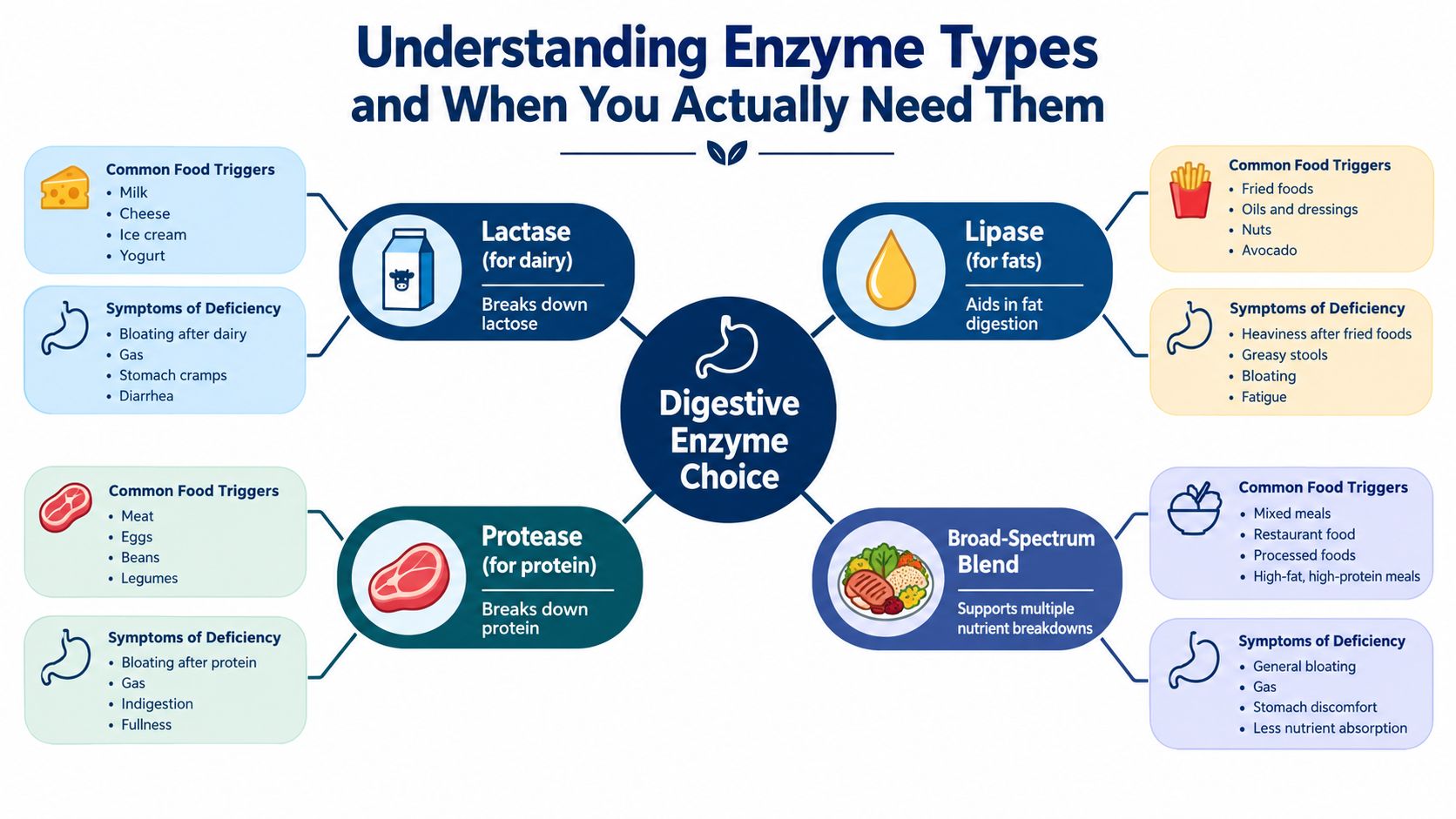
Start with the food that causes the problem, rather than choosing the longest ingredient label. A targeted enzyme is often the better choice when one food group repeatedly triggers symptoms. Reserve broad formulas for mixed meals.
- Lactase breaks down lactose, the sugar in dairy. It fits patterns involving milk, ice cream, soft cheese, or other dairy foods. Evidence is strongest when the issue is lactose intolerance, so use lactase with dairy instead of treating it as an every-meal supplement.
- Lipase supports fat digestion. It may suit rich, oily, or fried meals that cause heaviness, especially when exocrine pancreatic insufficiency is part of the clinical picture.
- Protease helps break down protein from meat, fish, eggs, and dairy. A protease-containing product may be reasonable when protein-heavy meals consistently cause difficulty. Symptoms after protein alone do not establish an enzyme deficiency.
- Broad-spectrum blends combine activities for proteins, fats, and carbohydrates, sometimes adding lactase or enzymes for plant foods. They can fit meals with several potential triggers. A wider ingredient list does not automatically mean better support.
Match the product to the indication
Use is easier to justify when a defined digestive issue is present. Vitacost's condition-specific enzyme overview describes stronger benefits for lactose intolerance and exocrine pancreatic insufficiency, mixed results for IBS-related bloating, and weaker support for healthy adults seeking general digestion support.
That distinction should shape the product choice. A person with lactose intolerance may use lactase only with dairy. Someone receiving care for pancreatic insufficiency may require prescribed pancreatic enzyme replacement therapy with meals and snacks. A healthy adult with occasional overeating may gain little from taking a broad-spectrum product every day.
Read the label for actual enzyme activity, rather than counting ingredients. For pancreatic support, compare a product such as NOW Pancreatin 2,000 with a general blend, and check whether it supplies the enzyme activities relevant to the intended use. The active site on BacteriaFAQ.com explains the biochemical region where an enzyme interacts with its substrate.
Persistent or worsening symptoms need clinical assessment instead of repeated product changes.
When to Take Digestive Enzymes for Best Results
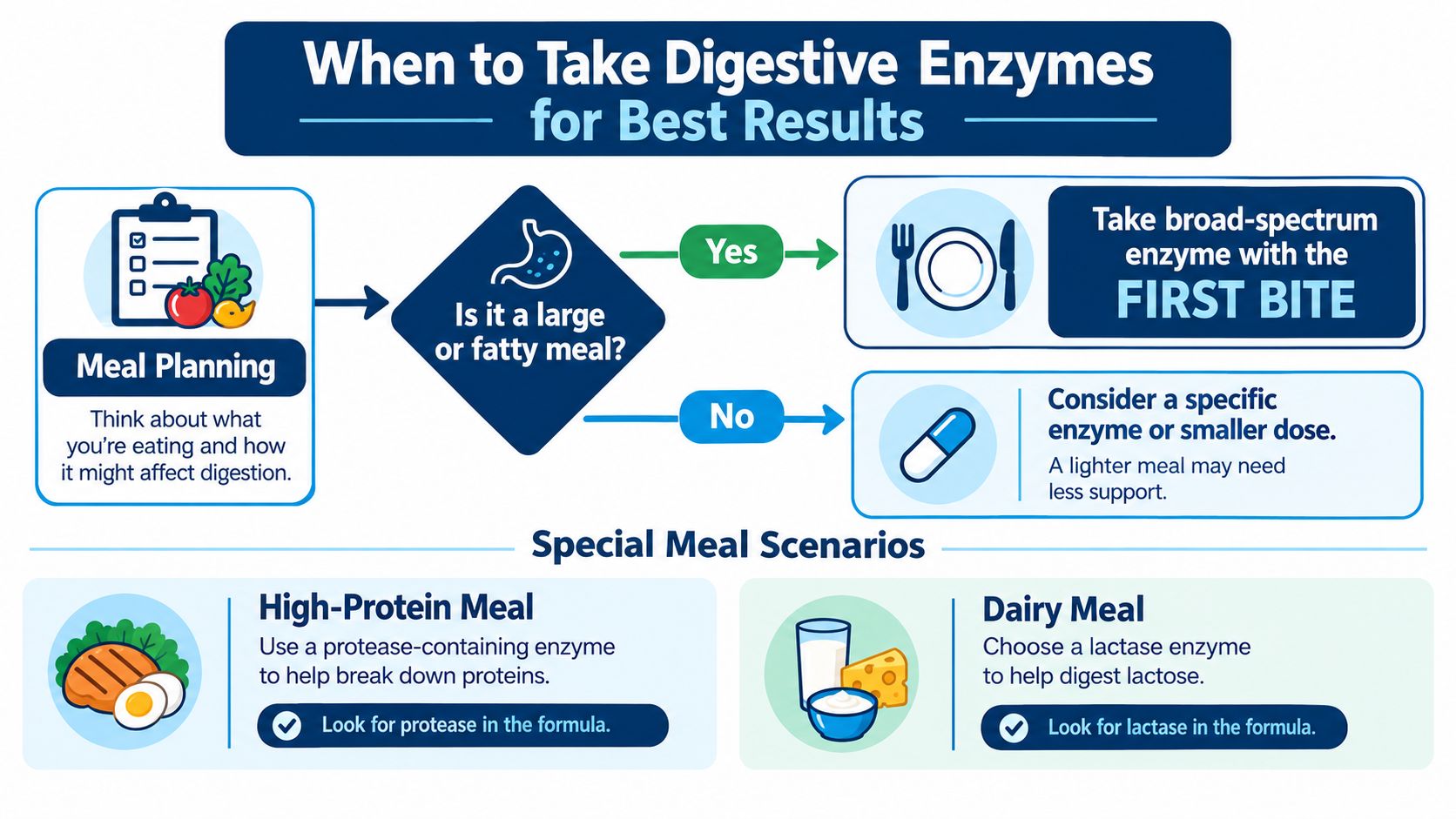
For most digestive enzyme supplements, take the capsule with the first bite of the meal. Don't take it on an empty stomach and expect it to remain perfectly matched to food eaten later. The enzyme has to travel with the meal so it can mix with food in the stomach and small intestine.
Use meal length as your timing guide
The simplest routine is to look at how long you'll eat.
- Meal under 15 minutes: Take the full dose at the beginning.
- Meal lasting 15–30 minutes: Take about half with the first bite and the remaining half midway through.
- Meal longer than 30 minutes: Divide the dose into thirds across the meal.
This isn't about following a clock for its own sake. It's about keeping enzyme activity distributed through the food as the meal moves through digestion.
Practical rule: The longer the meal, the more useful it is to spread the enzyme through the meal rather than taking everything before or after it.
A quick lunch eaten in ten minutes calls for a different approach from a long dinner with several courses. If you're eating a sandwich rapidly, taking the product with the first bite may be sufficient. If dinner lasts forty minutes, splitting the labeled serving helps keep the supplement aligned with the food.
Avoid common handling errors
Don't crush or chew an enteric-coated capsule or tablet unless the product instructions specifically allow it. The coating protects the contents from stomach acid and may be important for delivery farther along the digestive tract. Also check your medication routine, because calcium- or magnesium-containing antacids may reduce enzyme effectiveness, according to guidance on enzyme timing and dosing.
Digestive enzymes aren't interchangeable with betaine HCl. If you're considering a product that contains both, review the full label and your personal situation rather than assuming the added ingredient is necessary. A product such as NOW Betaine HCl 648 mg belongs to a different category and shouldn't be treated as a substitute for enzyme guidance.
How to Dose and Combine Enzymes With Probiotics
A short snack and a long, rich dinner should not receive the same enzyme plan. Dose according to the meal and the condition, then match the enzyme type to the food. Product labels use different activity units, so follow the stated serving unless a clinician has prescribed another approach.
For diagnosed exocrine pancreatic insufficiency, dosing requires clinical supervision. Adult guidance commonly starts at 25,000–50,000 lipase units per meal. UK practical guidance recommends at least 50,000 units with meals and 25,000 units with snacks, according to the clinical practice guidance for pancreatic enzyme replacement. Severe malabsorption, ongoing symptoms, or nutritional concerns call for an individualized plan rather than casual supplement use.
Adjust by response, not guesswork
For general wellness use, begin with the smallest serving that fits the label and the meal. Record the food, enzyme type, timing, and symptoms for about a week. A repeatable pattern, such as better tolerance of dairy after lactase, matters more than a single result after an unusually large meal.
A long meal may justify dividing the labeled serving across the meal, provided the product directions allow it. Repeatedly adding capsules after one episode of bloating is poor troubleshooting. Meal size, fermentable carbohydrates, reflux, food intolerance, or another condition may explain the symptom, and enzymes will not correct those causes.
Keep probiotics in their own lane
Probiotics contain living microorganisms; digestive enzymes are different compounds with different roles. They can be used together, but assess each product on its own terms. The pharmacist guide to probiotics offers practical points on strains, storage, and label directions before you combine supplements.
Take the enzyme with the meal, then schedule the probiotic according to its own label. If the probiotic causes gas or loose stools, pause it and evaluate that response separately instead of assuming the enzyme is responsible. Product instructions also vary by format, as shown by Jarrow Formulas Probiotic Duo, so do not transfer dosing habits from one probiotic to another.
Practical Tips for Lactose Protein and High Fat Meals
A dairy-heavy breakfast, a protein-rich dinner, and a fried meal create different enzyme decisions. Match the product to the food component, then time it around the meal rather than taking a broad blend automatically.
Choosing the Right Enzyme Strategy by Meal Trigger
| Meal Trigger | Best Enzyme Approach | When to Take It | Practical Tip |
|---|---|---|---|
| Dairy such as milk or ice cream | Lactase | With the dairy food or first bite of the meal | Use it for a repeatable dairy trigger |
| Large protein meal with meat, fish, or eggs | Protease-containing formula | With the first bite | Check the label for protease activity and serving directions |
| Fried or very rich meal | Lipase-containing support | With the first bite, splitting during a long meal | Do not use enzymes to justify meals that repeatedly cause symptoms |
| Mixed meal with protein, fat, and starch | Broad-spectrum blend | With the first bite | A broad formula can suit meals without one dominant trigger |
| Bloating without a clear food pattern | Do not assume enzymes are the answer | Seek assessment if symptoms continue | Targeted use has a clearer rationale than general wellness use |
Dairy requires a specific answer
If milk, ice cream, or cheese repeatedly causes bloating, gas, or loose stools, lactase is a more sensible trial than a generic enzyme cocktail. Take it with the dairy food or at the first bite, so the enzyme is present as lactose enters digestion. For a longer meal, follow the product directions about whether the serving can be divided.
Taking lactase only after symptoms begin is poor timing. It also cannot address reactions caused by milk proteins or another gastrointestinal issue. Persistent symptoms call for reassessing the trigger, not repeatedly increasing the dose.
Protein and fat are different problems
A steak dinner and a creamy dessert may both feel heavy, but protease and lipase act on different food components. Use a protease-containing product when protein is the consistent concern, lipase-containing support when fat is the clearer trigger, and a blend when both are prominent in the same meal.
For a long, rich meal, a labeled serving may be divided across the meal if the instructions permit it. Do not chew coated products. A broad blend also will not correct bloating from oversized portions, carbonation, constipation, or another condition.
A clear food pattern makes a short, targeted trial easier to interpret. General wellness use is less specific, so avoid treating every episode of bloating as an enzyme problem.
Safety Precautions and Simple Habits That Make Enzymes Work
Digestive enzymes work best as targeted tools. Taking more than the meal requires can cause gas, bloating, diarrhea, or other gastrointestinal symptoms, making the original trigger harder to identify. Match the product to a repeatable food pattern instead of treating every episode of discomfort with a broad blend.
If milk, ice cream, or cheese repeatedly causes bloating, gas, or loose stools, try lactase with the dairy food or at the first bite. For a longer meal, divide the serving only if the product directions allow it. Taking lactase after symptoms begin is poor timing, and lactase will not address milk-protein reactions or another gastrointestinal issue.
Steak and creamy dessert involve different enzymes. Use protease when protein is the consistent concern, lipase when fat is the clearer trigger, and a blend when both are prominent in the same meal. A broad product will not correct discomfort from oversized portions, carbonation, constipation, or another condition.
Use a short evaluation window
Choose one product, follow its label, and assess the same symptom across repeated meals. For a long, rich meal, a labeled serving may be divided if permitted. Do not chew coated products. If improvement is inconsistent, stop increasing the dose and reassess the food trigger, product choice, and need for clinical evaluation.
Seek medical guidance for suspected pancreatic disease, ongoing malabsorption, unexplained weight change, persistent diarrhea, significant abdominal pain, pregnancy, a medical condition, or medication concerns. Prescription pancreatic enzyme replacement requires condition-specific supervision.
Store enteric-coated products in a cool, dry place. Keep capsules intact unless the manufacturer says otherwise, and reread directions when changing products.
Supplemynts Inc organizes digestive health, enzyme, and probiotic products by purpose. Visit Supplemynts Inc to compare digestive support products and shop with free continental US shipping and a 60-day return policy.







Please complete your information below to login.
Sign In
Create New Account