

You're standing in a store aisle with two supplement bottles that look almost interchangeable. Both promise daily wellness, energy, or immune support, and both use polished colors, confident wording, and a few prominent ingredients to win your attention. The useful information, however, is usually quieter. It sits on the back panel in serving sizes, ingredient amounts, warnings, and directions.
Learning how to read supplement labels turns that crowded shelf into a set of practical questions. What are you getting in one daily dose? Are the individual ingredients disclosed? Does the product's form matter? Is a certification mark verifiable, and does the label support the impression created by the front panel? The framework below starts with the label rules established under the Dietary Supplement Health and Education Act of 1994, then adds a dose-realism check for blends, ingredient forms, and modern packaging.
Table of Contents
- Standing in the Aisle With a Bottle in Your Hand
- Decoding the Supplement Facts Panel Step by Step
- Reading Between the Ingredients on the Back
- Marketing Language Versus What the Label Actually Proves
- Third-Party Seals, Expiration Dates, and Special Labels
- Your Label Reading Checklist Before You Buy
Standing in the Aisle With a Bottle in Your Hand
You have two bottles in your basket, both promising daily wellness. Their front panels highlight different nutrients, bright claims, and polished design. Turn each bottle around before deciding. The back panel is where a fair comparison begins.
Under the Dietary Supplement Health and Education Act of 1994 framework, a supplement label identifies the product as a supplement, states the net quantity, names the manufacturer, and provides directions for use. The Supplement Facts panel lists the serving size, active ingredients, amount per serving, and percent Daily Value where available. The rest of the label may identify fillers, binders, sweeteners, colors, flavorings, and allergens.
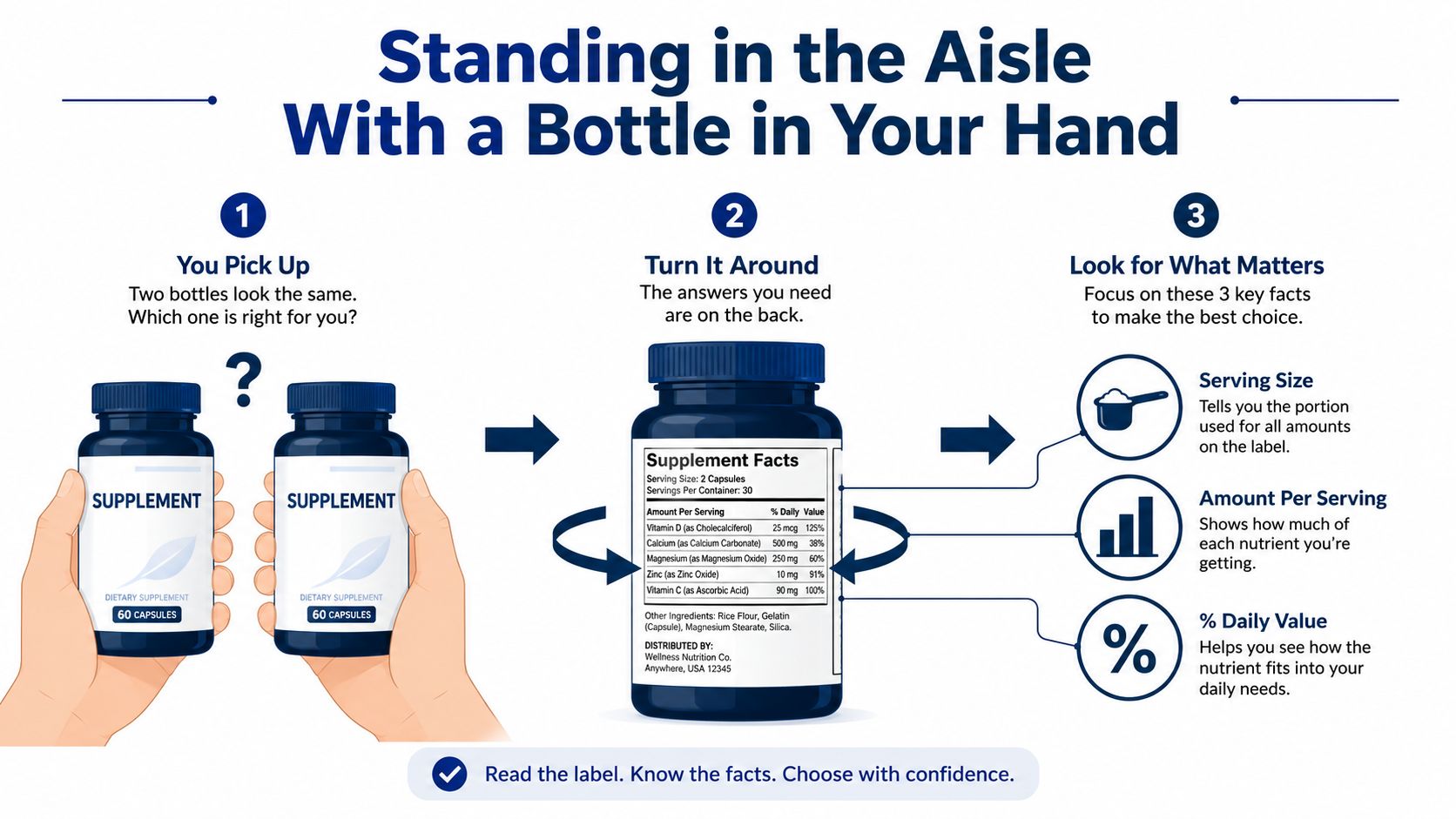
Start with three information areas
Read the bottle in this order:
- Supplement Facts panel: Check the product form, serving size, servings per container, amount per serving, and percent Daily Value where listed.
- Complete ingredient list: Look past the headline nutrient. Identify active compounds, ingredient forms, fillers, binders, sweeteners, colors, flavorings, and allergens.
- Directions and cautionary text: Review suggested use, storage instructions, age restrictions, medication warnings, expiration or best-by information, and any named quality certification.
This order turns label reading into a shopping decision. Does the product contain what the front emphasizes? How many tablets, capsules, gummies, scoops, or liquid measures provide the listed amount? A one-capsule serving and a two-gummy serving cannot be compared by bottle size or unit count alone.
Dose realism matters here. A proprietary blend may name several ingredients without showing each amount, making it difficult to judge whether any component is present at a meaningful dose. A mineral salt or other ingredient form may also look impressive on the front while providing less of the named compound than you expected. Minimalist packaging can hide those details, so use the back panel rather than the design as your evidence.
The panel is called Supplement Facts, not Nutrition Facts. Dietary ingredients, serving size, and servings per container appear there. Ingredients without an established Daily Value, including many botanicals, may have no percentage listed. That blank does not prove the ingredient has no value. It means you must examine its amount, form, and directions more carefully.
Practical rule: Read the bottle from the back forward. Let disclosed amounts, forms, directions, and warnings determine whether the front-panel promise deserves attention.
For a familiar multivitamin comparison, inspect the label details on Bayer One A Day Men's Complete Multivitamin, then compare its serving information with another product instead of relying on the product name. The same approach works for capsules, powders, gummies, liquids, probiotics, and performance products.
Decoding the Supplement Facts Panel Step by Step
The front of a bottle may promise a simple solution, but the Supplement Facts panel shows what you are buying. Read it in order, like a map: first identify the serving, then the amount, then the ingredient form and directions.
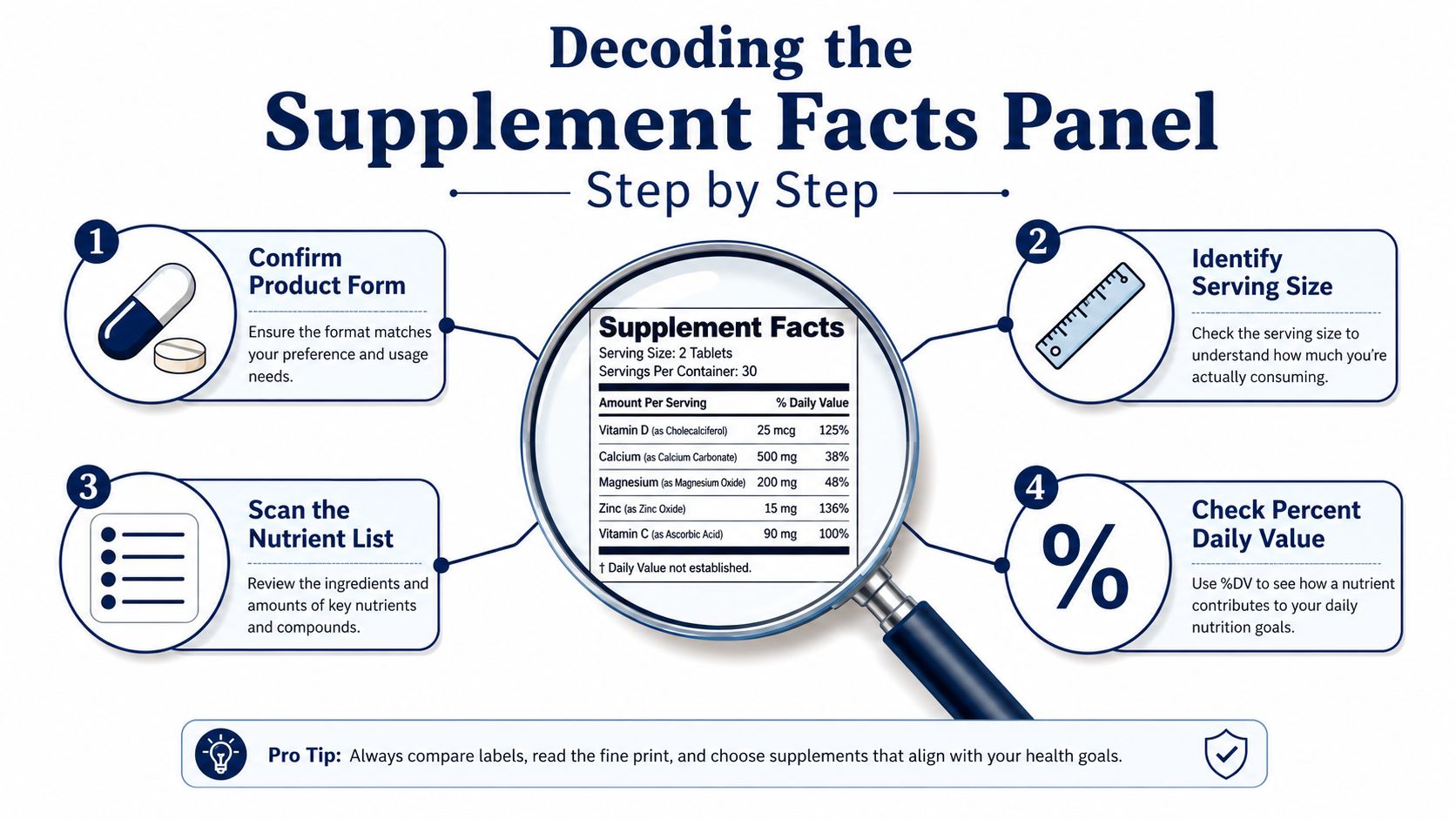
Confirm the form and serving size
Start by identifying whether the product is a tablet, capsule, softgel, gummy, powder, or liquid. The serving size applies to that form. One capsule may equal one serving, while a gummy product may require several gummies. A powder may define a serving as one scoop, but that scoop is not necessarily a precise household measure unless the label explains it.
Then find servings per container. This indicates how many labeled doses the package contains. A large bottle can run out sooner than expected if each serving requires several units, so compare products by full serving rather than container appearance or unit count.
The listed serving size is the manufacturer's suggested basis for the panel. Your health care provider may recommend a different amount, so separate the label's serving from your personal plan. Maximum Health Products supplement advice offers another consumer-oriented explanation of this label-reading process.
Read amount per serving, not just the ingredient name
Under each dietary ingredient, locate the amount per serving and its unit. Milligrams, micrograms, and international units measure different things. The listed number may also describe a compound or salt rather than the active portion you want, which makes the ingredient form part of the dose calculation.
For nutrients with an established Daily Value, %DV places the amount in the context of a daily intake. FDA guidance identifies 5% Daily Value or less as low, but %DV is not a universal target. Herbs, probiotics, and specialty ingredients may have no established Daily Value, leaving an amount without a percentage. That blank requires closer attention to the dose, form, and directions.
A proprietary blend deserves the same caution. It may list several ingredients under one combined amount without showing each ingredient's share. You cannot confirm whether every named component reaches a meaningful dose, even when the front panel lists an impressive collection. Mineral salts create a related problem: the label may name a mineral, while the actual elemental amount is less obvious.
Ingredients generally appear in descending order by weight, although formulation and processing rules can create exceptions. Compare products using the complete labeled serving. If one requires multiple capsules and another requires one, check both the total serving amount and how often the directions call for use.
A prominent ingredient name means little until you know the serving size, amount per serving, and form.
For a concrete comparison, examine the Amazing Formulas Calcium Magnesium Zinc Vitamin D3 label, including its serving information and listed mineral amounts. Apply the dose-realism test to every product: can you identify the amount of each priority ingredient across the full daily serving? If not, let the undisclosed details outweigh the polished front-panel design.
Reading Between the Ingredients on the Back
The ingredient list reveals what the front panel leaves out. It can show the source and form of an active nutrient, the materials used to make a tablet or capsule, and substances that matter because of allergies, dietary preferences, or medication use.
Proprietary blends reduce dose visibility
A proprietary blend usually provides one total blend amount while grouping several ingredients underneath it. You may know the combined weight, but not how much of each ingredient you're receiving. That makes it difficult to decide whether a particular botanical, extract, mineral, or performance ingredient is present at a meaningful amount.
Words such as complex, matrix, and multi-ingredient formula can deserve the same inspection. They aren't automatically problematic, but they may describe a shared amount rather than individually disclosed doses. Calculate the total daily amount from the serving instructions, then ask whether every priority ingredient has its own listed quantity.
Ingredient form matters, too. Mineral salts can provide different amounts of elemental mineral, herbal extracts may identify standardization to a marker compound, and vitamins can appear in different forms with different practical considerations. A label that names only “magnesium” or “curcumin” may leave important details unresolved.
Separate necessary ingredients from avoidable ones
The “Other Ingredients” list can include binders, fillers, bulking agents, capsule materials, sweeteners, flavorings, preservatives, and coloring agents. An unfamiliar name isn't automatically harmful, and some excipients help a product hold together, remain stable, or taste acceptable. The shopping question is whether the ingredients fit your needs and whether the label is clear enough for you to make that decision.
Scan for allergen information, including milk, egg, fish, shellfish, tree nuts, peanuts, wheat, and soy. Shared-facility statements may matter when you need strict avoidance. Terms such as “natural flavors” can also be too broad for shoppers who need to identify a specific source.
| Label clue | What to check | Shopping implication |
|---|---|---|
| Proprietary blend | Is each active ingredient assigned an amount? | Prefer a formula with individual disclosure when dose matters. |
| Mineral name | Is the chemical form or elemental amount identified? | Compare forms instead of comparing the headline mineral name alone. |
| Botanical extract | Does the label state extract details or standardization? | Look for enough information to distinguish a studied extract from raw material. |
| Other ingredients | Which fillers, binders, colors, sweeteners, and capsule materials appear? | Choose based on personal tolerance and dietary requirements. |
| Allergen statement | Are major allergens or shared facilities disclosed? | Set aside products that don't answer an important avoidance question. |
A label can be technically complete yet still leave meaningful quality differences hidden. The same principle applies when comparing product formats in a broader consumer context, such as Ultra pouches versus other pouch options. For a turmeric formula, inspect the ingredient form and serving details on Amazing Formulas Turmeric Curcumin BioPerine rather than assuming the prominent milligram figure tells the whole story.
Marketing Language Versus What the Label Actually Proves
A front label can make a product sound more specific than it is. Phrases such as “supports heart health,” “brain health,” or “supports cognitive function” are generally structure/function wording, not proof that a product treats a disease. The distinction is easy to miss because consumers often interpret supportive language as a medical promise.
Research summarized in reporting on consumer misunderstanding of supplement claims identifies this as a significant communication gap. The practical lesson isn't to reject every structure/function statement. It's to read the wording narrowly and ask whether the facts panel provides enough information to evaluate the product behind it.
Separate a promise from evidence
Words such as detox, advanced, ultra, plus, and proprietary formula can describe positioning rather than dosage. “Natural” doesn't establish safety, and “clinically proven” should prompt you to look for a specific, relevant citation rather than accepting the phrase at face value. “Doctor recommended” is also incomplete if the label doesn't identify who made the recommendation or what evidence supports it.
The FDA and NIH label guidance emphasize that a compliant label doesn't prove efficacy, safety, or suitability for a particular outcome. Certification, claims, and ingredients are separate evidence streams. A product may disclose its contents properly without demonstrating that it will produce the result suggested by the front panel.
| Front-panel phrase | What it sounds like | What the label should show | Red flag if... |
|---|---|---|---|
| “Supports immunity” | It may prevent illness | Clear ingredients, amounts, directions, and cautions | The formula hides amounts in a blend or makes disease-like promises. |
| “Advanced complex” | It may contain a superior formula | Individually disclosed ingredients and forms | The complex has only one combined weight. |
| “Clinically proven” | Research confirms the product works | A relevant study or clearly identified evidence | No citation or product-specific explanation appears. |
| “Natural” | It may be safer | Complete ingredients and warnings | The term replaces dose, source, or safety information. |
| “High potency” | It may provide more useful support | Actual amount per serving and full daily directions | The label gives a dramatic phrase but little measurable detail. |
Compare two products from the same category side by side. Ignore the superlatives, then check whether each highlighted ingredient has an individual amount, a clear form, and a realistic serving. If one bottle sounds louder but reveals less, the quieter label may be the more responsible choice.
Third-Party Seals, Expiration Dates, and Special Labels
Quality marks can add useful information, but they don't all answer the same question. A named third-party program may test identity, potency, purity, contaminants, or banned substances, while none of those checks automatically proves that a supplement will achieve your personal health goal.
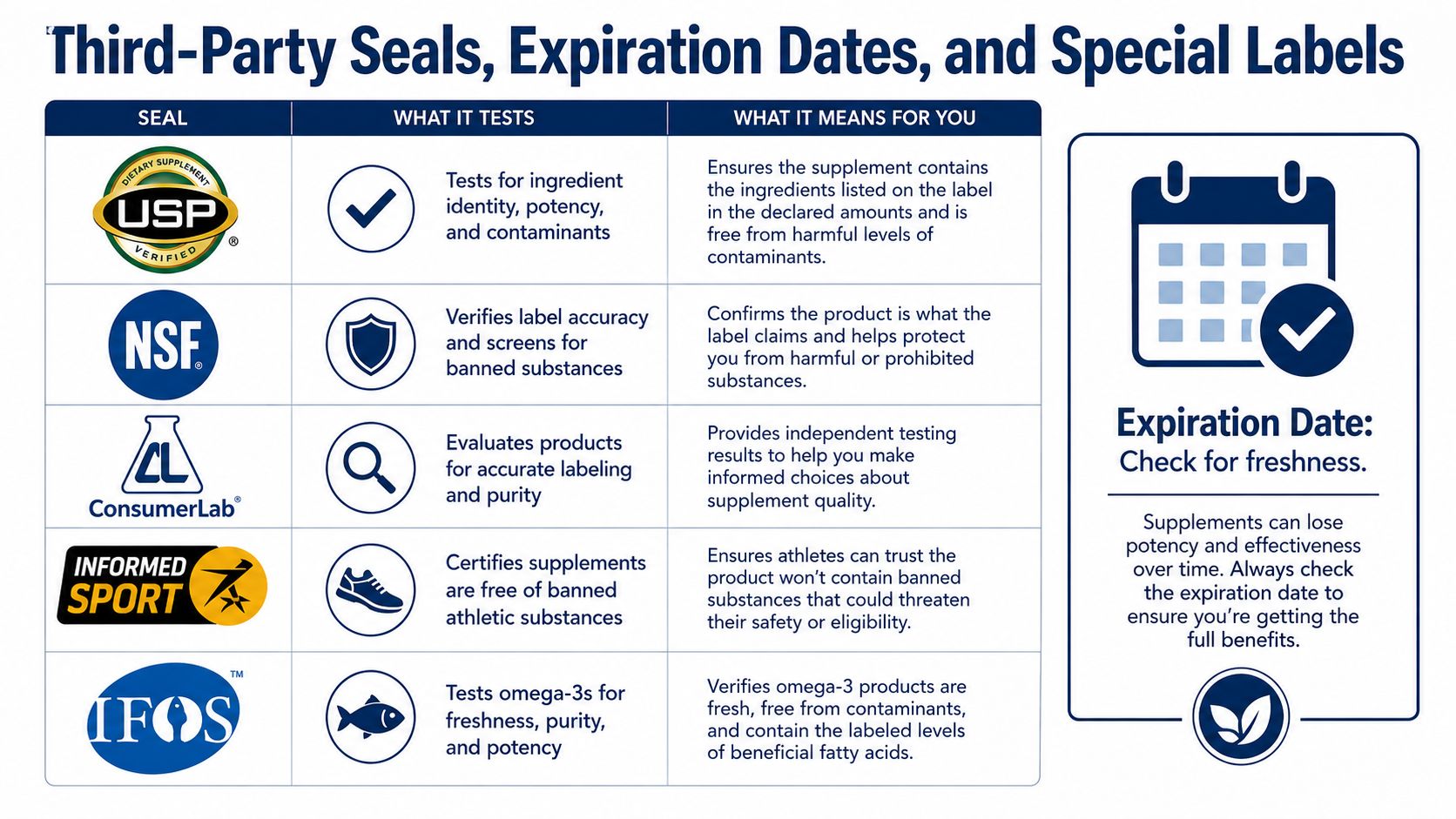
Compare the seal with the claim
The USP Verified mark signals that quality testing has confirmed a product meets USP standards, as described by USP's guide to supplement labels and the USP Verified mark. NSF programs can address label accuracy and banned-substance screening, ConsumerLab evaluates products for labeling and purity, Informed Sport focuses on banned athletic substances, and IFOS is associated with omega-3 freshness, purity, and potency testing.
Treat those as different filters. If you want an omega-3 product, an omega-3-specific testing program may answer a more relevant question than a general quality statement. If you're an athlete, banned-substance screening may carry special importance. A seal doesn't replace the Supplement Facts panel, and a logo without a named certifier or verifiable program deserves caution.
Check a QR code or registry URL when available. A phrase such as “quality tested” is weaker than a current, identifiable certification that you can verify independently. Packaging and traceability also matter beyond supplements, and resources such as MSP Packaging's money bags illustrate why secure handling and clear identification can be practical concerns in product distribution.
Read the date and special-label details
Look for the expiration or best-by date, then follow storage instructions. A “manufactured on” date tells you when production occurred, while a lot number supports traceability. Neither substitutes for an expiration date when freshness or potency can change over time.
For vegan, vegetarian, gluten-free, and non-GMO statements, ask whether the claim is third-party verified or declared by the manufacturer. The distinction matters most when you have a medical, ethical, or religious reason to avoid a substance.
Probiotic labels need extra care. Check whether the product identifies the genus, species, and strain, whether CFU information is tied to manufacture or expiration, and whether refrigeration or special storage is required. A product that names a strain clearly gives you more useful information than one that lists only a broad bacterial category. Enteric coatings may also matter when the product is designed to protect contents during passage through the stomach.
One example is Swanson Immunobiotic Immuno-LP20 Immune Health Support, which comes in 30 veggie capsules and is formulated with heat-treated Lactobacillus plantarum. The product description connects it with immune and general wellness support, but you should still inspect its own serving, ingredient, storage, and caution information before deciding whether it fits your needs.
Your Label Reading Checklist Before You Buy
A reliable label routine should work both in a store and on a product page. Start with the bottle in your hand, but use the same questions online. If a retailer doesn't show the complete label, treat that missing information as a reason to pause rather than filling in the gaps with assumptions.
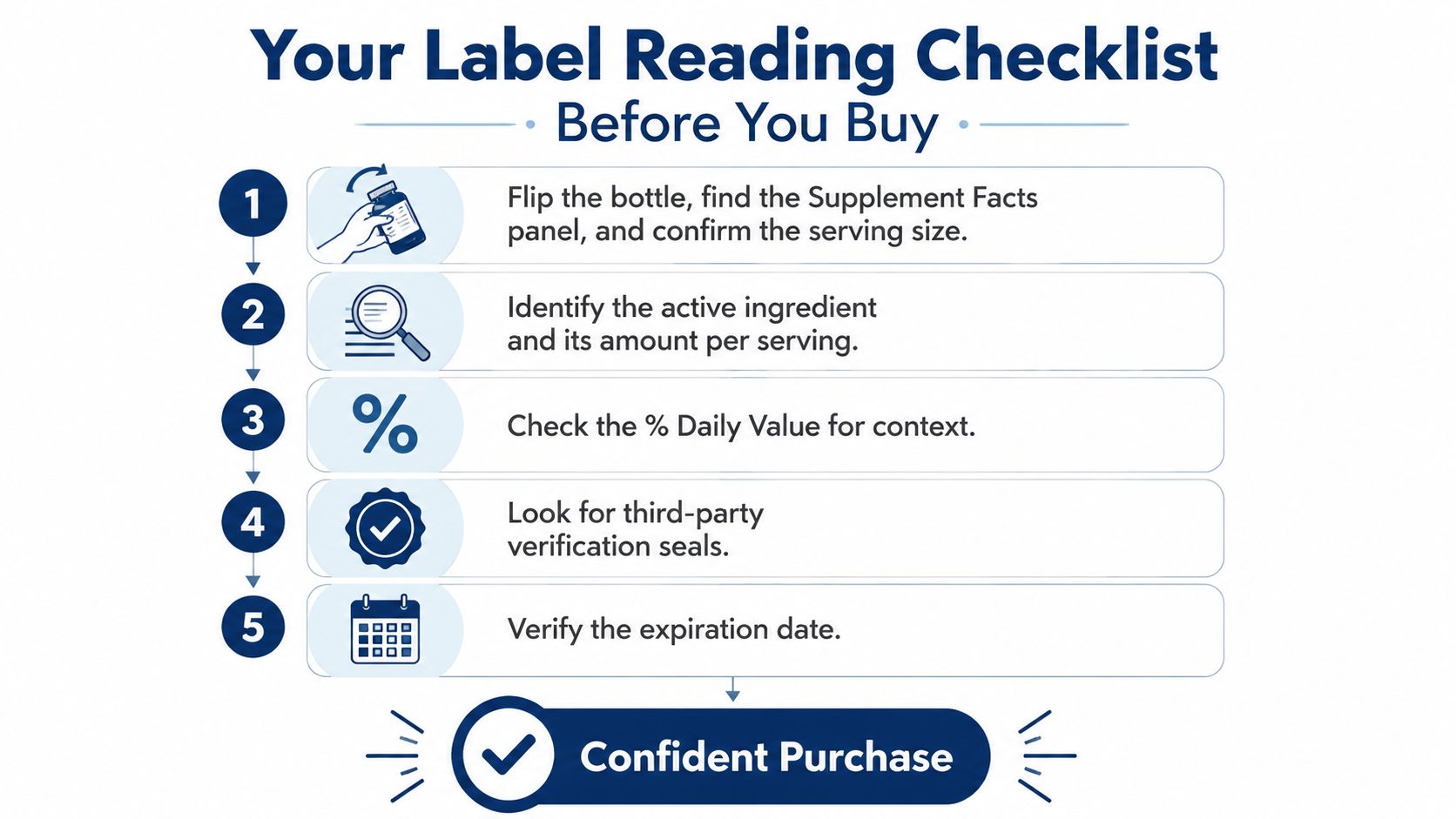
Use the seven-question bottle check
Find the Supplement Facts panel. Confirm the product form, serving size, servings per container, and amount per serving. Use the suggested daily frequency to understand the actual daily dose rather than assuming one capsule equals one serving.
Name the active ingredient you care about. Write down its individual amount. If it appears inside a proprietary blend, complex, or matrix without a separate quantity, mark the dose as unknown.
Use %DV for context. For vitamins and minerals with an established Daily Value, note whether the contribution is low or substantial. The FDA's label guidance identifies 5% DV or less as low, but %DV isn't available for many botanicals, probiotics, and specialty ingredients, so don't treat a missing percentage as a defect by itself. FDA's dietary supplement labeling guide explains the panel requirements and the role of Daily Values.
Read “Other Ingredients.” Check capsule materials, binders, fillers, sweeteners, flavors, colors, and preservatives. Then look for allergen statements and animal-derived ingredients that could conflict with your diet.
Translate the front-panel claims. Treat “supports,” “advanced,” “natural,” and “high potency” as prompts to inspect the facts panel, not as proof of an outcome. Be particularly cautious when disease treatment language appears or when a broad promise is paired with hidden amounts.
Verify freshness and quality signals. Locate the expiration or best-by date, follow storage instructions, and identify any third-party seal. If the logo isn't tied to a named program, QR code, or registry, don't give it more weight than the label supports.
Apply category-specific questions. For probiotics, look for strain identification and whether CFU information is guaranteed through expiration. For multivitamins, compare mineral forms and the presence or level of iron according to your personal needs. For herbal extracts, look for standardization or other form details that distinguish the material.
Keep this compact checklist in your phone or save it with your online shopping notes:
- Serving: What is the serving size, and how many servings does the container provide?
- Daily dose: How many units or scoops do the directions require each day?
- Transparency: Does every priority ingredient have an individual amount?
- Form: Is the nutrient, mineral, botanical, or probiotic form clearly identified?
- Context: What does the %DV show, and which ingredients have no established Daily Value?
- Extras: Are fillers, sweeteners, capsule materials, and allergens acceptable?
- Claims: Does the wording describe support, or does it imply treatment without adequate evidence?
- Quality: Is the third-party seal named and verifiable?
- Freshness: Is the expiration date clear, and are storage conditions practical?
- Safety: Could any ingredient interact with medication or conflict with a health condition?
Decision rule: If you can't answer an important question from the label, choose a more transparent alternative or ask a qualified health care professional before buying.
A label review is also a safety step. Supplements can alter medication effects, so people taking prescription drugs should scan every ingredient, including excipients, and discuss potential interactions with a health care provider. The NIH Dietary Supplement Label Database is useful for comparing current and historical label information, but the NIH also cautions that company-declared labels can be incomplete or inaccurate. Independent verification can strengthen confidence in identity and quality, but it still doesn't establish that a product is effective for your specific goal.
For a visual reminder of the workflow, use the video below after reviewing the written checklist.
The best label isn't necessarily the one with the longest ingredient list or the most dramatic front panel. It's the one that gives you enough information to understand the dose, form, purpose, limitations, and safety considerations before you commit.
Supplemynts Inc organizes vitamins, minerals, herbs, proteins, probiotics, vegan options, and purpose-based wellness products so you can compare products by category and ingredient. Visit Supplemynts Inc to browse the available selections and apply this label-reading checklist before you buy.





Please complete your information below to login.
Sign In
Create New Account