



People looking up how to improve digestive health usually want afternoon bloating, unpredictable stools, or late heartburn to ease within a month. A new bottle is the tempting first move, and it is usually the wrong one. When no warning sign is present, a calmer gut comes from changing a single habit, writing down the result, and stopping that habit if it fails.
Table of Contents
- Why Digestive Symptoms Need a Plan
- Build a Plate That Digests Calmly
- Follow a Four Week Digestive Routine
- Raise Fiber Without a Bloat Spike
- Decide on Probiotics and Enzymes
- Test Foods Then Add Them Back
- Know When Self-Care Should Stop
- Keep the Change or Drop It
Why Digestive Symptoms Need a Plan
Digestive disease is a population problem, which is why a personal plan beats a random product. A 2023 analysis of Global Burden of Disease data found that digestive diseases accounted for 277 million disability-adjusted life years worldwide in 2019, and that PubMed-indexed analysis reported little or no decline in global age-standardized incidence or prevalence between 1990 and 2019.
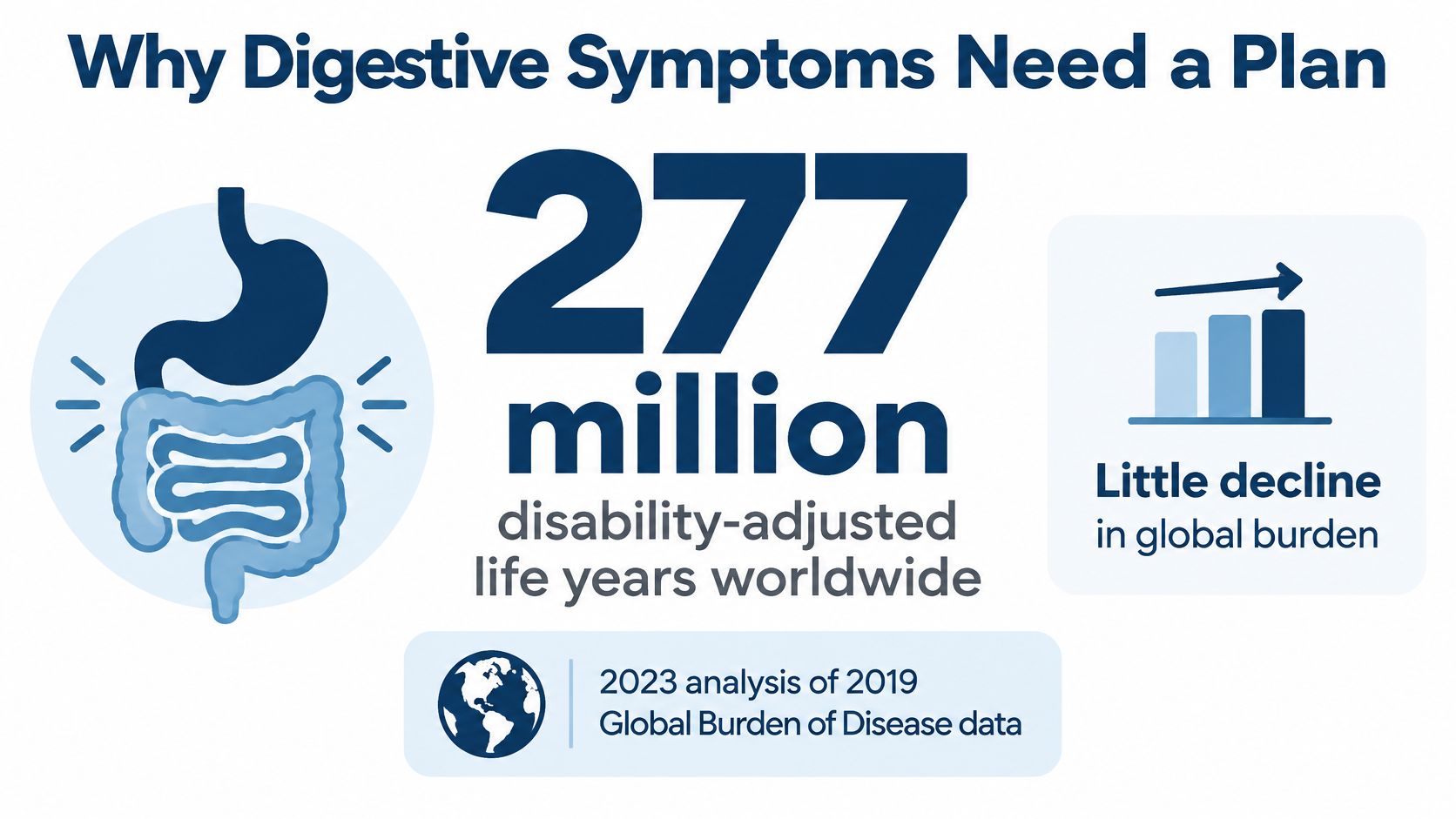
Those figures mix gastrointestinal infections, reflux-related disorders, inflammatory diseases, and other illnesses. They describe burden. They aren't a head count of people who share your symptoms.
What one person can change
Three patterns are reasonable places to start, and none of them is a diagnosis: afternoon bloating, stools that swing between hard and loose, and reflux after a late or large meal.
Hold everything else steady. Change one lever for a set number of days, record the result, and only then consider a supplement or a short diet trial. Use the four-week schedule as this month's plan, not as a pile of tips to try at once.
Build a Plate That Digests Calmly
The baseline plate is what later experiments adjust. It isn't a cleanse, and it doesn't ban a food group.
Fill the plate before you subtract
- Vegetables first. Fill half the plate, then add one cooked legume or a whole grain so fiber arrives with the meal instead of as a bran dump.
- Fruit once a day. Keep the skin on when you tolerate it. A pear or an apple beats juice, which skips the chew and most of the fiber.
- Protein you already eat. Fish, eggs, poultry, tofu, or dairy you tolerate is enough. Don't hunt a new "gut protein" in the first week.
- Fluid with the food. A glass alongside each meal spreads water through the day, which matters once fiber rises.
For reflux, finish eating about three hours before bed and keep that meal smaller than your usual dinner. Fried or fatty food, alcohol, and caffeine stay put unless the first week's notes tie them to symptoms. Cutting them "just in case" muddies the result.
Skipping gluten, dairy, and beans together isn't this step. If evenings are the weak point, repeat a simple home plate and browse healthier alternatives to takeout when you need a meal you can cook again tomorrow. A cup of Alvita Organic Ginger Root tea after dinner is only a drink. It counts as your one change for the week if you add nothing else.
Practical rule: If a food is still on the plate, you can test it later. If you already banned it, you can't tell whether it was the problem.
Follow a Four Week Digestive Routine
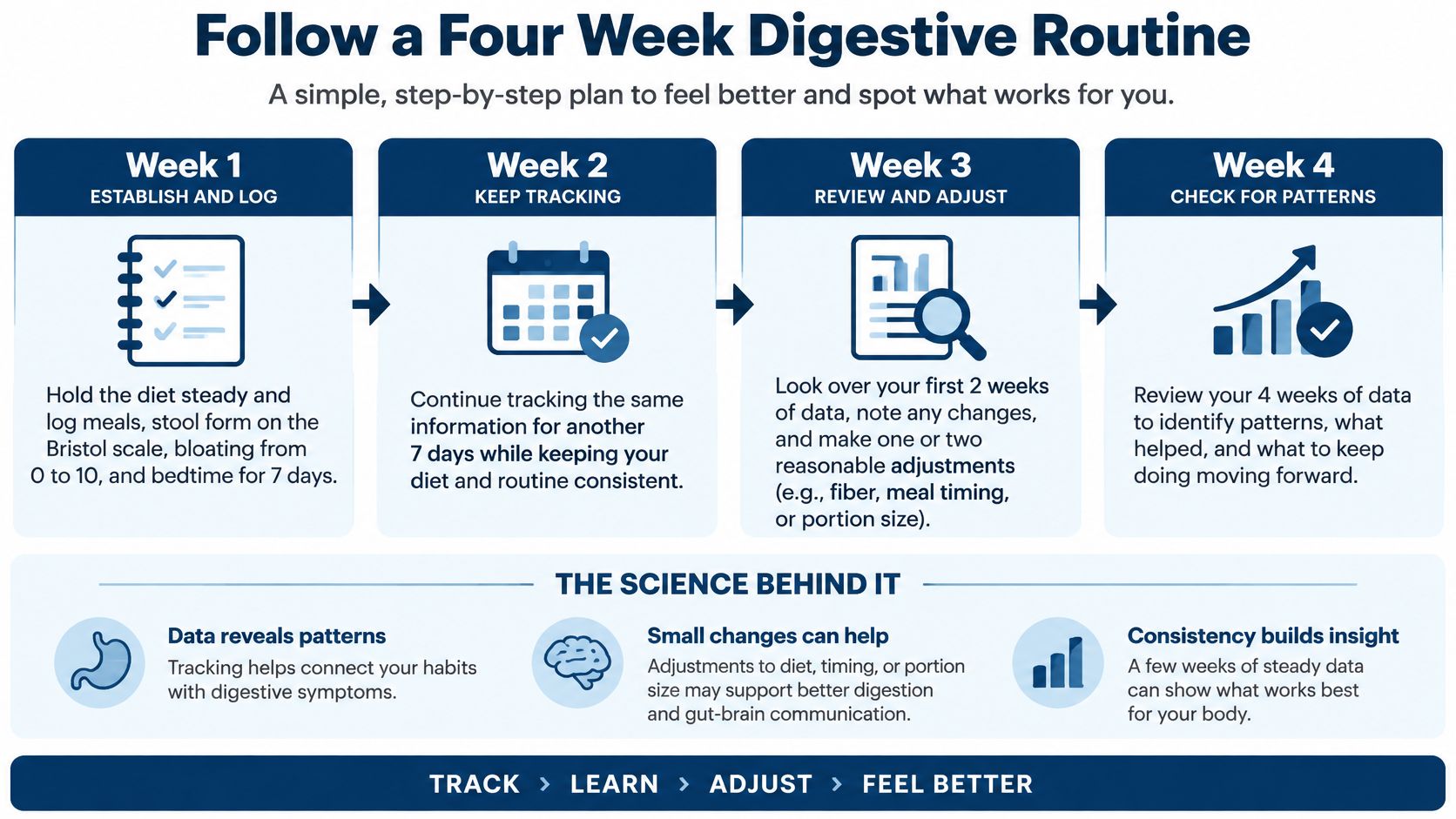
Put the month on a calendar before you compare supplement labels. Each week has one job, a pass mark, and a reason to stop.
Week by week
- Week 1 is the baseline. Hold meals steady for 7 days. Log what you ate, stool form on the Bristol scale, bloating from 0 to 10, and bedtime. You pass if you can describe the pattern without guessing. You fail, and you stop, if pain, bleeding, or vomiting appears.
- Week 2 adds one fiber-rich food at one meal, plus a glass of water. Caffeine and alcohol stay where they already are. You pass if urgency eases, stools get softer but formed, or bloating drops about 2 points. You fail if there's new pain, diarrhea, or no change after the full week. Drop that food. Don't add a second one to "balance" it.
- Week 3 sets the clock. Place three meals about 4 to 5 hours apart, finish dinner 3 hours before bed, and walk 20 to 30 minutes most days. Grazing and late plates blur whatever the food log was trying to show. You pass if the earlier gain holds and nighttime reflux or late bloating eases. You fail if the new schedule adds pain or nothing moves. Keep only the habit that already helped.
- Week 4 allows one optional test, and only if symptoms remain. Keep the useful habit. Then run either a labeled probiotic for a preset 2 to 4 weeks or a dietitian-guided low-FODMAP trial. Never both. You pass if that single test moves the same scores. You stop on the date you wrote down if the scores are flat.
Say someone bloats after a rushed lunch. Breakfast stays identical. In week 2 they add lentils at dinner twice, with water, and they don't also drop coffee. If bloating falls, lentils stay. If it spikes, lentils go, and lunch timing waits for week 3.
Meal spacing is easier to see than to remember from a list.
Fiber amounts, label rules, and the symptoms that end self-care are separate decisions. They aren't extra tasks for week 1.
Raise Fiber Without a Bloat Spike
For constipation-prone adults, fiber works best as a gradual adjustment rather than a pantry overhaul. Add about 3 to 5 g per day every several days, with fluid, and work toward roughly 25 to 30 g total. The synthesis of 113 randomized trials on fiber and constipation found that greater fiber intake generally softens stools, increases stool weight and frequency, and shortens gastrointestinal transit time. The average benefit was small to modest, not a cure.
If a supervised fiber trial still fails, ask a clinician whether polyethylene glycol is an option. In one randomized study, it increased complete spontaneous bowel movements by an estimated 2.90 per week versus placebo, as reported in that synthesis. More fiber is not always the answer.
How to shop the step
A half cup of cooked lentils, a pear with the skin, or a bowl of oats can provide roughly one 3 to 5 g step. Check the package and adjust for serving size, since portions and brands differ. If food sources are difficult to manage, a measured serving of Healthy Origins Healthy Fiber powder can supply a few grams. Count it in your log.
Psyllium is a soluble fiber often used when food alone falls short. Insoluble bran may feel rougher when fluid intake is low, so choose fiber by how you tolerate it, not by how large the scoop looks. The Cocoavia Cardio Health Dark Chocolate Flavor Vegan Powder is a cocoa flavanol powder for blood flow and energy, not a fiber source.
Fiber may be less useful when bowel movements are already regular, and its role in preventing constipation for that group is uncertain. A rapid increase can worsen gas and distension. Fiber type, hydration, medicines, other foods, and existing disease can all affect the response.
| Step | Amount | Sources | Stop or switch if |
|---|---|---|---|
| Start | Current intake, no jump | Usual meals plus a food log | Pain or bleeding is already present |
| Add | About 3 to 5 g every several days | Lentils, oats, fruit, vegetables, or psyllium | Bloating, pain, or loose stools appear |
| Target | About 25 to 30 g total per day | A mix of plant foods | Gas or distension follows a fast increase |
| If still constipated | Do not keep escalating fiber | Ask a clinician about polyethylene glycol | Blood, weight loss, vomiting, or new late-life symptoms occur |
Log stool form for two weeks before judging the dose. If bloating, pain, or loose stools appear, reduce the amount and reassess. Pushing past the point where symptoms appear fails the step.
Decide on Probiotics and Enzymes
A daily probiotic is an optional habit, not a digestive requirement. If you have IBS, treat one as a short, focused trial: choose a symptom to track, write down a stop date, and change no other variable during the test.
The U.S. National Center for Complementary and Integrative Health's summary of probiotic research for IBS describes a 2020 review of 35 randomized trials involving 3,452 people. In those trials, probiotics performed better than placebo for overall symptoms, including abdominal pain, bloating, and flatulence. A separate 2024 review of 23 studies and 3,288 participants reported mean differences of −1.66 for pain, −2.13 for bloating, and −1.52 for stool problems on the scales used in those trials. Because the studies tested different organisms, combinations, doses, and treatment periods, their average results may not apply to every product or to people without IBS.
The MD Anderson explainer on daily probiotic supplements notes that U.S. over-the-counter probiotics are dietary supplements, not drugs the FDA pre-reviews for safety or effectiveness. Label claims may also be unreliable. A high CFU count alone cannot predict whether a product will help a particular symptom.
What to read on the label
Look for a product that names its genus, species, and strain, gives a studied dose, and explains how to store it. Set a stop date 2 to 4 weeks after starting. Avoid self-treatment if you are immunocompromised, seriously ill, elderly and frail, or choosing a product for an infant.
Lactase may help with a known dairy intolerance; it is not a general digestive aid. Yogurt and kefir provide live cultures as foods, while a probiotic capsule is a concentrated strain trial. Start with a small serving of fermented food and see how it feels.
| Option | Reasonable if | Check on the label | Skip or stop if |
|---|---|---|---|
| Strain-named probiotic | You have diagnosed IBS and have tried diet steps | Genus, species, strain, dose, storage | No change by the preset stop date |
| Fermented food | You prefer food to a capsule | Live cultures listed, tolerable portion | Bloating worsens after a small serving |
| Lactase or a targeted enzyme | You have a known food intolerance | The enzyme matches the food | You are using it to mask an undiagnosed illness |
| More CFUs or a kitchen-sink blend | A named strain and its evidence support the choice | Studied strain and dose, not just a high CFU count | Immune compromise, serious illness, frailty, or infant use |
If a combined capsule is the one trial you choose, check the strain and enzyme list on Zenwise Daily Digestive Enzymes and set your stop date before taking it. Prefer a seller that clearly prints the strain and dose and accepts returns if the trial does not help. Keep the test separate from a new fiber dose so you can tell which change affected your symptoms.
Test Foods Then Add Them Back
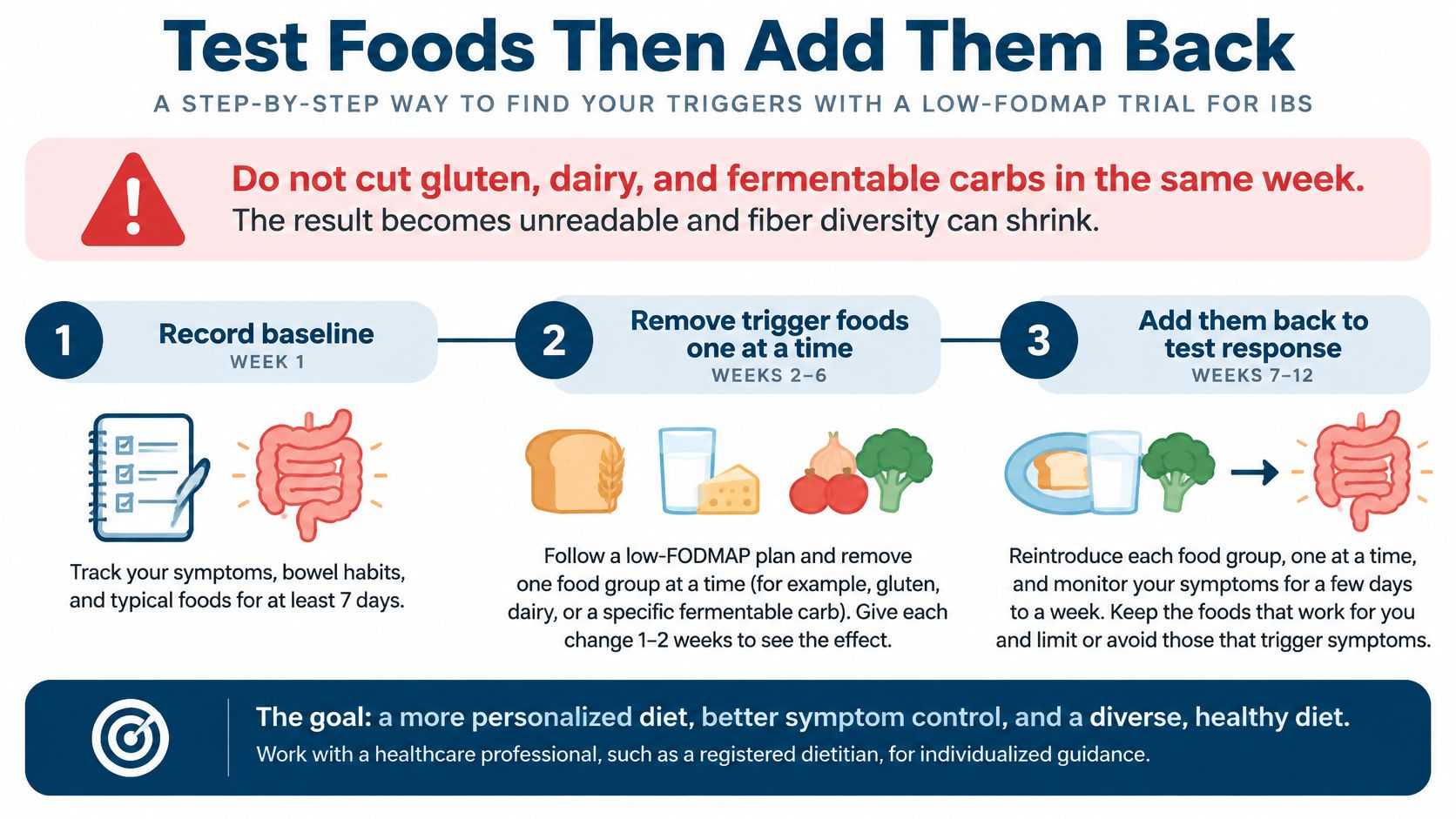
Cutting gluten, dairy, and fermentable carbohydrates in the same week makes it hard to identify a trigger. It can also undo some of the fiber variety built during the previous month. Change one lever at a time, and decide in advance when to stop the test.
Three phases, then widen the diet
For IBS, a low-FODMAP diet works best as a time-limited experiment, not a permanent short menu. Keep the sequence simple:
- Record a baseline for about 1 to 2 weeks before removing foods. Note symptoms and what you eat.
- Reduce major fermentable-carbohydrate sources until symptoms settle, with a registered dietitian's help when available.
- Reintroduce one FODMAP group at a time in rising portions. Find your threshold, then return to the widest diet that remains tolerable.
The American College of Gastroenterology clinical guideline recommends a limited low-FODMAP trial for global IBS symptoms, while rating the evidence very low quality. The same guideline describes inconsistent evidence for probiotics and cites a Canadian analysis that found a relative risk of 0.81 (95% confidence interval 0.74 to 0.89) for IBS not improving; results varied by strain. Prolonged elimination can reduce fiber diversity, and changing foods, supplements, and medicines together makes it difficult to tell what helped.
A 2025 report on restrictive eating in IBS describes people restricting beyond guideline advice and skipping reintroduction, alongside microbiome differences and fewer pathways tied to short-chain-fatty-acid production. The 2025 Seoul Consensus describes elimination, reintroduction, and long-term personalization as phases of the approach, while rating the overall symptom evidence as low. In a multicenter trial, 238 adults following an IBS-specific IgG-guided diet had a higher abdominal-pain response than those on a sham diet, 59.6% versus 42.1%; the researchers said larger validation is still needed. That result is not a reason to use a home IgG panel to decide which foods to ban.
During the elimination phase, swap in other fiber and protein so meals do not narrow to rice and chicken. If you want a menu with a clear endpoint, plan a SIBO-friendly low-FODMAP diet and write the reintroduction week on the same page. Treat each food challenge as a small test: change one group, observe the response, and add foods back as you learn your tolerance.
A restriction without a reintroduction date has already gone too far.
Know When Self-Care Should Stop
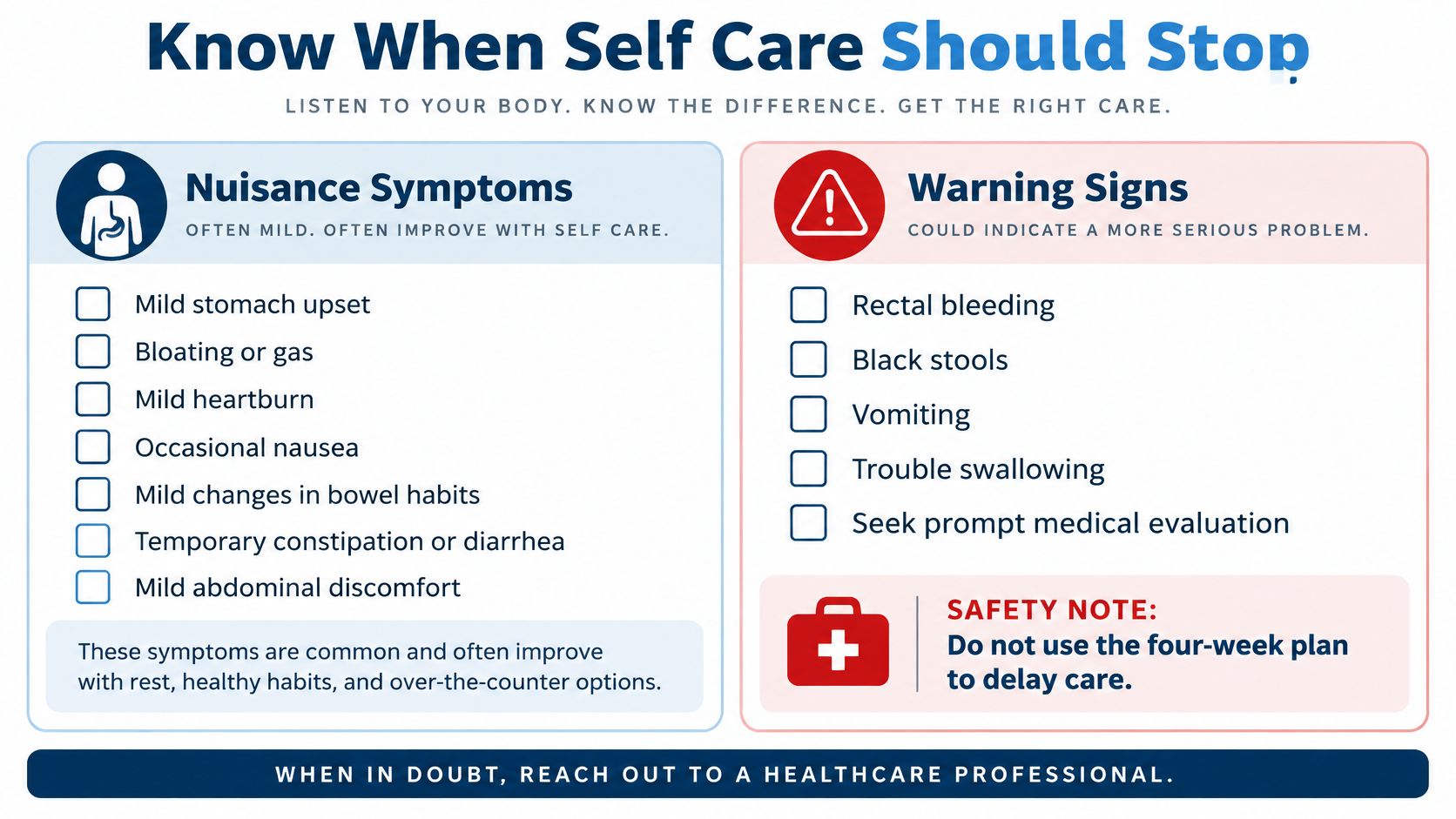
Red-flag symptoms are the point where self-care ends. The four-week routine can help you assess mild digestive changes, while warning signs call for a clinician's judgment.
Warning signs versus a finishable month
Seek prompt medical care for rectal bleeding, black stools, vomiting, trouble swallowing, unexplained weight loss, anemia, fever, pain that wakes you at night, or a new change in bowel habits later in life. Constipation that continues despite a supervised fiber trial, or severe IBS-like pain, also needs clinical assessment. Only a clinician should decide what to do next.
Medicines can contribute to digestive symptoms. Opioids, iron, some antacids, and certain diabetes or blood-pressure drugs can slow the gut or irritate it. Ask the prescriber whether a medicine could be involved; changing its dose without guidance can create another problem.
A clinician can arrange tests that a diary cannot provide, including celiac testing before you avoid gluten and stool tests when infection or inflammation is possible. They can also decide whether colonoscopy is appropriate based on age and alarm features. A mail-order microbiome kit cannot make that decision or select a probiotic.
Consider a 58-year-old who develops new constipation and a little blood. They should stop the routine and contact a clinician. A younger adult with years of mild bloating, formed stools, and no warning signs may be able to complete the habit weeks first. In either case, a symptom log gives the clinician a clearer account of what changed.
Keep the Change or Drop It
Score a change only when it was the only new variable. Two new habits in one fortnight give you a story, not an answer.
Keep the week 1 columns and add one line a day for 14 days: meal time, the change you made, Bristol stool type, and bloating from 0 to 10.
| Decision | When it applies | Next action |
|---|---|---|
| Keep | Stool settles toward Bristol types 3-4 and bloating falls about 2 points on most days | Hold the change and add the next single lever |
| Drop | Scores are flat at day 14, or pain or diarrhea appears sooner | Stop that lever and test the next one |
| Escalate | Any red-flag symptom on the medical list appears | Bring the log to a clinician before changing anything else |
Don't start a probiotic in the same fortnight as a new fiber dose or a FODMAP cut. If the habit you kept is enough, stop there. If a strain-specific product is still the missing test, shop by the label rules you already set, and take the same log to a clinician if any red flag showed up.
Tonight, pick the week 2 fiber add or the week 3 meal rhythm. Start the log. Put the 14-day review on the calendar before you talk yourself into a second change.
Supplemynts Inc sells digestive-health items such as fiber powders, enzyme and probiotic capsules, and herbal teas, so you can match one product to a single timed test instead of guessing from a front-of-label promise. Free shipping in the continental United States and a 60-day return window fit a trial you may need to stop. Visit Supplemynts Inc when you're ready to read strain, dose, and fiber details before you start the log.










Please complete your information below to login.
Sign In
Create New Account