



Yes, probiotics can help with certain digestive complaints. A 2025 umbrella meta-analysis found lower risks of diarrhea, bloating, and nausea, including a diarrhea relative risk of 0.44, but that doesn't make probiotics a universal fix for digestion.
The popular advice to “rebalance your gut” leaves out the most important detail: feeling better and changing the microbiome aren't the same outcome. A probiotic may ease bloating or shorten diarrhea without permanently reshaping the diversity of microbes living in your gut.
That distinction matters because probiotics aren't one treatment. They include many different microorganisms, and their effects depend on the strain, dose, symptom, and underlying condition. A product studied for antibiotic-associated diarrhea isn't automatically the right choice for irritable bowel syndrome, constipation, or everyday digestive discomfort.
Table of Contents
- The Short Answer on Probiotics and Digestion
- How Probiotics Actually Work in Your Gut
- What Clinical Trials Show for Common Digestive Problems
- Matching the Condition to the Evidence
- How to Run Your Own Probiotic Trial
- Symptom Relief Versus Microbiome Repair
- Safety Limits and When to Talk to a Clinician
The Short Answer on Probiotics and Digestion
The evidence supports a careful yes. Probiotics can reduce some digestive symptoms, especially diarrhea, bloating, nausea, and abdominal discomfort, but the benefit isn't consistent across every product or every person. A recent umbrella meta-analysis found significant reductions in diarrhea risk, bloating, epigastric pain, and nausea, although the studies varied considerably in quality and results according to the 2025 gastrointestinal umbrella meta-analysis.
The complication comes from the word probiotic. It describes a broad category of live microorganisms, not a single ingredient with one predictable effect. Two products can contain different species, different strains, different combinations, and different amounts. Their clinical evidence may apply to entirely different digestive problems.
What the evidence supports
Probiotics make the most sense when you define the problem first. Someone dealing with acute diarrhea is asking a different question from someone with recurring IBS-related bloating. Someone who feels healthy but wants “better digestion” has a less clearly defined target than someone trying to prevent diarrhea associated with antibiotics.
The strongest practical message is this:
Choose a probiotic for a specific symptom or condition, then judge it over a defined trial period.
That approach is more useful than choosing the product with the largest number on the label or assuming that a multi-strain formula will suit everyone. A probiotic might help symptoms through temporary biological activity without permanently colonizing the gut or repairing an underlying disease.
A realistic way to shop
If you're comparing options marketed for digestive wellness, a purpose-based resource such as probiotics for gut health support can help you start with the category that matches your goal. You should still check the label for strain information and discuss persistent or severe symptoms with a clinician.
This guide focuses on what probiotics appear to do, where clinical evidence is strongest, how to run a sensible personal trial, and why “microbiome repair” is often a stronger promise than the research can support.
How Probiotics Actually Work in Your Gut
Think of the gut as a crowded apartment building. Your existing microbes are the long-term residents, while a probiotic introduces new, well-behaved tenants. Those newcomers may influence the building's neighborhood, interact with the building manager, and affect local activity, but they don't necessarily evict the existing residents or renovate the entire structure.

The biological conversation
Expert reviews describe probiotics as acting through direct interaction with gut immune cells and by helping maintain immunologic balance in the gastrointestinal tract. In plain language, some probiotic organisms can influence how the immune system responds in the gut, which may help reduce symptoms connected with excessive or poorly regulated inflammation as described in this review of probiotic mechanisms and IBS evidence.
That doesn't mean every probiotic reduces inflammation in every person. The effect depends on the organism and the condition being studied. The same review reported better overall IBS symptoms than placebo, with standardized mean differences of -0.55 for global symptoms and -0.89 for abdominal pain. These are study-level comparisons, not a guarantee that an individual will experience the same result.
Probiotics may also affect the local environment by competing with other microbes or changing chemical activity around the intestinal lining. Those mechanisms can influence symptoms without producing a permanent change in the overall microbial community. The apartment analogy is useful because it shows why temporary influence and long-term reconstruction are different claims.
Three terms shoppers often confuse
Probiotics are live microorganisms provided with the intention of delivering a health benefit. A useful label identifies the organism beyond a broad category, ideally showing its genus, species, and strain.
Prebiotics are components of food that humans don't digest but that can feed certain microbes already present in the gut. They're not the same as adding live organisms. Some people tolerate prebiotic fibers well, while others notice more gas or bloating when they increase them quickly.
Fermented foods are foods transformed by microorganisms during fermentation. They may contain live microbes, but their microbial content can vary, and they aren't automatically equivalent to a clinically studied probiotic product.
Reading the label without getting distracted
A species is a narrower biological group within a genus, while a strain identifies a particular version within that species. The strain is often the detail that matters most when you're trying to connect a product to clinical research.
CFUs, or colony-forming units, describe the amount of viable microorganisms in a serving. A larger CFU figure doesn't automatically mean better results, because effectiveness isn't determined by quantity alone. A well-studied strain at an appropriate amount may be more relevant than a product selected only for a large headline number.
For example, NatureWise Time Release Probiotics Women Care 90 Billion 40 Capsules is a named probiotic product, but the product name alone doesn't tell you whether it matches the strain and digestive problem supported by a particular trial.
What Clinical Trials Show for Common Digestive Problems
Probiotics have a clearer clinical case for a defined outcome, such as diarrhea, than for the broad promise of “better digestion.” A measurable symptom gives researchers something specific to track, while general comfort can reflect diet, stress, illness, and bowel habits.
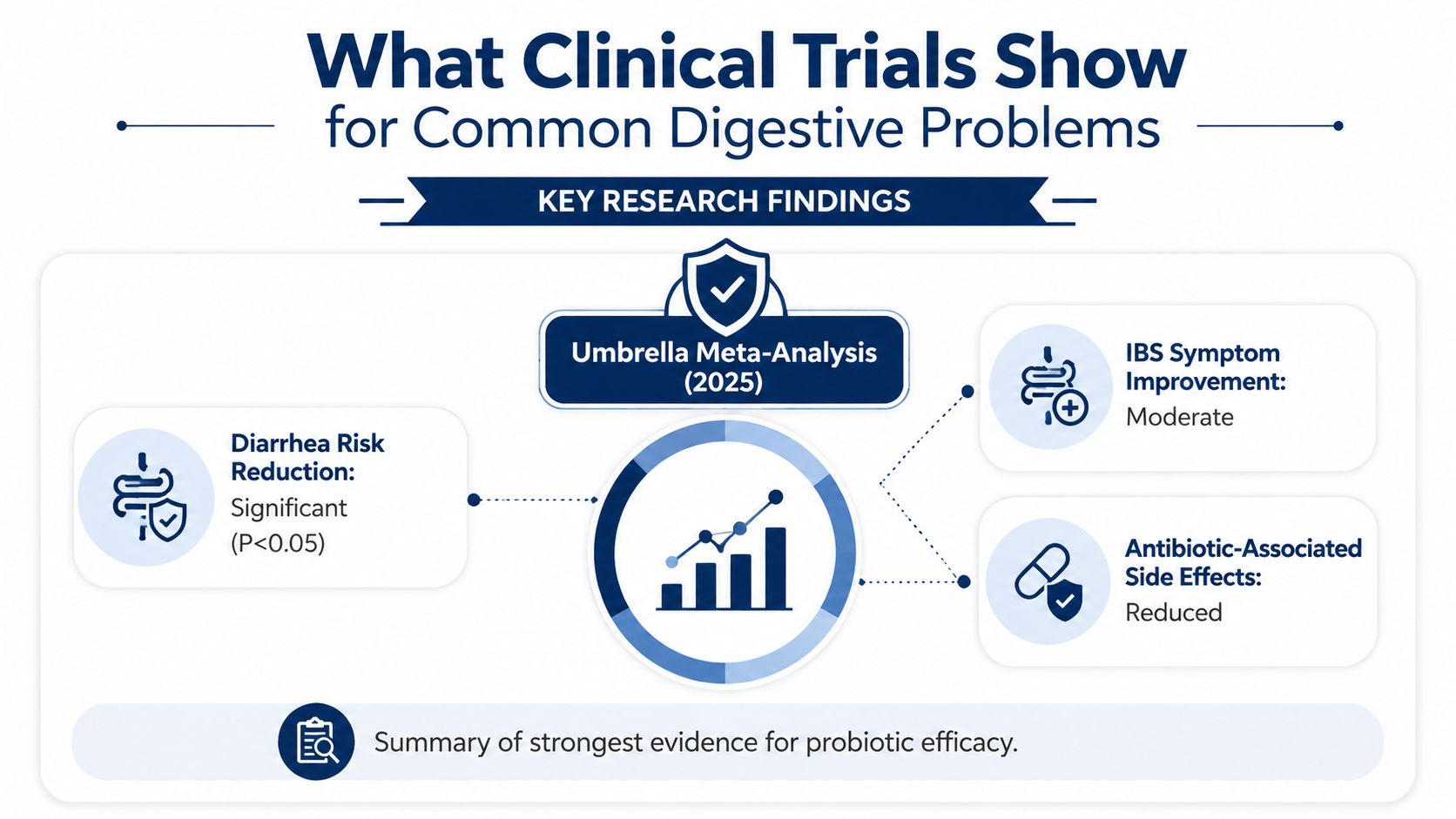
A 2020 Cochrane review summarized in this NIH-hosted review found that probiotics reduced the risk of diarrhea lasting 48 hours or more by 36%, based on 82 randomized controlled trials involving 12,127 participants. Mean diarrhea duration was also 21.3 hours shorter. Those results describe a possible change in the course of diarrhea, not proof that every product works for every cause.
For antibiotic-associated diarrhea, the product details matter. The Cochrane evidence included studies of specific organisms, including Lactobacillus rhamnosus GG, with tested doses in the range of 10 billion to 20 billion CFUs per day. A product that lists a different strain, dose, or combination cannot automatically inherit those findings. The same logic applies to acute diarrhea: symptom relief does not replace fluids or medical care when illness is severe.
What the broader symptom evidence says
The 2025 umbrella meta-analysis found lower relative risks for diarrhea, bloating, epigastric pain, and nausea, with reported values of 0.44, 0.74, 0.71, and 0.59. The reported p-values were below 0.001 for these outcomes, as summarized in that same analysis. The results support symptom-level relief, not a universal microbiome repair claim.
The studies also differed in products, conditions, doses, and participants. Moderate to high heterogeneity and generally low methodological quality make the pooled estimates less precise for an individual shopper. In plain language, probiotics may quiet a symptom without restoring microbiome diversity or producing the same result across products.
Where IBS fits
The British Society of Gastroenterology stated in 2021 that probiotics as a group may help global IBS symptoms and abdominal pain, but it could not confidently recommend one species or strain in its IBS guideline. That position leaves room for individual benefit while recognizing that the evidence is too product-specific for a universal choice.
A label such as a 16-strain probiotic with FOS still requires comparison with the trial strain and dose. If food choices also affect comfort, how olive oil aids digestion naturally offers a separate point of reference. Food and supplements address different questions, and persistent symptoms need evaluation rather than indefinite self-treatment.
Matching the Condition to the Evidence
The useful question is not whether probiotics help with digestion in general. Ask which product, if any, has been studied for the problem you want to change. A probiotic tested during antibiotic use should not automatically be expected to relieve IBS pain or improve everyday digestion.
The table offers a practical way to narrow the choice. “Stronger” means research provides a clearer reason to consider a trial, not a guaranteed result. “Mixed” means some findings are encouraging, while differences in products, participants, or outcomes make the result harder to apply to every person.
| Digestive Concern | Evidence Strength | What to Expect |
|---|---|---|
| Antibiotic-associated diarrhea | Relatively stronger | A specific probiotic may reduce diarrhea risk, but the product and strain matter. |
| Acute diarrhea | Relatively stronger | Research supports a possible shorter episode and lower risk of prolonged diarrhea. |
| IBS symptoms | Moderate and variable | Some people may see improvement in global symptoms, abdominal pain, bloating, or bowel irregularity. |
| Bloating and nausea | Promising but inconsistent | Reviews suggest symptom-level reductions, but results vary between studies and products. |
| General daily digestion in healthy people | Less clearly established | A probiotic may feel helpful, but broad microbiome or digestion claims aren't well supported for everyone. |
The umbrella analysis discussed above supports a cautious interpretation of the table. The clearest potential benefits concern particular symptoms, including diarrhea, bloating, upper-abdominal discomfort, and nausea. Differences between studies were substantial, however, so the pooled pattern does not predict a fixed response for one shopper. It also supports symptom relief more directly than claims that a product will rebuild microbiome diversity.
Why strain matching changes the decision
The condition and the tested strain should guide the decision together. A strain studied alongside antibiotics may act differently from one investigated for IBS-related abdominal pain. A multi-strain formula is not automatically a better match than a single-strain product, and a larger CFU count does not show that it addresses your symptom.
Check whether the label names the genus, species, and strain, then look for research involving that exact organism and condition. A product such as Swanson Dr. Stephen Langer's Ultimate 16 Strain Probiotic FOS can be part of a comparison of broad formulas, but its name alone cannot establish suitability for a specific diagnosis.
Decision rule: Choose based on the closest match between the studied strain, your target symptom, and the outcome you want to improve.
How to Run Your Own Probiotic Trial
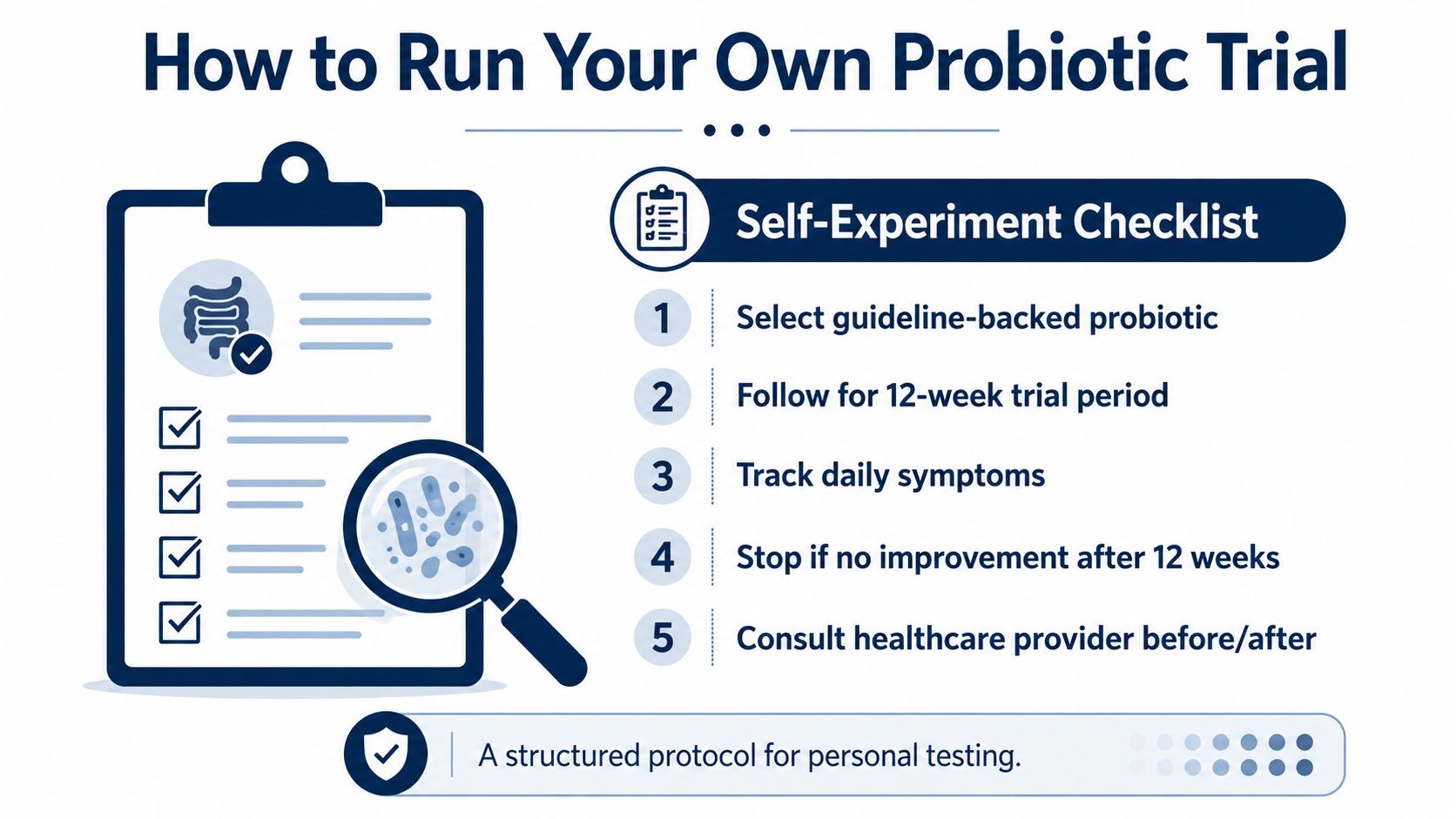
A probiotic trial works best as a short, defined experiment, not an open-ended subscription. Choose one symptom, such as loose stools, bloating, or abdominal pain, and record how often it occurs, how intense it feels, and how much it disrupts your day. This approach tests symptom relief directly. It cannot show that the product has repaired or permanently diversified your microbiome.
A disciplined testing method
Define the target. Pick one main outcome. “Improve digestion” is too broad to track, while “less evening bloating” gives you a clear observation.
Check the strain information. Look for the genus, species, and strain on the label. Compare that identity with research or professional guidance. A higher organism count or longer ingredient list does not prove a closer match for your symptom.
Change one variable. Keep your usual routine as steady as practical. Changing diet, fiber intake, medication, and other supplements at the same time makes the result difficult to interpret.
Keep a short diary. Record the target symptom, bowel changes, discomfort, and unwanted effects. One brief daily note is enough. The goal is a useful comparison, not a laboratory project.
Set the stop date before you begin. For IBS, the British Society of Gastroenterology recommends trying probiotics for up to 12 weeks and stopping if symptoms do not improve, as noted in its 2021 guideline. A different condition or product may call for a different timeframe, so follow relevant clinical advice.
Do not continue indefinitely because you have not decided whether the product works. Improvement should be clear enough to notice and record.
Reduce purchase risk
Comparing products by their stated purpose can simplify shopping, while a clear return policy limits the cost of an unsuccessful trial. Supplemynts.com states that it offers a 60-day return window, so review that policy before purchasing. For comparison, shoppers can examine the American Health Daily chewable probiotic tablet for digestive support.
The aim is a measured choice: match the strain as closely as possible, track the symptom you selected, and stop when your observations show that the product is not helping. Feeling better can support a symptom benefit without proving that the gut microbiome has been rebuilt.
Symptom Relief Versus Microbiome Repair
The most overstated probiotic promise is that taking a capsule will broadly “rebalance” or repair your microbiome. That language suggests a durable renovation of the gut's microbial community, but recent evidence gives a more restrained picture.
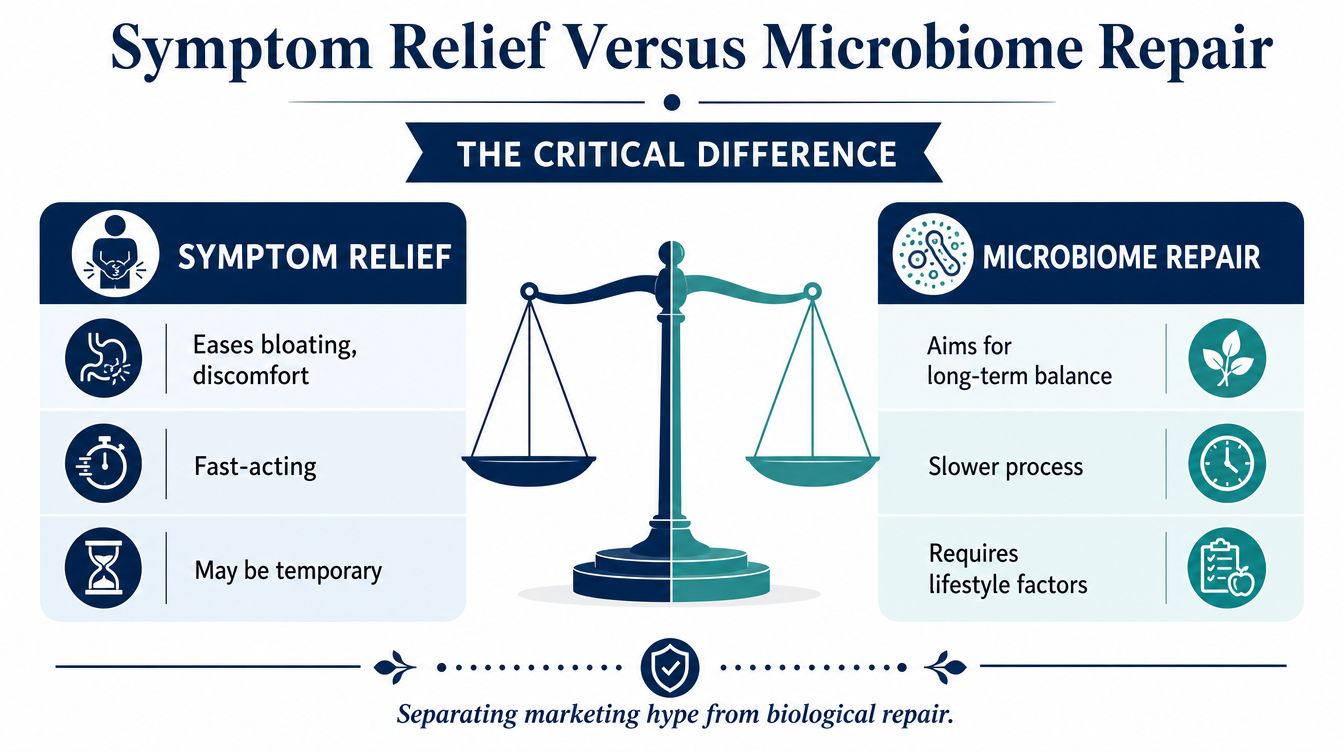
A 2026 review found that probiotic supplementation didn't significantly change gut microbiota diversity in healthy individuals. That doesn't prove probiotics never affect microbes, and it doesn't cancel out symptom benefits. It means that improved comfort shouldn't automatically be interpreted as proof that the entire microbiome has been restored in the recent review.
Why feeling better isn't the same as rebuilding
A probiotic may interact with gut immune cells or influence local gastrointestinal activity for as long as it remains active in the digestive tract. That temporary effect could reduce bloating or discomfort even if the overall diversity of resident microbes remains largely unchanged.
This is why the apartment analogy matters. A helpful tenant can improve the atmosphere in a building without changing its ownership, floor plan, or permanent resident list. Likewise, symptom relief can be real without proving that a probiotic has permanently corrected an underlying imbalance.
A 2024 IBS meta-analysis reported improved overall symptom response and quality of life, but it also found significant heterogeneity and uncertainty about whether higher doses or multiple strains work better. The research therefore supports a targeted, measured expectation, not the assumption that more strains or a larger dose must produce deeper microbiome repair.
Better questions to ask before buying
Instead of asking whether a product “restores balance,” ask:
- What symptom was studied? Look for a defined outcome rather than a broad wellness promise.
- Which strain was tested? Species-level labeling may not be precise enough.
- What result matters to me? Fewer loose stools, less bloating, or lower abdominal pain are different targets.
- What happens if it doesn't work? Decide on a stop date before you start.
For digestive enzymes, another category sometimes considered alongside probiotics, NOW Optimal Digestive System Full Spectrum Enzymes illustrates why ingredient categories should remain separate. Enzymes and probiotics aren't interchangeable, and neither category should be selected on the assumption that it will repair every digestive complaint.
Safety Limits and When to Talk to a Clinician
Healthy adults usually tolerate probiotics, but suitability depends on the person and the symptom. Anyone with serious illness, a weakened immune system, complex medical conditions, or treatments that affect immune function should consult a clinician before starting one.
A supplement should never delay evaluation of warning signs. Seek medical advice for persistent abdominal pain, blood in the stool, unexplained weight loss, ongoing changes in bowel habits, persistent nausea lasting more than a week, or unexplained vomiting. Probiotics may affect symptoms, but they cannot identify or treat every underlying cause.
Use a sensible boundary
For a healthy adult with a mild, clearly defined complaint:
- Choose carefully. Match the documented strain and product purpose to the symptom.
- Track changes. Note possible benefits alongside gas, bloating, diarrhea, or other unwanted effects.
- Set a stopping point. Use a time-limited trial based on clinical guidance, rather than continuing indefinitely when nothing improves.
- Escalate when needed. Contact a clinician if symptoms persist, worsen, or develop red-flag features.
The practical conclusion is straightforward. Probiotics help some people with some digestive symptoms, while evidence varies by condition and product. They may reduce symptoms without repairing microbiome diversity, so symptom relief should not be confused with microbiome repair. A focused trial with clear monitoring is more sensible than open-ended use based on claims about “balance.”
Supplemynts Inc offers vitamins, minerals, herbs, proteins, digestive-health products, and probiotic supplements organized by health purpose, with customer support and a stated 60-day return policy. Visit Supplemynts Inc to compare options and review product and return information before buying.







Please complete your information below to login.
Sign In
Create New Account