


The popular promise says a broad enzyme capsule will “get you going.” The National Institute of Diabetes and Digestive and Kidney Diseases reports about 16 out of 100 U.S. adults have constipation symptoms, rising to about 33 out of 100 adults aged 60 and older; a market that large makes the promise sound plausible. Separate the jobs before spending: enzymes split food in the upper gut, while hard or infrequent stools reflect colon water, transit time and pelvic floor release. A reader can take a capsule with dinner, feel less fullness by bedtime, and still strain over the same dry stool in the morning. If your pattern is meal gas and fullness, an enzyme has a plausible target; if it is stool passage, the levers are fluids, gradual fiber, and clinician-directed polyethylene glycol (PEG). That is the test to run before buying digestive enzymes for constipation.
Table of Contents
- Which Symptoms Enzymes May Ease and Which They Miss
- Why Enzyme Activity and Stool Passage Are Different Problems
- What Trials and Guidelines Say About Enzymes and Constipation
- Enzyme Types, Their Targets and Where Each Fits
- Interactions and Contraindications to Check First
- How to Trial an Enzyme Supplement Safely
- Fiber, Fluids and Habits to Try Before a Supplement
- Confirm the Cause Before Buying Another Bottle
Which Symptoms Enzymes May Ease and Which They Miss
Start with the clock. Enzymes act on food while it sits in the upper gut, so the only discomfort they can plausibly touch is discomfort tied to a meal. Bloating or gas within a few hours of eating points to undigested food fermenting downstream. Infrequent movements, hard stools, and straining point elsewhere: how much water stays in the stool, how fast the colon moves it, and whether the muscles coordinate the exit.
Clinicians define constipation by a symptom list: fewer than three bowel movements a week, hard or lumpy stools, straining, painful passage, or a feeling of incomplete evacuation. None of these measure enzyme activity. The National Institute of Diabetes and Digestive and Kidney Diseases estimated 63 million people with chronic constipation in the United States in 2000, and prevalence on that scale invites a lot of supplement marketing. NIDDK guidance still points to fluids, dietary fiber, lifestyle measures, and approved medicines for selected chronic conditions.
| Symptom pattern | Can enzymes plausibly help? | First step |
|---|---|---|
| Bloating and gas within 1-3 hours of meals | Yes, this is the pattern enzymes act on | Cut portion size and trigger foods for two weeks |
| Gas and cramps after milk or soft cheese | Possibly, lactase is the most direct match | Test lactose reduction before trying any blend |
| Fewer than three bowel movements a week | No established effect | Fluids, gradual fiber, and clinician review |
| Hard, lumpy stools | No established effect | Increase fluid and fiber gradually; discuss PEG with a clinician |
| Straining or feeling of incomplete emptying | No, this points to transit or pelvic floor function | Clinician evaluation |
| Greasy, floating stools with weight loss | Possibly, but only after a pancreatic diagnosis | Medical evaluation for prescription enzymes |
How to read one row
Say fullness hits one to three hours after a large pasta dinner, while stools stay daily and easy to pass. That is the one everyday pattern where an enzyme trial is even plausible, and only after two weeks of smaller portions and fewer trigger foods. If your main complaint is three stools a week or hard lumps, the enzyme column reads no. Straining with a sense that the rectum never empties points to transit or pelvic floor function, including cases that need specialist care for neurogenic bowel incontinence. Greasy stools plus weight loss are a medical problem first, not a capsule experiment.
Practical rule: Find the row that matches your week, then act on that first step. A mismatch is how people buy a digestion product for a passage problem.
Why Enzyme Activity and Stool Passage Are Different Problems
Think of digestion as a kitchen and the colon as the drain.
Amylase, protease, and lipase are the prep crew from the mouth through the small intestine. Amylase splits starches. Proteases split proteins. Lipase splits fats into pieces the gut can absorb. By the time leftovers reach the colon, most usable nutrients are already gone.
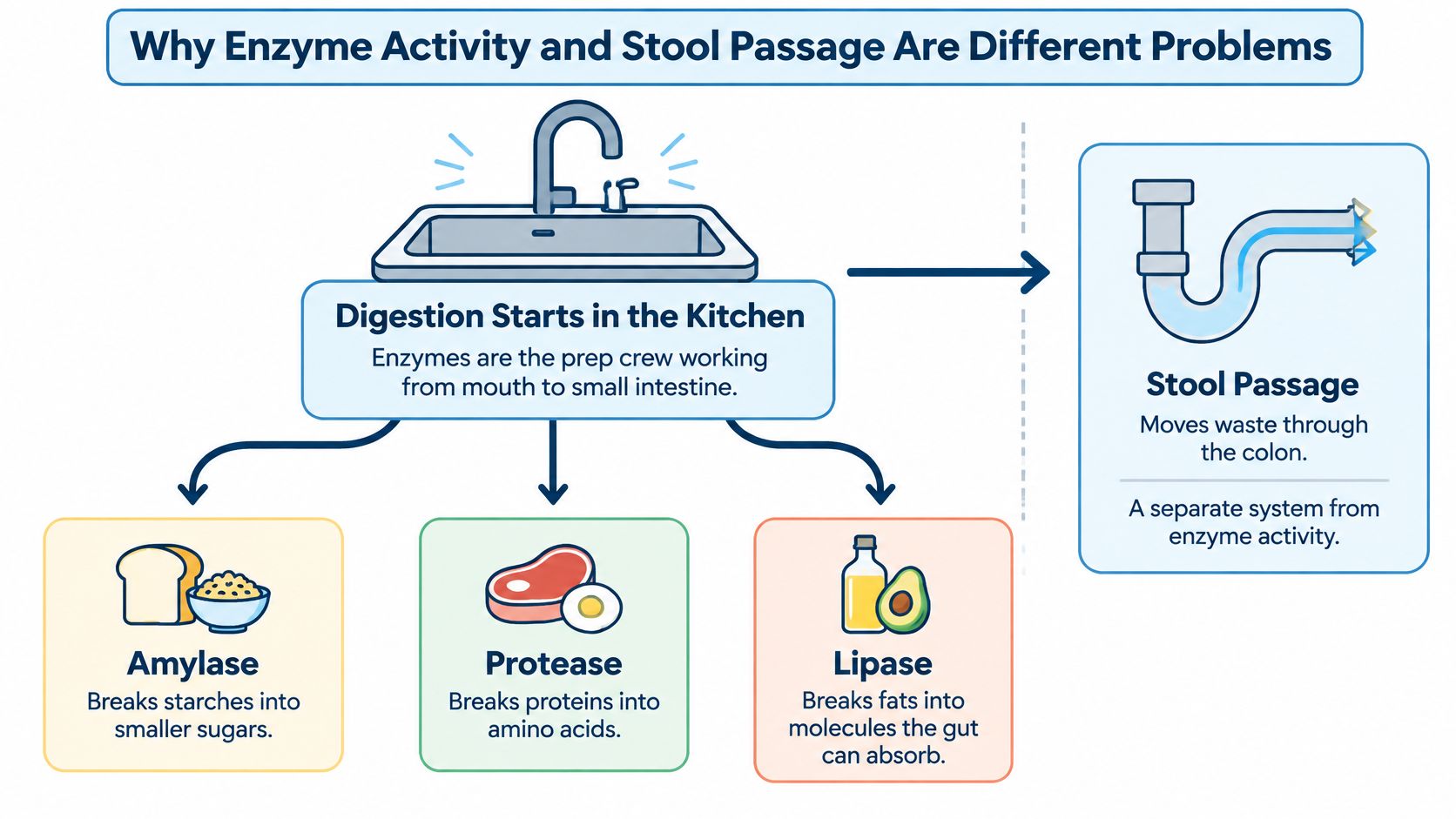
Constipation happens downstream. The colon pulls water and salts back into the body. Bacteria ferment leftover fiber. Muscle contractions push stool toward the rectum, and the pelvic floor plus the sphincters have to coordinate the exit. A faster prep crew doesn't unclog that drain. Stool water, transit speed, and muscle coordination control whether you pass stool.
Where the picture overlaps
Many adults move a meal through the whole gut in roughly one to three days. Slow transit is only one cause. Undigested lactose or starch can still reach the colon, ferment, and make gas. That's why bloating can sit next to hard stool without sharing a fix. Gas is fermentation. Hard stool is water and time. Treating the gas doesn't soften the stool.
A stimulant such as Genexa Senna Laxative acts on the colon, not on starch or fat breakdown. It's a different tool, used for short-term relief, not proof that an enzyme blend moves stool.
Answer three questions before you choose a product.
- Fullness and gas after meals: The upper gut and a food trigger are the likely system.
- How often you go, or how hard the stool is: Water, fiber, and transit are the system.
- Effort and a feeling of incomplete emptying: Pelvic-floor coordination or outlet function is the system.
Each answer points somewhere else. Buying one bottle for all three wastes the trial.
What Trials and Guidelines Say About Enzymes and Constipation
Evidence for constipation relief stacks in tiers. Enzymes sit at the bottom of that stack, and the gap between the tiers explains why.
Guideline tier
For persistent constipation, the mechanism with the strongest guideline support is holding water in the gut, not digesting the meal faster. The joint American Gastroenterological Association and American College of Gastroenterology guideline strongly recommends polyethylene glycol (PEG). It's the only over-the-counter therapy with a strong recommendation for chronic use. PEG increases water kept in the intestinal lumen, which hydrates stool and helps transit.
The same guideline treats bisacodyl and sodium picosulfate as short-term or rescue therapy, then strongly recommends linaclotide, plecanatide, and prucalopride once over-the-counter options stop working. Every step on that path acts on the stool itself. An enzyme only belongs in the plan when the complaint is food intolerance or post-meal bloating, and warning signs call for a clinician before any supplement.
Enzyme tier and how to read a trial
Reviews of enzyme therapy find relief mainly for bloating, distension, fullness, and flatulence after meals. Constipation is rarely the outcome those trials were built to test. The closest stool-related result in this area is a synbiotic trial pairing Bifidobacterium animalis BL-99 with fructooligosaccharides, which reported better stool frequency and consistency in older adults. That product is a live-microbe supplement rather than an enzyme, and the trial wasn't run in diagnosed chronic idiopathic constipation.
PEG holds water in the stool. An enzyme doesn't do that job, so a digestion study can't stand in for a constipation trial.
Check four things on any paper a label cites. Sample size tells you whether a handful of people drove the result. Duration tells you whether anyone was followed past a few weeks. Condition studied tells you whether participants had diagnosed constipation or ordinary post-meal discomfort. Product match tells you whether the tested strain, dose, and formula are the bottle on the shelf.
| Option | Evidence level | What it means for a shopper |
|---|---|---|
| Polyethylene glycol (PEG) | Strong guideline recommendation for chronic use | Only over-the-counter option with a strong recommendation; holds water in stool |
| Stimulant laxatives (bisacodyl, sodium picosulfate) | Recommended short-term or as rescue | Not a daily fix without clinician direction |
| Fiber and fluids | First-line measures in NIDDK guidance | Works gradually, over weeks rather than days |
| Synbiotic (B. animalis BL-99 with fructooligosaccharides) | Promising early research in older adults | Strain-specific; results do not transfer to other products |
| Digestive enzyme blends | No condition-specific trials in chronic idiopathic constipation | Possible adjunct for meal discomfort only |
Read the bottom row against your own pattern. Gas and fullness after meals are the symptoms an enzyme could plausibly touch. Infrequent or hard stool is the pattern this table never assigns to an enzyme.
Enzyme Types, Their Targets and Where Each Fits
Each digestive enzyme is a small tool with exactly one substrate it can cut. Lactase shows the cleanest match: lactose intolerance is a defined mechanism, so the enzyme lines up directly with milk, ice cream, and soft cheese. The other enzymes have narrower jobs, and none of them is a first-line treatment for chronic idiopathic constipation.
A review of enzyme therapy found symptom relief mainly for post-meal bloating, abdominal distension, fullness, and flatulence, with constipation rarely the predominant symptom studied. Amylase, protease, lipase, and lactase hydrolyze carbohydrates, proteins, fats, and lactose, which may reduce maldigestion-related gas. None of them reliably raises colonic water, stimulates propulsion, or softens stool, and the guideline evidence covered earlier lands on the same conclusion: an enzyme is at most an adjunct for meal discomfort.
| Enzyme | Breaks down | Typical trigger foods | Where evidence stands |
|---|---|---|---|
| Lactase | Lactose | Milk, ice cream, soft cheese | Most direct evidence, since lactose intolerance is a defined mechanism |
| Alpha-galactosidase | Galacto-oligosaccharides | Beans, lentils, cabbage, onions | Some trials show less gas |
| Amylase | Starches | Bread, rice, potatoes, pasta | Limited trial data for constipation-adjacent symptoms |
| Protease (bromelain, papain) | Proteins | Meat, eggs, dairy proteins | Small plant-derived studies; allergy cross-reactions |
| Lipase | Fats | Fried foods, rich sauces, butter | Mainly studied in pancreatic insufficiency |
| Pancrelipase (prescription) | Fats, proteins, starches | Only after a specialist diagnosis | Approved prescription for exocrine pancreatic insufficiency |
Match the food, not the bottle
The useful question is which food precedes the symptom. Gas that arrives within an hour of bean chili points toward alpha-galactosidase, while milk followed by loose stools points toward lactase. Either can be tested on its own, taken with the trigger meal, while you track stool frequency on a separate line so you can see whether anything beyond the meal symptoms changed.
A twelve-enzyme blend tells you less in that situation. Many blends hide amounts inside a proprietary mix, so you can't tell which enzyme did anything or whether the dose matched the food. One targeted product with a stated dose is easier to judge.
Labels on the same shelf can mislead in a different way. Sport Supplements 60 Capsules Get Hard Pills Men Libido Booster is a capsule blend marketed for libido, energy, and sexual performance, a different category that happens to share shelf space and packaging style with digestive products. Read what a capsule contains and what it claims to do before assuming it fits your symptom pattern.
Interactions and Contraindications to Check First
Use this screen before the first capsule. Interaction data for over-the-counter enzymes are thinner than for prescription drugs, so the cautious default is a pharmacist or prescriber whenever a row applies to you.
| Condition or medicine | Concern | Action |
|---|---|---|
| Blood thinners, antiplatelet drugs, or planned surgery | Bromelain may add to bleeding risk | Ask a prescriber before the first dose; stop before surgery if advised |
| Pineapple, papaya, or latex allergy | Cross-reactivity with bromelain or papain | Avoid plant-protease blends |
| Known pancreatic or gallbladder disease | Enzymes are prescribed and dosed by specialists | Do not self-dose; see a gastroenterologist |
| Pregnancy or breastfeeding | Limited safety data for most blends | Ask a clinician before use |
| Children | Adult blends are not dosed for children | Use only with pediatric advice |
| Any product causing rash, swelling, or breathing difficulty | Allergic reaction | Stop the product and seek urgent care |
Two concerns that need the most caution
Bleeding risk is the one people skip. Bromelain may add to the effect of blood thinners and antiplatelet drugs. If you take those medicines, or surgery is on the calendar, ask a prescriber before a first dose and stop beforehand if you're told to.
Allergy cross-reactivity is the other. Plant proteases can trouble people who already react to pineapple, papaya, or latex. Skip those blends rather than "trying a little." Known pancreatic or gallbladder disease needs specialist dosing, not a grocery-store guess. Pregnancy, breastfeeding, and childhood use lack solid dosing data for most blends.
Common effects include gas, bloating, nausea, and loose stools. Those can look like the problem you hoped to fix, which is why a written log matters. A separate mineral product, such as Amazing Formulas Magnesium Oxide 500mg, is not an enzyme and can change stool on its own. Don't start it in the same week as an enzyme trial. Bring the enzyme label to the pharmacist. The ingredient list, not the front claim, is what an interaction check uses. Rash, swelling, or trouble breathing means you stop the product and get urgent care.
How to Trial an Enzyme Supplement Safely
A fair trial changes one thing and writes down what happened. University of Miami gastroenterology guidance notes that over-the-counter enzymes aren't designed to treat gastrointestinal ailments, aren't FDA-regulated as drugs, and may offer only nominal benefit. Persistent symptoms should prompt a look for an underlying condition.
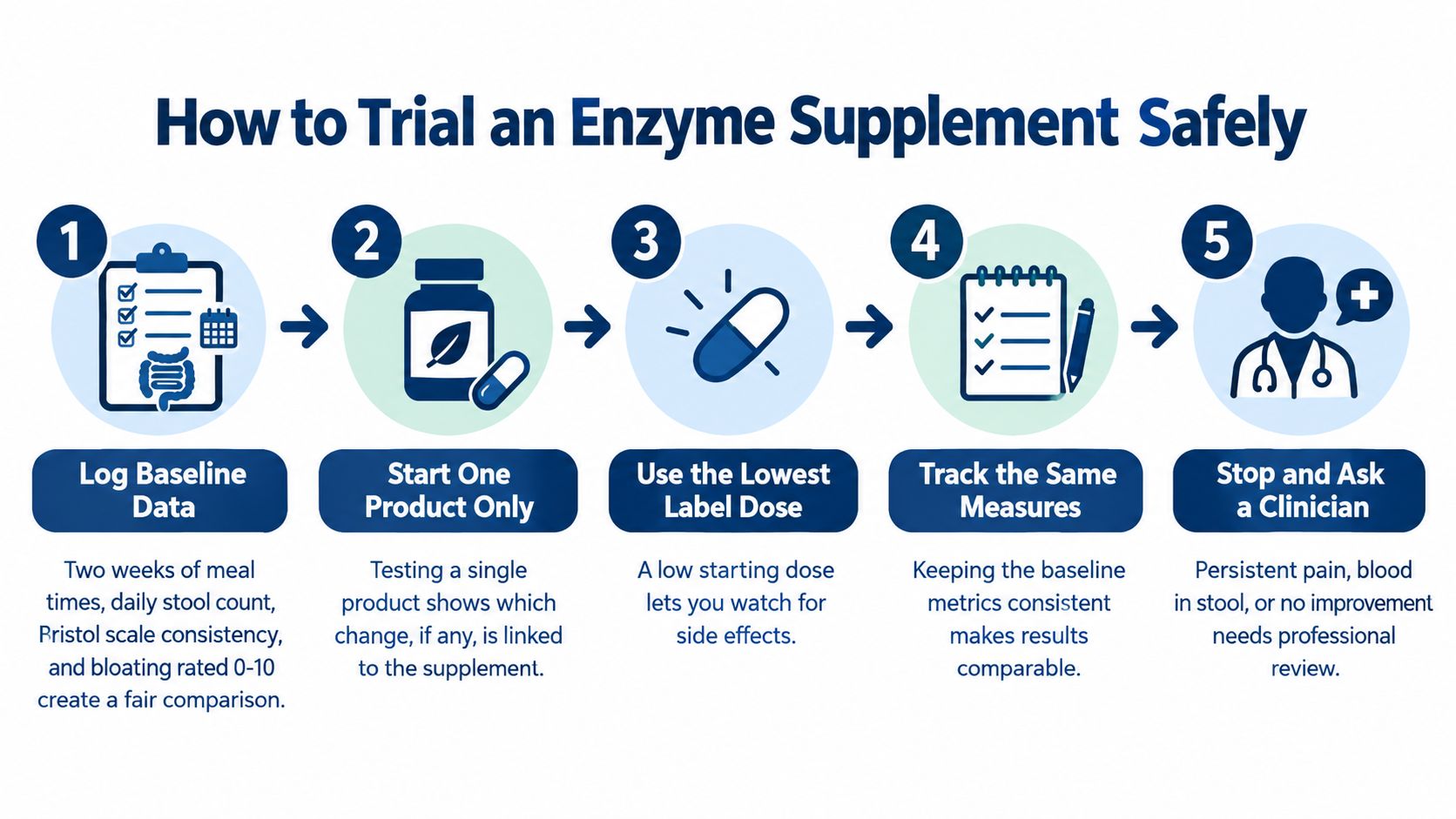
Enzymes break down food components. Constipation is defined by stool frequency, consistency, evacuation difficulty, and intestinal transit. Your log has to track both, or you'll credit a capsule for a change in breakfast.
- Log two baseline weeks. Meal times, daily stool count, Bristol stool type, and bloating from 0 to 10 give you a comparison that memory can't fake.
- Read the activity units. Look for a single enzyme or a named blend, with FCC or USP units and a per-capsule amount. Skip proprietary blends that hide the dose.
- Look for a USP or NSF seal. Supplements aren't held to the same standard as prescription drugs, and commercial products lack standardized dosing.
- Match the enzyme to your trigger food. Lactase for milk, alpha-galactosidase for beans. Don't start with a kitchen-sink blend.
- Take it as labeled, usually with the first bite. Don't exceed the label dose. A low start makes side effects easier to spot.
- Change one variable. Same fiber, same fluid, same walk. Otherwise you won't know what moved.
- Reassess at two to four weeks. Keep it only if bloating or gas clearly improves and the stool pattern stays stable. Stop if nothing changes.
- Stop sooner if you get worse. New pain, a new symptom, or a stool change that lasts more than two weeks means a clinician, not a second bottle.
Gas, bloating, and nausea are known effects, and enzymes can interact with conditions or medicines. "Digestive support" marketing can pull attention away from slow transit, pelvic-floor dysfunction, medication effects, IBS-C, or a shortfall of fiber and fluid.
A short walk-through of how people confuse those patterns is worth watching before you start the log.
Stop the trial if bloating doesn't clearly improve, if stool frequency gets worse, or if any warning sign shows up. An open-ended experiment isn't a safety plan.
Fiber, Fluids and Habits to Try Before a Supplement
Before adding a capsule, fix the pattern enzymes were never designed to touch: how often stool forms, how much water it holds, and how easily it leaves. Fiber is the main lever here, and the pacing decides whether it works.
Consider someone who eats very little fiber and jumps to a high-fiber pattern in a single day. Bloating often spikes, and fiber gets the blame. The same person who adds a small extra portion once or twice a week, oats at breakfast, lentils at lunch, a pear in the afternoon, usually tolerates the change. Give that ramp several weeks.
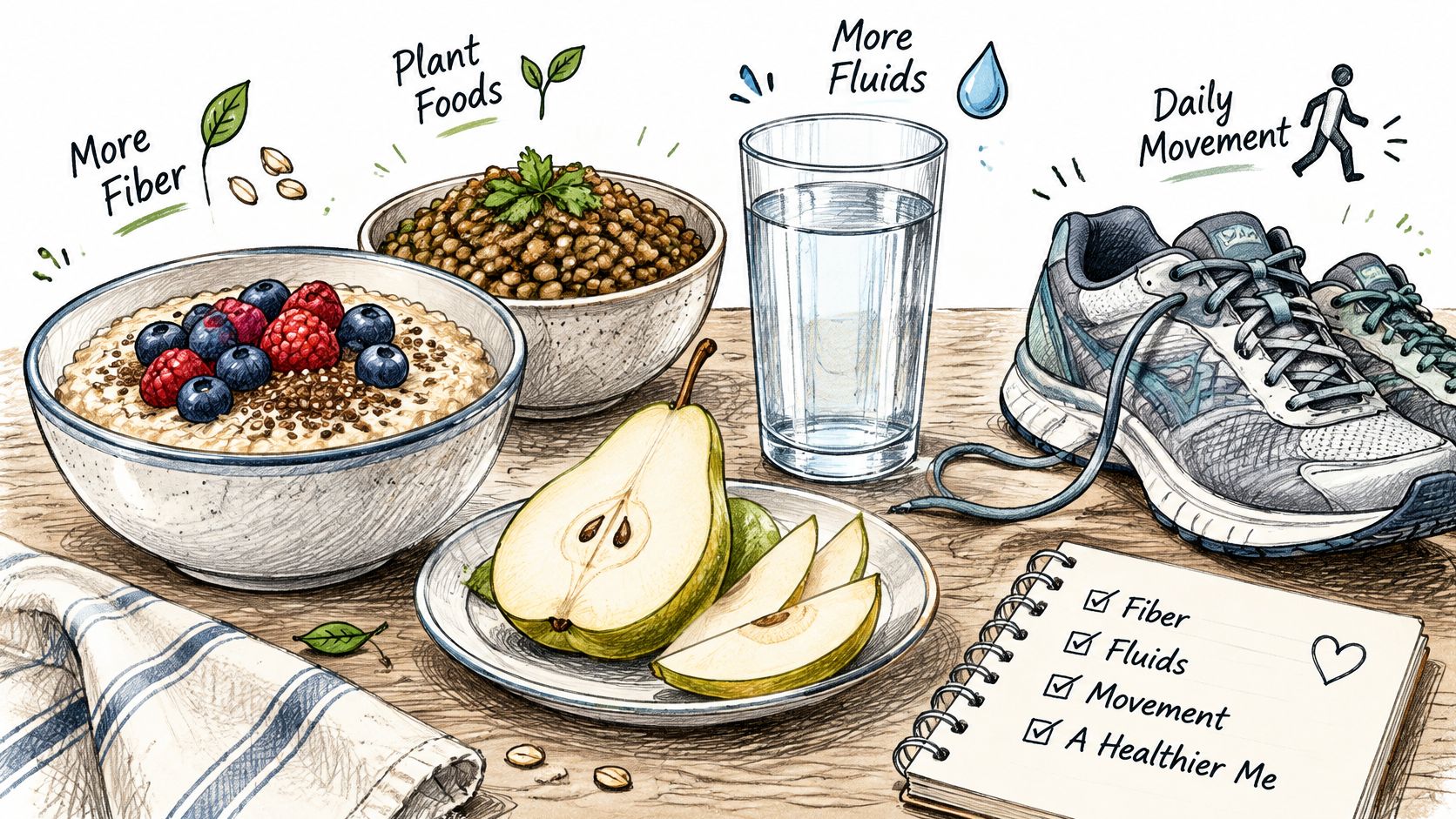
Fluids matter because fiber without water can make stool bulkier and harder. A simple check is whether urine stays pale through the day. Movement of about 20 to 30 minutes, a walk counts, supports the muscle rhythm of the colon.
Toilet habits and medicines
- Answer the urge. Holding it trains the rectum to ignore the signal.
- Allow unhurried time. A footstool that raises the knees can make evacuation easier.
- Review slowing medicines with a prescriber. Opioids, some antidepressants, anticholinergic drugs, and iron or calcium supplements are common culprits. Don't stop a prescription on your own.
Meal pattern matters too. Repeated low-fiber plates and long gaps between meals show up in discussions of unhealthy habits in Indian meal planning, and the same trap exists in any cuisine built on refined grains and little produce. A fiber powder such as Healthy Origins Healthy Fiber can fill a food gap. It works through bulk like dietary fiber, so it still needs fluid.
Probiotics are a different category
A 2025 randomized trial in 67 adults aged 60 or older found that a synbiotic containing Bifidobacterium animalis BL-99 and fructooligosaccharides increased weekly spontaneous bowel movements from a placebo-adjusted baseline and shortened whole-gut transit time, with benefits still present two weeks after treatment ended. Other small studies point in a similar direction for probiotic formulas and for specialized procedures such as fecal microbiota transplantation, but those are separate interventions, not retail enzymes.
Enzymes, probiotics, prebiotics, synbiotics, fiber, and laxatives all work through different mechanisms. Strain-specific results do not transfer to the next bottle, and small, short trials do not prove long-term benefit. If you try a synbiotic, match the studied strain and dose, wait several weeks, and keep it as an add-on to fiber rather than a replacement for it. PEG remains a clinician-directed option when those steps are not enough.
Confirm the Cause Before Buying Another Bottle
Some patterns rule out a home trial completely. Book care promptly, and skip the supplement, if you have rectal bleeding, black or bloody stools, anemia, vomiting, unexplained weight loss, severe or persistent abdominal pain, fever, constipation that began after age 50, or symptoms that wake you at night.
If none of those apply, set a three-week checkpoint. After consistent fiber, fluid, and habit changes, book primary care if constipation is still there. Bring the log: stool count, Bristol type, and meal times. A clinician may check thyroid function, calcium, and blood counts, and may discuss PEG or tests such as transit studies. Outlet and nerve problems are a different diagnosis from a heavy meal. A clear primer on understanding digestive motility disorders helps you see why a slow colon isn't fixed by splitting starch faster.
Verdict by situation
- Meal-related gas with normal stools: A targeted enzyme, lactase or alpha-galactosidase, is a reasonable two-to-four-week trial after portion changes.
- Infrequent or hard stools: Fiber, fluids, and a clinician visit come before any enzyme. PEG is a conversation with that clinician, not a guess from a feed.
- Any red flag above: See a clinician now. Don't add a bottle while you wait.
An enzyme is at most an adjunct for meal discomfort. It should never delay a diagnosis, and a second bottle isn't a plan when the first one didn't change the log.
Supplemynts Inc sells dietary supplements across digestive health, fiber, minerals, and related categories, with free shipping in the continental United States and a 60-day return window. Use that range to compare a fiber or mineral product with your symptom pattern, not to replace clinician-directed care. Visit Supplemynts Inc when you're ready to match a label to the row you actually fit.







Please complete your information below to login.
Sign In
Create New Account