


A complete multivitamin for women covers key vitamins and minerals at appropriate doses for her life stage, uses bioavailable forms, and is third-party tested. It can be useful, but it isn't necessary for everyone, and “complete” means very little if the formula is poorly matched, overloaded, or inadequately verified.
That's the part most labels skip. A bottle can list a long roster of nutrients and still miss what matters most in practice: the right iron and folate strategy, reasonable dosing, forms your body can use, and evidence that the product is clean.
The counterintuitive part is that multivitamins are both mainstream and often oversold. Multivitamin and mineral products have been part of the U.S. market since the early 1940s, and they're now taken by an estimated one-third of U.S. adults and about one-quarter of children and adolescents, according to the NIH information cited in this women's multivitamin market overview. Yet broad health outcomes are far less impressive than the marketing language suggests.
If you're looking for a complete multivitamin for women, the right question isn't “Which one has the most ingredients?” It's “Which one fits my body, my diet, my life stage, and my risk profile without creating new problems?”
Table of Contents
- Why Complete Is Not the Simple Answer
- What Makes a Multivitamin Truly Complete for Women
- The Nutrient Breakdown Vitamins Minerals and Dosages by Life Stage
- Form and Bioavailability Why the Type of Nutrient Matters
- Common Dietary Gaps That a Complete Multivitamin Can Address
- Quality and Safety Concerns Beyond the Label
- How to Choose a Complete Multivitamin for Your Situation
- Where to Shop with Confidence Using Supplemynts Tools
Why Complete Is Not the Simple Answer
“Complete” sounds reassuring. In reality, it's a packaging word, not a clinical standard.
A long ingredient panel can hide three common problems. The first is misalignment. A reproductive-age woman with regular menstrual losses has different priorities than a post-menopausal woman who may not want routine iron at all. The second is excess. More isn't automatically better, especially with minerals that can build up or cause side effects. The third is false expectation. Many people buy multivitamins as if they're broad disease-prevention insurance. That's usually the wrong frame.

What the label doesn't tell you
When I evaluate a women's multivitamin, I care less about how many line items appear on the Supplement Facts panel and more about four practical questions:
- Who is it for: Is it built for reproductive years, pregnancy planning, perimenopause, or post-menopause?
- What problem is it solving: Is it aimed at likely gaps such as folate, iron, or vitamin D, or is it making vague wellness promises?
- How is it dosed: Are the nutrients balanced, or does the formula rely on megadoses to look impressive?
- How is quality verified: Is there any meaningful sign that the product has been checked beyond the label?
Practical rule: A complete multivitamin for women should reduce decision risk, not create it.
The category became mainstream for a reason. Women's multivitamins grew alongside public health focus on micronutrient adequacy, especially folate, iron, calcium, and vitamin D, as noted in the same market background on women's multivitamins. But mainstream use doesn't mean every formula is sensible.
A better definition of complete
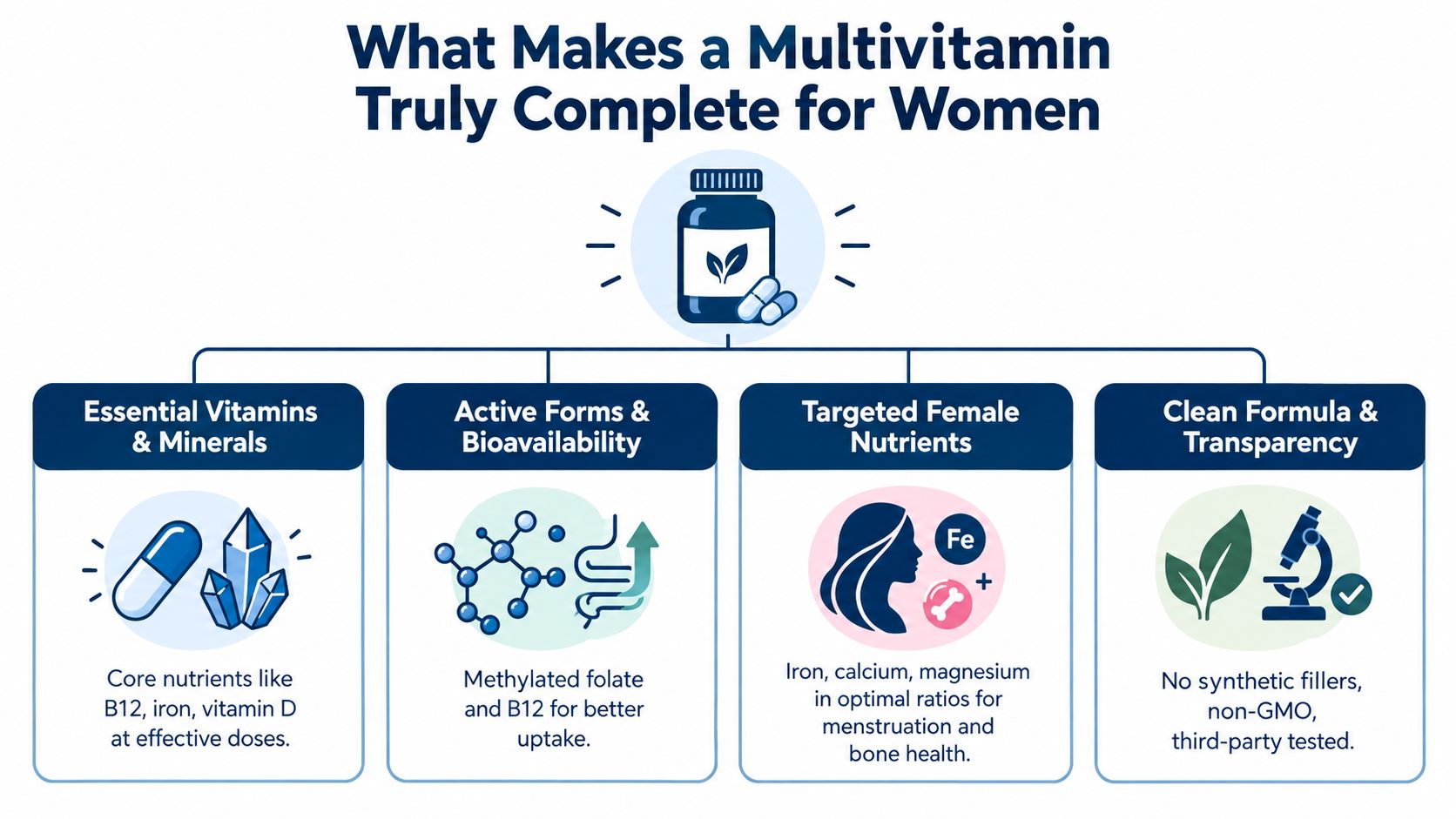
For women, completeness has four parts:
- Relevant nutrients
- Appropriate amounts
- Usable forms
- Demonstrated quality
That's the standard worth using. Everything else is marketing decoration.
What Makes a Multivitamin Truly Complete for Women
Some formulas try to win by cramming in everything. Better formulas win by being selective, balanced, and transparent.
Breadth matters, but only if it's relevant
A useful women's multivitamin should cover the core vitamins and minerals commonly considered in women's health. That usually includes folate, vitamin D, B vitamins, zinc, and depending on life stage, iron and bone-supportive minerals.
But breadth alone can mislead. A label can look full while underdelivering on the few nutrients that matter for that woman. A product with dozens of ingredients isn't superior if the meaningful ones are token doses or poor forms.
Balance is where good formulas separate themselves
Many “complete” products fall apart. They chase headline nutrients and ignore proportion.
A balanced formula respects trade-offs:
- Iron isn't universal: Some women need it. Some women should avoid extra iron.
- Folate deserves precision: It matters especially for women who could become pregnant.
- Fat-soluble vitamins need restraint: Bigger numbers aren't a free upgrade.
A supplement should fill a gap you plausibly have, not create a surplus you didn't need.
Bioavailability changes the real value
Two labels can look similar and perform very differently. Form matters. A thoughtful formula uses nutrient forms chosen for tolerance and uptake, not just low manufacturing cost.
That's one reason I don't treat ingredient count as quality. If a brand spends its budget on forms that are easier to absorb and easier on the stomach, that often matters more than adding extra herbs or trace ingredients that look impressive on a front label.
Safety belongs in the definition of complete
A complete multivitamin for women isn't just nutritionally broad. It's clean and verifiable.
That means looking for signs that the company takes testing, manufacturing controls, and dose transparency seriously. “Complete” should include confidence that what's in the bottle matches the label and that the product has been checked for contaminants, not just assembled to satisfy a marketing concept.
The Nutrient Breakdown Vitamins Minerals and Dosages by Life Stage
The most important shift in women's multivitamins is life stage. The same bottle shouldn't automatically follow you from your twenties through post-menopause.
The nutrients that change the decision
The two nutrients I scrutinize first are iron and folate. Expert guidance notes that women of reproductive age often warrant attention to both because menstrual blood loss and pregnancy-related demands can raise deficiency risk. The same literature also cautions that many healthy adults should avoid excess iron and keep total intake below the tolerable upper limit of 45 mg/day, and CDC-linked guidance highlights 400 mcg/day folic acid for women capable of becoming pregnant to reduce neural tube defect risk in this review on multivitamin use and folic acid guidance.
That one paragraph explains why “complete” has to be personal. A woman trying to conceive has a different use case from a woman who's long past menstruation.
If you want a more individualized starting point, especially when family history, diet pattern, or nutrient metabolism questions are in play, a vitamin genetic health check guide can help frame better questions before you buy a broad formula.
Life stage matters more than label hype
Here's a practical way to read the category.
| Nutrient | Reproductive Age (19-50) | Pregnancy | Post-Menopause (50+) |
|---|---|---|---|
| Folate | Usually a priority, especially if pregnancy is possible | High priority | Still relevant, but usually less central than in pregnancy planning |
| Iron | Often relevant because of menstrual blood loss | Often a major focus | Often needs reevaluation rather than automatic inclusion |
| Vitamin D | Commonly reviewed as a gap-filler nutrient | Still important | Still important |
| Calcium | Diet-plus-supplement strategy often matters more than label claims | Important | Often becomes more prominent in bone-health planning |
| B12 | Worth checking in restricted diets or absorption concerns | Relevant | Often deserves closer review with aging |
| Magnesium | Useful when diet is inconsistent | Relevant | Relevant |
| Zinc | Supportive, but not usually the main reason to choose a formula | Relevant | Relevant |
This table is intentional qualitative. It reflects how decisions are made in clinic-style conversations. You don't choose a formula because it contains everything. You choose it because it emphasizes the nutrients that fit your current physiology.
What I'd flag on a product page
When comparing women's multivitamins, I look for clues that the formula understands life stage. For example, a general formula such as Vimerson Women's Multivitamin with Zinc Biotin Calcium Vegetarian 60 Pills may suit someone looking for broad foundational coverage, but I'd still check whether the iron and folate approach makes sense for her specific situation.
A complete multivitamin for women should never force you to accept nutrients you don't need just to get the ones you do.
Form and Bioavailability Why the Type of Nutrient Matters
Two supplements can list the same nutrient and behave very differently in real life. That's not label trivia. It affects absorption, stomach tolerance, and whether you'll keep taking the product.
The form can change the experience
Minerals are where women notice this first. Some forms are harsher on the stomach or less practical in a daily multivitamin format. If a product leaves you nauseated, constipated, or reluctant to take it, it has failed even if the label looks excellent.
That's why I prefer women to read beyond the front panel and inspect the actual nutrient forms. A gentler, more usable formula usually beats a more aggressive one that sits untouched in a cabinet.
Delivery format also shapes compliance
The best multivitamin is the one you can take consistently without dreading it. Capsules, tablets, softgels, powders, and gummies each create different trade-offs in taste, convenience, and excipient load. If you're comparing formats, this overview of types of gummies explained is useful for understanding why delivery form can matter beyond preference alone.
I'd also compare formula style across products made for different age ranges. A product such as mykind Organics Women's Multivitamin 40 Plus Health Support 120 Caps shows how brands often shift both ingredient profile and delivery approach for older users.
If a multivitamin consistently upsets your stomach, don't assume supplements “just aren't for you.” Often the issue is the form, the dose density, or taking it at the wrong time of day.
Cheap completeness is usually obvious
Watch for formulas that boast a massive ingredient list but feel vague where it counts. If the product page highlights superfoods, blends, or beauty extras more than mineral forms and life-stage fit, that's usually a sign the formula was designed to sell first and solve second.
Common Dietary Gaps That a Complete Multivitamin Can Address
A complete multivitamin earns its place by covering predictable gaps, not by pretending to replace a solid diet or prevent every major disease.
Where multivitamins are genuinely useful
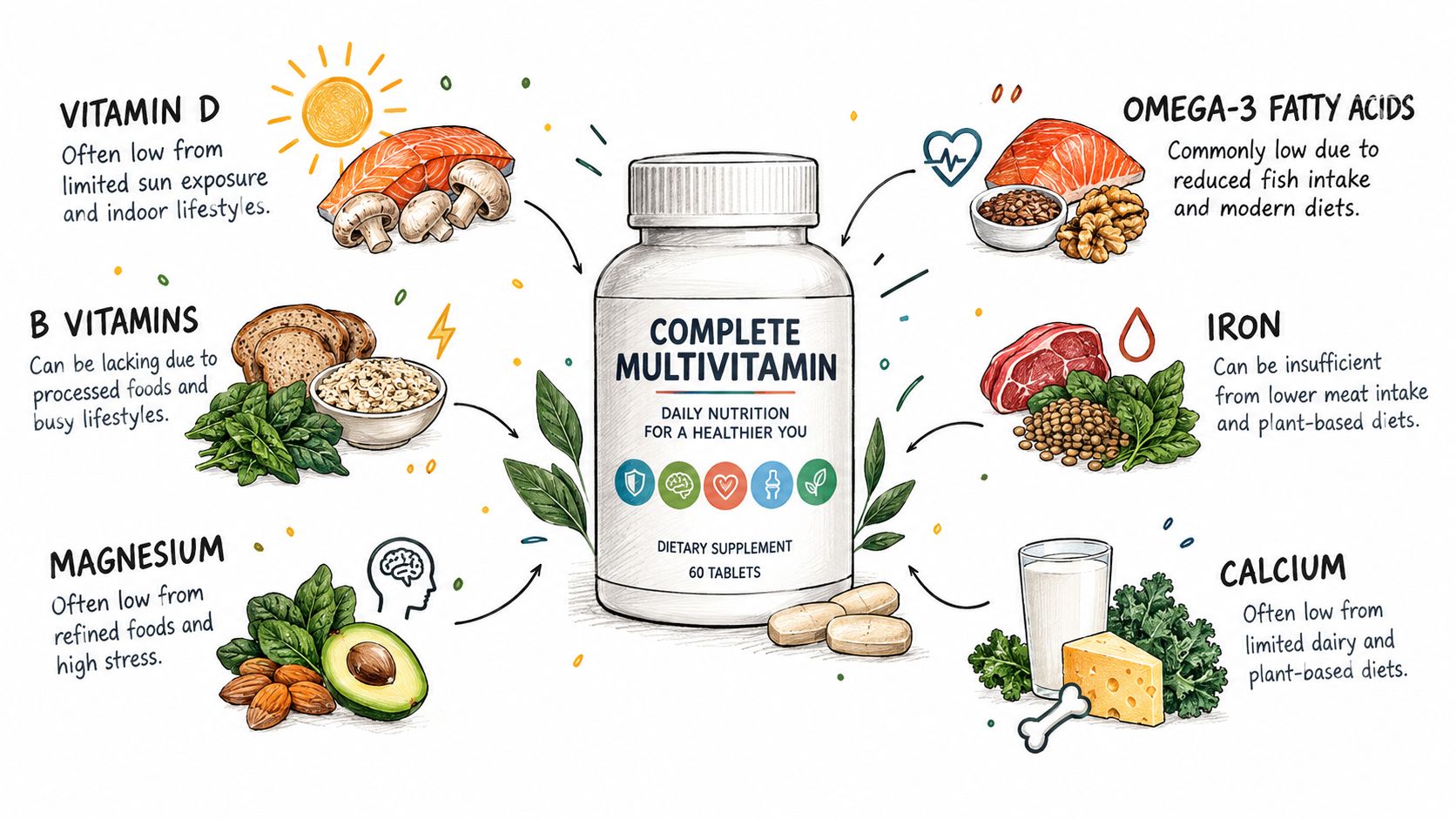
In practice, the women who benefit most are not always the ones chasing the longest ingredient list. They are usually the ones with uneven intake, low appetite, restrictive eating patterns, busy schedules, or a life stage that raises nutrient demands. In those cases, a well-built formula can help close recurring shortfalls in folate, vitamin D, iodine, B12, iron, or magnesium, depending on the woman and the product.
There is a measurable upside to that gap-filling role. In a controlled study of healthy premenopausal women, 12 weeks of multivitamin use increased serum vitamin D and folate, according to the NIH fact sheet on multivitamin and multimineral supplements for health professionals. That is a useful standard. A multivitamin should improve intake in areas where real diets often fall short.
Where expectations usually go wrong
A better nutrient baseline is not the same as broad disease protection. The same NIH summary notes that multivitamins generally do not reduce cardiovascular disease, cancer, cognitive decline, or early death for most adults in broad population use.
That trade-off matters. A formula can be worth taking and still have limits.
The most realistic uses look like this:
- Folate backup: Helpful for women who could become pregnant and are not reliably getting enough from food alone.
- Vitamin D support: Useful for women with low sun exposure or diets that do not include much fortified dairy or fatty fish.
- B12 coverage: Often relevant for vegetarian, vegan, or low-animal-food eating patterns.
- Iron support: Sometimes useful for menstruating women, though not every woman needs extra iron and some do better avoiding it unless there is a clear reason.
- General coverage during inconsistent eating: Practical during travel, stress, dieting, or periods when meal quality slips.
This is also where the idea of "complete" needs a reality check. A formula stuffed with dozens of ingredients is not automatically better if the doses are trivial, the forms are poorly absorbed, or the product ignores the needs of a menstruating woman, a woman trying to conceive, or a woman in midlife.
Diet still carries the load
A multivitamin does not provide protein, fiber, omega-3 fats, or enough magnesium and potassium to correct a poor eating pattern on its own. It also will not fix fatigue, hair loss, low mood, or gut symptoms that deserve proper evaluation.
For more specific concerns, targeted education usually helps more than adding random extras to a daily stack. For example, resources on vitamins for vaginal health can help separate focused support from generic multivitamin marketing.
A multivitamin works best as nutritional insurance for common gaps. It works poorly as a substitute for meals, testing, or a plan matched to the woman taking it.
Quality and Safety Concerns Beyond the Label
The conversation gets more serious. Many women spend time comparing vitamin percentages and almost no time asking whether the product itself is clean.
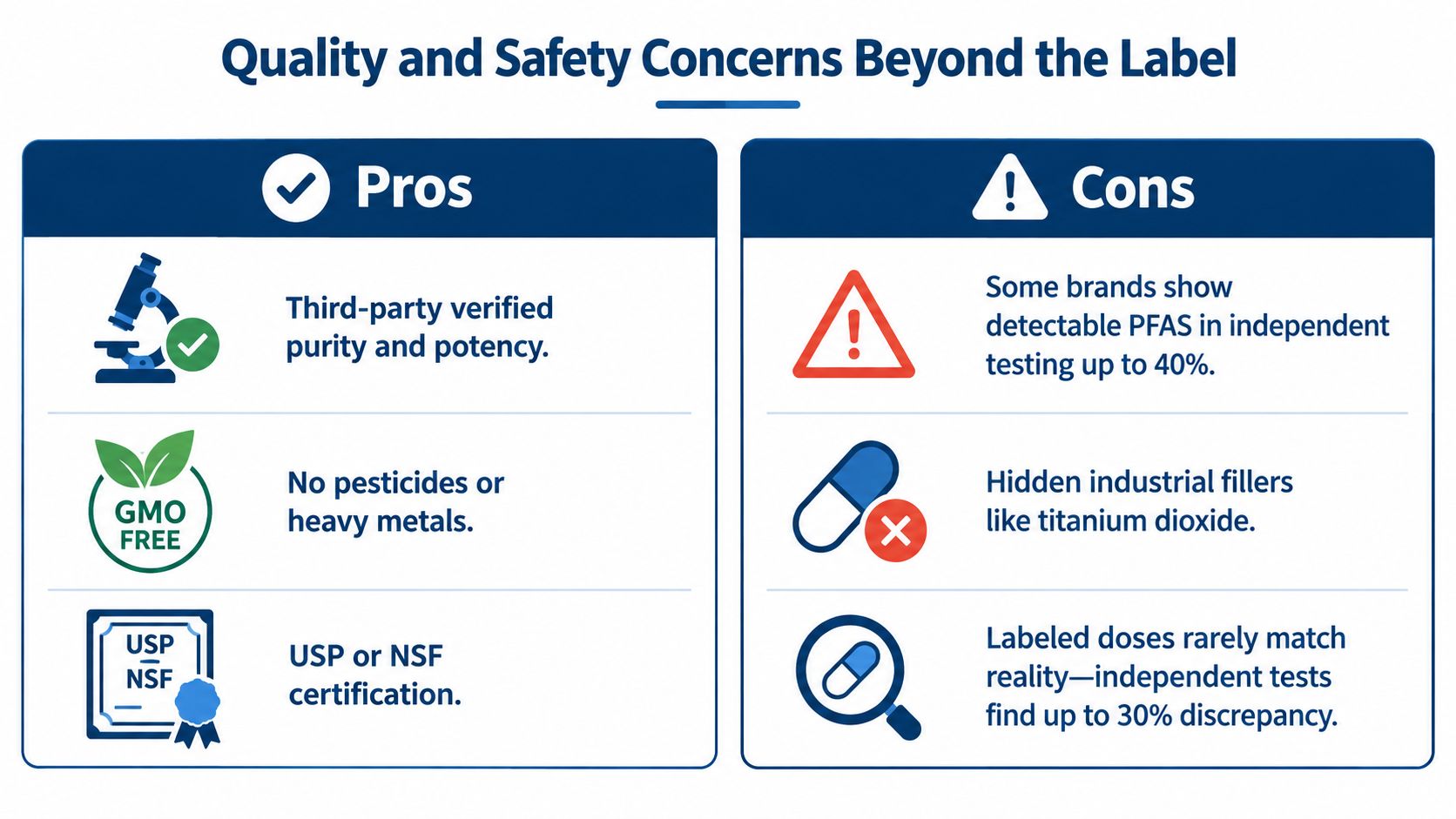
Recent third-party testing reported detectable PFAS in 40 percent of women's multivitamins, ortho-phthalates in 100 percent, and other pesticides in 30 percent of tested products, according to this independent testing summary of women's multivitamins. That doesn't mean every product is unsafe. It does mean “complete” should include contaminant awareness.
What to check besides the ingredient list
A cleaner buying process starts with a short checklist:
- Third-party verification: Look for evidence that an outside organization has assessed purity or manufacturing quality.
- Transparent labeling: Favor brands that clearly identify forms and doses instead of hiding behind proprietary blends.
- Realistic positioning: Be skeptical of formulas sold as universal protection against major disease.
- Compatibility with your regimen: Consider fortified foods, separate supplements, and medications before adding another all-in-one.
One medication interaction deserves special attention. NIH guidance notes that vitamin K can interfere with warfarin, and that people using fortified foods or additional supplements should ensure combined intake doesn't exceed upper limits.
Why this matters more than marketing polish
Women often assume the danger comes from deficiency alone. In practice, the risk can come from the wrong formula, the wrong context, or an inadequately vetted product.
This short video is a useful reminder that supplement quality deserves more scrutiny than many shoppers give it.
My baseline standard
I want three things before I call a women's multivitamin worth considering:
- A life-stage rationale
- Label transparency
- Independent quality signals
If one of those is missing, the product may still sell well, but I won't assume it's a wise default.
How to Choose a Complete Multivitamin for Your Situation
Women don't stop using multivitamins because products disappeared. They stop because the habit stops making sense, the formula feels wrong, or the promise was too broad. Usage patterns have shifted over time. A nationally representative analysis found that daily multivitamin use among women of reproductive age fell from 32.7 percent in 2006 to 23.6 percent in 2016, while non-use rose from 44.3 percent to 60.1 percent, according to this market analysis citing multivitamin use trends. That tells me shoppers are making more selective decisions, not just blindly buying the category.
Start with your situation, not the bottle
I'd sort women into practical decision groups:
- Reproductive years: Check folate carefully. Reassess iron need.
- Trying to conceive or open to pregnancy: Don't treat folic acid as optional.
- Perimenopause: Review whether the old formula still matches symptoms, diet, and cycle pattern.
- Post-menopause: Revisit iron. Many women continue taking it out of habit rather than need.
- Restricted diets: Give extra attention to B12, vitamin D, and overall formula design.
Then read the label in this order
Don't start with the front-of-bottle claims. Start here:
- Core nutrients first: Does the product cover the nutrients most relevant to your life stage?
- Dose logic next: Are the amounts reasonable, or does the label chase shock value?
- Forms after that: Are the nutrients presented in forms you'll likely tolerate?
- Quality signals last: Can the brand support its cleanliness and manufacturing claims?
A broad formula like NOW Eve Softgels Superior Women's Multivitamin might fit someone looking for a general foundation, but I'd still run it through the same filter. Product popularity doesn't replace personal fit.
Choose the formula you can justify on paper before you choose the one with the prettiest front label.
When not to force a multivitamin
If your diet is strong, your labs are stable, and you don't have a life-stage reason for broad coverage, you may not need a complete multivitamin for women at all. In that situation, targeted supplementation often makes more sense than taking an all-in-one “just in case.”
Where to Shop with Confidence Using Supplemynts Tools
Once you know what a good formula should look like, the challenge becomes filtering the market without getting overwhelmed. That's where shopping tools matter more than people think.
A large supplement catalog is only useful if you can narrow it quickly by purpose. Supplemynts organizes products by broad categories such as vitamins, minerals, herbs, and proteins, and also by health goals such as immunity support, brain support, digestive health, vegan supplements, and other purpose-led collections. For a shopper trying to compare women's formulas, that structure reduces the usual mess of scrolling through unrelated products.
Use filters to narrow the field
The smartest way to shop isn't to open dozens of tabs. It's to start with constraints.
If you're looking for a complete multivitamin for women, use a process like this:
- Pick the health purpose first: General foundational support is a different search from menopause-focused support or a vegan formula.
- Filter for dietary fit: If you avoid animal-derived ingredients, start with vegan-labeled options instead of checking each label manually.
- Compare dosage style: Some products take a broader, gentler approach. Others are denser and more aggressive.
- Save contenders: A wishlist or account-based shortlist helps you compare later without restarting the search.
That sounds basic, but it prevents the most common buying mistake. People compare products before they've decided what kind of product they need.
Use policy pages as part of quality screening
Most supplement buyers focus on ingredients and ignore the store itself. That's a mistake.
A reliable supplement retailer should make its operating policies easy to find. Supplemynts publishes a refund policy, shipping policy, privacy policy, terms and conditions, FDA compliance information, and California CCPA opt-out details. That kind of documentation doesn't prove a given formula is ideal for you, but it does reduce transaction uncertainty.
The practical benefits are straightforward:
- Free shipping within the continental United States: This makes trial purchases less annoying when you're comparing options.
- A 60-day return policy: That lowers risk if a formula doesn't work for you in practice.
- Direct support channels: Email and phone support matter when you need help verifying product details before purchase.
- Environmentally friendly packing: Not a clinical issue, but it can matter to values-driven shoppers.
Curated browsing helps when you know the goal but not the brand
One underrated shopping advantage is purpose-based curation. If you know you want a women's multivitamin that aligns with a plant-based lifestyle, or you want to compare broad wellness products without getting pulled into unrelated categories, curated collections can save time.
That's especially helpful because the women's multivitamin category includes very different product philosophies. Some formulas are minimalist. Some are kitchen-sink blends. Some lean hard into beauty positioning. Some are built more around foundational nutrition. A retailer that organizes by purpose gives you a cleaner starting point than a generic marketplace.
Common questions women still ask
Do I need a complete multivitamin if I eat well
Not always. If your diet is varied and your life stage doesn't create a clear need, an all-in-one may add little value. It makes more sense when there's a plausible gap, a restricted diet, or a specific nutrient priority.
When should I take it
Most women do better taking a multivitamin with food, especially if the formula is dense or contains nutrients that can upset an empty stomach. Consistency matters more than choosing a “perfect” time.
What if it makes me nauseated
That usually points to form, dose density, iron content, or timing. Try taking it with a meal. If that doesn't help, reassess the formula instead of assuming all multivitamins will affect you the same way.
Can I combine it with separate supplements
Sometimes, yes. But you need to account for overlap. A multivitamin plus fortified foods plus targeted add-ons can push total intake higher than intended, so review the full stack before adding more.
What matters most when I'm shopping online
Three things: life-stage fit, label transparency, and store policies that reduce friction if the product isn't right for you. Those criteria cut through most of the noise.
Supplemynts Inc offers a practical way to shop this category without getting lost in generic marketplace clutter, with purpose-based navigation, vegan filters, curated collections, and documented policies that lower buying risk. If you're comparing options for a complete multivitamin for women and want a cleaner shopping experience, visit Supplemynts Inc.





Please complete your information below to login.
Sign In
Create New Account