


Chromium and cinnamon are often marketed for blood sugar support, but a controlled four-month trial in 62 adults found only a limited fasting-glucose signal, with no significant improvement in HbA1c or several other metabolic measures. In that study, fasting plasma glucose fell by 0.24 mmol/L with the supplement and rose by 0.12 mmol/L with placebo.
If two familiar ingredients appear together in a capsule, does that automatically mean they work better together? The answer is no. Chromium and cinnamon may have plausible roles in glucose metabolism, but the clinical evidence is mixed, and outcomes can depend on the formulation, dose, study duration, and a person's existing health.
That distinction matters because “supports healthy blood sugar” can sound very close to “treats diabetes.” It isn't. A supplement may be worth discussing as an adjunct to nutrition, movement, monitoring, and medical care, but it shouldn't replace prescribed treatment or create false confidence.
Table of Contents
- Why Chromium and Cinnamon Capture Attention
- How Chromium and Cinnamon Work in the Body
- What the Research Shows
- Typical Dosing and How to Choose Products
- Safety Considerations and Who Should Be Cautious
- Is Chromium and Cinnamon Right for You?
- Key Takeaways for Informed Decisions
Why Chromium and Cinnamon Capture Attention
What makes chromium and cinnamon seem like a convincing blood sugar pairing? A person searching for natural ways to support healthy glucose levels may encounter chromium described as a mineral connected with insulin, cinnamon presented as a familiar food with metabolic benefits, and combination supplements marketed as an easy daily option.
The appeal is easy to understand. Cinnamon is familiar, affordable, and simple to add to food. Chromium sounds more technical, while its proposed relationship with insulin signaling gives marketers a clear explanation. Placing both ingredients in one capsule can make the formula appear to address glucose processing and insulin response at the same time.
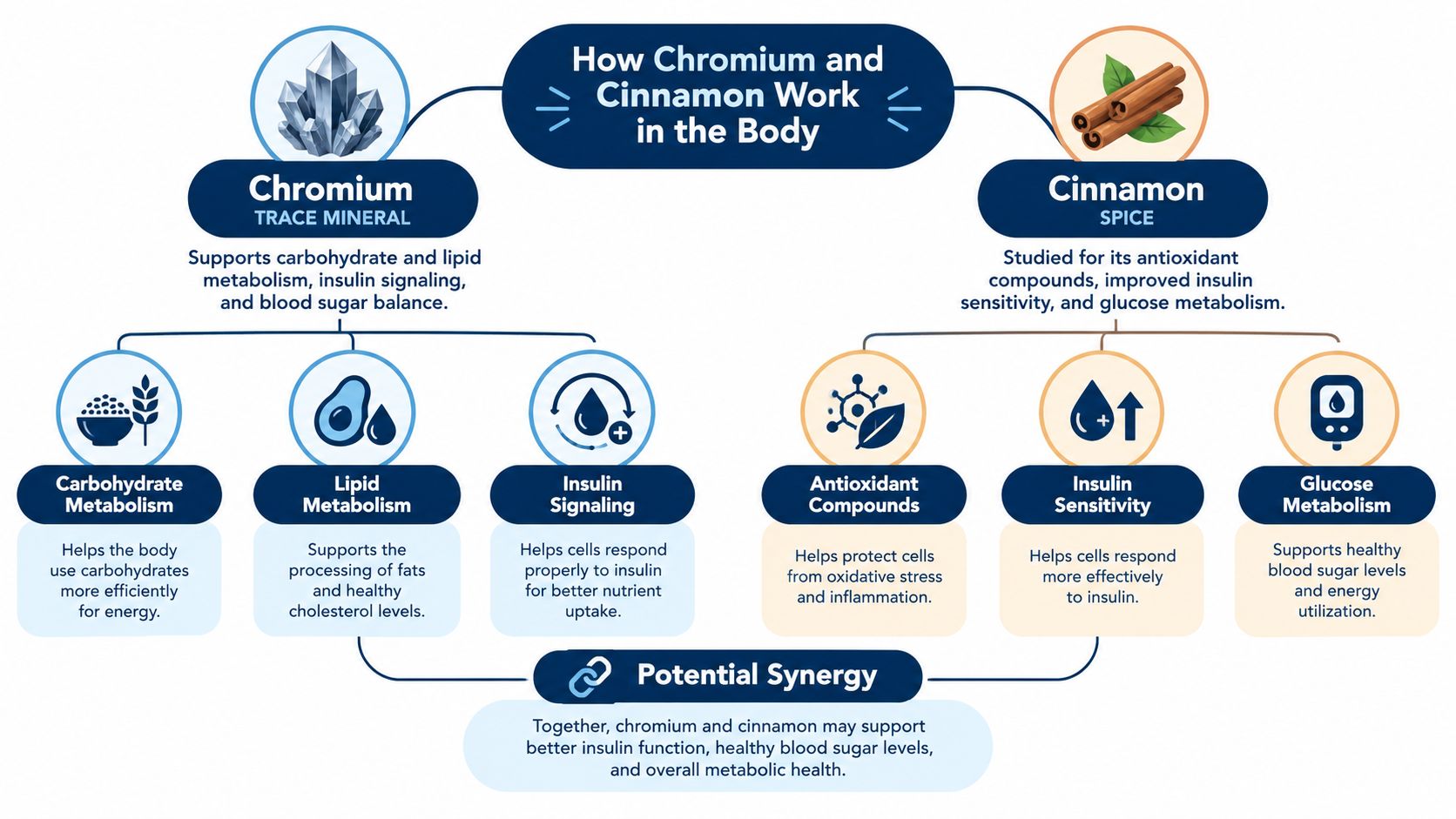
The visual below summarizes how these two ingredients are often presented as interacting with glucose metabolism.
That presentation can sound more certain than the clinical evidence supports.
Why combination labels can mislead
A product containing two ingredients provides no proof that they work better together. The label also cannot show whether researchers tested that exact combination, in the same form, at the same amount, and over a comparable period.
Companies may select ingredients because they are recognizable and marketable. The NIH consumer information on chromium describes the evidence as mixed and does not establish chromium as a dependable treatment for diabetes.
Marketing often compresses several different ideas into one phrase:
- A biological theory: an ingredient may influence a pathway involved in glucose metabolism.
- A laboratory finding: a marker may change under particular study conditions.
- A clinical promise: a person may experience better long-term health.
These claims require separate evaluation. A change in fasting glucose, for example, does not automatically show that a supplement reduces complications or prevents diabetes.
Practical rule: Treat a blood sugar supplement as a question to investigate rather than a disguised treatment.
Education about food, activity, and glucose handling gives lifestyle decisions more context than a dramatic product promise. A resource on a sugar-hungry workout for glucose explains how movement can fit into that broader discussion. Chromium and cinnamon may be worth examining, yet their meaning depends on the larger metabolic picture and the quality of the evidence behind the product.
How Chromium and Cinnamon Work in the Body
Chromium's proposed role is relatively straightforward to describe, even though the clinical results are not. It may enhance insulin signaling, which is the communication process that helps the body respond to insulin and move glucose from the bloodstream into cells.
A useful analogy is a key and a lock. Insulin is part of the signal that tells a cell to accept glucose, while chromium has been proposed as a factor that may help the signaling system work more effectively. That analogy explains the hypothesis, not a guaranteed outcome. The NIH Office of Dietary Supplements notes that clinical findings remain inconsistent across studies, forms, doses, and participants. Its professional fact sheet on chromium also describes reported adverse effects and unresolved questions about long-term safety.
Cinnamon is different. It isn't a trace mineral, and its effects can't be reduced to the same insulin-signaling theory. Researchers have studied cinnamon in relation to glucose metabolism, but results vary according to the cinnamon species, preparation, amount, and population being studied.
Why proposed synergy isn't proven synergy
The combination is often explained as if each ingredient handles a separate job. Chromium is described as supporting the body's response to insulin, while cinnamon is described as influencing how glucose is processed after eating. That makes the formula sound complementary, but a plausible division of labor isn't the same as demonstrated clinical synergy.
To show that a combination is superior, researchers would need to compare the combination with each ingredient alone and with a placebo, using a carefully matched design. Without that comparison, a positive result could come from one ingredient, the other ingredient, another part of the formula, or ordinary variation between participants.
The practical lesson is to separate three questions:
- Could the ingredients affect related biological pathways? Possibly, based on proposed mechanisms.
- Does the combination reliably improve useful clinical outcomes? Current evidence doesn't establish that.
- Can an individual safely add it to existing care? That depends on medications, liver and kidney health, pregnancy status, and the specific product.
Mechanisms help scientists form hypotheses. They don't give consumers permission to assume that a supplement will prevent diabetes, reverse insulin resistance, or replace a prescription.
What the Research Shows
How should a promising supplement result be read without turning it into a marketing promise? The clearest approach is to separate a preliminary finding from a definitive verdict. A signal can support further research, while still falling short of a strong label claim.
One controlled trial studied a supplement containing cinnamon, chromium, and carnosine in 62 overweight or obese adults with impaired fasting glucose. Participants took 1.2 g per day for four months. Fasting plasma glucose fell by 0.24 mmol/L in the treatment group, while it rose by 0.12 mmol/L with placebo. HbA1c, insulin sensitivity markers, insulin, lipids, and inflammatory markers showed no significant differences between the groups. These results appear in the published trial record.
The finding points to a limited short-term fasting-glucose signal in one particular group using one particular formula. It does not establish the same effect for people with diagnosed diabetes, people with normal glucose levels, or products with different ingredients or proportions.
Why surrogate markers need context
Fasting glucose and HbA1c provide different views of blood sugar. A fasting measurement is a snapshot taken under specific conditions. HbA1c reflects glucose exposure over a longer period, more like a time-lapse record. When one measure changes without a corresponding change in the other, the result needs careful interpretation before supporting a broad health claim.
Insulin, lipids, and inflammatory markers require the same caution. They help researchers study physiology, but a laboratory change does not automatically mean that someone feels better or faces a lower risk of complications.
Readers reviewing their own results may find educational metabolic health biomarker insights useful for understanding what different measurements represent. Personal interpretation still belongs with a qualified clinician familiar with the person's medical history.
What inconsistent evidence means for shoppers
Reviews of chromium have produced conflicting findings, and professional guidance does not treat chromium as an established diabetes therapy. Cinnamon studies also vary in species, extracts, doses, combinations, and participant groups. Those differences make a single conclusion difficult and explain why promotional claims can sound more certain than the clinical evidence.
A more useful set of questions is:
- Did the study involve people with prediabetes, impaired fasting glucose, or diagnosed diabetes?
- Did researchers test the exact product formula?
- Was the outcome fasting glucose, HbA1c, or another marker?
- Did the study last long enough to assess a meaningful health outcome?
- Was the combination compared with each ingredient alone?
A product page that cannot answer basic label questions deserves caution. Futurebiotics CinnaCare may appear during a shopper's comparison of glucose-focused supplements, but its listing does not demonstrate that its specific formula improves clinical outcomes.
Typical Dosing and How to Choose Products
The label is where a marketing idea becomes a real exposure. Before considering chromium and cinnamon, check the exact form, serving size, botanical identity, and amount per serving. Don't assume that a large number printed on the front represents the amount of each active ingredient.
The available evidence doesn't establish one universally appropriate dose for everyone. A trial using the combined supplement tested 1.2 g per day, but that result shouldn't be used to calculate a personal dose or applied automatically to a different product. Different formulations may contain different cinnamon species, chromium compounds, and additional ingredients.
A more useful label checklist
| Look for | Why it matters | Red flag |
|---|---|---|
| Named cinnamon species | Cassia and Ceylon cinnamon can differ in coumarin exposure | “Cinnamon blend” with no species |
| Chromium form and amount | It lets you compare the label with the research | A proprietary blend that hides individual amounts |
| Clear serving size | It shows how much the manufacturer means per day | A prominent total with no per-serving breakdown |
| Quality-testing information | It provides useful manufacturing context | Claims of guaranteed disease treatment |
| Cautions and directions | It helps identify medication and health concerns | No warning for people using glucose-lowering medicine |
A product should make the math easy. If the label lists a complex without explaining how much chromium or cinnamon it contains, you can't meaningfully compare it with clinical research. You also can't tell whether the formula resembles the product used in a study.
Choosing between convenience and flexibility
A combination product can be convenient because it puts both ingredients in one serving. The tradeoff is that you can't adjust one ingredient independently, and you may continue taking an ingredient that doesn't suit you if you experience a problem with the formula.
If you want to compare a standalone option, examine the Eidon Ionic Minerals chromium concentrate by its current label rather than by its product name alone. Look for the form, serving instructions, and any relevant cautions. Third-party testing can add confidence about product identity and contamination controls, but it doesn't prove that the supplement will improve your glucose markers.
Avoid products that imply they prevent diabetes, replace medication, or deliver prescription-like results. Those claims move beyond responsible structure and function language. A transparent label should help you understand what you're taking, not pressure you into assuming what it will do.
Safety Considerations and Who Should Be Cautious
Could a supplement affect more than your blood sugar? “Natural” describes an ingredient's origin, not its safety profile. Chromium supplementation has been associated with gastrointestinal symptoms, headaches, insomnia, and mood changes. Rare reports have involved kidney, liver, muscle, or skin injury, particularly with high-dose use. Long-term safety also remains insufficiently characterized.
Cinnamon raises a separate issue: its species changes the risk discussion. Cassia cinnamon can contain substantially more coumarin than Ceylon cinnamon. Prolonged or concentrated exposure may concern people with liver disease, and rare liver-injury reports exist. At the same time, controlled diabetes trials have not shown clinically meaningful increases in liver enzymes. That distinction matters because marketing language can make “natural” sound safer than the clinical evidence supports.
People who should seek advice first
Speak with a healthcare professional before using a chromium and cinnamon product if you:
- Take glucose-lowering medication: A supplement that may influence glucose handling could complicate monitoring or increase the risk of glucose going too low.
- Have liver disease: Cassia cinnamon and concentrated products may create avoidable concerns.
- Have kidney problems: Rare reports of kidney injury make unsupervised supplementation inappropriate.
- Are pregnant or breastfeeding: Safety data may not be sufficient for a personal recommendation.
- Manage diagnosed diabetes: Supplements should not alter a prescribed treatment plan without clinical supervision.
People with existing conditions have less room for trial and error, especially when a supplement is added without telling the clinician or pharmacist. Sharing the product label and serving instructions gives them a clearer basis for advice.
Safety first: Never stop, reduce, or replace prescribed diabetes treatment because a supplement label sounds reassuring.
If a clinician agrees that supplementation is reasonable, keep a record of the product name, serving instructions, and start date. Report unusual symptoms promptly. Add only one new product at a time, so a problem is easier to connect with its likely cause. This cautious process supports informed decisions without treating a supplement as a substitute for clinical care.
Is Chromium and Cinnamon Right for You?
The answer depends less on whether the ingredients sound natural and more on what you're trying to accomplish. A person with normal blood sugar who wants general wellness has a different decision from someone with impaired fasting glucose or diagnosed diabetes.
Start with the health context. If you have a medical diagnosis, take glucose-lowering medication, or are monitoring changing results, professional guidance should come before experimentation. A supplement can't tell you whether a change in glucose is meaningful, and it can't safely adjust medication.

Match the decision to the goal
For someone with impaired fasting glucose, discussing a clearly labelled product with a clinician may be reasonable if expectations stay modest. The purpose would be cautious adjunctive support, not diabetes prevention by capsule.
For someone with diagnosed diabetes, the priority is coordinated care. Chromium and cinnamon shouldn't replace prescribed therapy, and a product shouldn't become an excuse to delay testing, follow-up, nutrition support, or a medication review.
For someone seeking general wellness, food-based cinnamon use and a consistent routine may be more sensible than concentrated supplementation. The evidence doesn't justify treating the combination as a guaranteed shield against future disease.
The same logic applies when comparing products. A Genius Blood Sugar Support formula may appear in a shopper's search, but the decision should still depend on its current ingredient panel, personal health context, and the quality of its claims. A longer ingredient list isn't automatically a stronger formula.
A short educational video can also help explain why blood glucose decisions need context rather than one-size-fits-all promises.
Before buying, write down your goal, check whether the label identifies the cinnamon species and chromium form, and ask whether the expected benefit is worth the possible uncertainty. Prioritize meals that support your health, repeatable physical activity, sleep, and medical follow-up. Supplements may have a place, but they shouldn't become the foundation.
Key Takeaways for Informed Decisions
Chromium and cinnamon have plausible biological explanations, but clinical evidence remains limited and inconsistent. The combined trial found a modest fasting-glucose signal without significant changes in HbA1c or other tested metabolic markers. Results may vary with the formula, cinnamon species, chromium form, study population, and a person's health status. Choose products with clear labels, avoid disease-treatment claims, and discuss supplementation with a professional if you take medication or have liver or kidney concerns. Key among these considerations is treating chromium and cinnamon as possible adjuncts, never as substitutes for prescribed care or sustainable health habits.
Supplemynts Inc offers an online selection of vitamins, minerals, herbs, proteins, and wellness products, including ingredient-based and vegan options. If you're comparing chromium, cinnamon, or other supplements, visit Supplemynts Inc to review product details, support options, shipping information, and return policies before you buy.







Please complete your information below to login.
Sign In
Create New Account