


You're standing in a supplement aisle comparing a whey isolate, a cheaper concentrate, a plant blend, and a hydrolyzed formula. Every tub promises faster recovery, leaner muscle, and better results. Then you notice the details that matter: one powder makes you bloated, another doesn't disclose testing, and a third costs more without clearly delivering better protein.
That's why the best protein powder for men isn't one universal product. The right choice depends on your goal, dairy tolerance, digestion, leucine density, calorie target, and verification status. A lifter trying to gain size has different needs from a man cutting calories, avoiding lactose, or choosing vegan nutrition.
This guide uses a practical decision tree instead of a generic “best overall” ranking. You'll learn how much protein a scoop contributes, when concentrate makes sense, why isolate can justify a premium, how hydrolyzed whey differs from both, and how to evaluate plant blends without relying on marketing language. You'll also get a quality and safety filter that puts independent testing ahead of taste claims.
Table of Contents
- Introduction Why Best Protein Powder for Men Depends on Your Goal
- How Much Protein Men Actually Need and What a Scoop Covers
- Whey Concentrate vs Isolate vs Hydrolyzed vs Plant Blends Compared
- How to Evaluate Labels for Protein Quality and Value
- Choosing the Best Protein Powder for Men by Goal and Diet
- Safety Quality and Third Party Testing What to Verify Before You Buy
- Smart Buying Recommendations and Next Steps for Men
Introduction Why Best Protein Powder for Men Depends on Your Goal
Consider three common buyers. The first is a healthy man who tolerates dairy, trains after work, and wants an affordable shake to help him eat enough. A whey concentrate may be the sensible answer because it delivers useful protein without paying for maximum filtration.
The second trains hard while cutting calories and gets stomach discomfort from ordinary whey. He needs a leaner formula, lower lactose, and a label that doesn't bury unnecessary carbohydrates or fillers. For him, whey isolate or hydrolyzed whey is more practical than the cheapest tub.
The third avoids animal products entirely. Ranking whey as the winner doesn't help him. A plant blend may fit better, but only if the formula provides a strong amino acid profile and his digestion handles its ingredients.
Practical rule: The best powder is the one you can digest, afford, verify, and use consistently.
Protein powder became popular because it solves a simple problem. Whole foods remain the foundation of a good diet, but cooking, commuting, training, and appetite can make daily protein inconvenient. A measured scoop gives you a predictable contribution without requiring another full meal.
The market now reflects that variety. Protein powder sits within a global protein supplements category valued at roughly USD 30 billion in 2025 and 2026, with industry projections reaching the low-to-mid USD 60 billions by the early 2030s. One industry report projects the category at USD 32.89 billion in 2026 and USD 66.23 billion by 2034, while another estimates USD 31.9 billion in 2026 rising to USD 63.2 billion by 2033. Protein powder is described as the dominant form in one report, with a projected 54.94% share in 2026, and North America is repeatedly identified as the largest regional market, with reported shares ranging from 36.71% to 38.5% in 2025. These figures come from Straits Research's protein supplements market analysis.
Those market figures don't tell you which tub to buy. They do explain why the shelf is crowded. Use the comparison below to narrow the format first, then judge the label and testing evidence.
| Your priority | Best starting point | Main trade-off |
|---|---|---|
| Affordable muscle support and easy daily use | Whey concentrate | More lactose and slightly more calories than isolate |
| Lean macros or lower lactose | Whey isolate | Usually costs more |
| Fast digestion or a sensitive stomach | Hydrolyzed whey | Premium price, and taste can be less appealing |
| Vegan or dairy-free nutrition | Pea and rice plant blend | Leucine density and digestion vary by formula |
| Maximum confidence before purchase | Any format with transparent third-party testing | Verified products may cost more |
The recommendations ahead are deliberately situational. Don't buy the product with the loudest promise. Buy the format that matches the job.
How Much Protein Men Actually Need and What a Scoop Covers
Start with your diet, not the supplement label. The standard adult benchmark is 0.8 grams of protein per kilogram of body weight, and public health guidance cited by Harvard Health places the general daily requirement for adult men at about 56 grams. Under that same formula, a 200-pound man would need at least 72 grams per day. These figures are summarized by Harvard Health's review of protein powders.
That benchmark helps answer a basic question: are you missing protein, or are you buying powder because the label looks impressive? If your meals already cover your needs, a shake is optional. If breakfast is light, lunch is rushed, and dinner varies, powder can close a real gap.
Use the scoop as a gap-filler
Harvard Health notes that one serving of many protein powders provides 15 to 30 grams of protein. Against the 56-gram adult-male benchmark, that represents roughly 27% to 54% of the daily target, depending on the product and serving size. One shake can be meaningful, but it isn't a complete nutrition plan.
Australia's national nutrient reference values list 64 grams per day for men aged 19 to 70 and 81 grams per day for men over 70. Those figures reinforce the same point: age and body size change the context, so don't treat a scoop as a fixed prescription.
Use this simple process:
- Estimate your food intake. Write down the protein in a normal day of meals.
- Find the shortfall. Compare that intake with a sensible personal target based on your size, age, diet, and training.
- Choose the smallest useful serving. If meals leave a modest gap, you may not need the largest scoop on the shelf.
- Reassess your digestion. A shake that causes discomfort isn't a successful supplement, even if the panel looks excellent.
A practical example is a man whose meals reliably provide most of his daily protein but leave breakfast or post-training nutrition uncertain. One serving can make that routine easier. The powder supplements whole foods rather than replacing meat, fish, eggs, dairy, legumes, or other nutrient-dense meals.
Use the product's serving size as directed. A “scoop” isn't a universal measurement, and the powder's protein contribution depends on how much the manufacturer defines as one serving. Check the nutrition panel before comparing tubs.
For a straightforward product reference, compare the label of Amazing Formulas Grass-Fed Whey Protein with your current diet, not with an unrealistic promise about what a powder can do. The useful question is whether its serving size, ingredients, and format help you cover your actual intake gap.
Whey Concentrate vs Isolate vs Hydrolyzed vs Plant Blends Compared
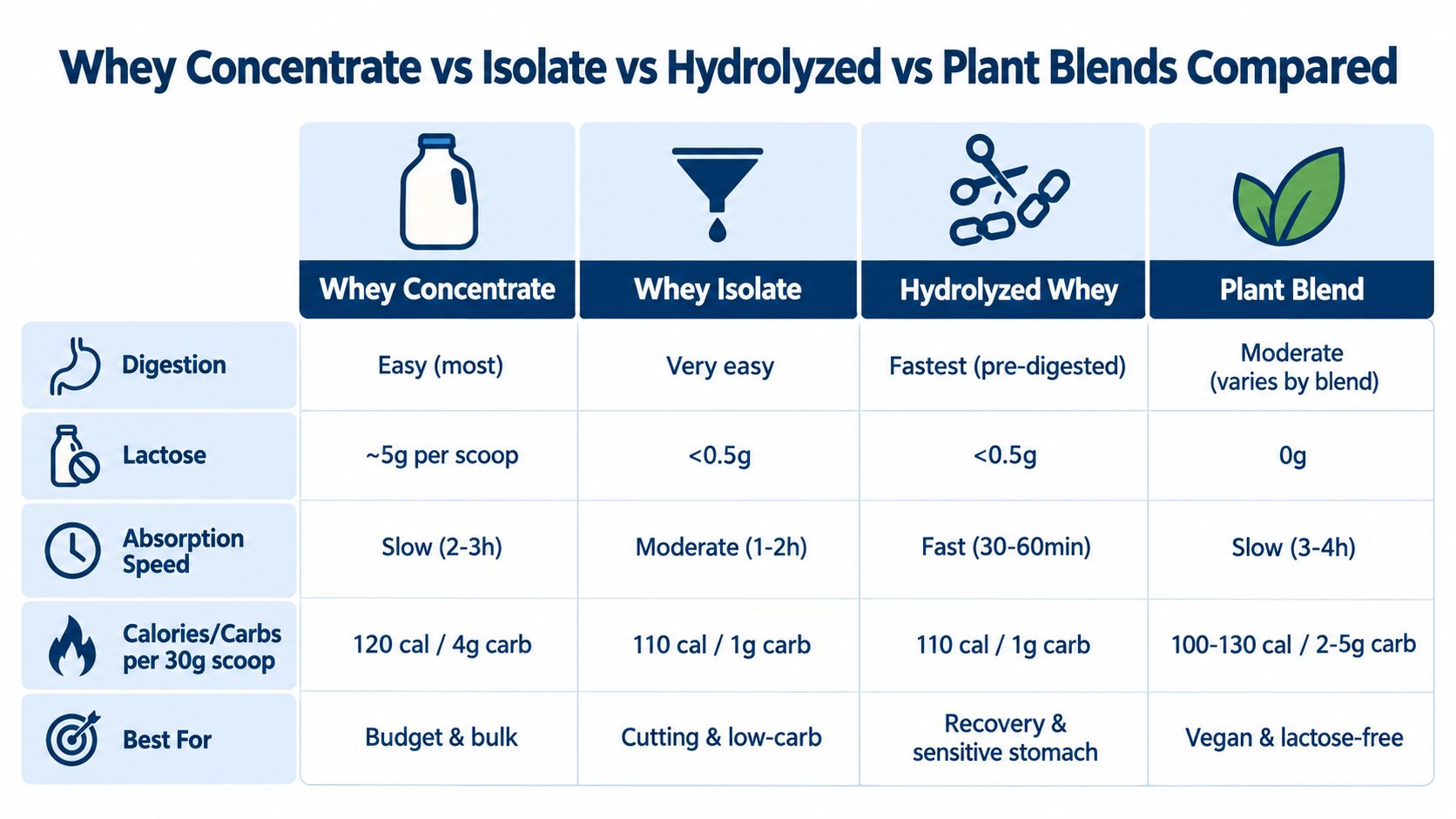
The four main formats solve different problems. Whey concentrate undergoes less filtration than isolate, so it generally retains more lactose, fat, and carbohydrate. That makes it a reasonable budget choice for men who digest dairy comfortably and don't need the leanest possible panel.
Whey isolate receives more filtration, which removes much of the lactose and non-protein material. It's the better pick for cutting, lower-carbohydrate diets, or men who tolerate isolate better than concentrate. It isn't automatically more effective for every user. The premium makes sense when the cleaner macro profile or improved tolerance changes how consistently you use it.
Hydrolyzed whey is processed into smaller protein fragments before consumption. Men who prioritize rapid digestion or struggle with heavier shakes may prefer it, although the higher price means it should earn its place through comfort or convenience rather than novelty.
Plant protein requires a different evaluation. Pea and rice blends can complement one another's amino acid profiles, and they eliminate lactose. Their texture, fiber content, sweeteners, and digestibility vary sharply, so don't assume every plant tub performs the same way.
| Format | Digestion and tolerance | Best fit | Watch for |
|---|---|---|---|
| Whey concentrate | Usually comfortable for dairy-tolerant users | Budget-conscious muscle support | Lactose, added carbs, and extra calories |
| Whey isolate | Often easier for men limiting lactose | Cutting and lean macros | Price and sweetener tolerance |
| Hydrolyzed whey | Designed for quick digestion | Recovery-focused use or sensitive stomachs | Cost and flavor |
| Plant blend | Dairy-free, with tolerance depending on ingredients | Vegan and lactose-free diets | Leucine density, texture, and blend quality |
A useful technical comparison is this whey isolate versus concentrate guide from NZ Supps. It helps clarify why filtration changes the product experience without turning isolate into a universally superior choice.
The deciding question: Does the extra processing solve a problem you actually have?
If you feel fine after concentrate and you're trying to gain size, paying extra for hydrolyzed whey may add little practical value. If concentrate leaves you uncomfortable, switching formats is more intelligent than forcing yourself to finish the tub.
Men following a vegan diet should focus on the blend rather than the word “plant.” Check whether the formula combines complementary sources and whether its leucine content is disclosed. A plant powder can work well, but a low-quality blend with a long ingredient list and vague amino acid information deserves scrutiny.
For another isolate option to compare, review the Onnit Grass-Fed Whey Isolate Protein. Compare its nutrition facts with products in the same format, then judge whether the ingredient profile fits your diet and digestion.
How to Evaluate Labels for Protein Quality and Value
A protein number alone doesn't tell you enough. Two powders can list similar protein per serving while differing in leucine density, total protein percentage, digestibility, sweeteners, and verification.
Leucine deserves special attention because it plays a direct role in initiating muscle protein synthesis. Products reaching about 2.5 grams or more of leucine per serving are considered strong options for triggering that process. The benchmark examples include Dymatize ISO100 Hydrolyzed 100% Whey Isolate at 2.7 grams of leucine per 25 grams of protein, NOW Sports Whey Isolate at 2.7 grams, and Optimum Nutrition Gold Standard at or above the same threshold, as listed in Protein Benchmark's powder comparison.
Read the panel in the right order
First, check the serving size and protein grams. Then look for an amino acid profile or a disclosed leucine value. If a manufacturer highlights total protein but gives you no useful information about amino acid density, you have less evidence for comparing it with a transparent competitor.
Next, calculate protein density by dividing protein grams by serving weight. The benchmark lists Dymatize ISO100 at 76.9% protein density, with a DIAAS of 1.15. DIAAS is a digestibility and amino acid quality measure, so this combination signals efficient essential amino acid delivery for a commercial powder.
| Metric | What good looks like | Why it matters |
|---|---|---|
| Leucine per serving | About 2.5 grams or more | Supports a stronger muscle protein synthesis signal |
| Protein density | A high share of the serving comes from protein | Helps you avoid paying for excess fillers, sugars, and fats |
| Digestibility quality | A disclosed DIAAS or comparable quality measure | Adds context beyond raw protein grams |
| Ingredient transparency | Specific sources and quantities are visible | Makes comparison and dietary screening easier |
| Calories and carbohydrates | Match your current calorie strategy | Prevents a “protein” product from undermining a cut |
A powder with a larger serving size isn't automatically better. If much of that serving consists of flavoring, gums, or carbohydrate, compare the actual protein percentage rather than the scoop weight.
Judge value per usable protein
Price per tub can mislead you. Compare the cost against the protein you'll realistically consume, then factor in tolerance. A lower-priced concentrate that causes bloating may sit unused, while a more expensive isolate can be better value if you use it consistently.
Don't chase a high DIAAS or leucine figure while ignoring taste, texture, or testing. Quality is a combination of amino acid delivery, digestibility, transparent formulation, and reliable manufacturing.
Choosing the Best Protein Powder for Men by Goal and Diet
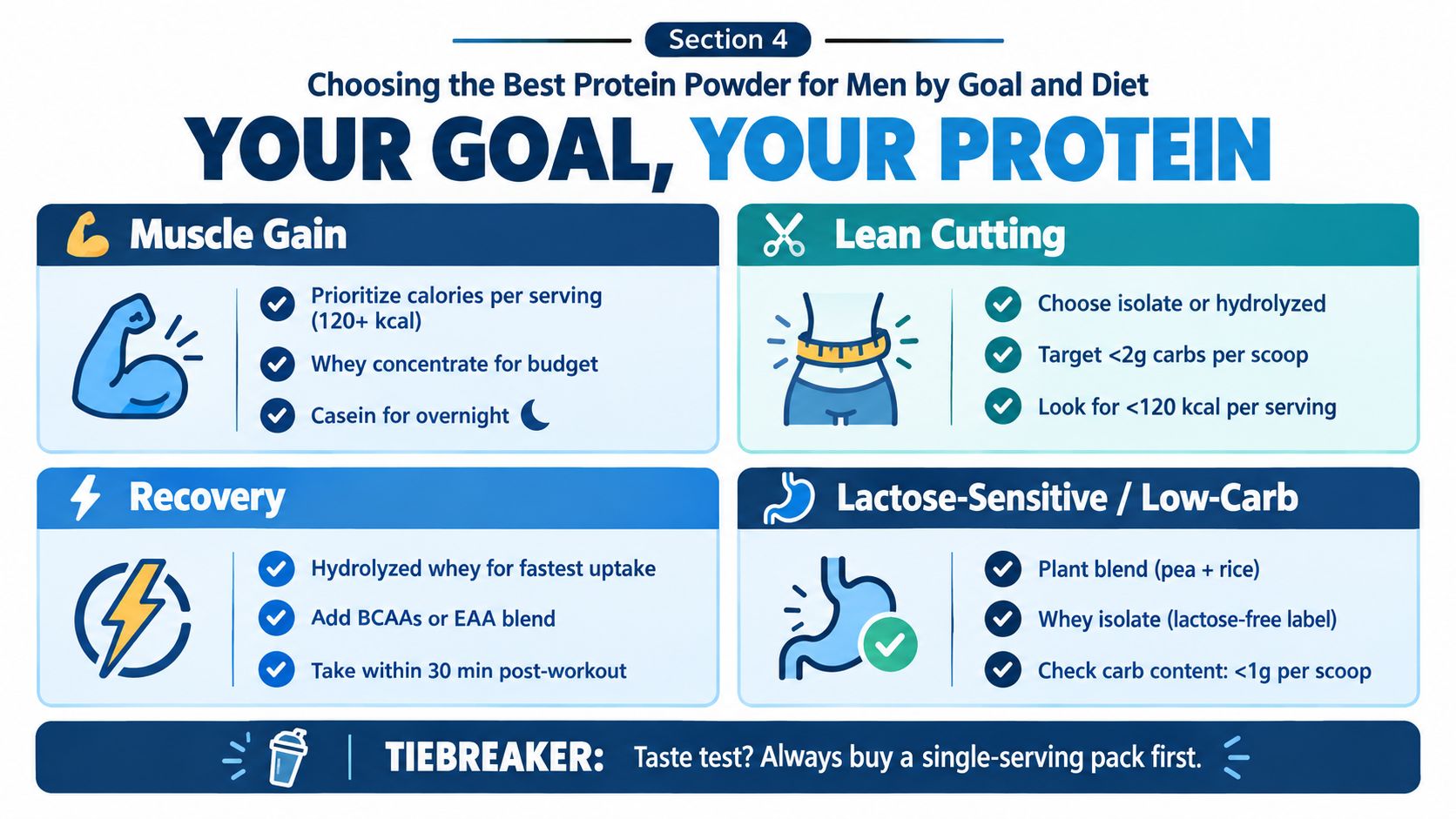
Your goal should determine the format, not the other way around. Start with what you're trying to make easier in your routine.
For muscle gain
Choose whey concentrate if you digest dairy well and need an economical way to add protein and calories. It suits men who struggle to eat enough and don't mind a less stripped-down formula. A shake can accompany a meal or fill a gap after training, but it won't replace progressive resistance training and adequate food.
If you're gaining size but dairy causes problems, move to isolate, hydrolyzed whey, or a verified dairy-free alternative. Don't interpret digestive distress as a sign that the product is “working.” It's a reason to change the product.
For lean cutting
Whey isolate is my default recommendation for men who want a high-protein shake without unnecessary carbohydrate or fat. Hydrolyzed whey also fits, particularly when quick digestion matters or ordinary formulas feel heavy.
Read the full panel rather than trusting “lean” on the front. Check protein density, sweeteners, serving size, and total calories. The best cutting powder disappears into your calorie plan instead of forcing you to compensate elsewhere.
For recovery
A hydrolyzed formula can be practical after demanding training when you want a fast, light shake. The important quality filter remains leucine density and complete protein, not a dramatic post-workout slogan.
Recovery also includes sleep, food, hydration, and managing training load. A powder can make protein easier, but it can't correct an inadequate recovery routine.
For lactose sensitivity or dairy avoidance
Try whey isolate if you can tolerate dairy proteins but react to the lactose found in less-filtered products. If dairy itself causes symptoms, choose a plant blend and inspect the ingredients carefully.
Pea and rice blends are a sensible starting point for vegan men because the combination can provide a broader amino acid profile than relying on one source. Still, compare disclosed leucine values where available, and begin with a modest serving if your gut reacts to added fibers or sugar alcohols.
For men comparing protein with broader fitness supplements, the ArtNaturals wellness gummy guide offers useful context on reading supplement formats and ingredient claims. It shouldn't replace a protein label comparison, but it's a reminder to assess the entire formula rather than the headline ingredient.
For a product designed around a specific dietary angle, compare the Bulletproof Keto Friendly Collagen Protein Powder with a complete muscle-focused protein. Collagen and whey or plant protein don't serve identical nutritional roles, so choose based on the job you need the powder to perform.
Safety Quality and Third Party Testing What to Verify Before You Buy
A good flavor and smooth texture don't prove that a powder is clean. Contaminants, inaccurate labels, and undeclared substances matter more than whether the shake mixes in a few seconds.
Consumer Reports testing found that 47% of tested protein powders exceeded California Proposition 65 safety thresholds for toxic metals, and the report found higher contamination levels among organic products. The same reporting discussed FDA interim reference levels used to assess concern, including 8.8 micrograms of lead per day for women of childbearing age and 2.2 micrograms per day for children. Read the NutraIngredients coverage of the protein powder contamination report for the cited testing context.
Those reference levels aren't a male-specific dosing recommendation. They do show why “natural,” “organic,” or “clean” language shouldn't substitute for actual verification.
Look for external checks
Prioritize products that identify credible independent verification, such as NSF International, Informed Sport, or Labdoor. Certification and testing programs differ, so look for a clear explanation of what the product was tested for and whether the evidence applies to the specific product or batch.
A manufacturer that publishes batch testing or a certificate of analysis gives you more useful information than one that prints “premium quality” on the tub.
Use this purchase filter:
- Check the testing status: Look for a named independent organization or accessible batch documentation.
- Review the ingredient list: Avoid proprietary blends that hide amounts you need to compare.
- Scan for banned substances: Competitive athletes should use products with sport-specific testing where relevant.
- Compare the protein source: Confirm that the stated whey, plant, or other protein matches your dietary needs.
- Match the formula to your body: Remove lactose, sweeteners, gums, or other ingredients that repeatedly cause symptoms.
Verification beats popularity. A famous product with no clear testing evidence isn't automatically a better purchase than a less familiar product with transparent documentation.
Paying more can make sense when the premium buys a cleaner macro profile, better tolerance, stronger amino acid disclosure, or meaningful independent testing. It doesn't make sense when you're paying only for packaging and a louder claim.
Smart Buying Recommendations and Next Steps for Men
Make the decision in this order. If you tolerate dairy and want an affordable daily shake, start with whey concentrate. If you're cutting calories or need lower lactose, choose whey isolate. If digestion and rapid uptake are your priorities, test hydrolyzed whey. If you avoid dairy or animal products, choose a transparent plant blend and compare its amino acid information.
Then inspect the label. Confirm the serving size, protein grams, leucine disclosure, protein density, ingredients, calories, and carbohydrates. Finally, verify the product through a credible third-party program or accessible batch documentation before buying a large container.
Taste still matters, but it should be your final filter, not your first. Buy the smallest practical size or a single-serving option when possible. A powder that tastes excellent but disrupts your digestion won't support a consistent routine.
Don't forget the rest of recovery. Training stress, sleep, meals, and soreness management all influence whether you can keep showing up. If post-workout soreness interferes with your routine, this guide to warming pads for post-workout soreness offers another practical recovery consideration.
Use this short checklist before checkout:
- Name the job: Muscle gain, cutting, recovery, or dietary restriction.
- Choose the format: Concentrate, isolate, hydrolyzed whey, or plant blend.
- Check the amino acids: Look for strong leucine density and transparent protein information.
- Confirm tolerance: Avoid ingredients that repeatedly trigger GI symptoms.
- Verify the product: Prefer independent testing over popularity or front-label hype.
The best protein powder for men is the product that survives that checklist and earns a place in your daily routine.
Supplemynts Inc offers proteins and other dietary supplements organized by ingredient and health purpose, making it easier to compare options for men, vegan diets, digestive needs, and general wellness. Visit Supplemynts Inc to use its category navigation and advanced search, then shop with free continental US shipping and a 60-day return policy.






Please complete your information below to login.
Sign In
Create New Account