



The most popular advice about a B complex with methylcobalamin is also the least reliable: that the “methylated” form of vitamin B12 is automatically better for everyone. Methylcobalamin has legitimate biological relevance, but the form printed on the label is only one part of the decision. Absorption capacity, dietary pattern, treatment goal, dose, and delivery route can matter just as much, or more.
That distinction matters because a supplement can display a very large B12 number without delivering a proportionally large amount into the bloodstream. It also matters because evidence comparing methylcobalamin with cyanocobalamin doesn't support a universal winner. A thoughtful choice starts with understanding what the formula contains and what your body needs, rather than treating “active” or “methylated” as a guarantee.
Table of Contents
- Why Methylated B12 Is Not Always the Automatic Winner
- What a B Complex With Methylcobalamin Contains
- Comparing Methylcobalamin to Other B12 Forms
- Key Benefits and Who Should Consider Methylcobalamin
- Understanding Dosing and the Absorption Ceiling
- How to Read a B-Complex Label and Choose a Quality Formula
- Putting It All Together for Your Supplement Routine
Why Methylated B12 Is Not Always the Automatic Winner
Methylcobalamin is a natural form of vitamin B12 commonly used in supplements. Its label has also fueled a convenient marketing assumption: natural means superior. The evidence does not support that rule. A review of the research describes possible advantages for impaired absorption or methylation, while an earlier controlled-trial review found limited clinical evidence that methylcobalamin consistently outperforms other cobalamin forms.
The comparison can even favor cyanocobalamin in a specific setting. In healthy vegans, the review literature summarized by the National Center for Biotechnology Information reported better maintenance of holotranscobalamin with cyanocobalamin than with methylcobalamin. That result does not make methylcobalamin ineffective. It shows that the appropriate form depends on the person, the goal, and how the supplement is absorbed.
A healthy vegan maintaining B12 status has a different situation from someone with confirmed deficiency, a gastrointestinal condition, or symptoms requiring medical evaluation. A product that fits one person may be poorly matched to another.
The practical rule: “Methylated” identifies a chemical form. It does not, by itself, establish better absorption, stronger clinical effects, or suitability for your goal.
A B complex may also contain methylfolate, which can appeal to people focused on methylation-related genetic results. A genetic finding alone should not determine a high-dose supplement plan. If you are comparing folate forms, Life Extension Optimized Folate with L-methylfolate illustrates how a label can highlight one folate form. Discuss your individual needs with a qualified clinician.
The useful question is not whether methylcobalamin sounds more advanced. Ask: Which form and dose fit my absorption, diet, and intended outcome? Absorption mechanics may matter more than the form named on the front label, and cyanocobalamin may be the better match in some cases.
What a B Complex With Methylcobalamin Contains
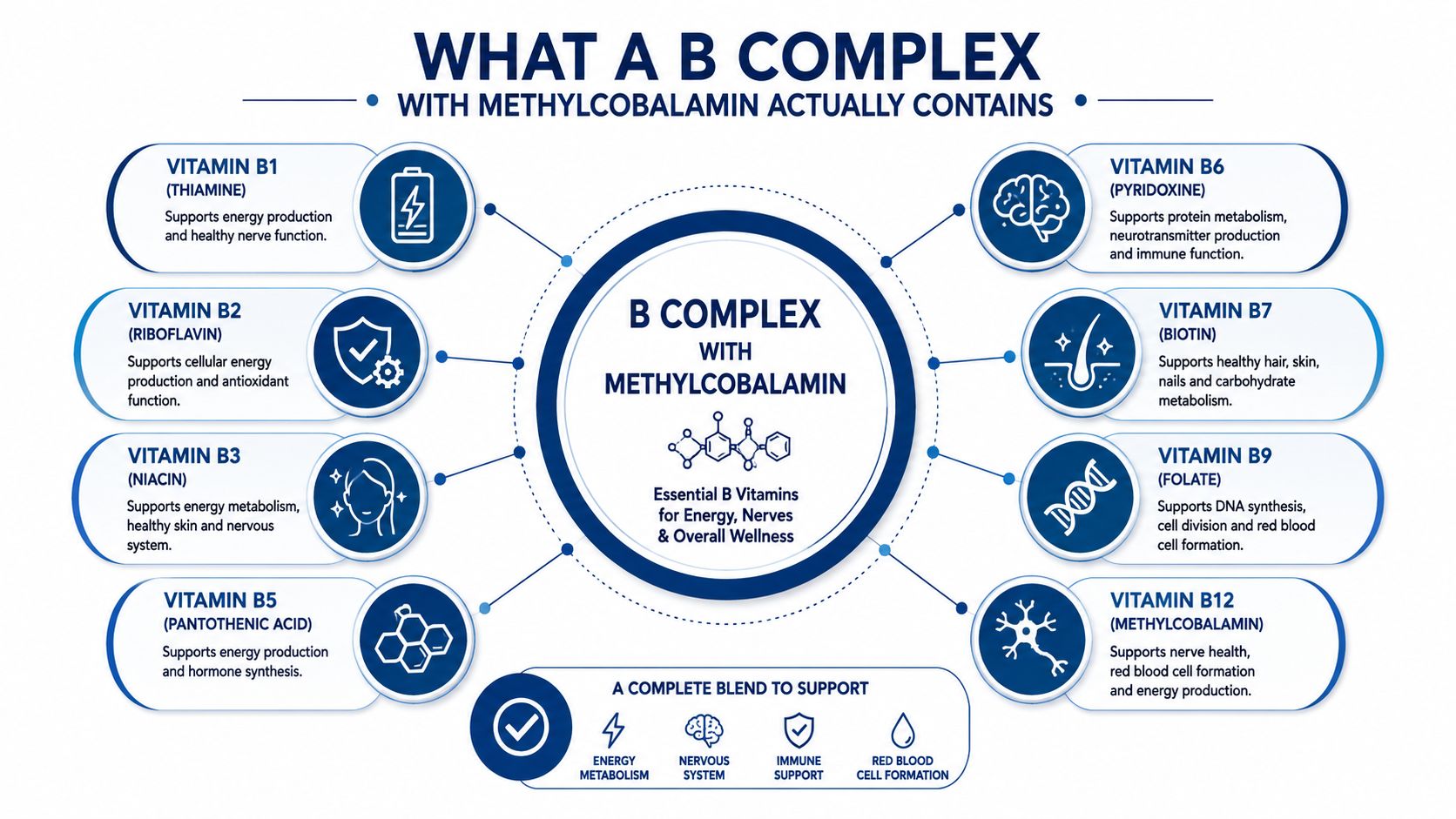
A B-complex supplement brings the eight B vitamins into one formula:
- B1, thiamin
- B2, riboflavin
- B3, niacin
- B5, pantothenic acid
- B6
- B7, biotin
- B9, folate or folic acid
- B12, cobalamin
“with methylcobalamin” identifies the form of B12. It does not describe a ninth B vitamin or mean that every vitamin in the product is methylated. A formula may contain the full B-vitamin group while using methylcobalamin only for B12. Since the other nutrients can appear in different chemical forms, the complete Supplement Facts panel deserves a close look.
Where methylcobalamin fits
Vitamin B12 acts as a coenzyme in two important reactions. One supports methyl transfer, including the conversion of homocysteine to methionine. The other supports conversion of L-methylmalonyl-CoA to succinyl-CoA. A coenzyme works like a helper tool in a metabolic process. It is not the whole system, yet the process may not run normally without it. The review in Nutrition Reviews explains these functions and places B12 within the broader B-complex network.
The adult recommended dietary allowance for vitamin B12 is 2.4 micrograms per day, as noted in the same review. This figure describes daily nutritional intake, not necessarily the amount printed on a supplement label. Products may list a much larger dose because oral absorption captures only part of what is swallowed, especially when receptor-mediated transport reaches its limit.
B vitamins participate in connected metabolic pathways, so combining them can provide several nutrients in one serving. The combination does not automatically treat fatigue, nerve pain, or a methylation-related genetic variant. Its practical value depends on nutritional status, the amounts supplied, and the reason for using it.
A label-reading example
“Vitamin B12, as methylcobalamin” tells you the B12 form only. It does not reveal whether the folate is folic acid or methylfolate, which B6 form is present, or whether the formula supplies balanced amounts. Those answers require reviewing each ingredient and dose separately.
Comparing Methylcobalamin to Other B12 Forms
Four B12 forms commonly appear on supplement labels: methylcobalamin, cyanocobalamin, hydroxycobalamin, and adenosylcobalamin. Methylcobalamin and adenosylcobalamin are coenzyme forms. Cyanocobalamin is a synthetic form that the body converts, while hydroxycobalamin is an established cobalamin form used in clinical care.
Calling one form “active” and another “inactive” makes the comparison sound simpler than it is. Oral results depend heavily on dose, intrinsic-factor transport, and passive absorption. The delivery route matters too. Evidence summarized in this review of B12 forms and delivery routes shows that performance varies by route, population, and clinical context.
| B12 Form | Type | Absorption Notes | Best Suited For |
|---|---|---|---|
| Methylcobalamin | Natural coenzyme form | Oral performance still depends on dose, intrinsic factor, and passive absorption | People who prefer a coenzyme form, or whose clinician has identified a relevant reason to use it |
| Cyanocobalamin | Synthetic form converted by the body | Can perform well in oral supplementation; the form alone does not determine delivery | General maintenance and situations with established oral evidence |
| Hydroxycobalamin | Natural cobalamin form used clinically | Delivery route and absorption status remain central considerations | Clinical treatment plans, including cases where injections are selected |
| Adenosylcobalamin | Natural coenzyme form | Must still pass through the chosen absorption pathway | Formulas that provide another coenzyme form alongside or instead of methylcobalamin |
This table compares options rather than ranking them. Methylcobalamin may suit someone seeking a coenzyme form, but cyanocobalamin can be a practical oral choice because the body converts it and oral performance is not determined by the label form alone.
In people who have had Roux-en-Y gastric bypass, oral methylcobalamin at 1,000 micrograms per day was reported as effective as hydroxycobalamin injections at normalizing vitamin B12 values, according to the National Institutes of Health Office of Dietary Supplements fact sheet. That finding applies to a specific population and should not be extended to every person with impaired absorption or deficiency.
An injection is a medical delivery choice, not automatically a stronger supplement. A clinician-directed service such as Aspire for Wellness Together B12 injections can explain that route, while diagnosis, laboratory findings, and clinical judgment determine whether it fits.
Key Benefits and Who Should Consider Methylcobalamin
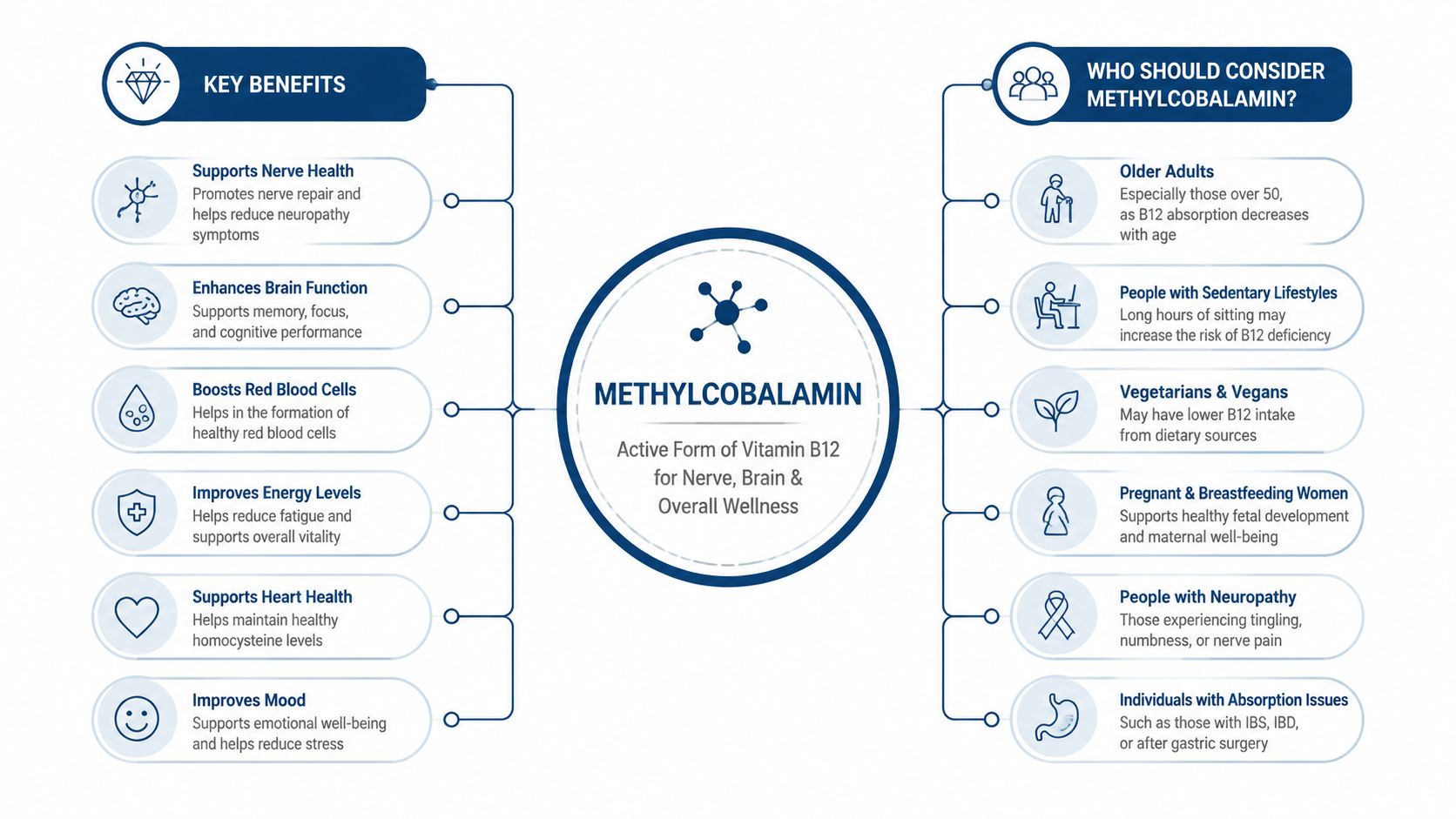
Methylcobalamin's clearest biological role is as a coenzyme in the methyl-transfer reaction that converts homocysteine to methionine. That connects B12 with a pathway involved in cellular chemistry, but it doesn't mean a methylcobalamin supplement automatically improves every process associated with the word “methylation.” A balanced intake of related nutrients and a person's underlying health status remain important.
The strongest reason to consider any B12 supplement is a meaningful risk of inadequate status or a confirmed deficiency. People following vegan diets deserve particular attention because ordinary unfortified plant foods don't provide a dependable source of B12. Vegetarians may also need to review their intake, depending on how much dairy, eggs, or fortified food they consume.
Situations that deserve individualized advice
- Restricted dietary intake: Vegans and some vegetarians may need a reliable B12 source rather than relying on symptoms to identify a problem.
- Reduced absorption: Gastrointestinal disorders, previous gastrointestinal surgery, or reduced intrinsic-factor activity can make ordinary low-dose products less practical.
- Older age: Changes affecting digestion and absorption can alter how effectively someone obtains B12 from food.
- Methylation concerns: A genetic result involving folate or B12 metabolism doesn't automatically prove that methylcobalamin is required. Laboratory results and symptoms should guide the decision.
- Neurological symptoms: Numbness, tingling, balance changes, or weakness need medical assessment. A supplement shouldn't delay evaluation of a potentially significant deficiency or another neurological condition.
Nerve support needs careful wording
Mecobalamin, another name used for methylcobalamin, has been studied in nerve-related conditions. A 2025 meta-analysis reported improved overall clinical therapeutic efficacy and nerve-conduction outcomes when mecobalamin was used in combinations, but it did not show improvement in pain scores or neuropathic symptom outcomes. The authors also reported that most included studies had a high risk of bias. Read the PubMed record for the meta-analysis.
That distinction is essential. Nerve-conduction findings are objective measures, while pain and tingling describe a person's lived experience. A product may be studied as part of a combination containing B1, B6, folate, or alpha-lipoic acid, yet its packaging may present the result as if methylcobalamin alone caused the benefit.
People researching clinical options can review an explanation of uses for B12 injections while remembering that injection decisions belong with a healthcare professional. If your goal is nerve pain relief, ask what diagnosis is being treated, which ingredients were studied, and how improvement will be assessed.
Understanding Dosing and the Absorption Ceiling
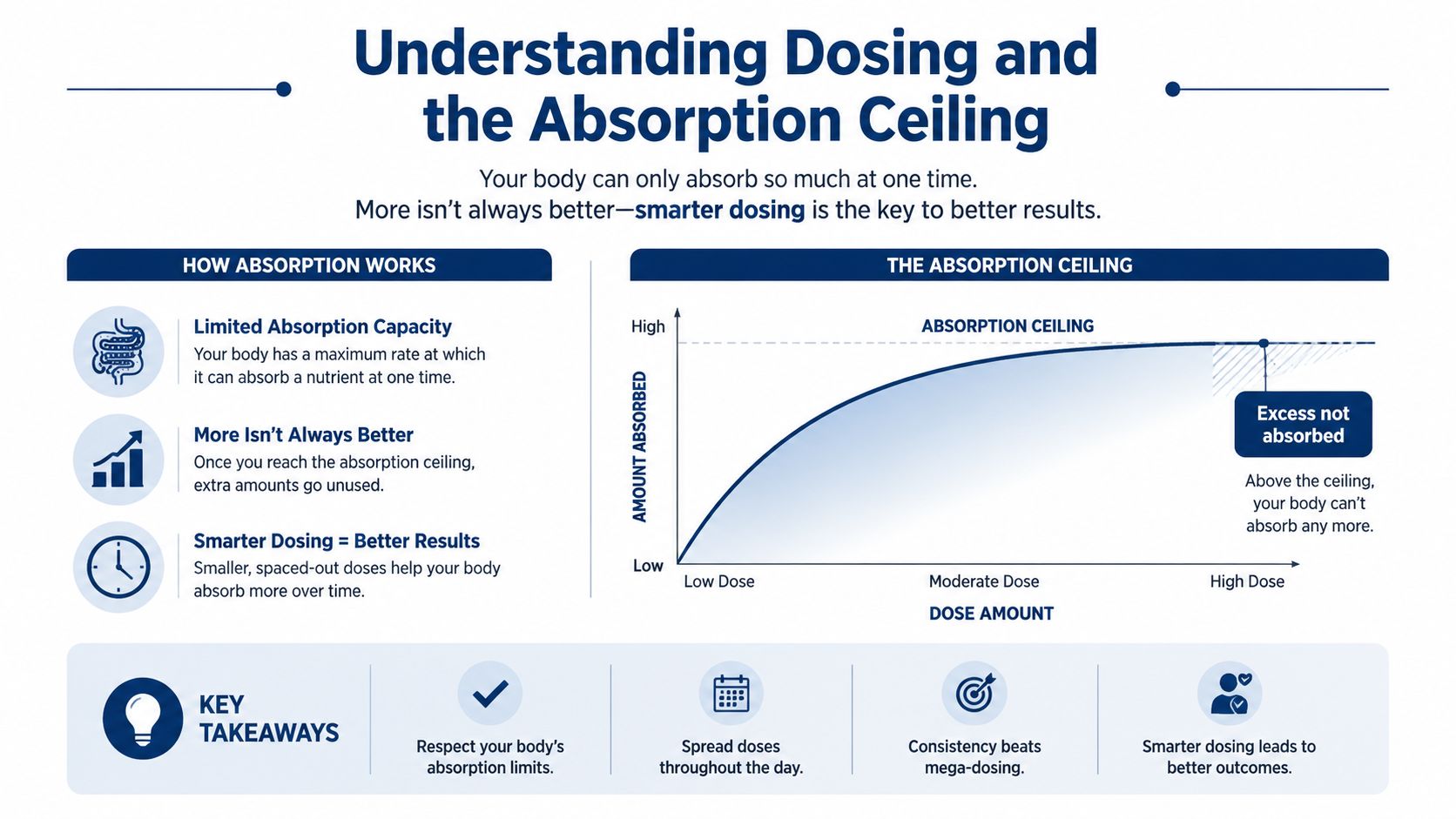
A large B12 number on a label does not mean the body absorbs a large amount. Vitamin B12 uses intrinsic-factor transport, and that pathway becomes less efficient as the oral dose rises. After receptor-mediated uptake reaches its limit, passive absorption through the gut and mucous membranes contributes only about 1% to 2% of an oral dose, according to this review of B12 absorption.
The dose-response pattern explains why a supplement label can list far more B12 than the adult recommended dietary allowance. Historical absorption data report that about 50% of a 1 microgram oral dose, 20% of a 5 microgram dose, and about 5% of a 25 microgram dose may be absorbed. A 1,000 microgram oral dose may provide roughly 10 to 12 micrograms absorbed, showing why high-potency products can help when absorption is limited.
What that means for choosing a dose
Many methylcobalamin formulas use 500 to 1,000 micrograms because the larger label dose can compensate for limited uptake. The body does not absorb the entire amount. One review describes roughly 1% to 1.2% absorption at approximately 500 micrograms, so comparing products by label size alone can mislead.
Absorption capacity also differs between people. Someone with normal absorption may need a different approach from someone with gastrointestinal disease, prior surgery, or a deficiency that requires prompt correction. Oral treatment may suit some situations, while a clinician may select a non-oral route when intrinsic-factor transport is unreliable. For general context on symptom timelines after injections, read how long until B12 works. Individual response still depends on the underlying problem.
For a standalone oral example, KAL B12 Methylcobalamin 1,000 micrograms ActivMelt shows how a product can pair a high label amount with a convenient format. That detail does not establish that it suits every person. If deficiency or impaired absorption is a concern, use laboratory testing and professional guidance.
How to Read a B-Complex Label and Choose a Quality Formula
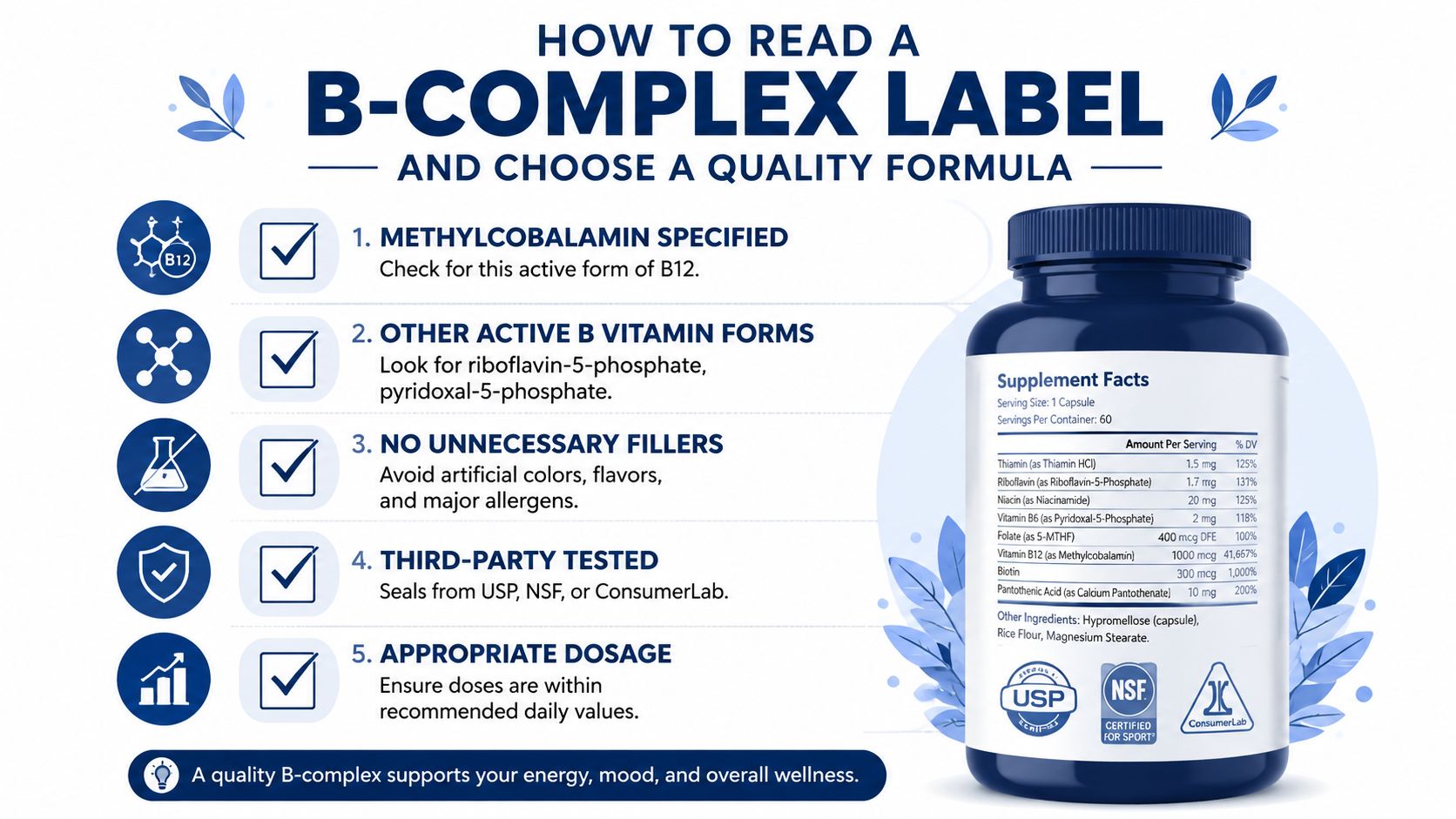
The B12 form deserves attention, but it shouldn't dominate the label review. Start by checking whether the formula identifies each B vitamin separately and lists its amount. A proprietary blend that combines ingredients without individual quantities makes it difficult to judge what you're taking.
Five label checks
- Confirm the B12 form: Look for methylcobalamin, cyanocobalamin, hydroxycobalamin, or adenosylcobalamin. Don't assume the most prominently advertised form is the most suitable.
- Inspect the other B vitamins: A formula may use different forms of folate, riboflavin, or B6. The complete panel gives more information than the front label.
- Review the doses: A higher amount isn't automatically a better amount. Pay particular attention to the overall B6 and niacin content, especially if you plan to take other supplements.
- Look for transparent manufacturing information: Third-party testing and recognized manufacturing standards can provide useful quality signals, although a seal doesn't prove clinical superiority.
- Match the formula to the goal: A general maintenance product, a vegan B12 plan, and a deficiency-treatment plan shouldn't be evaluated by the same criteria.
Combination claims need a closer look
Nerve studies often evaluate combinations rather than isolated methylcobalamin. If a product also contains B1, B6, folate, or alpha-lipoic acid, separate the evidence for the combination from the evidence for B12 itself. That protects you from attributing every possible effect to one highlighted ingredient.
The same principle applies to energy claims. B12 supports normal metabolism, but a high dose isn't a guaranteed energy enhancer for someone who isn't deficient. If you're comparing a broad formula with a product such as NOW Sustained Release B-100, read the entire panel and consider overlap with other multivitamins.
For a visual explanation of label details, review the following video:
Putting It All Together for Your Supplement Routine
Consider two shoppers. One follows a vegan diet, has no known absorption disorder, and wants dependable B12 maintenance. Another has a diagnosed deficiency and a history of gastrointestinal surgery. Both may see the same methylcobalamin formula online, but their decisions shouldn't be identical. The first person may compare oral forms and label transparency, while the second needs a clinician-led plan that addresses absorption and follow-up testing.
Your goal should determine the starting point:
- For maintenance: Compare the B12 form, dose, diet, and total intake from other supplements.
- For suspected deficiency: Arrange appropriate testing and professional advice rather than relying on a symptom-based guess.
- For nerve symptoms: Seek evaluation, especially for persistent numbness, weakness, balance changes, or pain.
- For methylation concerns: Treat genetic information as context, not as a prescription.
- For impaired absorption: Ask whether a higher-dose oral or non-oral strategy makes more sense for your situation.
A B complex with methylcobalamin can be a sensible choice, but it isn't automatically superior to cyanocobalamin. The most defensible decision weighs form, route, dose, absorption, and evidence for the actual health goal. Choose a transparent formula, avoid stacking overlapping products casually, and involve a healthcare professional when deficiency or neurological symptoms are possible.
Supplemynts Inc offers vitamins and wellness products organized by ingredient and health purpose, including B12 and broader supplement categories, with product information, direct support, continental US shipping, and a 60-day return policy. Visit Supplemynts Inc to compare available formulas and make your next supplement purchase with a clearer understanding of the label.







Please complete your information below to login.
Sign In
Create New Account