


You're standing in front of a vitamin shelf, or scrolling through a supplement page, holding a bottle labeled B Complex with C. The label promises energy, stress support, or immune support, but one question comes first: do these nutrients belong together?
They can, but the right choice depends on more than whether the vitamins are compatible. You're really making three decisions: whether to buy one combined product or separate bottles, how to time the doses, and whether the vitamin C amount is high enough to deserve special attention around vitamin B12. This guide breaks down the biology and the label-reading details without treating every shopper as though they needs the same formula.
Table of Contents
- What B Complex with C Actually Is
- How the B Vitamins and Vitamin C Came Together in One Pill
- What Each Vitamin Does in Your Body
- Combined Pill vs Separate Bottles
- How Much to Take and When
- Who Really Needs One and Who Should Hold Off
- Shopping Tips for Supplemynts Inc Shoppers
- Frequently Asked Questions
What B Complex with C Actually Is
B complex with C usually means one capsule, tablet, or powder that combines the eight recognized B vitamins with vitamin C. The B group includes thiamine, riboflavin, niacin, pantothenic acid, vitamin B6, folate, vitamin B12, and biotin. Vitamin C is usually listed as ascorbic acid, although some products use a buffered form.
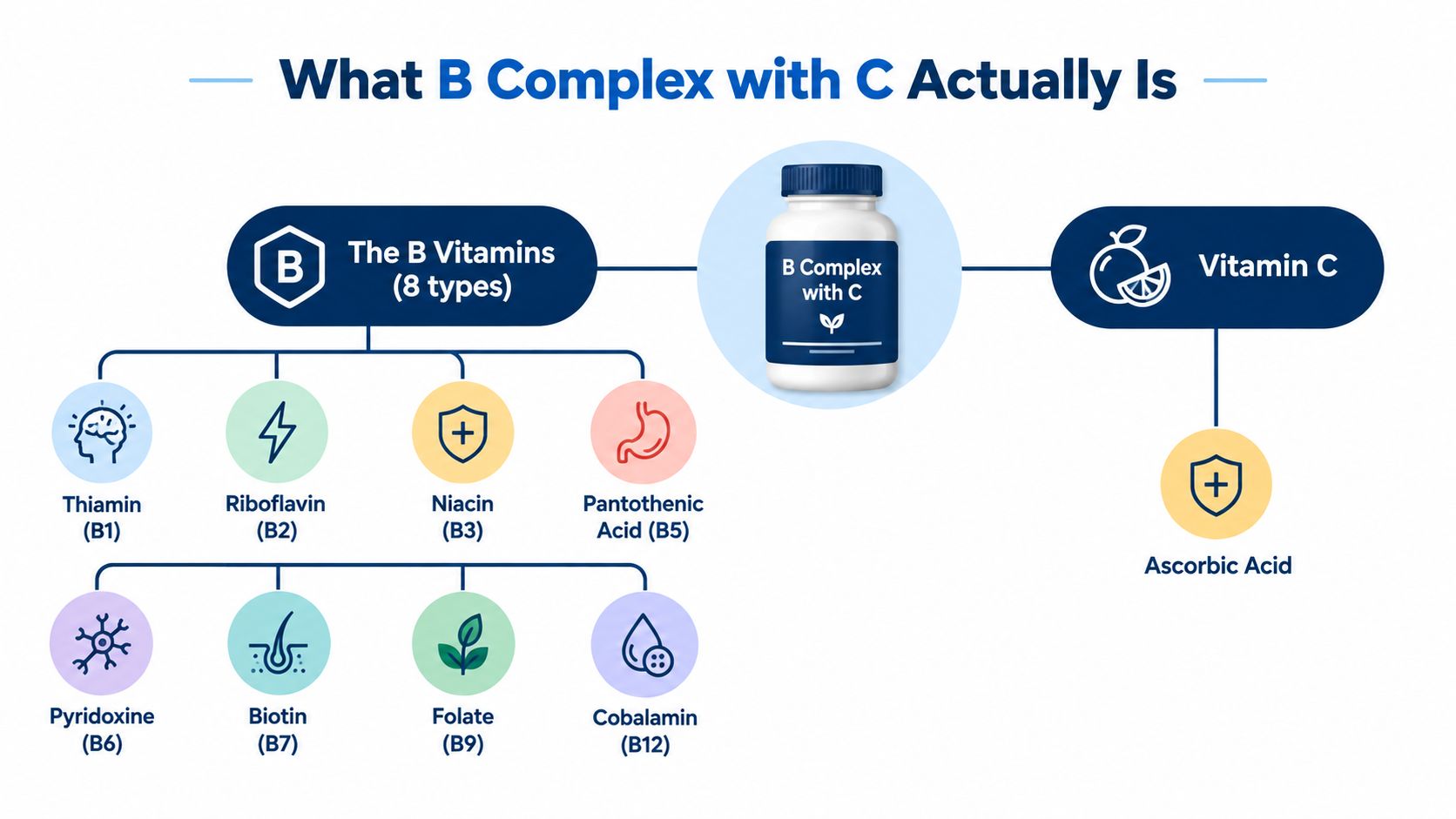
That definition helps you avoid a common shopping mistake. A B-complex-with-C product isn't automatically a multivitamin, because it may contain few or none of the fat-soluble vitamins, minerals, or other nutrients found in a broader multivitamin. It also isn't a prenatal formula, and it isn't the same thing as a high-dose standalone vitamin C tablet with a little B12 added.
Why manufacturers bundle them
The formula makes practical sense because both groups are water-soluble vitamins. B vitamins act mainly as coenzymes, helping enzymes carry out reactions involved in energy metabolism, cell production, and nervous-system function. Vitamin C has different jobs, including collagen formation, antioxidant defense, and support for iron absorption.
A single bottle also reduces the number of daily decisions. Instead of remembering a B-complex in one cabinet and vitamin C in another, you take one product. That convenience can be useful, but it can also hide an important limitation: a fixed blend doesn't let you adjust one nutrient without changing the others.
Label-reading rule: Identify every vitamin and its amount before judging the product. “B complex” describes a group, not a standardized dose.
Look for the Supplement Facts panel rather than relying on front-label language such as “energy” or “immune.” Check whether all eight B vitamins appear, whether folate is listed as folic acid or another form, whether B12 is present, and how much vitamin C you're getting per serving. The serving size matters too. Two capsules may deliver the listed amount, even when the bottle looks like a once-daily product.
How the B Vitamins and Vitamin C Came Together in One Pill
A shopper comparing two bottles may assume “B complex” names one nutrient. It does not. Early research grouped several water-soluble compounds under vitamin B, then scientists separated them by chemical structure, function, and deficiency pattern. The American Chemical Society's account of the vitamin B complex traces how that broader label became a family of distinct vitamins.
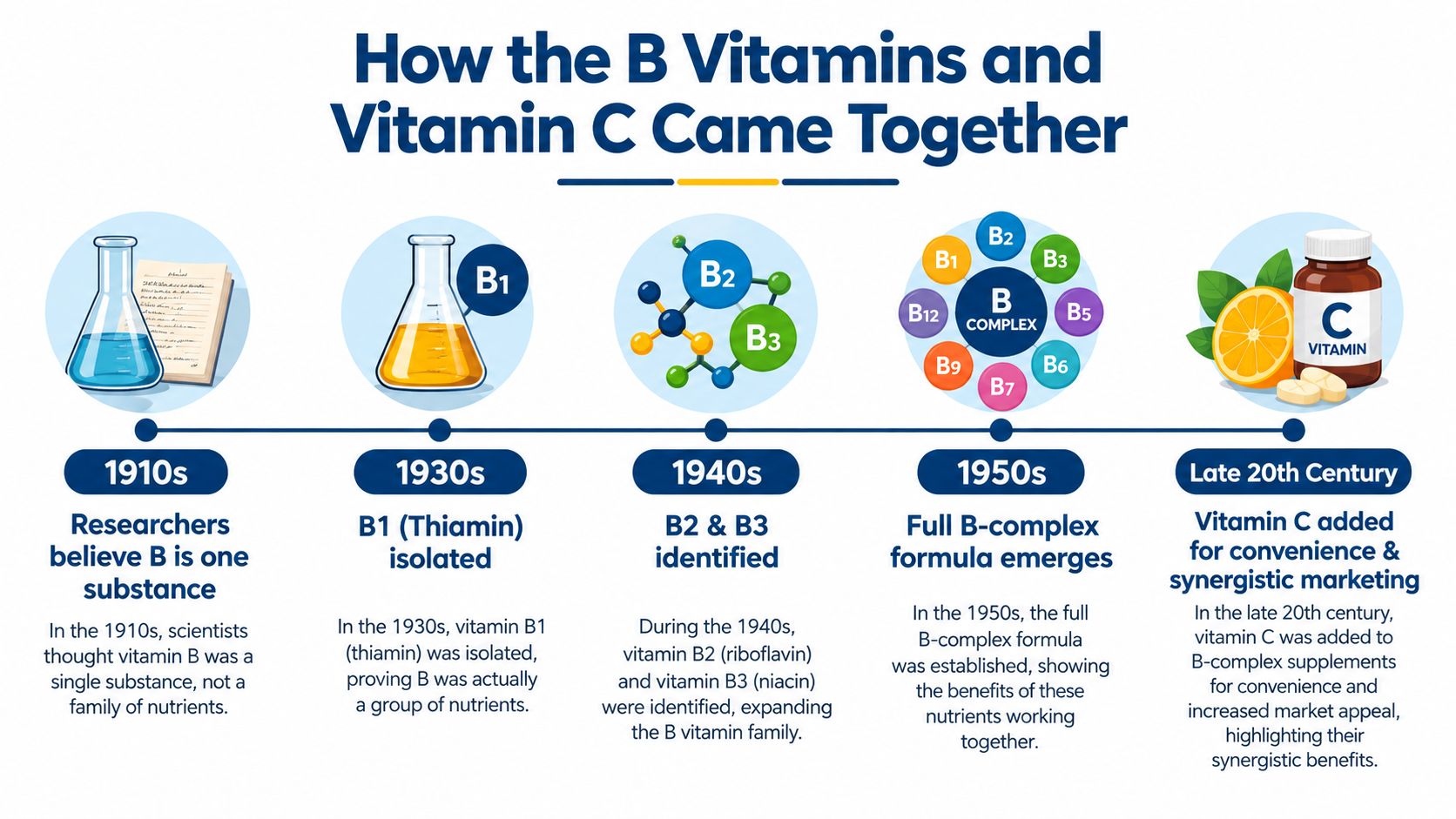
During the 1930s and 1940s, Merck scientists reported major milestones, including industrial synthesis of vitamins B1, B2, and B5, followed by work involving B6 and the isolation of B12. The category changed from one vague deficiency factor into a defined group of nutrients with different chemical structures and physiological tasks.
Vitamin C followed a separate path. Scurvy had been recognized for centuries, including among crews on long sea voyages from the sixteenth through eighteenth centuries. Its incidence fell after the potato spread through Europe in the seventeenth century. Later nutrition research clarified vitamin C's role and established intake guidance.
Why history still matters at the shelf
A modern B-complex-with-C product combines two histories, not one naturally occurring super-vitamin. It includes a selected group of individually named B vitamins and adds vitamin C in a format that is convenient to package and explain as a daily supplement.
That pairing can support three different shopping decisions. A combined pill may reduce the number of bottles and daily reminders. Separate bottles allow more control over each nutrient's dose. Timing also matters if a shopper is considering a high-dose formula, because later label questions involve how much vitamin C is present alongside B12.
The biology explains why the combination sounds sensible. B vitamins help cells use food through metabolic pathways, while vitamin C supports connective tissue, antioxidant protection, and iron absorption. Those roles complement one another, yet a shared tablet does not make every nutrient necessary for every person.
A balanced diet supplies these vitamins through different foods. A supplement becomes more relevant when intake is limited, needs are increased, or a deficiency has been identified.
CDC summaries of U.S. biomarker data estimated vitamin C deficiency at 6% overall and reported vitamin C and vitamin B12 among nutrients with intermediate deficiency prevalence in monitored populations. Broader U.S. supplement research summarized by CDC found biomarker-defined deficiency levels of 17.5% for vitamin B6 and 10.5% for vitamin C among adults not taking a multivitamin or multimineral, with lower prevalence among users, as described in the CDC vitamin and mineral status report.
What Each Vitamin Does in Your Body
Think of B vitamins as a group of assistants working around the cell's energy and construction systems. They don't supply calories themselves. Instead, they help enzymes process carbohydrate, fat, and protein, build cells, and support communication within the nervous system.
Thiamine, or B1, helps initiate carbohydrate metabolism. Riboflavin, or B2, and niacin, or B3, help move electrons through energy-producing reactions. Pantothenic acid, or B5, contributes to coenzyme A, a central helper in the processing of fats, carbohydrates, and amino acids.
The B-vitamin team
Vitamin B6 helps with amino-acid metabolism and neurotransmitter production. Folate and B12 work in cell division and DNA-related reactions, while B12 also supports normal nerve function and red blood cell formation. Biotin participates in reactions involving fats and carbohydrates.
Vitamin C plays a different role. It supports collagen formation, antioxidant defense, and iron absorption. That makes it less like another energy-production assistant and more like a maintenance and protection specialist working alongside the B-vitamin team.
| Vitamin | Primary role | Plain-language analogy | Notable pairing |
|---|---|---|---|
| B1, thiamine | Carbohydrate metabolism | Starts the fuel-processing line | Works with food-derived carbohydrates |
| B2, riboflavin | Electron-transfer reactions | Carries energy-related passengers | Works with B3 in cellular energy pathways |
| B3, niacin | Energy metabolism | Helps move chemical currency | Supports the same metabolic neighborhood as B2 |
| B5, pantothenic acid | Coenzyme A formation | Supplies a central processing tool | Helps process fats and carbohydrates |
| B6 | Amino-acid and neurotransmitter metabolism | Translates raw materials into signals | Works with protein metabolism |
| Folate, B9 | DNA and cell production | Supplies building instructions | Interacts with B12 in cell metabolism |
| B12, cobalamin | Nerve and red blood cell support | Helps maintain wiring and transport crews | Pairs functionally with folate |
| Biotin, B7 | Fat and carbohydrate metabolism | Handles specific fuel conversions | Works within broader energy pathways |
| Vitamin C | Collagen, antioxidant defense, and iron absorption | Protects structures and supports repair | Supports iron absorption and connective tissue |
For shoppers comparing formulas, the sustained-release B-100 energy-production product information can help illustrate how a B-focused label presents its nutrient panel. If you're comparing formats rather than buying a specific formula, you can also review options for liquid vitamin C supplements, especially if swallowing tablets is difficult.
The key point is that these nutrients don't create an unlimited supply of energy. They help the body carry out normal processes. Benefits are most plausible when baseline intake is inadequate or requirements are increased, not because a product contains a large number of milligrams.
Combined Pill vs Separate Bottles
A combined product is a convenience decision. Separate bottles are a control decision. Neither format automatically absorbs better when the same nutrient amount is delivered in a similar form.
A combined pill may suit someone who wants one daily habit, fewer containers, and a formula that covers both nutrient groups. It can also prevent accidental omission of one bottle. The drawback is that you can't easily change the vitamin C dose, reduce a B vitamin, or pause one component without abandoning the entire blend.
Separate bottles make sense when you have a defined reason to adjust the plan. You might need vitamin C at a different time, want a lower-dose B-complex, or already obtain enough B6 from food and another supplement. Separate products also make it easier to respond to lab results or clinician-directed treatment.
| Factor | Combined pill | Separate bottles |
|---|---|---|
| Convenience | One product and one routine | More bottles and more scheduling |
| Flexibility | Fixed ratio of B vitamins to vitamin C | Each nutrient can be adjusted independently |
| Absorption | Usually comparable for similar per-serving doses | Allows vitamin C to be divided across the day |
| Overlap control | Requires careful comparison with multivitamins | Easier to remove nutrients you already get elsewhere |
| Best fit | General routine use with modest doses | Targeted supplementation or clinician-guided plans |
| Main drawback | A high dose of one ingredient may force unwanted doses of others | More decisions and greater risk of a complicated routine |
When the combined option wins
Choose the combined pill when your priority is a low-friction routine and the label provides reasonable amounts without unnecessary mega-doses. This is especially practical when you aren't trying to treat a confirmed deficiency and don't need vitamin C for a separate protocol.
When separate bottles are smarter
Separate products offer more control if your vitamin C intake is substantially higher than your B-vitamin needs. Vitamin C absorption is saturable. Human data indicate roughly 80% to 100% absorption at single doses up to 100 to 200 mg, while fractional bioavailability falls below 50% above about 1,000 mg, according to the NIH vitamin C fact sheet for health professionals. Dividing a larger total into smaller doses can therefore make more sense than taking one large bolus.
Practical choice: Buy the combined formula for simplicity. Choose separate bottles when dose control, timing, or a documented nutrient need matters more than convenience.
How Much to Take and When
A shopper comparing two labels may see one formula near ordinary nutrition targets and another with much larger amounts. Start with the serving size and compare each nutrient with adult reference amounts. A higher number does not automatically make a product more suitable for daily use.
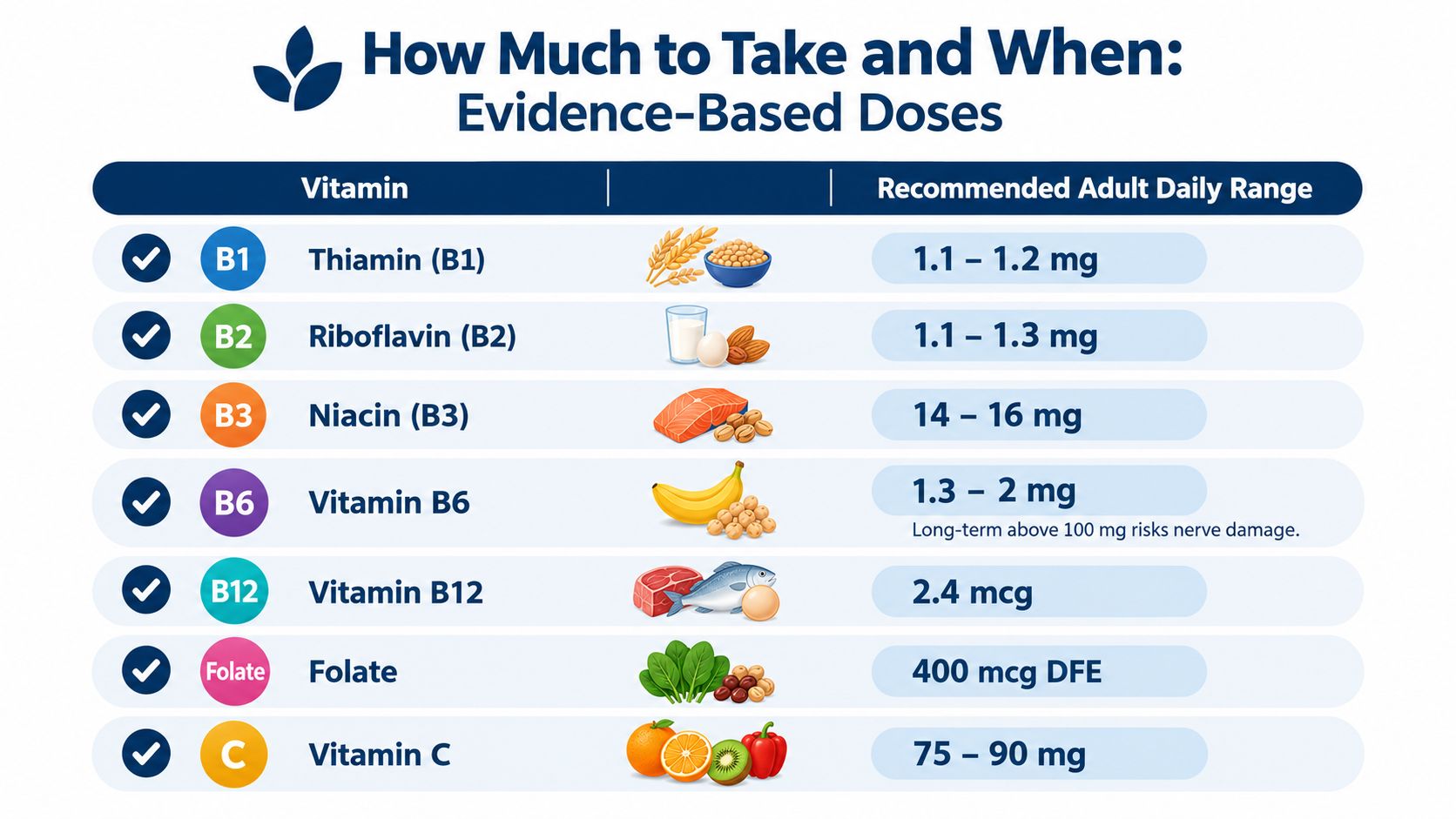
Typical adult reference amounts include:
- Thiamine, B1: 1.1 to 1.2 mg.
- Riboflavin, B2: 1.1 to 1.3 mg.
- Niacin, B3: 14 to 16 mg.
- Vitamin B6: 1.3 to 2 mg.
- Folate: 400 mcg.
- Vitamin B12: 2.4 mcg.
- Biotin: 30 mcg.
- Pantothenic acid: 5 mg.
- Vitamin C: 75 to 90 mg.
The 60 mg per day vitamin C recommendation in the 1980 RDA was intended to maintain body stores of about 1.5 g. 10 mg per day can prevent or cure scurvy. These historical figures describe nutritional adequacy, not a universal supplement prescription.
Timing that keeps the routine practical
Take a B-complex earlier in the day if it feels stimulating or affects sleep. Food is not required for absorption, but a meal may reduce stomach discomfort. Release format is a separate label decision from vitamin content. For example, a time-release B-100 complex releases its contents over time, but that feature does not change the listed vitamin amounts.
Vitamin C needs its own dose check. The tolerable upper intake level ranges from 400 to 2,000 mg per day depending on age. Excess intake commonly causes diarrhea, nausea, or abdominal cramps. A single large dose is not proportionally more efficient, so dividing it may feel gentler.
High-dose vitamin C and a B12-heavy formula also create a timing question. High-dose vitamin C may reduce B12 absorption, although standard combined products are generally considered safe. Separating them by two hours is a practical precaution when feasible, particularly for someone who depends on B12 supplementation or uses a high-potency vitamin C product.
Who Really Needs One and Who Should Hold Off
A B-complex-with-C supplement is most useful when it addresses a plausible nutritional gap. It isn't a diagnostic test for tiredness, and fatigue can result from sleep problems, anemia, thyroid disease, medication effects, mood disorders, infection, or many other causes.
People who may need individualized guidance include:
- Adults over 50: B12 absorption can become less efficient with age.
- People with restricted diets: Vegan or low-dairy eating patterns can make B12 or riboflavin intake harder to maintain.
- Pregnant or breastfeeding people: Nutrient needs change, and a prenatal formula may be more appropriate than a general B+C blend.
- People with heavy alcohol use, prolonged illness, or recovery after surgery: Intake, absorption, or requirements may be affected.
- People taking long-term metformin or proton-pump inhibitors: These medicines can be associated with lower B12 status.
A well-fed adult who already takes a complete multivitamin and has normal relevant bloodwork may gain little from adding another broad formula. The extra nutrients may be excreted, while the bigger risk is overlooking the actual cause of a symptom.
Situations that call for caution
Speak with a clinician before using high-dose vitamin C if you have a history of kidney stones, hemochromatosis, or another condition affected by iron handling. Vitamin C can increase iron absorption, and high intake can raise concerns for people prone to certain stone-related problems. Anyone receiving cancer treatment should get explicit medical guidance before adding antioxidant supplements.
Medication review matters too. If you use warfarin or other prescription medicines, don't assume a water-soluble label means there are no interaction concerns. Bring the exact Supplement Facts panel to a pharmacist or clinician.
Fatigue alone doesn't justify a high-dose B complex. If low energy persists, ask about appropriate laboratory evaluation before spending money on a product. For readers considering injectable B12 instead, a clinician-reviewed guide on B12 shot side effects can provide useful background, but it doesn't replace personalized medical advice.
Shopping Tips for Supplemynts Inc Shoppers
A good shopping process starts with the back label, not the promise on the front. Use the same checklist whether you're comparing a combined B+C product, a B-only formula, or a standalone vitamin C tablet.
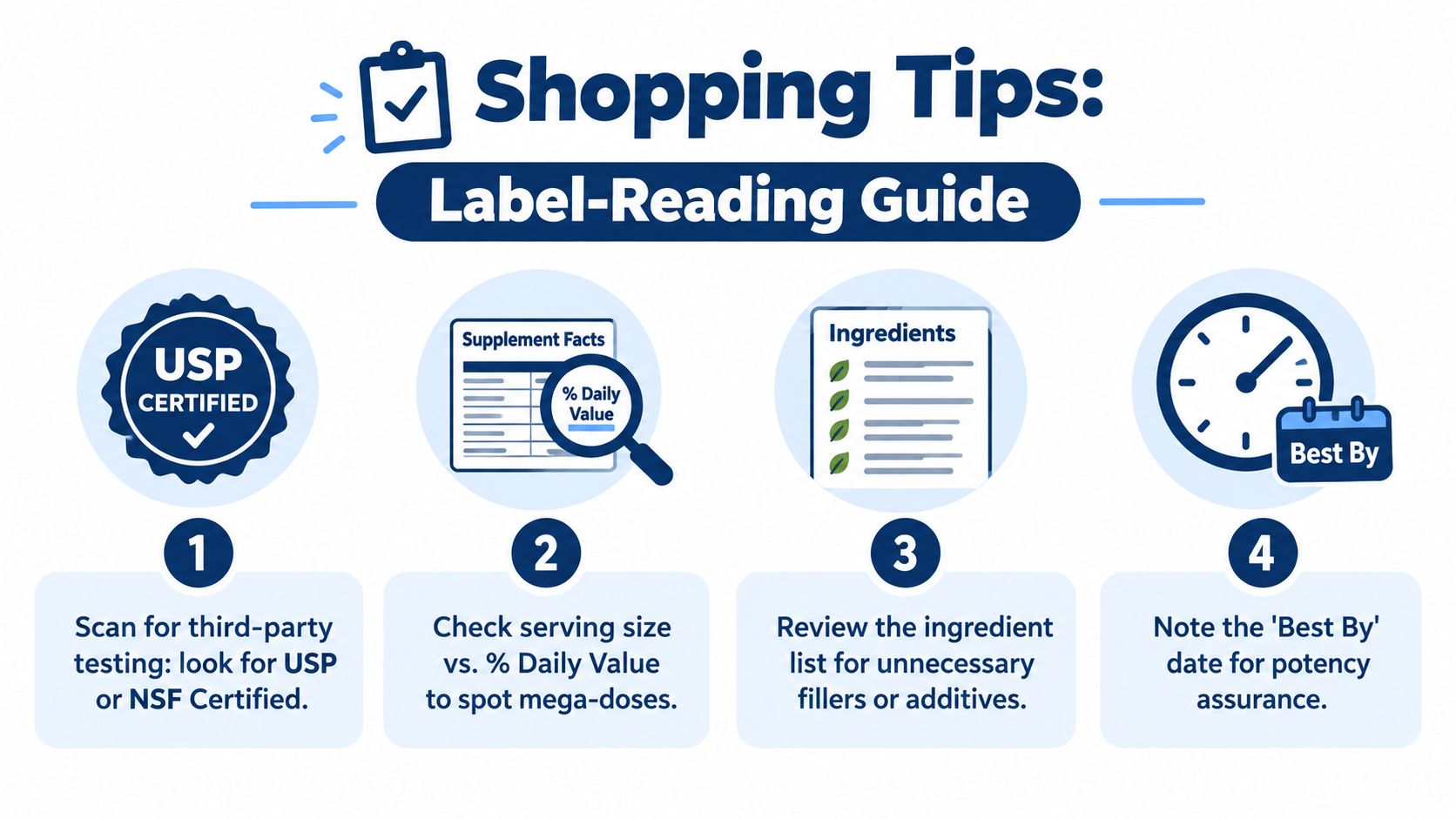
Four label checks
Look for independent quality information. Seals such as USP or NSF Certified can provide useful manufacturing and testing context. Don't treat a seal as proof that a formula is right for your needs, but do treat missing quality information as a reason to investigate further.
Read every dose. A proprietary blend that hides individual amounts makes comparison difficult. Confirm the serving size, then inspect the amount of B6, niacin, folate, B12, and vitamin C. The percentage of Daily Value can reveal when a product is far more concentrated than a basic nutritional supplement.
Match the delivery form to your preferences. Capsules, tablets, powders, and liquids differ in swallowing convenience and excipients. Vegan shoppers should check whether the capsule uses gelatin or a plant-based material such as pullulan or tapioca. Check the B12 form too, including whether the label lists cyanocobalamin or methylcobalamin.
Scan for practical details. Review allergens, sweeteners, colors, unnecessary fillers, expiration information, and the number of servings per container. Price per serving is more useful than the sticker price, especially when two bottles require different daily serving sizes.
Supplemynts Inc organizes supplements by ingredient and purpose, including vitamin, vegan, immunity, digestive, brain, and other wellness categories. That kind of navigation can help you start with a goal, then verify whether a B+C formula matches it rather than choosing a bottle because “energy” appears in large type.
If you already know that you need vitamin C but don't need a B complex, compare the Nature Made Vitamin C 1000 mg tablets with combined formulas instead of paying for nutrients you don't need. Also check serving count, shipping terms, return information, and available customer support before placing an order.
Frequently Asked Questions
Should vitamin C at 1,000 mg or more be separated from B12?
Spacing is sensible when vitamin C is high-dose and your B12 intake is important. High vitamin C may reduce B12 absorption, so taking the products at different times can reduce that concern. Standard, modest-dose combination products are generally considered safe, but ask a clinician or pharmacist if you're treating a known B12 deficiency.
Can I stack a B complex with a multivitamin?
You can, but first add the amounts from both labels. Pay particular attention to vitamin B6, niacin, folate, B12, and vitamin C. The NIH vitamin C guidance lists an upper intake level of 400 to 2,000 mg per day depending on age, and excessive vitamin C commonly causes gastrointestinal symptoms. A pharmacist can review the complete stack more reliably than a front-label claim.
Do pregnancy and breastfeeding change the decision?
Yes. Pregnancy and breastfeeding involve specific nutrient needs, so a prenatal or clinician-selected plan may be more suitable than a general B+C product. Don't switch formulas or combine products without reviewing the labels with your obstetric clinician or another qualified professional.
How long should I try one before judging it?
There isn't a universal trial period that proves a B+C product is working. If you have a confirmed deficiency, follow-up should be based on symptoms, laboratory results, and clinician guidance. If you're using it for general wellness, define the reason before starting and stop if it causes side effects or adds unnecessary overlap.
For help comparing products, use ingredient and purpose filters, then contact Supplemynts Inc customer support with the exact labels you're considering. That approach keeps the buying decision connected to your diet, medications, and actual nutrient needs.
Supplemynts Inc offers vitamins and other dietary supplements organized by ingredient and wellness purpose, including vegan and immunity-focused selections. Visit Supplemynts Inc to compare B complex with C products, check serving details, and choose a formula that fits your routine rather than relying on marketing language alone.










Please complete your information below to login.
Sign In
Create New Account