


You're halfway through your post-workout shake when your stomach starts turning. Maybe whey leaves you bloated, dairy no longer fits your diet, or you're vegan and tired of treating every protein powder as though it were interchangeable with milk-based protein. You may also be wondering whether a plant powder can support recovery without forcing you to compromise on amino-acid quality.
The right answer depends on the problem you're solving. Pea protein is a strong general-purpose option, soy is useful when you want a complete plant protein, egg works well for dairy-free athletes who still eat animal products, and collagen belongs in a different category because it isn't a complete muscle-building protein. Safety matters, too. Testing summarized by Consumer Reports found substantially higher lead in plant-based powders than in whey-based products, so “vegan” and “clean” shouldn't end your evaluation.
Table of Contents
- Why People Look Beyond Whey Protein
- The Protein Quality Yardstick You Need First
- Eight Whey Alternatives Worth Your Money
- Matching the Right Protein to Your Situation
- Dosing and Blending Strategies That Actually Work
- The Heavy-Metal Question Most Articles Skip
- Side-by-Side Comparison and Final Picks
- Practical Questions Shoppers Ask Before Switching
Why People Look Beyond Whey Protein
Whey works well, but it can fail the person drinking it. Start with the problem you need to solve: digestion, allergy management, dietary values, recovery timing, or concern about contaminants.
Digestion is a common reason to switch. Whey concentrate may retain lactose, which can trigger bloating, cramping, or loose stools in people with lactose intolerance. Whey isolate usually contains less lactose, but anyone with a confirmed milk allergy should avoid milk-derived whey altogether. In homes managing dairy allergies, a plant-based powder can also reduce cross-contact risk when the manufacturer clearly explains its allergen controls.
Dietary preferences create another clear dividing line. Vegans need a non-dairy, non-animal protein, while flexitarians may want less reliance on dairy. Pea, soy, rice, hemp, and whole-food concentrates can meet those needs, though their amino-acid profiles, texture, and leucine delivery differ. The plant-based protein supplements market was estimated at USD 2.84 billion in 2024 and is projected to reach USD 5.94 billion by 2033, with a projected 8.6% CAGR from 2025 to 2033, according to Grand View Research. The category now serves shoppers with specific dietary and performance priorities.
The five reasons people switch
- Lactose or dairy sensitivity: Choose a dairy-free powder if whey repeatedly disrupts digestion.
- Allergy management: Avoid whey for a confirmed milk allergy, and check whether the product shares equipment with dairy.
- Ethics and sustainability: Pea, soy, rice, hemp, and whole-food concentrates support vegan or lower-dairy routines.
- Recovery strategy: Select a protein that supplies enough leucine in a serving you tolerate and will use consistently.
- Contaminant concerns: Review testing and sourcing, particularly if you drink protein daily.
Heavy metals deserve particular attention. Consumer Reports found plant-based powders averaged nine times the lead found in whey-based powders, while Clean Label Project testing reported five times more cadmium in plant-based products than in dairy-based counterparts, as summarized in the same Consumer Reports investigation. These findings do not make whey universally safer or condemn every vegan product. They make product-level testing and sourcing part of a sensible purchase decision.
Whey alternatives include pea, soy, rice, hemp, egg, casein, collagen, and minimally processed concentrates from chickpea, lentil, or quinoa. Each solves a different problem, so treat the choice as a fit assessment rather than a search for one universal winner. For context on how supplements differ from peptide products, see the Peptide Warehouse USA comparison guide.
The Protein Quality Yardstick You Need First
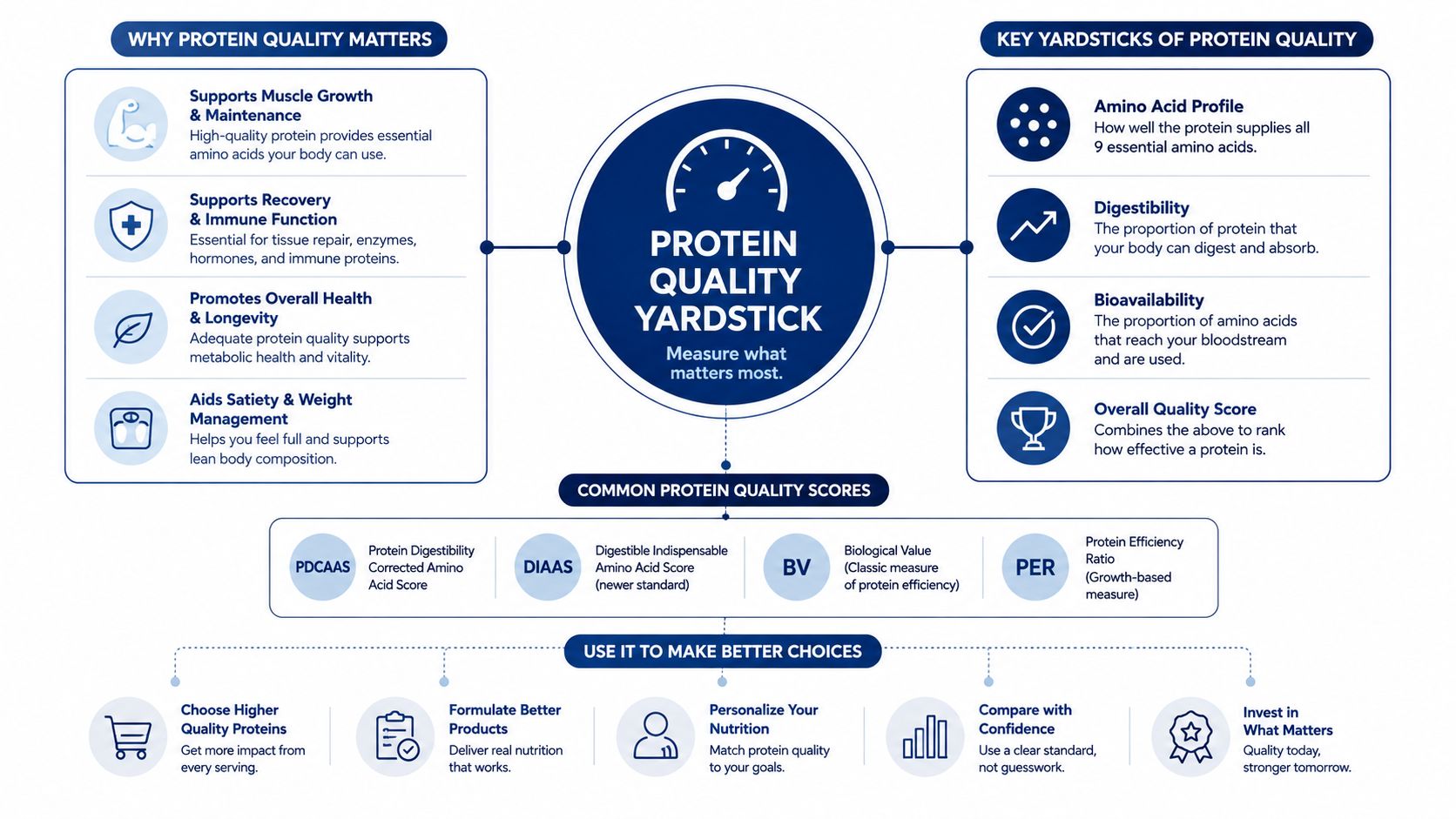
Protein quality has three practical dimensions: amino-acid completeness, digestibility, and leucine delivery. A powder can display an impressive protein number on the front of the tub and still provide less usable muscle-building value than the label suggests if its amino-acid pattern is weak or its digestibility is lower.
DIAAS, the Digestible Indispensable Amino Acid Score, evaluates indispensable amino acids using digestibility measured at the end of the small intestine. That makes it more informative for comparing protein sources than relying only on crude protein content. In the quality comparison published by Glanbia Nutritionals, whey protein isolate is listed at 1.09 DIAAS, soy protein concentrate at 0.90, pea protein isolate at 0.82, and rice protein concentrate at 0.37.
Leucine is the practical bottleneck
Leucine helps initiate muscle protein synthesis. Whey's advantage is not merely that it contains protein. It delivers a relatively concentrated dose of indispensable amino acids, including leucine, in a rapidly digested form.
Soy illustrates the difference. In the cited comparison, whey produced roughly twice the muscle protein synthesis of soy and about three times the plasma leucine exposure, while essential amino-acid and total-amino-acid exposure were around twice as high for whey, according to Examine's whey and soy analysis. That doesn't make soy ineffective. It means soy may require a larger serving or a carefully designed meal when rapid post-training delivery is the priority.
Digestibility also changes the meaning of the protein number on a label. The body doesn't use every listed gram identically, and lower-DIAAS sources can require more total powder or complementary proteins to provide a comparable indispensable amino-acid profile. Anti-nutrient compounds, processing, preparation, and individual tolerance can all influence the result.
Practical rule: Judge a powder by its protein source, amino-acid profile, digestibility, testing, and how consistently you can use it. The front-label protein number is only the starting point.
The evidence isn't one-sided. A review in the National Library of Medicine notes whey's higher leucine content and generally stronger digestibility, while also discussing evidence that the difference in muscle outcomes can be modest when overall protein and training are properly matched. This is why a well-formulated plant blend can be a sensible choice, even though whey isolate remains the quality benchmark.
Eight Whey Alternatives Worth Your Money
The table below gives you a useful screening tool. Exact protein and leucine values vary by formulation, so use the product's Supplement Facts panel for the final decision. Where a published DIAAS value is available, the source is identified above rather than pretending every alternative has an equally established score.
Eight Whey Alternatives at a Glance
| Protein Source | Protein per 30 g | Leucine (g) | DIAAS | Allergens | Best Use | Watch-Out |
|---|---|---|---|---|---|---|
| Pea isolate | Varies by product | Varies by product | 0.82 for pea isolate | Pea, possible facility cross-contact | Vegan muscle support | Can be chalky and lower in sulfur amino acids |
| Soy isolate | Varies by product | Varies by product | 0.90 for soy concentrate | Soy | Complete plant protein | Beany flavor and individual soy concerns |
| Rice concentrate | Varies by product | Varies by product | 0.37 for rice concentrate | Usually low allergen, check facility | Sensitive diets and blends | Low lysine, best paired with pea |
| Hemp | Varies by product | Varies by product | Not established here | Hemp, possible seed cross-contact | Fiber-containing shakes | Lower protein density |
| Egg protein | Varies by product | Varies by product | Not established here | Egg | Dairy-free athletic use | Not vegan and can taste eggy |
| Casein | Varies by product | Varies by product | Not established here | Milk | Slow, between-meal protein | Still dairy and unsuitable for milk allergy |
| Collagen | Varies by product | Varies by product | Not a complete muscle protein | Animal source | Joint and skin support | Don't use it as your main recovery protein |
| Whole-food concentrates | Varies by product | Varies by product | Varies by source | Depends on ingredient | Minimal-processing preference | Texture and amino-acid balance vary |
Pea protein is my first plant-based recommendation. The cited 2015 trial included 161 participants divided among pea, whey, and placebo groups. After 12 weeks, the pea group recorded a 20.2% increase in muscle thickness, compared with 15.6% for whey and 8.6% for placebo, while strength increased 17.0% with pea and 17.6% with whey, according to the published trial report. Verdict: choose pea isolate for vegan strength training, then consider a blend if your servings are small.
Soy protein is the most straightforward complete plant option. It's useful when you want one plant source rather than a blend, and its published DIAAS value is stronger than pea or rice in the cited comparison. Verdict: use soy isolate when you tolerate soy and can accept its flavor.
Rice protein is attractive for shoppers avoiding dairy, soy, and common legumes. Its weakness is amino-acid balance, particularly lysine, and its cited DIAAS score is 0.37, so rice works better with pea than alone. Verdict: use it as a complementary half of a blend.
Hemp protein brings fiber and a more whole-food character, but that also means a less concentrated protein serving and a distinctly earthy taste. Verdict: use hemp in breakfast smoothies or snack shakes, not as your only performance powder.
Egg protein is a strong dairy-free choice for omnivores. It's complete, mixes more cleanly than many plant powders, and fits athletes who want animal protein without milk. Verdict: choose egg white protein when dairy is the problem but vegan eating isn't your goal.
Casein is still milk protein, so it isn't a true solution for dairy allergy or vegan diets. Its slower digestion makes it more appropriate between meals or before sleep than immediately after training. Verdict: choose casein for convenience and satiety if milk is tolerated.
Collagen is a connective-tissue supplement, not a whey replacement for muscle protein. It can fit joint or skin routines, but pair it with a complete protein source for training. Verdict: use collagen for connective-tissue goals only.
Whole-food concentrates, including chickpea, lentil, or quinoa powders, suit shoppers who want fewer processing steps. They can be useful in soups, oats, and savory recipes, but their taste and amino-acid balance vary substantially. For comparison, even unusual protein formats have specialized uses, such as black soldier fly protein powder for pets, which is a pet product, not a human supplement. Verdict: choose whole-food concentrates for ingredient preference, not automatically for superior athletic performance.
For a collagen-specific option, a product such as Bulletproof Keto Friendly Collagen Protein Powder should be evaluated as collagen support, not as a complete whey substitute.
Matching the Right Protein to Your Situation
The best alternative changes as soon as the reader's problem changes. Someone avoiding lactose needs a different answer from an athlete chasing the fastest possible post-training amino-acid delivery.
Reader scenarios and direct recommendations
| Scenario | Primary Pick | Backup Option | Key Caution |
|---|---|---|---|
| Lactose intolerance | Pea isolate | Egg protein | Don't assume all dairy protein will be tolerated |
| Post-workout recovery | Pea isolate with a leucine strategy | Egg or soy isolate | Don't use collagen as the only recovery protein |
| Pregnancy or breastfeeding | Third-party-tested pea, rice, or soy | Plain whole-food concentrate | Avoid unnecessary herbal additions and review ingredients with a clinician |
| Joint or skin focus | Collagen peptides plus complete protein | Egg protein | Collagen shouldn't replace training protein |
| Strict vegan diet | Pea and rice blend | Soy isolate | Don't rely on rice alone |
| High-volume strength training | Soy, egg, or casein if tolerated | Pea blend | Don't confuse total protein with adequate leucine delivery |
If whey causes digestive trouble, start with pea isolate. It's dairy-free and has meaningful sports-nutrition evidence. Egg protein is the better backup if you eat animal products and want a more complete dairy-free source. The mistake to avoid is switching to collagen because the label says “protein.” Collagen has a different amino-acid purpose and shouldn't anchor a muscle-building plan.
For training sessions followed by a meal much later, pea isolate is practical, but I'd pay attention to serving size and leucine delivery. Soy isolate is another sensible option because its amino-acid profile is more complete than many plant powders. The mistake is choosing a powder solely because it says “plant-based” without checking how much protein and what kind of blend it provides.
Pregnancy and breastfeeding require more caution than ordinary supplement shopping. A plain, third-party-tested pea, rice, or soy powder can be easier to evaluate than a product loaded with proprietary herbs, stimulants, or botanical blends. Discuss any regular supplement with your obstetric or primary-care clinician, particularly if you have allergies, kidney disease, or a medically restricted diet.
For joint or skin goals, collagen peptides can be useful as an adjunct, especially when paired with a complete food-based protein pattern. The mistake is letting collagen displace eggs, soy, legumes, dairy, or another complete source that supports broader protein needs. A nutrient-dense product such as BareOrganics Spirulina Powder may add variety to a smoothie, but it shouldn't be treated as a substitute for a properly dosed protein powder.
Strict vegans should choose a pea and rice blend or use both sources across the day. Soy isolate offers a simpler one-powder solution if soy fits your diet. The mistake is assuming every vegan powder is nutritionally equivalent.
Dosing and Blending Strategies That Actually Work
Most plant-protein mistakes happen in the shaker bottle, not in the ingredient list. People use a small serving of a lower-DIAAS protein, miss the leucine target, dislike the texture, and conclude that plant protein doesn't work.
For a high-quality protein, aim for roughly 25 to 35 grams in a meal or recovery serving. Lower-DIAAS plant sources may require roughly 35 to 45 grams to deliver a similar amino-acid stimulus, depending on the product. A useful target is approximately 2.5 to 3 grams of leucine per anabolic trigger, but the actual leucine content must come from the label or manufacturer data, not from guesswork.
Build the blend around complementary amino acids
Pea and rice work together because their amino-acid limitations complement each other. A blend near 60:40 pea to rice is a practical starting point, although the exact formula depends on the manufacturer's amino-acid profile. Soy and quinoa can work independently more effectively than rice alone because their amino-acid patterns are more balanced.
Use fast-digesting proteins around training when convenience matters. Pea isolate, egg protein, and whey-style formulations fit a post-workout shake, while casein and hemp make more sense between meals or before bed when you want a slower, more filling option.
Three practical combinations:
- Post-workout shake: Blend pea isolate with banana, water or a tolerated milk alternative, and creatine. Adjust the powder until the shake provides the protein amount you're targeting.
- Leucine-focused smoothie: Combine soy milk, rice protein, and a leucine-fortified yogurt. This approach adds complementary protein rather than forcing a large amount of rice powder into one glass.
- Savory recovery soup: Use a complete protein such as egg white alongside vegetables and broth. Collagen can be included for connective-tissue support, but it shouldn't be the only protein.
Mixability improves when you add liquid first, then powder, then ice. Start with enough water to create a fluid shake, let thicker powders sit briefly, and blend again rather than adding a large amount of powder at once. Plant powders often perform better in a blender than a handheld shaker, especially when combined with oats, banana, nut butter, or yogurt.
For a broader amino-acid product, NOW Sports Amino Complete is a separate supplement category, not a replacement for a complete protein serving. Keep that distinction clear when you calculate your daily intake.
The Heavy-Metal Question Most Articles Skip
Plant protein is not automatically cleaner. Testing has found higher lead levels in some plant-based powders than in whey-based powders, while other reports have identified greater cadmium concerns in plant products. The risk depends on the ingredient and manufacturing process, not on whether the label says plant-based or organic. See Consumer Reports' testing coverage for the testing context.
The concern is cumulative exposure. Daily powder use adds to metals encountered through food, water, cookware, and other supplements, even when one serving causes no obvious symptom. Chocolate powders and mineral-rich plant ingredients deserve closer scrutiny because their contamination risk can vary with sourcing and processing.
What to check before buying
- Third-party certification: Look for NSF Certified for Sport, Informed Sport, or USP certification when the product carries it.
- Batch documentation: Ask whether the manufacturer provides a batch-level Certificate of Analysis.
- Source transparency: Prefer brands that identify ingredient origins and explain their testing program.
- Testing scope: Confirm that testing covers lead, cadmium, arsenic, and other contaminants, rather than accepting a vague “quality tested” statement.
- Daily exposure: Use the lowest effective serving and avoid combining powders with overlapping ingredients.
Rotate protein sources when practical. Unflavored or non-chocolate products may reduce exposure from ingredients that warrant extra scrutiny. A plant-based label is not a purity guarantee. Choose verified testing plus sensible use, not a marketing adjective.
Side-by-Side Comparison and Final Picks
A useful ranking has to separate athletic performance from diet fit. The scores below are qualitative, on a one-to-five scale, because the verified data doesn't provide comparable price, taste, or digestibility measurements for every source.
Whey Alternatives Compared at a Glance
| Protein | Leucine/25g | DIAAS | Digestibility | Allergen Risk | Taste/Mixability | Cost/Serving | Best For |
|---|---|---|---|---|---|---|---|
| Pea | 4 | 3 | 3 | 4 | 3 | 4 | Vegan muscle support |
| Soy | 4 | 4 | 4 | 3 | 3 | 4 | Complete plant protein |
| Rice | 2 | 2 | 3 | 4 | 3 | 4 | Complementary blending |
| Hemp | 2 | Not established | 3 | 4 | 2 | 3 | Fiber and whole-food preference |
| Egg | 4 | Not established | 4 | 3 | 4 | 3 | Dairy-free omnivores |
| Casein | 4 | Not established | 4 | 2 | 4 | 3 | Slow digestion |
| Collagen | Not suitable as a complete score | Not complete | 3 | 3 | 4 | 3 | Joint and skin support |
| Whole-food concentrates | 2 to 3 | Varies | 3 | 4 | 2 | 3 | Minimal processing |
The decision tree is straightforward:
- Does dairy cause symptoms or pose an allergy risk? Choose pea, egg, or soy. Skip casein.
- Are you strictly vegan? Choose pea and rice together, or soy isolate.
- Is immediate post-workout recovery your priority? Choose pea isolate with a leucine-aware serving, or egg if dairy-free but not vegan.
- Are joints or skin the main goal? Add collagen, but keep a complete protein for muscle support.
- Is budget the deciding factor? Compare cost per usable serving, not tub price, and favor plain pea, soy, or a pea-rice blend.
My best all-rounder is pea isolate, especially for people who need dairy-free versatility. The best budget direction is usually a plain plant isolate or blend, but check the serving panel and testing rather than buying on price alone. For athletes pursuing peak muscle protein synthesis and who tolerate dairy, whey isolate still has the strongest quality and kinetic position. Among non-dairy choices, egg or soy isolate is my direct pick for amino-acid density.
Practical Questions Shoppers Ask Before Switching
Are alternatives to whey protein expensive? Prices vary by source, formulation, flavor, certification, and serving size. Compare the cost of a serving that meets your protein and leucine needs, not merely the number printed on the tub.
How long does an opened powder last? Follow the manufacturer's date and storage directions. Keep the container sealed in a cool, dry place, and discard powder with a rancid smell, damp clumps, unusual discoloration, or an altered taste. Plant powders can develop stale flavors even when preservatives aren't obvious on the label.
Can partners share one tub? Only if both people tolerate every ingredient and the allergen controls are acceptable. A vegan powder may work for an omnivore, but collagen or egg protein won't suit a strict vegan household.
Should you ever switch back to whey? Yes. If dairy is tolerated, personal preference, a demanding training phase, or a need for a fast, high-quality protein can justify returning to whey isolate. There's no prize for avoiding a food that works for you.
Travel with the original labeled container when possible, and check customs requirements before taking supplements across borders. Unflavored powders usually work well in oatmeal, blended soups, and savory recipes, while sweetened products can make those uses unpleasant. Supplemynts organizes vegan protein and broader supplement categories so you can compare options by dietary preference and intended use.
Supplemynts Inc offers proteins, vegan supplements, powder products, and purpose-based wellness categories through its online store, with product information and customer support available for shoppers. Visit Supplemynts Inc to compare protein options and choose a formula that matches your dietary needs, training goal, and tolerance.






Please complete your information below to login.
Sign In
Create New Account