


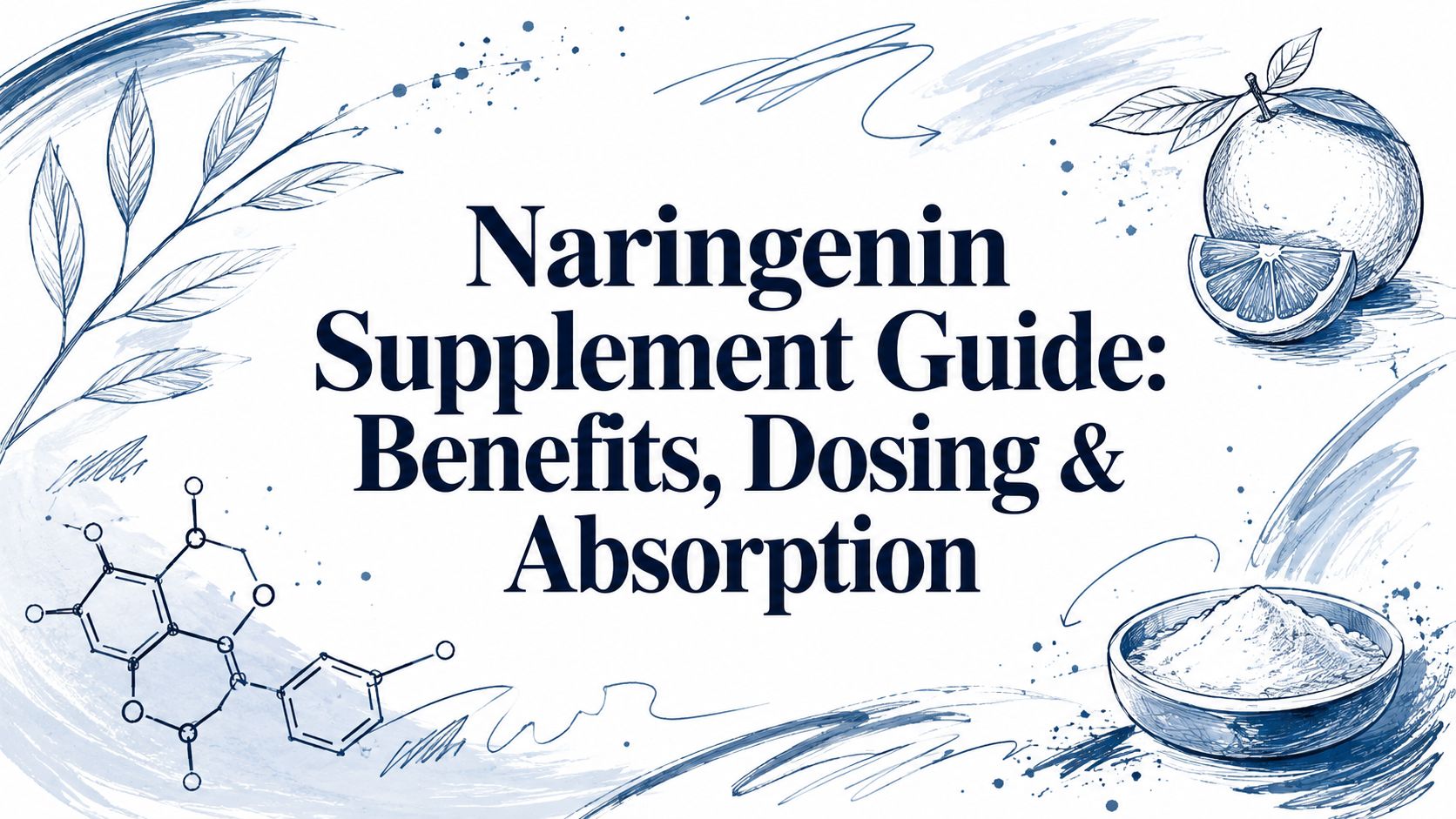
Have you ever compared two bottles labeled 500 mg of naringenin and assumed they should work the same way? That assumption misses the most important part of the equation. The body doesn't absorb every milligram that reaches the stomach, and the formulation, digestion process, metabolism, and foods taken alongside the capsule can influence how much naringenin enters circulation.
Naringenin is a citrus flavonoid with promising laboratory findings and early human research, but it isn't a proven cure-all. The practical question is less “What does naringenin do in theory?” and more “How much active compound reaches the body, and what outcomes have researchers observed in people?”
Table of Contents
- Does Naringenin Work in Real People
- What Naringenin Is and Where It Comes From
- The Bioavailability Problem That Changes Everything
- Potential Health Benefits Supported by Evidence
- Understanding Dosing and Timing
- Comparing Supplement Formats and Delivery Technologies
- Safety Considerations and Who Should Avoid Naringenin
- Making Smart Purchasing Decisions
Does Naringenin Work in Real People
Can a naringenin supplement produce measurable effects in humans, or do its promises still rest mainly on cell and animal research?
The answer is mixed. A 2019 review found that only 10 clinical studies had been registered in ClinicalTrials.gov using the terms naringenin or naringin up to that point, indicating that human research was limited despite extensive preclinical interest (review of naringenin clinical evidence). Laboratory and animal findings explain why researchers study naringenin, but they cannot show that a standard capsule will create the same result in people.
The milligram count also does not tell the whole story. Two products may list the same amount while delivering different exposure because absorption, metabolism, and formulation affect how much active compound reaches circulation. Food taken with the supplement can influence that process as well, so the label amount is only the starting point for judging likely results.
A human safety study tested single oral doses of 150, 300, 600, and 900 mg, and participants tolerated those doses well. Serum concentrations also rose in proportion to the dose, showing that researchers could measure human exposure rather than infer it only from animal work (human safety and exposure review).
A later pilot trial randomized 44 overweight or obese patients with nonalcoholic fatty liver disease to naringenin or placebo for 4 weeks. The naringenin group had statistically significant reductions in several cardiovascular risk markers, including atherogenic index of plasma and cholesterol ratio measures, along with decreases in BMI and visceral fat (human naringenin research summary). The result is encouraging, yet its small sample and short duration cannot establish broad benefits for every user.
A useful expectation: naringenin is an emerging clinical ingredient, not a finished answer to every health goal.
Treat online claims as a starting point for checking, not proof. For naringenin, review the human evidence, the form and delivery method, and the limits of the label's promise, much as you would compare recent Turbonino Casino bonus codes before choosing.
What Naringenin Is and Where It Comes From
Naringenin is a flavonoid, a class of plant compounds that helps give fruits and vegetables their color, flavor, and protective chemistry. Plants use these compounds as part of their defense systems. Humans consume them through food, and supplement makers isolate selected flavonoids when they want to study or deliver a concentrated form.
Naringenin occurs naturally in citrus, especially grapefruit. It also appears in other citrus fruits and has been identified in plant sources such as chamomile. In food, naringenin often exists as part of a sugar-bound form called naringin. Digestion can separate that attached sugar, allowing the body to process naringenin itself.

That distinction helps explain why a grapefruit serving and a capsule aren't interchangeable. Food contains a mixture of compounds, fiber, water, and sugars, while a supplement may provide isolated naringenin, naringin, or a standardized citrus extract. The label should tell you which form it contains and how much of that named ingredient is present.
Why manufacturers isolate it
Researchers became interested in naringenin because laboratory work suggests that it can interact with pathways involved in oxidation, inflammation, lipid handling, and glucose regulation. Those mechanisms make it scientifically interesting, but a mechanism isn't the same as a confirmed clinical outcome.
A short educational overview can help visual learners understand how plant compounds move from food into the body. The key takeaway is that naringenin's origin explains its identity, but not its effectiveness as a supplement.
The source also matters. A product made from citrus extract may list naringin or total flavonoids instead of a clearly quantified naringenin dose. That makes direct comparisons difficult, especially when one product uses a delivery system designed to improve absorption.
The Bioavailability Problem That Changes Everything
Bioavailability means the portion of a swallowed compound that reaches circulation in a form the body can use. Labeled doses act like shipments entering a delivery network. Some dissolve poorly, some are transformed in the gut, and others are processed by the liver before reaching the bloodstream.
A 2011 NIH-hosted paper found that an oral 135 mg dose given to six healthy volunteers reached peak plasma concentration after about 3.5 hours, with estimated bioavailability of only 5.8% (oral naringenin pharmacokinetics). Review literature places oral bioavailability in roughly the 5% to 15% range. Poor water solubility, rapid metabolism, and first-pass elimination all help explain the gap between the labeled dose and circulating compound.
Two products with the same nominal milligram amount may therefore produce different exposure. A standard powder may dissolve slowly, while a liposome, nanoparticle, or other complex may keep naringenin dispersed and easier to transport. The capsule label shows what was added, not necessarily what reaches circulation.
Food can change the equation
Review material also notes that milk proteins and bulky dietary fibers may reduce naringenin bioavailability. This does not mean every user must avoid food. Product directions still matter, and taking a supplement at a consistent time can make personal results easier to interpret.
Formulation research shows why manufacturers test different delivery systems. Cyclodextrin complexation increased solubility by over 400-fold and improved gut transport by 11-fold in a model system. A mouse study also found that a liposomal formulation increased relative bioavailability by about 13.44-fold compared with free naringenin (formulation and absorption review). These findings describe model-system and animal results, not guaranteed human outcomes.

The practical lesson: milligrams tell you what enters the capsule, not necessarily what reaches your bloodstream.
Compare whether a label names a delivery technology and states the actual naringenin amount. Life Extension Fast-C Bio-Quercetin Phytosome shows why “phytosome” language can describe a formulation approach, although its current label must confirm whether it contains naringenin. RAE 60 Capsules Complexion Clear Skin from Within Gluten Free is a plant-based skin supplement featuring vitamin E, zinc, and turmeric, so it is not a substitute for a naringenin-specific formulation.
Potential Health Benefits Supported by Evidence
Could naringenin's possible benefits extend beyond cholesterol and liver markers? Current research points to several promising areas, but the strength of evidence differs sharply between human outcomes and laboratory mechanisms.
In neuroprotective research, naringenin's antioxidant and anti-inflammatory activity has led scientists to examine how it may help protect brain cells from oxidative stress. Bone research follows a similar pattern: cell and animal studies suggest possible effects on pathways involved in bone formation and breakdown. These findings explain scientific interest, but they do not show that a naringenin supplement prevents cognitive decline or strengthens bones in people.
Metabolic research also examines glucose handling, lipid regulation, and liver pathways. These mechanisms may help explain cardiometabolic interest, yet a biological effect in a cell culture or animal model is not the same as a reliable benefit for supplement users. Human trials still need to clarify which outcomes matter, for whom, and with which formulation.
A practical evidence hierarchy helps:
- Human evidence: Early, limited signals exist for specific cardiometabolic markers, while broader claims remain unconfirmed.
- Mechanistic evidence: Antioxidant and anti-inflammatory activity provides a possible explanation for effects studied in the brain, bone, glucose, lipid, and liver fields.
- Preclinical evidence: Cell and animal findings require confirmation in well-designed human research.
- Unresolved questions: Formulation, absorption, food interactions, long-term use, and consistency across populations may change the real-world result.
The bioavailability gap matters here. Two products can list the same milligram amount yet deliver different exposure because one formulation dissolves or transports naringenin more effectively. Food and other ingredients may also alter how much reaches circulation. The capsule label is therefore only the starting point, not a guarantee of benefit.
Plant-derived products should not be treated as interchangeable. Amazing Formulas Grapeseed Extract contains grapeseed extract, not naringenin. Readers considering stress or metabolic goals can also review medical alternatives to cortisol supplements, rather than assuming every antioxidant supplement addresses the same need.
Understanding Dosing and Timing
What does a human dose study tell you? It provides a safety signal under controlled conditions, not a universal prescription. Researchers reported that single oral doses of 150, 300, 600, and 900 mg were safe and well tolerated in healthy adults. Exposure increased approximately in proportion to the dose in both fasted and fed states, with clearance occurring within 24 hours (human naringenin dose study).
A separate pharmacokinetic summary reported a 135 mg dose, an elimination half-life of 2.31 hours, and cumulative urinary excretion of 5.81%. These findings suggest that exposure declines relatively quickly. In plain language, naringenin behaves more like a short-acting visitor than a compound that steadily accumulates in the body.
How to read the label
Begin with the serving size and exact chemical form. A label may list pure naringenin, naringin, citrus bioflavonoids, or a proprietary blend. These names do not represent the same dose, so the front-panel milligram figure cannot be compared accurately without checking the Supplement Facts panel.
Two products with the same listed milligrams may produce different exposure. Dissolution, transport, and food can affect how much naringenin reaches circulation. Timing should therefore follow the product directions, especially when the formula uses an enhanced-delivery system.
Keep other variables steady when possible. Changing the product, meal pattern, and dose simultaneously makes it difficult to identify the cause of a perceived benefit or side effect.
A sensible approach: choose a clearly labeled product, use it consistently, and treat a higher milligram count as a label detail, not proof of a better result.
The short exposure window helps explain why split dosing or improved delivery may be considered instead of one large dose. That remains practical reasoning, not an established universal protocol. Anyone considering a higher dose should discuss it with a healthcare professional, particularly when prescription medicines are involved.
Comparing Supplement Formats and Delivery Technologies
Why can two naringenin supplements with the same milligram amount produce different results? The label shows how much compound is present, not how much survives digestion and reaches circulation. A standard powder is straightforward, yet poor water solubility and substantial metabolism can limit the amount available to the body.
| Formulation Type | What the evidence suggests | Key Advantage | Typical Cost Premium |
|---|---|---|---|
| Standard extract powder | Oral absorption may be limited | Simple label and familiar format | Not established |
| Cyclodextrin complex | A model system reported markedly higher solubility and gut transport (formulation research) | Helps disperse the compound in experimental conditions | Not established |
| Liposomal naringenin | A mouse study found substantially higher relative bioavailability than free naringenin (liposomal formulation research) | Packages the compound inside lipid structures | Not established |
| Nanoparticle delivery | Researchers are examining it to address solubility and transport barriers | Uses engineered particles to potentially improve exposure | Not established |
These formats work like different delivery vehicles. The same amount of cargo may arrive in different quantities depending on how well the vehicle protects it and releases it. Results from mice or model systems cannot establish the same effect in humans, and available evidence does not show a typical price premium for each format.
A meal may also change the journey through digestion. Product directions can reflect the formulation, so copying the timing used for a standard powder may not suit an enhanced-delivery product.
What to look for on packaging
Check the exact naringenin amount per serving, the source material, and the named delivery platform. A proprietary blend can conceal the active amount. “Advanced absorption” wording is less useful when the label does not explain the technology or provide testing information.
An example from another botanical category is Amazing Formulas Turmeric Curcumin with BioPerine, which identifies an absorption-support ingredient. It is not a naringenin product, so use it only as an example of clearer formulation labeling. Compare products by ingredient identity, delivery method, testing details, and directions, rather than front-label milligrams alone.
Safety Considerations and Who Should Avoid Naringenin
“Naturally derived” does not mean compatible with every medicine. Naringenin comes from citrus, and grapefruit compounds can affect enzymes and transporters involved in drug absorption and breakdown. A concentrated supplement may therefore alter how some medicines reach the bloodstream. The risk depends on the medication, dose, formulation, and the person's health, so a grapefruit warning on a prescription deserves specific professional advice.
Medication details matter. Grapefruit-related effects can involve CYP3A4, an enzyme that helps process many drugs. Naringenin may also affect transport proteins, creating uncertainty for medicines with a narrow safety margin. People taking certain statins should ask whether altered metabolism could increase exposure. Anyone using warfarin should consult a clinician or pharmacist before trying it, because changes in medication handling can complicate anticoagulation management. Do not adjust a prescription dose independently.
Who should ask first
Speak with a qualified healthcare professional before using naringenin if you:
- Take prescription medicine: Provide the exact product, serving size, and medication list, including statins, warfarin, and drugs with grapefruit warnings.
- Have liver or kidney concerns: These organs help process and eliminate compounds, so impaired function may change exposure.
- Are pregnant or breastfeeding: Available human information may not address your situation.
- Plan surgery or use multiple supplements: A professional can check for additive effects and timing concerns.
- Want a high-dose product: Findings from limited single-dose testing do not establish safety for every formulation or long-term schedule.
Stop and seek medical advice if concerning symptoms develop. A lack of immediate symptoms does not show that the supplement works. Naringenin should not replace prescribed treatment for cholesterol, fatty liver disease, diabetes, or cardiovascular risk.
Making Smart Purchasing Decisions
A responsible naringenin supplement purchase begins with a label, not a promise. Look for a clearly stated amount of naringenin or naringin, a complete ingredient panel, serving instructions, lot or batch information, and contact details for the manufacturer. If the formula claims enhanced absorption, identify the named technology rather than accepting a vague phrase such as “maximum delivery.”
The evidence supports a measured buying framework:
- Confirm the active form. Naringenin and naringin aren't identical label terms.
- Check the delivery method. Standard powder, liposomal, cyclodextrin, and nanoparticle approaches address absorption differently.
- Evaluate the claim. Cardiometabolic markers have early human signals, while many broader benefits remain preclinical.
- Review interactions. Ask a pharmacist or clinician about grapefruit-related medication concerns.
- Set a tracking plan. Keep the product, timing, serving, and other supplements consistent so you can judge tolerance fairly.
Third-party testing can add useful information about identity and contamination, but a certification doesn't prove that naringenin will deliver a specific health outcome. Price also can't substitute for transparent labeling or human evidence. A premium formula may be scientifically interesting, but its value depends on whether the manufacturer explains what the technology changes and whether the product fits your needs.
For broader label-reading skills, consult this practical guide on how to read a supplement label the right way. The most realistic expectation is that naringenin may be worth considering for carefully selected cardiometabolic goals, while its clinical reach and ideal dosing remain unsettled.
Supplemynts Inc organizes dietary supplements by ingredient and wellness purpose, including vitamins, minerals, herbs, proteins, digestive support, immunity, brain, joint, and skin categories. Visit Supplemynts Inc to compare clearly categorized products, review store policies, and contact the support team before choosing a formulation that matches your goals and medications.





Please complete your information below to login.
Sign In
Create New Account