

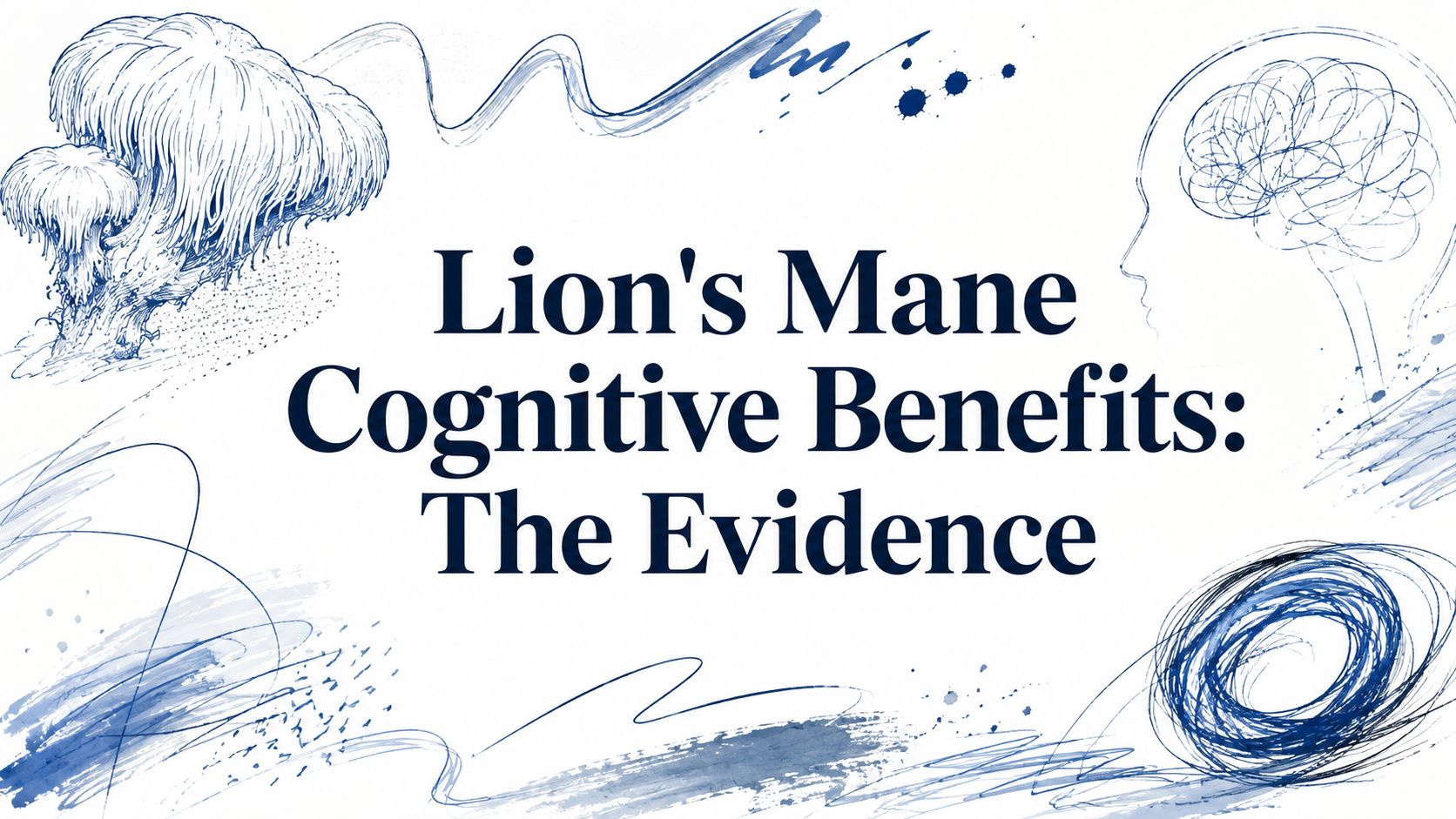
Most advice about lion's mane makes it sound like a shortcut to sharper thinking. It is narrower and more interesting, because the mushroom has a plausible brain-related mechanism, but the human evidence for broad cognitive benefits is still modest, small, and uneven. If you want the clearest answer possible, start with this: lion's mane cognitive benefits are biologically plausible, but the strongest claims go far beyond what current human trials can support.
Table of Contents
- The Gap Between Hype and Evidence
- What Clinical Trials Reveal About Cognitive Performance
- How Lion's Mane Interacts with Your Brain Chemistry
- Who Benefits Most Based on Current Research?
- Practical Dosing and Timeline Expectations
- Evaluating Supplement Quality and Sourcing
- Making an Informed Decision About Lion's Mane
The Gap Between Hype and Evidence
Lion's mane has spread through podcasts, supplement stacks, and social feeds because it offers a tidy story about brain support. That story is appealing, but popularity can move faster than evidence, especially when a mushroom has a plausible mechanism and only a limited human trial record. The gap matters because public discussion often treats lion's mane as if its cognitive effects were already settled.
The human research does not support that level of certainty. One 12-week double-blind, placebo-controlled trial in 31 healthy adults over 50 found that 3.2 g/day improved performance on the Mini-Mental State Examination (MMSE), but not on two other cognitive tests in the same study, so the result is interesting but narrow ALZ Discovery cognitive vitality review. That is the kind of finding you take seriously, then test again in larger, longer studies.
Practical rule: when one cognitive measure improves and others do not, treat the result as a clue, not a conclusion.
A broader review of the field points in the same direction. Published cognitive trials remain small and short, and the literature has focused heavily on older adults and people with cognitive concerns rather than healthy young people looking for sharper focus ALZ Discovery cognitive vitality review. The evidence is not empty, but it is also not the kind of repeated human data that supports strong marketing claims. As discussed in NexiHerb's supplement evidence guide, the difference between a promising signal and a confirmed effect matters a lot in supplement claims.
That tension explains why lion's mane keeps getting attention. It has a real biological rationale, yet the human evidence has not caught up with the boldest promises. Keeping that distinction clear makes the rest of the research easier to read.
What Clinical Trials Reveal About Cognitive Performance
The most useful way to read the human studies is to ask what changed, in whom, and for how long. Once you do that, the picture is more restrained than the supplement hype suggests. The best evidence points to small trials, mostly in older adults or people with cognitive concerns, where global cognition measures sometimes improved.
The most consistent signal comes from global cognition scales
The 12-week trial in adults over 50 is often cited because it used a randomized, placebo-controlled design and found a benefit on MMSE at 3.2 g/day ALZ Discovery cognitive vitality review. That matters because it shows the human evidence includes controlled data, not just animal or cell work. It also matters because the result was limited, one measure improved, while two others did not.
A second randomized, double-blind, placebo-controlled study reported significant improvements in cognitive performance versus placebo, and the effect declined after supplementation stopped systematic review in PubMed Central. That pattern hints that any benefit may depend on continued use rather than a one-time “reset” of cognition. For an ingredient marketed like a quick brain booster, that is an important correction.
The broader reviews are helpful because they put individual trials in context. One review found a combined weighted mean increase of 1.17 points on MMSE across randomized, placebo-controlled studies, while another review found only 2 human trials with positive cognitive results among the studies it evaluated PubMed Central review. Those two facts can coexist. A small average improvement can still sit inside a literature that is sparse and inconsistent.
What the trial design limitations mean for readers
The limits are not minor. The studies are short, the samples are small, and the populations are narrow, which means the findings may not generalize well beyond the groups tested. Also, the benefits that appear most often are measured on broad cognition scales like MMSE, not on every mental task people care about in daily life.
A useful way to think about it is this, a trial can show a signal without proving a practical everyday effect. That is why the research supports cautious optimism, not certainty.
If you want a way to read supplement claims with more skepticism, NexiHerb's supplement evidence guide is a useful general reference point. The same habit applies here, separating a controlled-trial signal from a marketing claim that reaches farther than the evidence.
The trial literature is also where many readers first run into the phrase “memory support” and assume it means the same thing as better focus, faster thinking, or more productivity. It does not. A study can hint at global cognitive support without proving an acute boost in attention, and that distinction matters when you are deciding whether a supplement is worth trying.

For readers comparing products, the Moksha Focus lion's mane formula page shows how a branded supplement may be presented, which makes it easier to separate formulation claims from trial evidence.
How Lion's Mane Interacts with Your Brain Chemistry
Lion's mane stands out because its biology reads more like a repair story than a stimulant story. The compounds most often discussed are erinacines and hericenones, and the research says they may cross the blood-brain barrier and influence nerve growth factor, or NGF pathways neurotrophic mechanism review. That route is tied to neuronal maintenance, neurite outgrowth, and the kind of support people usually mean when they talk about memory-related benefits.
NGF works like a maintenance signal
NGF does not behave like a caffeine-style switch that makes the brain feel instantly sharper. It works more like a maintenance crew for neural wiring, helping keep connections in good repair and supporting new growth where the brain needs it. If neurons are the cables, NGF helps keep the system organised, which is why lion's mane is usually described as a neuro-support ingredient rather than a fast nootropic neurotrophic mechanism review.
That distinction clears up a lot of confusion. Many people expect an immediate mental lift and assume the supplement failed when they feel little on the first day. The mechanism points in the opposite direction, toward sustained exposure and gradual change, which fits the human study pattern where any benefits tend to show up over weeks rather than hours ALZ Discovery cognitive vitality review PubMed Central review.
Why the mechanism matters for expectations
The science still helps, even when the clinical evidence remains limited. If a product claim promises immediate alertness, quicker reaction time, or a stimulant-like effect, that promise does not line up with the mechanism described in the research neurotrophic mechanism review. The better fit is a longer view, where the question is whether ongoing use may help support cognitive function over time.
One practical takeaway is straightforward. Assess lion's mane like a long-term support ingredient, not like an instant-focus stack component. That keeps the biology and the user experience in the same frame.
A product page such as Moksha Focus Lion's Mane Mushrooms Erinacines Brain Health 60 Caps shows how this kind of formulation is presented, with lion's mane and erinacines positioned for brain-health support. The label language is one thing, though, and human evidence should still set expectations.

For readers comparing mechanisms across ingredients, how Semax Selank support cognition gives a different example of how cognition-focused products are often explained. Lion's mane is distinct because its appeal rests on neurotrophic chemistry rather than a short-acting mental performance effect.
Who Benefits Most Based on Current Research?
The clearest fit is not the broad “brain fog” crowd that ads often target. Current human research has concentrated mainly on older adults and people with mild cognitive impairment, where small improvements on global cognition measures have been reported. That does not mean other people cannot try it, but it does mean the evidence is strongest in a narrower group than the marketing usually implies.
Older adults are the main studied population
That focus makes sense because age-related cognitive change is easier to track than day-to-day productivity. In older groups, a shift on an MMSE-style measure can point to a real functional change, even when the effect is modest ALZ Discovery cognitive vitality review PubMed Central review. The research record also shows that the human studies have been limited, with evidence concentrated in small trials rather than large, settled ones.
That is why the broad message that lion's mane helps everyone with focus can feel overstated. A trial in older adults does not automatically translate into better output for someone trying to power through a workday or study block. The starting point, the outcome measures, and the biological context are different.
A practical example is a product page like Dr. Emil 30-Day Supply Nutrition Lion's Mane Mushroom 90 Veggie Caps, which presents lion's mane as a general brain-support supplement. The label can suggest a broad use case, while the human evidence still points more narrowly.
Healthy younger adults are still an open question
The thinner part of the evidence is healthy younger adults who want sharper focus, better memory, or higher productivity. A 2025 review found that most intervention studies were small pilot trials with mixed results, and a 2025 acute study in healthy younger adults found no significant overall improvement in global cognition or mood young-adult evidence review. That does not show lion's mane has no value for this group, it shows the claim has not been established yet.
Healthy people who want better daily concentration are often the most eager buyers, but they are also the group with the weakest direct evidence.
If you are comparing supplements for attention or concentration, the ADHD adults supplement options overview is a useful way to compare categories more carefully. The point is not that lion's mane has no role, it is that the evidence for healthy younger users is still too thin to support strong promises.

Practical Dosing and Timeline Expectations
The cleanest way to think about dosing is to start with the trial designs, not with broad internet advice. Human studies that reported benefits used steady daily intake over weeks, and the clearest positive result cited in research summaries used 3.2 g/day in a 12-week study. Another study reported effects over 16 weeks, and those effects faded after supplementation stopped, which suggests the timeline is gradual rather than immediate.
What to expect in the first few months
If lion's mane is going to matter for cognition, the change is more likely to appear over weeks than overnight. That does not mean every person will notice a clear shift, only that the study patterns fit a slow-build model. The strongest expectation is subtle progress, not a sudden burst of mental energy.
Those changes may show up as feeling a little less mentally scattered, recalling names with less effort, or staying with a task for longer. They should not be mistaken for a stimulant response. If a product feels like caffeine on the first day, that feeling is more likely tied to the rest of the formula, your expectations, or both.
Consistency matters as much as format. Capsules and powders are both used, but the container is less important than whether the product is taken every day in a steady pattern similar to the studies. A product such as Supplemynts' Dr. Emil 30 Day Supply Nutrition Lion's Mane Mushroom 90 Veggie Caps is packaged for ongoing use, which only makes sense if the goal is patient, repeated supplementation.
A simple monitoring approach
Before starting, choose one or two concrete signs to watch. That might be how often you lose your train of thought, how easily you remember details from meetings, or whether you can read for a longer stretch without drifting.
- Track one cognitive habit: pick a real-world task you repeat often, such as reading, note-taking, or remembering names.
- Keep the routine steady: daily use matters more than occasional use if you want to mirror the trial pattern.
- Watch for stop-and-start changes: if benefits fade when you pause, that fits the study pattern better than a lasting effect.
The goal is not to hunt for dramatic changes. It is to notice whether your day-to-day experience shifts in a small but repeatable way, which is a more realistic standard for a supplement with mixed human evidence.
Evaluating Supplement Quality and Sourcing
A lion's mane label can look convincing while telling you very little about what's inside. Quality matters because the research points to specific bioactives, especially erinacines and hericenones, and those compounds aren't guaranteed just because a bottle says “lion's mane.” The more precise the sourcing and extraction language, the easier it is to judge whether a product is built to resemble the studied material.
What to look for on the label
First, check whether the product clearly identifies the mushroom part used. In this category, the difference between fruiting body and mycelium can matter because extraction approaches and compound profiles may differ. Second, look for language about extraction, because bioactives need to survive processing if they're going to be relevant to a brain-focused formulation.
Third-party testing is another major filter. A responsible supplement should show some evidence of purity and potency testing, because consumers can't verify that from the front label alone. Vague wording, hidden dosages, and proprietary blends make it harder to know whether the product lines up with the formulations used in research.
Simple standard: if a label won't tell you what the product contains, it's asking for trust without earning it.
A quick way to sort strong signals from weak ones
Think in terms of evidence alignment. A product that references erinacines, lists the form clearly, and discloses testing is easier to evaluate than one that leans on broad brain-boosting language.
- Clear ingredient identity: the label should name the mushroom and ideally the extract type.
- Transparent dosing: you should be able to see how much is in each serving.
- Testing disclosure: third-party verification is a meaningful quality signal.
- Realistic claims: products that promise instant genius-level focus are overselling the ingredient.
One catalog example that fits the topic is Moksha Focus Lion's Mane Mushrooms, which is described as a capsule supplement featuring lion's mane mushrooms and erinacines for brain health, memory, and cognitive function. That description is aligned with the broader category language, but it still shouldn't be read as proof of a clinical outcome.
For shoppers comparing options, Four Sigmatic Focus Blend Mix 30 Serving Dietary Supplement Vegan is another relevant page to inspect for formulation style and ingredient transparency. The main point is simple, a quality supplement should make it easier to evaluate the product, not harder.

Making an Informed Decision About Lion's Mane
Lion's mane occupies an awkward middle ground. The mechanism is interesting, the human evidence exists but remains limited, and the clearest signal so far comes from smaller studies in older adults rather than broad claims that apply to everyone. That makes the mushroom worth treating as a cautious trial, not as a guaranteed cognitive enhancer.
For a healthy younger adult who wants sharper focus at work or school, the evidence is still thin. For an older adult or someone with mild cognitive concerns, the research may feel more relevant, although it still falls short of firm proof. The better question is not whether lion's mane sounds promising, but whether it matches your goal, your comfort with uncertainty, and your willingness to use it long enough to judge the result fairly.
Safety deserves the same careful attention as efficacy. Anyone with existing cognitive symptoms, anyone taking medications, or anyone with a health condition that could make supplementation more complicated should speak with a healthcare professional before starting. That is not overcautious advice, it is the simplest way to keep a supplement choice from turning into guesswork.
Lion's mane cognitive benefits are plausible and encouraging in specific settings, but the human literature is still too narrow to support broad, high-confidence claims.
Supplemynts Inc offers a structured online supplement store with brain-support products, clear category navigation, and documented shipping and return policies for U.S. shoppers. If you are comparing lion's mane options against the current research, visit Supplemynts Inc to review product listings, supporting details, and the wider wellness selection in one place.







Please complete your information below to login.
Sign In
Create New Account