


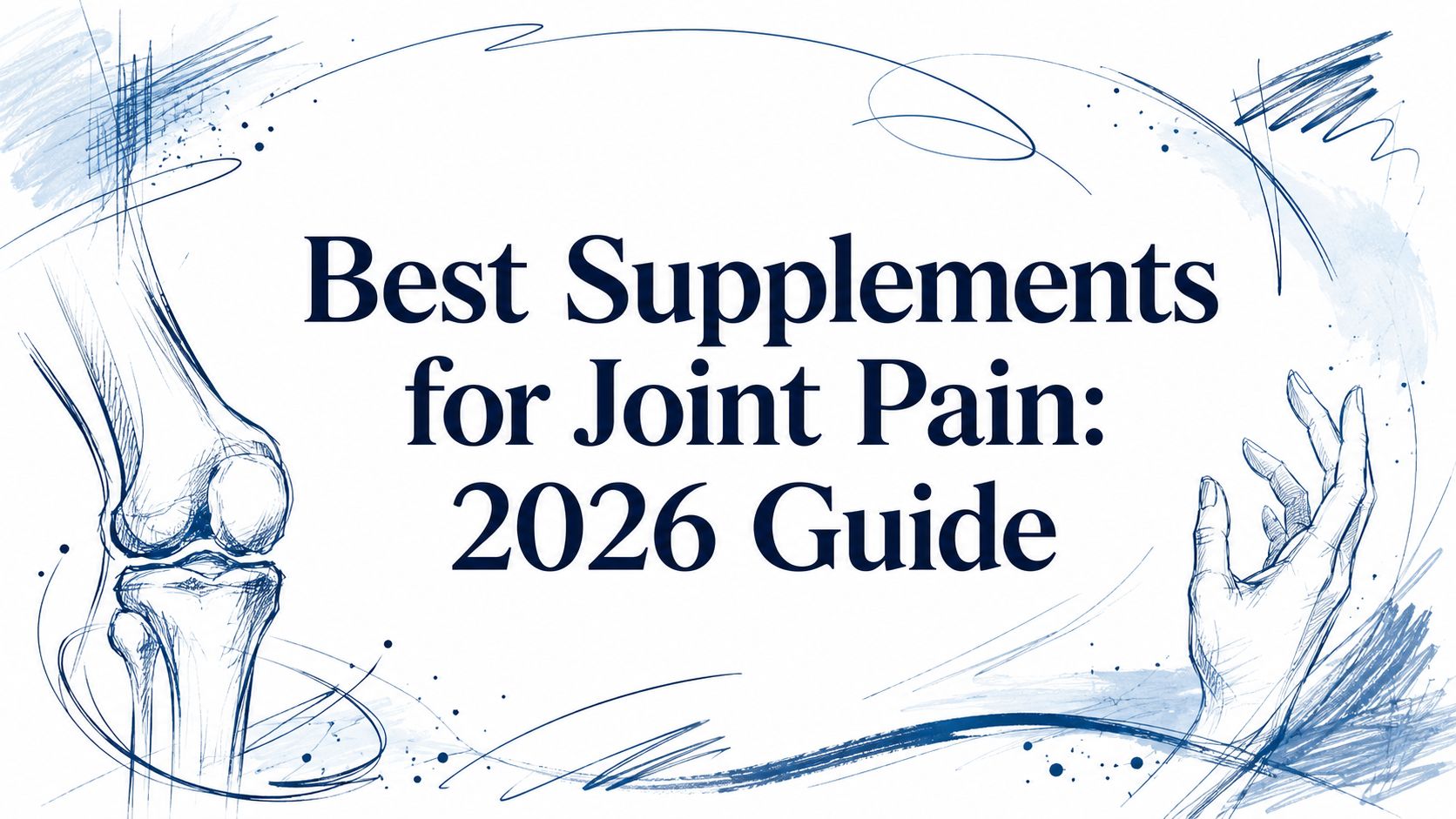
The usual advice for joint pain is backwards. The supplements individuals reach for first, especially the ones that have been marketed longest, are not the ones with the cleanest modern trial signal. A major 2017 systematic review in PubMed found moderate, clinically meaningful short-term improvements overall, but the quality of evidence was very low, and it found no clinically important medium- or long-term benefits; glucosamine and chondroitin were either ineffective or showed only small, arguably clinically unimportant effects (PubMed review).
That matters because joint pain is not one condition. Osteoarthritis, rheumatoid arthritis, and more general joint discomfort respond differently, so a supplement that looks promising in one setting can be underwhelming in another. The better question is not “What's the most popular joint supplement?” It's “Which ingredient has evidence that matches my joint problem, my dose, and my budget?”
Table of Contents
- Why the Most Popular Joint Supplements May Not Be the Best
- The Ingredients With the Strongest Clinical Evidence
- Popular Supplements With Weaker or Mixed Evidence
- How to Read Labels for Doses and Bioavailability
- Safety Considerations and Potential Interactions
- Shopping for Joint Supplements at Supplemynts
- Building a Realistic Joint Supplement Regimen
Why the Most Popular Joint Supplements May Not Be the Best
The supplement aisle rewards familiarity, not necessarily efficacy. Glucosamine and chondroitin became household names because they were early, visible, and easy to market as “joint support,” but the modern evidence base has moved toward a more selective view. The 2017 systematic review changed the conversation by showing that short-term symptom relief can appear in pooled data while still failing to hold up as a durable, clinically important benefit over time (PubMed review).
What the 2017 evidence shift actually means
That review matters because it separated signal from promise. The authors found moderate short-term improvements in pain and function overall, but they also rated the evidence very low quality, and they did not find clinically important medium- or long-term benefits (PubMed review). In practical terms, that means a supplement can feel helpful at first, yet still fail the test that matters most, which is whether it keeps helping once the novelty effect fades.
The same review also pushed the field toward ingredients with better trial signals, especially curcumin and Boswellia, while treating glucosamine and chondroitin more cautiously (PubMed review). That's the pivot in the best supplements for joint pain discussion. The goal is no longer to find the biggest brand category, it's to find the ingredient whose studied effect lines up with your condition.
Practical rule: If a joint supplement sounds broadly useful for “all joints,” be more skeptical, not less. The evidence is usually condition-specific.
Why condition matters more than branding
For osteoarthritis, the supplement conversation is mostly about symptom relief and function. For rheumatoid arthritis, some ingredients play a more adjunctive role, especially omega-3s, which the Arthritis Foundation notes may reduce pain, stiffness, and swelling in that condition (Arthritis Foundation). That does not mean omega-3s are a universal answer for every achy knee or stiff hip.
The bottom line is straightforward. Popularity doesn't equal effectiveness, and the modern evidence base asks you to shop by ingredient, dose, and diagnosis. If a product can't tell you what problem it was studied for, it's probably selling comfort more than it's selling evidence.
The Ingredients With the Strongest Clinical Evidence
The strongest modern trial data cluster around a small set of ingredients, and the most persuasive results are not coming from oversized proprietary blends. They are coming from curcumin, selected Boswellia serrata extracts, and, in condition-specific cases, omega-3s. MSM still appears in some reviews as a possible helper, but it sits lower on the confidence ladder than curcumin or Boswellia.
Curcumin leads the practical list
Curcumin has the clearest clinical story for shoppers who want something beyond brand recognition. The Arthritis Foundation describes a study in 367 people with knee osteoarthritis in which 1,500 mg/day of curcumin extract was as effective as 1,200 mg/day of ibuprofen, with no gastrointestinal side effects reported for the NSAID comparator in that study (Arthritis Foundation). A later review cited a meta-analysis of 10 randomized controlled trials with 786 participants, finding curcumin more effective than placebo and comparable to NSAIDs on WOMAC pain scores, which is the kind of signal that makes a non-prescription ingredient worth serious attention (Arthritis Foundation).
That still does not make curcumin magic. It does make it one of the few supplements with enough clinical weight to compare against common pain relievers, provided the formulation matches the one used in the study. Labels matter here because a generic turmeric capsule is not the same thing as a studied curcumin extract.
Boswellia is stronger than its reputation
Boswellia deserves more attention than it usually gets. Reviews of osteoarthritis supplements identify Boswellia serrata extracts, curcumin, and MSM among the ingredients with larger effects, and they note clinically important pain and disability benefits for branded Boswellia extracts such as 5-Loxin/AKBA and Aflapin at doses such as 50-125 mg twice daily for 5-Loxin and 50 mg twice daily for Aflapin (Rheumatology review). That detail matters because Boswellia is often sold as a vague herbal blend, while the signal in the literature sits in standardized extracts.
A shopper who sees only “Boswellia” on the front panel is still missing the main question. The relevant issue is whether the capsule contains a studied extract and a dose that resembles the clinical trials.
Omega-3s and MSM belong in narrower use cases
The Arthritis Foundation also notes that omega-3s may help rheumatoid arthritis pain, stiffness, and swelling, which is a narrower claim than “good for joint pain” in general (Arthritis Foundation). That distinction matters for people with inflammatory disease, because the supplement question is different from the one asked by someone with mostly degenerative knee or hip pain. For readers trying to compare supplement strategies with procedure-based care, the Illinois hip arthritis PRP guide is a useful reminder that joint pain management is not one-size-fits-all.
MSM is more tentative. Reviews keep it on the list of ingredients worth watching, but the conclusion remains cautious, especially next to curcumin and Boswellia (Rheumatology review). If budget matters, that ranking should shape what you buy first.
| Ingredient | Studied Dosage | Best For | Evidence Strength |
|---|---|---|---|
| Curcumin | 1,500 mg/day in a knee osteoarthritis study (Arthritis Foundation) | Osteoarthritis pain and function | Stronger than most non-prescription options |
| Boswellia serrata extracts | 50-125 mg twice daily for 5-Loxin, 50 mg twice daily for Aflapin (Rheumatology review) | Osteoarthritis pain, stiffness, disability | Stronger with standardized extracts |
| Omega-3s | Therapeutic EPA+DHA dosing, product-specific (Arthritis Foundation) | Rheumatoid arthritis adjunct support | Condition-specific, mixed overall |
| MSM | Trial doses vary, evidence remains limited (Rheumatology review) | Possible osteoarthritis support | Weaker and less consistent |
One practical point is that a standardized joint formula such as UC-II undenatured type II collagen may be worth comparing against these ingredients, but the useful question is never the brand name alone. The useful question is whether the label matches the studied ingredient, dose, and formulation.
Popular Supplements With Weaker or Mixed Evidence
A lot of shoppers buy what they've heard of, not what has the best trial support. Glucosamine, chondroitin, collagen, and vitamin D all show up in joint-pain searches, but they don't sit on the same evidence tier as curcumin or standardized Boswellia. That doesn't mean they're useless, it means you should treat them as conditional choices, not default buys.
Glucosamine and chondroitin are familiar, not convincing
The big problem is that the most popular ingredients often carry the least exciting conclusions when they're tested at scale. The 2017 systematic review found glucosamine and chondroitin to be ineffective or to show only small, arguably clinically unimportant effects, and it found no clinically important medium- or long-term benefits overall (PubMed review). That's a sharp contrast with the marketing around these products.
That doesn't mean nobody ever feels better on them. It means the average effect is weak enough that you should be careful about paying premium prices for a promise the data don't fully support. If you and your clinician decide to trial them anyway, the label should match the studied forms, not a trendy blend with vague amounts hidden in a proprietary formula.
Some products survive in the market because they are familiar, not because they are the most persuasive choice for a careful buyer.
Collagen and vitamin D need context
Collagen is a bigger category than the evidence can justify in one sentence. Some formulations are better studied than others, and the field is still sorting out which users get the most value. That makes collagen a “maybe” option rather than a headline answer for joint pain.
Vitamin D is even more context-dependent. It's biologically important, but joint supplements are not a substitute for checking whether a deficiency exists. In other words, vitamin D can be the right supplement for the right person, but it is not automatically a joint-pain supplement in the same way curcumin is being discussed in modern trials.
What to do with mixed-evidence products
If you're choosing between a mixed-evidence product and a stronger one, budget should matter. A glucosamine-chondroitin stack may still be reasonable if you've used it before and it clearly helped, but a new buyer usually gets more information from a focused trial of a better-supported ingredient. That's why the evidence gap matters in practice, not just in journals.

For readers comparing supplement-first approaches with interventional care, the Illinois hip arthritis PRP guide from Midwest Pain & Wellness is a useful adjunct resource because it covers another decision path when oral supplements aren't enough.
A product such as NOW Glucosamine Chondroitin with MSM is easy to understand as a market option, but the label still has to prove its relevance to your specific joint issue. Popularity alone doesn't do that work.
How to Read Labels for Doses and Bioavailability
The label is where the evidence either survives or falls apart. Two products can both say “joint support,” yet only one will resemble the studied version because dose, bioavailability, and standardization matter as much as the ingredient name. That's especially true for curcumin and Boswellia, where the form of the extract can be the difference between a meaningful trial and a wasted purchase.
Start with the studied form, not the front label
Curcumin is the clearest example. Evidence-based sources stress that enhanced-bioavailability forms are more useful than generic turmeric powder, because absorption drives real-world performance. If a product says “turmeric complex,” that's not enough information to compare it with the evidence-backed studies.
Boswellia needs the same scrutiny. The better-supported products aren't generic herbal dust, they're standardized extracts such as 5-Loxin, Aflapin, or AKBA-focused formulas (Rheumatology review). That standardization is what lets you compare the product to the clinical literature instead of hoping the blend happens to contain enough active compounds.
Label rule: If the label doesn't tell you the exact extract, exact amount, and exact serving size, it's not a clean evidence match.
Use a four-part shopping checklist
A practical label review does not need to be complicated. It needs to be disciplined.
- Check the serving size. Make sure the daily amount resembles the dose studied in trials, not a token sprinkle.
- Look for bioavailable forms. Enhanced curcumin forms and standardized Boswellia extracts matter.
- Verify what's listed. If a proprietary blend hides the dose, you can't judge value.
- Set a trial window. The review of osteoarthritis supplements recommends a 4-6 week trial and stopping if there's no obvious benefit (Rheumatology review).
Think in terms of therapeutic intent
For omega-3 products, the key issue is not just “fish oil” on the front label. Evidence summaries frame the decision around therapeutic EPA+DHA dosing, which means the amount of active fatty acids matters, not just total capsule weight (Arthritis Foundation). The same logic applies across the category.
If you want a broader resource on how absorption changes supplement performance, the guide on maximizing CBD effectiveness is a useful parallel read because it reinforces the same principle, the active compound has to reach the body in a usable form.
A good label makes it easy to answer one question. Does this product resemble the trial I'm trying to copy, or just the trend I saw in an ad?

For a product built around a focused curcumin form, CurcuBrain Longvida optimized curcumin illustrates why the delivery system matters as much as the ingredient name.
Safety Considerations and Potential Interactions
A supplement can have a plausible pain signal and still be a poor fit for your medication list. That's especially true if you take blood thinners, antiplatelet drugs, or prescription anti-inflammatory medications, because joint supplements are not isolated from the rest of your care. The safest approach is to treat any new supplement as a short, monitored trial rather than a permanent lifestyle accessory.
Where the main caution points sit
The strongest safety themes in the evidence are interaction-related, not because most products are dangerous, but because some combinations deserve a clinician's review. Omega-3s can raise bleeding concerns at higher intakes, and the Arthritis Foundation also flags that curcumin should be used thoughtfully because it can behave differently depending on the formulation and the rest of the medication profile (Arthritis Foundation). The same caution applies to anyone already managing complex drug regimens.
Glucosamine and chondroitin also deserve caution in people using anticoagulants, because even popular supplements can complicate medication management. That risk is one reason label-reading and medication review belong in the same conversation, not separate ones.
Short trial, clear stop point
The clinical advice that stands out most is simple. A review of osteoarthritis supplements recommends a 4-6 week trial and stopping if there's no obvious benefit (Rheumatology review). That protects you from drifting into long-term use without a clear response.
If a supplement hasn't changed pain, stiffness, or function within the expected window, more months of blind hope usually won't rescue it.
Who should be extra careful
People with multiple prescriptions, active bleeding disorders, upcoming surgery, pregnancy, or significant liver or kidney disease should not treat joint supplements as casual over-the-counter extras. Even when a product looks natural, the body still processes it as a biologically active compound. That is why “natural” never means “interaction-free.”
The practical standard is consistent. Check the label, check the dose, check the medication list, then reassess on a fixed timeline. That framework is safer than guessing and cheaper than buying a drawer full of half-tested capsules.
Shopping for Joint Supplements at Supplemynts
Supplemynts Inc organizes products by purpose-based navigation, so the fastest way to shop is to start in the joints health category and then narrow by ingredient and form. That matters because a broad supplement catalog can hide the difference between a well-studied formula and a pretty label. The site also lists free shipping within the continental United States, a 60-day return policy, and environmentally friendly packing, which lowers the friction of a trial purchase.
How to use the store without losing the plot
Start with the product category, then inspect the supplement facts panel before you look at marketing copy. If you're evaluating a curcumin product, check whether it specifies an enhanced-bioavailability form. If you're comparing Boswellia, look for standardized extracts rather than a generic herbal blend.
The store's support channels can help if a product page leaves out something you need. You can reach the company by phone at 1-888-333-8070 or email at info@supplemynts.com. That's useful when you need to confirm serving size, ingredient form, or whether a product resembles the studied version you're trying to match.
Lowering purchase risk
The 60-day return policy is especially relevant for joint supplements because the evidence-based trial window is usually measured in weeks, not days. That gives you enough time to judge whether a product is doing anything useful without being locked into a bad choice. If a supplement doesn't match the ingredient and dose logic from the earlier sections, don't keep it just because it arrived quickly.
The company also states that it sources products from trusted names and uses careful supplier selection, which is relevant when you're comparing multiple products that all claim joint support. For a broader view of how herbal traditions fit into modern supplementation, the guide on traditional Chinese herbal medicine from Arizona Valley Acupuncture is a useful background read because it shows how ingredient selection has always depended on formulation and context.

The point is not to buy more. It's to buy more intelligently, using the label and the store policies as part of the evidence check.
Building a Realistic Joint Supplement Regimen
One sensible approach is to start with the ingredient that best matches your condition, then add only if the first choice leaves gaps. For osteoarthritis, that often means beginning with curcumin or a standardized Boswellia extract. For rheumatoid arthritis, omega-3s make more sense as an adjunct than as a standalone answer, while general joint maintenance should stay conservative unless symptoms clearly justify more.

A practical regimen is easier to sustain when it's narrow. One focused product, one symptom tracker, one review date. If you stack several weak products at once, you won't know which one helped, which one didn't, or which one was just expensive background noise.
That's also where your broader care plan matters. Supplements tend to work best when they sit beside movement, load management, and medical care, not when they replace them. If your supplement trial doesn't improve pain, function, or stiffness within the expected window, stop it and redirect the budget toward something with a clearer signal.
Supplemynts Inc carries purpose-based supplement options that make it easier to compare ingredients, doses, and formulations against the evidence you've just read. If you want to shop with that framework in mind, visit Supplemynts Inc and use the joint-health category to narrow your choices before you buy.







Please complete your information below to login.
Sign In
Create New Account